

Learning how to automate on-page SEO for e-commerce is quickly becoming essential as online catalogs grow from a handful of products to thousands. Manually editing title tags, meta descriptions, and schema markup across an entire store simply does not scale. As a result, many growing brands turn to automation to keep every product and category page optimized without adding headcount. This guide breaks down the exact process, tools, and best practices you need to automate on-page SEO efficiently and consistently.
Quick Answer:
Automating on-page SEO for e-commerce means using software, such as an AI-driven optimization platform, to audit product pages, fix titles and schema at scale, and continuously monitor visibility, without manually editing each page by hand.
What Is On-Page SEO Automation for E-Commerce?
On-page SEO automation for e-commerce is a method of using software to identify and fix search optimization issues across many pages at once, rather than editing them individually. In particular, it targets elements like title tags, meta descriptions, header structure, internal links, and schema markup.
For a store with 50 products, manual fixes might be manageable. However, once a catalog grows past a few hundred SKUs, manual on-page SEO becomes a full-time job. Automation platforms solve this by scanning the entire site, flagging issues, and applying approved fixes in bulk. This same logic extends to broader e-commerce SEO workflows, where technical and content fixes often need to happen together.
Why Manual On-Page SEO Falls Short for Online Stores
Manual SEO work does not scale well because every new product, variant, or collection page needs its own title, description, and structured data. Consequently, SEO teams either fall behind or spend disproportionate time on repetitive tasks instead of strategy.
Industry research from BrightEdge has found that organic search drives more than 53% of trackable website traffic, which underscores why on-page optimization remains critical for revenue-generating product pages. Furthermore, as AI-driven answer engines increasingly summarize product information directly in search results, poorly structured pages risk being skipped entirely, both by traditional crawlers and AI systems.
How to Automate On-Page SEO for E-Commerce: A Step-by-Step Process
Successfully automating on-page SEO follows a repeatable sequence. Below is the process most automation platforms, including Rank Authority, use to move a store from manual guesswork to systematic optimization.
- Run a full site audit. Start by scanning every product, category, and collection page for missing titles, thin descriptions, duplicate content, and broken schema markup.
- Prioritize fixes by impact. Use a diagnostic score, such as a Rank Authority Score (RA Score), to prioritize pages based on traffic potential and current ranking gaps.
- Deploy automated on-page fixes. Push approved title tag, meta description, header, and internal link improvements across hundreds of product pages simultaneously.
- Generate and deploy schema markup. Automatically create structured data, such as Product, Review, and Breadcrumb schema, and apply it across page templates.
- Automate internal linking. Connect related products, categories, and guides to strengthen topical authority signals that search engines rely on.
- Monitor visibility and iterate. Track rankings, AI citation appearances, and competitor movement, then feed those insights back into future optimization rounds.
Notably, this is the same framework outlined in more detail in a dedicated resource on automating recurring e-commerce SEO tasks.

A diagnostic dashboard is often the first step in learning how to automate on-page SEO for e-commerce at scale.
Automating Technical SEO Fixes Across Your Product Catalog
Beyond titles and descriptions, technical issues like slow page speed, broken links, and duplicate content quietly undermine rankings. In fact, Google has long emphasized page experience as a ranking consideration, as outlined in its own SEO Starter Guide.
Automation tools can continuously scan for these issues rather than waiting for a quarterly audit. For example, broken link checkers, page speed analyzers, and duplicate content detectors can run on a schedule, flagging problems before they affect rankings. This approach is explored further in a guide on on-page SEO automation that saves time and improves rankings.
It’s worth noting that automation can submit updated or fixed pages for indexing. However, Google alone determines whether and when a page is actually indexed, so timelines can vary between stores and even between pages on the same site.
Using AI Tools to Automate Product Page SEO
AI-driven tools now handle much of the heavy lifting involved in e-commerce SEO. For instance, an AI Blog Builder can generate SEO- and AEO-optimized buying guides that support product pages, while competitor analysis tools like RankFast examine top-ranking rival pages and suggest rewrites designed to outrank them.
Similarly, internal linking automation, sometimes called topical siloing, connects related products and guides automatically, which helps both search engines and AI answer engines understand how your catalog is organized. This matters because Generative Engine Optimization (GEO), the practice of structuring content so AI systems can cite it directly, depends heavily on clear topical relationships between pages.
For a closer look at how these pieces fit together, see this breakdown of what actually automates on-page SEO changes behind the scenes.

AI-driven tools connect related products and guides automatically as part of a broader on-page SEO automation strategy.
Schema Markup Automation for Online Stores
Schema markup, a form of structured data defined by the Schema.org vocabulary, helps search engines understand prices, ratings, and availability on product pages. Without it, rich results like star ratings or price snippets rarely appear in search listings.
Manually coding schema for thousands of SKUs is impractical for most teams. Therefore, automated schema generators map product data, price, stock status, reviews, directly into structured templates applied sitewide. This reduces errors and keeps markup consistent as inventory changes.
Consequently, stores that automate schema deployment often see more consistent rich result eligibility than those relying on manual, page-by-page edits. Individual results vary depending on product category, competition, and existing site authority.
Measuring E-Commerce SEO Automation Results
Automation without measurement is incomplete. A Rank Authority Score (RA Score), for example, gives a snapshot of overall site health, while AI visibility monitoring tracks whether your brand is being cited across AI answer platforms, not just traditional search results.
In addition, competitor intelligence tools highlight where rivals are gaining ground, which helps teams decide where to focus the next round of automated fixes. Reviewing these metrics monthly, rather than only during major audits, tends to catch issues earlier.
To explore more tactical examples, this resource on automating recurring e-commerce SEO tasks covers specific workflows in greater depth. For a broader overview of the platform approach, visit Rank Authority directly.
Common Mistakes When Automating E-Commerce SEO
Even with strong tools, a few mistakes come up repeatedly. First, some teams automate changes without reviewing a sample batch first, which can allow errors to spread across many pages at once. Second, duplicate content across near-identical product variants often goes unnoticed until rankings stall.
Third, schema errors flagged during an audit sometimes get ignored because they seem minor. In reality, small schema errors can prevent rich results from appearing at all. Finally, treating automation as a one-time project rather than an ongoing process is a common oversight, since search algorithms and AI answer engines continue to change.
Frequently Asked Questions About How to Automate On-Page SEO for E-Commerce
What is on-page SEO automation for e-commerce?
On-page SEO automation for e-commerce uses software to scan, diagnose, and fix elements like title tags, meta descriptions, headers, and schema markup across every product and category page. Instead of editing each page manually, the platform applies approved changes site-wide, saving time as catalogs grow.
How to automate on-page SEO for e-commerce without hiring a full team?
Learning how to automate on-page SEO for e-commerce without hiring a full team starts with choosing a platform that audits your site, prioritizes fixes, and deploys approved changes automatically. Tools like 1-Click AI AutoPilot handle the technical workload so a small team or solo owner can manage SEO across thousands of pages.
Why does on-page SEO matter for online stores?
On-page SEO matters because search engines and AI answer engines rely on clear titles, descriptions, and structured data to understand what each product page offers. Without it, even well-designed stores struggle to appear in search results or AI-generated answers.
How much does e-commerce SEO automation typically cost?
Pricing varies by platform and the number of pages managed, with many tools offering tiered plans for small stores versus large catalogs or agencies. Several providers, including Rank Authority, offer a risk-free ten-day trial so you can evaluate fit before committing.
How long does it take to see results from automated on-page SEO?
Technical fixes like schema deployment or title updates can go live within days, but ranking and visibility changes typically unfold over several weeks as search engines recrawl and reassess pages. Individual results vary based on competition, site history, and niche.
What’s the difference between SEO automation and a traditional SEO agency?
A traditional agency typically performs manual audits and edits, which can be slow and costly at scale. SEO automation platforms instead use algorithms to identify issues and apply fixes across hundreds or thousands of pages simultaneously, reducing both cost and turnaround time.
What common mistakes should I avoid when automating on-page SEO?
Common mistakes include automating changes without reviewing them first, ignoring duplicate content across similar product variants, and overlooking schema errors flagged in audits. Skipping ongoing monitoring is another frequent error, since search algorithms and AI answer engines continue to evolve.
Can automation handle schema markup for product pages?
Yes, most automation platforms can generate and deploy structured data such as Product, Review, and Breadcrumb schema automatically. This helps search engines and AI systems understand price, availability, and ratings without manual coding.
Does automating on-page SEO guarantee higher rankings?
No tool can guarantee specific rankings, since search engines weigh many factors beyond on-page elements. Automation can submit updated pages for indexing, but Google alone determines whether and when a page is indexed or ranked.
What tools are commonly used to automate on-page SEO for e-commerce?
Common tools include site audit platforms, AI content generators, schema markup generators, and internal linking automation tools. Rank Authority, for example, combines several of these functions, including RankFast for competitor analysis and RankLink for internal linking.
How does on-page SEO automation improve AI search visibility?
Automation improves AI search visibility by structuring content and schema in formats that generative and answer engines can easily cite. This process, known as Generative Engine Optimization (GEO) and Answer Engine Optimization (AEO), helps product information appear in AI-generated answers, not just traditional search results.
Is on-page SEO automation safe for stores with thousands of products?
Yes, automation is built for scale and often performs more consistently than manual edits across large catalogs. Reviewing a sample of automated changes before full deployment is still a recommended best practice.
What best practices should I follow when automating e-commerce SEO?
Start with a full site audit, prioritize fixes by traffic potential, and review a sample batch of automated changes before rolling them out site-wide. Ongoing monitoring of rankings, AI citations, and competitor movement helps maintain results over time.
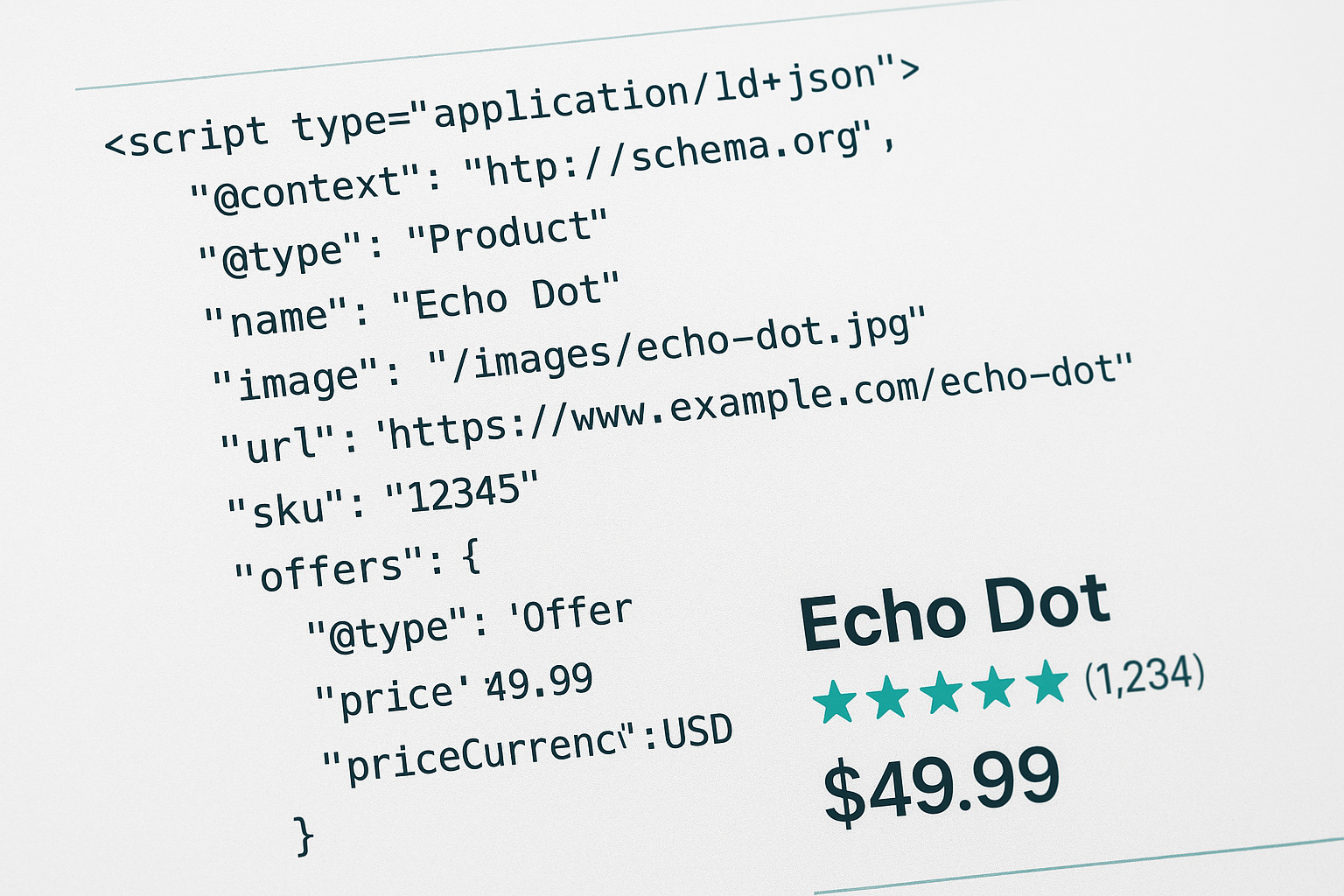
Automated schema deployment helps product pages qualify for rich results without manual coding.
Conclusion
Ultimately, understanding how to automate on-page SEO for e-commerce comes down to combining the right audit process, the right tools, and ongoing measurement. Rather than chasing manual fixes across an ever-growing catalog, automation lets you prioritize, deploy, and monitor changes at scale. From schema markup to internal linking, each piece works together to strengthen both traditional search visibility and AI citation potential. As search continues shifting toward AI-powered answers, stores that automate early are better positioned to stay visible, discoverable, and competitive. Platforms like Rank Authority bring these functions into a single dashboard, though individual results vary based on site history, competition, and niche.

