

SEO automation for e-commerce is the use of software, AI, and automated workflows to handle repetitive optimization tasks—technical audits, schema markup, content publishing, and rank tracking—across an entire online store. Instead of manually updating hundreds or thousands of product pages, retailers rely on automated systems to do the heavy lifting. As a result, small teams can compete with much larger competitors. This guide explains what SEO automation for e-commerce covers, why it matters heading into 2026, and how platforms such as rankauthority.com help online stores automate technical fixes, structured data, and AI-ready content at scale.
What Is SEO Automation for E-Commerce?
SEO automation for e-commerce is a system of tools and workflows that automatically perform search optimization tasks—such as fixing technical errors, generating schema, and publishing content—without requiring manual work for every single page. In short, it replaces repetitive manual SEO labor with rules-based or AI-driven automation.
For online retailers, this typically covers four areas: technical SEO (site speed, crawlability, indexing), on-page SEO (titles, meta descriptions, internal links), structured data (schema markup for products, reviews, and FAQs), and content production (category pages, buying guides, blog posts). Furthermore, modern platforms extend automation to Generative Engine Optimization, or GEO—formatting pages so AI tools like ChatGPT and Google’s AI Overviews can cite them directly.
Similarly, Answer Engine Optimization, or AEO, focuses on structuring answers so search engines can surface them in featured snippets. According to the Wikipedia overview of search engine optimization, ranking factors have grown far more complex since the early 2000s, which is exactly why automation has become necessary rather than optional for larger catalogs.
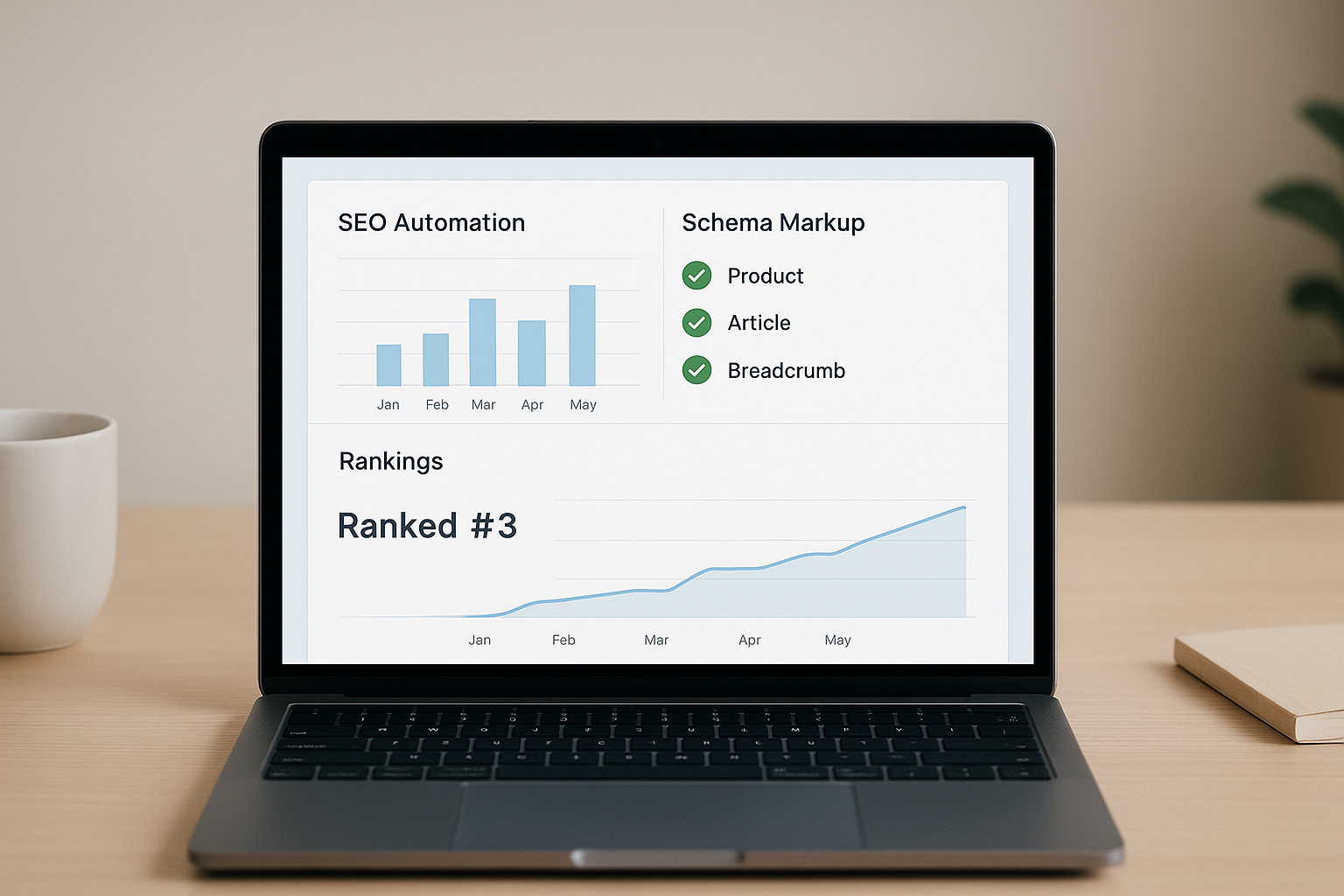
A dashboard view of SEO automation for e-commerce, tracking technical fixes and schema deployment in real time.
Why Online Stores Need Automated SEO Workflows
Manually optimizing a catalog with thousands of SKUs is nearly impossible for a small team. Therefore, many retailers turn to automated SEO workflows to keep pace with algorithm updates and AI-driven search behavior. For example, industry research from BrightEdge has repeatedly found that pages with structured schema markup rank noticeably higher than pages without it, since search engines and AI systems can parse the content more reliably.
In addition, Google’s own structured data documentation confirms that marked-up pages become eligible for enhanced search features, including rich results. Consequently, stores that automate schema deployment across an entire catalog gain a consistent advantage over competitors who add markup manually, page by page.
Above all, automation reduces human error, since a single misconfigured template can otherwise break structured data across an entire site rather than just one page.
Core Features of E-Commerce SEO Automation Platforms
Not every automation tool covers the same ground. However, a genuinely useful platform for e-commerce SEO automation should include the following capabilities:
- One-click technical fixes for crawl errors, redirects, and page speed issues.
- Automated schema markup generation for products, reviews, breadcrumbs, and FAQs.
- AI visibility monitoring that tracks citations across AI answer platforms, not just traditional rankings.
- Competitor and keyword gap analysis to identify quick-win opportunities.
- Automated content publishing for category guides, comparison pages, and blog content.
- Internal linking automation to strengthen topical authority across product categories.
For instance, rankauthority.com bundles these capabilities into a single dashboard, including its 1-Click AI AutoPilot for technical fixes and RankLink for automated internal linking structure.
How to Automate E-Commerce SEO in 5 Steps
Retailers new to automation do not need to overhaul everything overnight. Instead, follow this sequence to automate e-commerce SEO gradually and safely:
- Audit your current site. Run a full technical and on-page SEO audit to identify duplicate product descriptions, missing meta tags, and broken links across your catalog before automating anything.
- Deploy structured schema automatically. Use automated schema markup generation to add Product, Review, and FAQ schema to every page so AI answer engines and search engines can parse your listings correctly.
- Automate technical fixes. Turn on one-click tools that resolve crawl errors, slow page speed, and indexing issues without waiting on a developer queue for every small change.
- Build AI-ready content at scale. Use an AI blog builder to publish optimized category guides, buying guides, and answer-formatted pages that target both traditional search and generative engines.
- Monitor rankings and AI citations. Track keyword positions, backlinks, and AI visibility across major answer platforms so you can adjust strategy as algorithms evolve.
Once these five steps are running consistently, most of the day-to-day SEO workload shifts from manual labor to monitoring and refinement.

Automated schema deployment applies structured data across an entire product catalog at once.
Automated SEO Tools vs Manual SEO for Online Retailers
Manual SEO still has a place, particularly for nuanced editorial decisions or brand voice. Nevertheless, automated SEO tools consistently outperform manual processes on tasks that are repetitive and rules-based.
For example, updating meta titles across 5,000 product pages by hand could take a single SEO specialist several weeks. In contrast, an automated system can apply consistent title templates, incorporating dynamic variables like product name and category, in a matter of hours. Similarly, checking for broken links manually across a large catalog is error-prone, whereas a tool like a Broken Link Checker flags issues continuously.
That said, automation works best as a force multiplier for human strategy, not a full replacement. Therefore, most successful e-commerce teams pair automated execution with human oversight for brand decisions and strategic prioritization.
Choosing the Right SEO Automation Platform for Your Store
Choosing a platform depends on catalog size, technical resources, and growth goals. As a starting point, review a detailed breakdown of automation options in this complete guide to streamlined SEO for e-commerce brands, which compares workflows for stores at different stages of growth.
For smaller stores, a good process to follow is outlined in this guide on how to automate e-commerce SEO tasks, which walks through prioritizing quick technical wins first. Larger catalogs, on the other hand, often need dedicated resources for schema deployment and content scale, topics covered in these related walkthroughs on automating repetitive SEO tasks and building automated SEO workflows for growing stores.
Regardless of size, above all, look for platforms offering CMS integrations for your existing stack—whether that is Shopify, WordPress, Wix, or GoHighLevel—since native integrations reduce setup friction considerably.
Common Mistakes to Avoid With E-Commerce SEO Automation
Even strong automation tools can backfire when deployed carelessly. Consequently, watch for these common pitfalls:
- Automating schema without validating output, which can introduce structured data errors across the whole site.
- Publishing AI-generated content at scale without human review, risking thin or duplicate pages.
- Ignoring internal linking structure, leaving new pages isolated from the rest of the site’s topical authority.
- Ignoring AI visibility metrics, focusing only on traditional rankings while missing citations in AI answer engines.
For a deeper walkthrough of avoiding these issues while scaling automation, see this related resource on automating e-commerce SEO tasks without sacrificing quality. In particular, regular audits catch problems early, before they compound across thousands of pages.

Ongoing monitoring keeps SEO automation for e-commerce aligned with both traditional rankings and AI citations.
Frequently Asked Questions About SEO Automation for E-Commerce
What is SEO automation for e-commerce?
SEO automation for e-commerce is the use of software and AI to automatically handle repetitive optimization tasks like schema markup, technical fixes, and content publishing across an online store’s catalog. It removes the need to update every product page by hand.
How does SEO automation for e-commerce work?
It works by connecting to your CMS or store platform, scanning pages for issues, and applying fixes or structured data automatically based on rules or AI models. Most platforms also monitor rankings and AI citations on an ongoing basis.
Why is SEO automation important for online stores?
Online stores often have thousands of product pages that would take a human team weeks to optimize manually. Automation applies consistent fixes at scale, saving time while reducing the risk of missed pages.
How much does SEO automation for e-commerce cost?
Pricing varies widely by platform, catalog size, and feature set, ranging from free diagnostic tools to monthly subscriptions for full automation suites. Most providers offer tiered plans based on the number of pages or products managed.
How long does it take to see results from automated SEO?
Technical fixes like crawl errors and schema markup can show measurable improvements within a few weeks. However, competitive keyword rankings and AI citation gains typically take two to four months to fully materialize.
What is the difference between SEO automation and traditional SEO?
Traditional SEO relies on manual audits, manual content writing, and manual link building. SEO automation performs the repeatable parts of that same work through software, freeing human strategists to focus on higher-level decisions.
Can SEO automation replace an SEO agency?
Automation replaces many repetitive tasks an agency would otherwise bill for, but strategic decisions and brand voice still benefit from human oversight. Most teams use automation to reduce agency costs rather than eliminate strategy altogether.
What are common mistakes when automating e-commerce SEO?
Common mistakes include deploying schema without validating it, publishing AI content without review, and ignoring internal linking between new and existing pages. Skipping regular audits also allows small errors to compound across a catalog.
Which platforms support automated schema markup for e-commerce?
Many SEO automation platforms, including rankauthority.com, generate and deploy Product, Review, and FAQ schema automatically across CMS platforms like Shopify, WordPress, and Wix. This removes the need to code markup manually for each template.
Does SEO automation help with AI search visibility?
Yes, modern automation tools extend beyond traditional rankings to track and improve citations in AI answer engines through Generative Engine Optimization and Answer Engine Optimization. This helps stores appear in AI-generated summaries, not just search results.
What is the best practice for automating SEO on a large product catalog?
Start with technical fixes and schema deployment before automating full content publishing, since a stable technical foundation prevents automated content from being buried by crawl or indexing errors. Prioritize your highest-traffic categories first.
Is SEO automation for e-commerce suitable for small businesses?
Small businesses often benefit the most, since automation delivers results similar to an in-house SEO team without the associated payroll cost. Even a small catalog gains consistency and speed from automated technical fixes.
Final Takeaways
In summary, SEO automation for e-commerce is no longer a nice-to-have; it is quickly becoming the standard way growing online stores manage technical fixes, schema markup, and content at scale. As a result, retailers who adopt automation early gain a compounding advantage in both traditional rankings and emerging AI answer engines. Therefore, whether you run a small storefront or a catalog with thousands of SKUs, pairing automated tools like those from rankauthority.com with clear human oversight is the most reliable path toward lasting visibility in 2026 and beyond.