
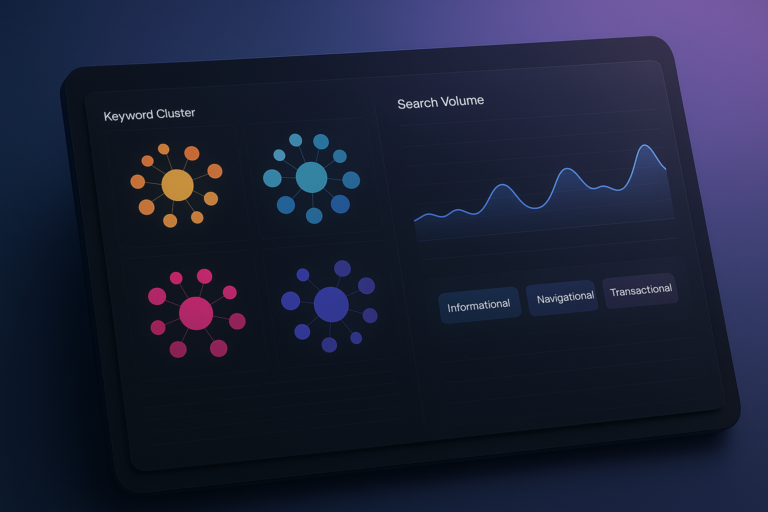
AI-powered keyword analysis is the practice of using machine learning and natural language processing (NLP) — technology that helps computers understand human language — to identify, cluster, and prioritize search terms based on intent, competition, and ranking potential. In 2025, it has become the engine behind every high-performing SEO strategy. Instead of manually sorting spreadsheets for hours, marketing teams can now surface thousands of high-value keyword opportunities in minutes, with far greater accuracy than any human analyst working alone.
Traditional keyword research was always time-intensive and prone to human bias. However, AI changes that equation entirely by processing enormous datasets and detecting semantic patterns that no analyst could spot alone. Furthermore, as Google’s algorithms grow more sophisticated — rewarding topical depth, intent alignment, and user satisfaction — the old volume-plus-difficulty formula simply cannot keep pace. For any site serious about ranking in 2025, understanding how AI-powered keyword analysis works is no longer optional.
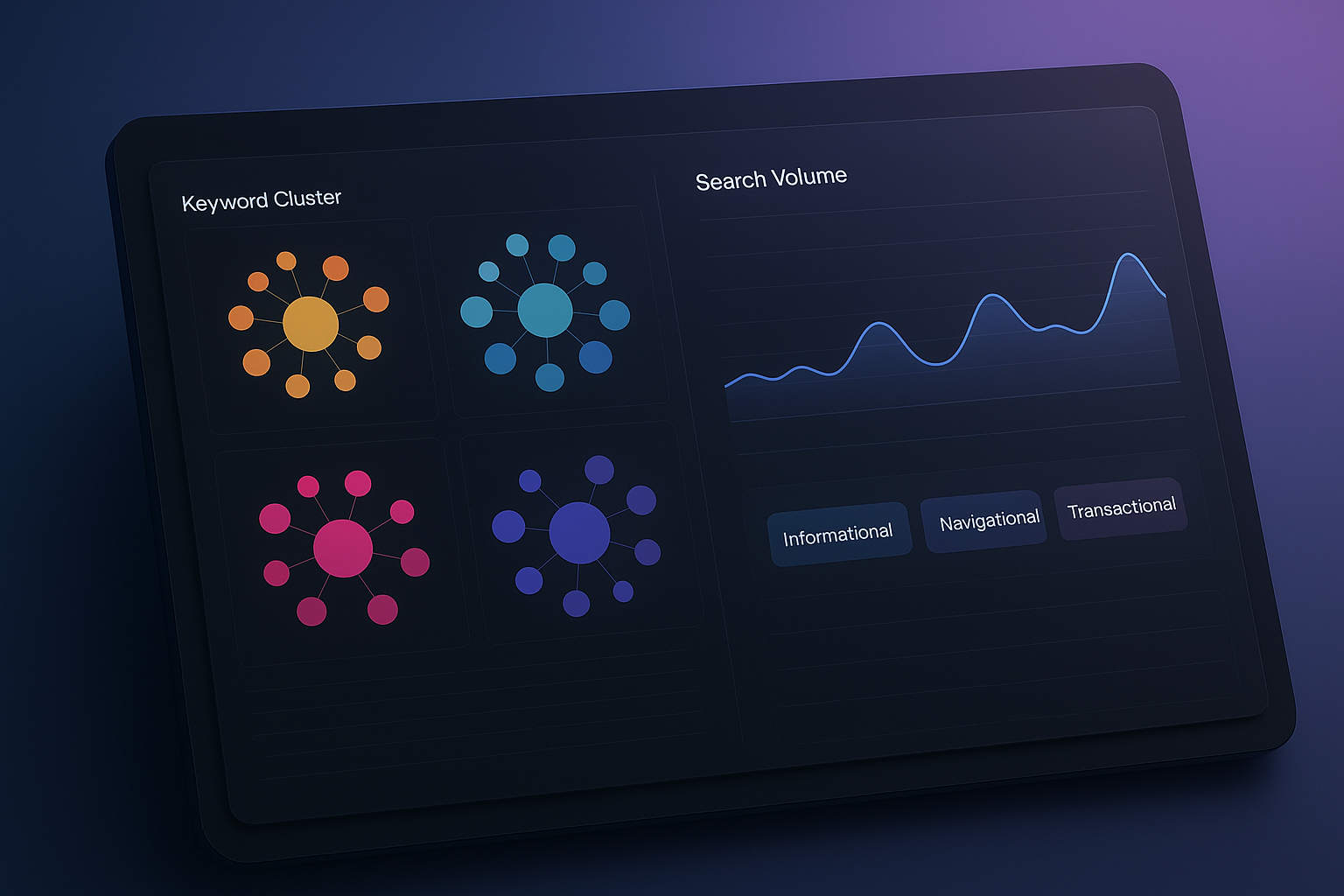
AI-powered keyword analysis platforms visualize intent clusters and opportunity scores in real time. Learn optimization tactics in our AI keyword optimization guide.
Why Traditional Keyword Research Falls Short in 2025
For years, SEO professionals relied on search volume and keyword difficulty as their primary filters. While those metrics remain useful, they tell only part of the story. Search engines now evaluate topical depth, semantic relevance, and user satisfaction signals. Consequently, a keyword with modest volume but strong intent alignment can outperform a high-volume term that attracts the wrong audience.
Manual research also struggles to scale. A site targeting hundreds of topics cannot realistically audit every keyword gap, competitor cluster, or emerging query trend by hand. As a result, important opportunities are routinely missed — and content calendars are built on incomplete data. In addition, manual processes introduce inconsistency: two analysts reviewing the same list often reach different priority decisions.
The Hidden Cost of Spreadsheet-Based Research
Beyond scale, spreadsheet-based methods miss entire categories of insight. They cannot detect whether two keywords share the same searcher goal, they cannot flag cannibalisation risk across hundreds of pages, and they cannot surface trending queries before they peak. According to Wikipedia’s overview of search engine optimisation, modern SEO increasingly depends on understanding the context and purpose behind queries — a task that requires computational intelligence, not manual filtering.
What AI-Powered Keyword Analysis Actually Does
At its core, AI-powered keyword analysis combines several technologies to deliver insights that go far beyond a simple volume report. NLP allows the system to understand the meaning behind queries — not just the words themselves. Meanwhile, machine learning models trained on billions of search interactions predict which content formats and topics are most likely to satisfy a given query.
Specifically, the core capabilities include:
- Semantic clustering — grouping keywords by shared meaning and topic, not just surface-level word overlap, so related terms map to a single piece of content rather than dozens of duplicate pages
- Intent classification — automatically labeling each term as informational, navigational, commercial, or transactional, eliminating guesswork about what a searcher actually wants
- Competitive gap detection — identifying terms your rivals rank for that your site does not yet target, ranked by traffic opportunity and ranking feasibility
- Trend forecasting — surfacing rising queries before they peak, giving early-mover advantage over competitors still relying on historical volume data
- Topical authority mapping — visualising which subtopics you cover well and which leave gaps in your content architecture, enabling a systematic fill strategy
- SERP feature targeting — identifying which keywords trigger featured snippets, People Also Ask boxes, or image packs, so you can optimise content format to capture those positions
- Cannibalization detection — flagging pages on your own site that compete for the same keyword cluster, which dilutes authority and confuses search engines about which page to rank
According to Wikipedia’s overview of natural language processing, NLP enables machines to interpret human language in context — which is precisely what makes modern AI keyword tools so much more powerful than their predecessors. The gap between an NLP-driven tool and a traditional volume checker is not incremental; it is categorical.
How Machine Learning Models Are Trained for Keyword Research
AI keyword tools do not simply scrape a search API and sort by volume. Instead, they train large models on click-through data, SERP layouts, content performance metrics, and entity relationships. Therefore, when the model clusters “best running shoes for flat feet” alongside “motion control running shoes,” it is recognising shared searcher intent — not just keyword overlap. This distinction is what separates a useful cluster from a noisy list.
Search Intent: The Factor That Changes Everything
Search intent is arguably the single most important dimension that AI keyword tools add to the research process. In practice, two keywords with identical search volume can produce completely different results depending on whether searchers want to learn, compare, buy, or navigate to a specific site.
For example, “best project management software” signals commercial investigation. In contrast, “how does project management software work” is clearly informational. Targeting the wrong intent — even with flawlessly optimised content — will consistently underperform because Google’s algorithms are specifically trained to match result types to intent types.
The Four Intent Types and What They Mean for Content
Informational
Searcher wants to learn. Best served by how-to guides, explainers, and deep-dive articles. Example: “what is keyword clustering.”
Navigational
Searcher wants a specific page or brand. Target these primarily for branded queries and homepage optimisation. Example: “Ahrefs login.”
Commercial
Searcher is evaluating options before buying. Best served by comparison pages and top-10 roundups. Example: “best AI keyword tools 2025.”
Transactional
Searcher is ready to act. Best served by product pages, landing pages, and CTAs. Example: “buy keyword research software.”
AI intent classification handles this mapping automatically. As a result, it saves hours of manual SERP analysis and dramatically reduces the risk of publishing content that is technically optimised but fundamentally misaligned with what the searcher needs.
How to Run AI-Powered Keyword Analysis: A Step-by-Step Process
Getting started with AI-powered keyword analysis is more straightforward than many SEOs expect. The following seven-step process applies whether you are launching a new site or auditing an established one with hundreds of existing pages.
1Define your seed keywords. Start with 5 to 15 broad terms that represent your core topics, product categories, or services. These act as anchors for the AI expansion process. Be specific enough to be meaningful but broad enough to allow expansion — “email marketing software” rather than “software” or “Mailchimp coupon codes.”
2Run AI expansion and semantic clustering. Feed your seed list into an AI keyword tool to generate hundreds or thousands of related terms, automatically grouped by intent and semantic similarity. Review the clusters before moving forward — the quality of your clusters determines everything downstream.
3Filter by intent and opportunity score. Prioritise clusters that align with your content goals and show achievable difficulty scores. Commercial and informational intents often deliver the best early returns. Consequently, eliminate clusters that are off-topic or that target searchers at the wrong stage of the funnel.
4Run a competitive gap analysis. Compare your keyword clusters against the top three to five competitors in your niche. Identify terms they rank for in positions 1–20 that your site does not currently target. Specifically, focus on gaps where competitor content is thin or outdated — these represent the fastest wins.
5Validate against live SERP data. Check the top-ranking pages for your priority keywords. Confirm intent alignment and understand the content depth, format, and word count required to compete. Above all, if the SERP shows mostly video results or product pages, your blog post will face an uphill battle regardless of optimisation quality.
6Audit for cannibalization. Before building new content, verify that no existing pages already target the same cluster. AI tools can cross-reference your sitemap against keyword groups and flag overlapping content. Fixing existing cannibalisation often improves rankings faster than publishing new pages.
7Build and prioritise your content plan. Map each keyword cluster to a specific page or post. Assign priority tiers based on traffic potential, business value, and competitive difficulty. Schedule production accordingly, and plan for quarterly reviews as search trends shift.

Validating AI keyword suggestions against live SERP data ensures intent alignment before content production begins.
Building Topical Authority Through Keyword Clusters
Modern search engines reward sites that demonstrate comprehensive expertise on a subject. Consequently, a single well-optimised page rarely outranks a site with deep, interconnected coverage of the same topic. This is where topical authority becomes a strategic priority — and where AI-powered keyword analysis delivers some of its greatest value.
AI keyword analysis maps the full landscape of a topic by identifying every meaningful subtopic, question, and related query. Additionally, it reveals which areas your existing content already covers and which gaps competitors are exploiting. By filling those gaps systematically, you signal to search engines that your site is the authoritative source on the subject.
Pillar Pages and Supporting Cluster Content
The most effective topical authority structure uses a pillar-cluster model: one comprehensive pillar page targets a broad head term, while multiple supporting cluster pages target specific subtopics and link back to the pillar. AI analysis makes this model practical at scale by automatically grouping keywords into pillar-worthy head terms and their supporting long-tail variants. Furthermore, internal linking between cluster pages amplifies the authority signal for the entire topic group.
Resources like those reviewed at RankAuthority help SEO teams build these topical maps efficiently, ensuring that content investments are always directed toward the highest-impact gaps rather than duplicating effort on already-covered ground. For a deeper look at how keyword clustering strategies drive content architecture decisions, RankAuthority’s keyword research guides provide practical frameworks used by top SEO teams.
AI Keyword Research vs. Traditional Methods: A Direct Comparison
Understanding exactly where AI-powered keyword analysis outperforms traditional methods helps teams decide where to invest their tooling budget. The differences are substantial — and in several dimensions, the gap is not even close.
| Capability | Traditional Research | AI-Powered Analysis |
|---|---|---|
| Intent classification | Manual / inconsistent | Automatic, at scale |
| Semantic clustering | Keyword match only | Meaning-based grouping |
| Trend forecasting | Historical data only | Predictive, real-time |
| Competitive gap analysis | Possible, very slow | Automated, prioritised |
| Cannibalization detection | Rarely done | Built-in, automatic |
| SERP feature targeting | Manual SERP review | Flagged automatically |
| Research time (500 keywords) | Hours to days | Minutes |
How to Use AI Keyword Analysis for Long-Tail Opportunities
Long-tail keywords — specific, lower-volume search phrases — are often where AI-powered keyword analysis delivers its most surprising wins. Because traditional research deprioritises low-volume terms, competitors frequently leave entire subtopics uncontested. In contrast, AI tools surface these gaps at scale and cluster them into coherent content themes, making them genuinely actionable.
For example, a head term like “content marketing” generates millions of searches per month but faces enormous competition. However, “AI content marketing strategy for B2B SaaS” is specific, lower competition, and far more likely to convert because searchers already know exactly what they need. AI clustering groups dozens of these hyper-specific terms into a single content brief, making one well-structured article satisfy fifty individual search queries simultaneously.
Prioritising Long-Tail Clusters by Business Impact
Not all long-tail clusters are equally valuable. Therefore, prioritise using a simple scoring framework: multiply the cluster’s estimated monthly traffic by your estimated click-through rate at position 1, then weight the result by intent quality. Commercial and transactional long-tails with low difficulty scores consistently deliver the highest return on content investment. Moreover, these terms frequently trigger featured snippets and People Also Ask boxes, amplifying visibility beyond the standard organic result.
AI Keyword Tools: What to Look for When Choosing a Platform
Not all AI keyword tools are built equally. Some are primarily volume-lookup tools with light NLP layered on top. Others offer genuinely intelligent clustering, intent modelling, and competitive intelligence. Knowing what to evaluate before committing to a platform saves significant time and budget.
Key Evaluation Criteria
- Data freshness — keyword data should be updated at least monthly; real-time or weekly updates are ideal for fast-moving niches
- Intent classification accuracy — test the tool by entering known keywords and verifying the intent labels match what you actually see in the SERP
- Clustering quality — look for semantic grouping that places conceptually related terms together, not just keyword-match clustering
- Competitive intelligence — the tool should allow direct competitor comparisons and export gap reports by traffic opportunity
- Workflow integration — consider how well the platform connects with your CMS, Google Search Console, or project management tools
- SERP feature detection — identifies which queries trigger featured snippets, video carousels, or local packs so you can target the right format
- Pricing transparency — some platforms charge per query; others offer unlimited access. Understand your usage needs before committing
Additionally, the Google Search Central SEO Starter Guide provides a useful baseline for understanding what search quality signals matter most — which in turn helps you evaluate whether a tool’s recommendations are aligned with what Google’s systems actually reward.
Common Mistakes to Avoid with AI Keyword Analysis
Even with powerful AI tools at hand, several pitfalls can undermine your keyword strategy. Understanding them in advance prevents wasted content investment and ranking setbacks.
- Over-relying on volume metrics. High search volume does not equal high value. Specifically, a 500-search-per-month term with strong commercial intent and low difficulty often outperforms a 50,000-search-per-month term dominated by authoritative brands. AI tools surface this distinction; however, you need to act on it.
- Skipping SERP validation. AI intent classification is accurate but not infallible. Therefore, always check the actual SERP for priority keywords before committing to a content format. If the top ten results are all video tutorials, a written how-to guide faces a structural disadvantage.
- Ignoring the competitive gap step. Many teams focus exclusively on their own site’s keyword performance. In contrast, examining what competitors rank for — and where their content is weakest — reveals the fastest path to incremental traffic gains.
- Creating content without intent-to-page mapping. Building a content plan without assigning clear keyword clusters to specific pages produces cannibalization. Multiple pages competing for the same term dilute each other’s authority and confuse search engines about which page to rank.
- Treating the AI output as final. AI tools provide a data-driven starting point. However, brand voice, audience nuance, and business strategy still require human editorial judgment. The best results come from combining AI efficiency with human expertise.
- Failing to revisit and refresh. Search trends shift continuously. A keyword cluster that was low competition three months ago may now be contested territory. Consequently, schedule quarterly keyword audits to keep your strategy current.
Measuring the Impact of Your AI Keyword Strategy
After implementing AI-driven keyword recommendations, tracking the right metrics confirms whether the strategy is working. Organic impressions and click-through rates in Google Search Console show early momentum, often weeks before rankings fully stabilise. Meanwhile, keyword cluster ranking reports reveal which topic groups are gaining traction and which need content reinforcement.
Furthermore, conversion data tied to organic landing pages demonstrates the business value of intent-matched content. Because AI tools prioritise high-intent clusters, well-executed strategies typically show improvements in both traffic quality and conversion rates simultaneously.
The Metrics That Matter Most
- Organic impressions by cluster — tracks which topic groups are gaining SERP visibility, even before clicks materialise
- Average position by cluster — shows ranking momentum at the topic level, not just the individual keyword level
- Click-through rate by intent type — reveals whether your title tags and meta descriptions match searcher expectations for each intent category
- Organic conversion rate — the most direct measure of whether intent alignment is translating into business outcomes
- Topical coverage score — the percentage of identified subtopics in a niche that your site currently covers; this should trend upward over time
- Cannibalization resolution rate — tracks how many previously conflicting pages have been consolidated or redirected to clean up the architecture
Revisiting your AI-powered keyword analysis every quarter ensures the strategy stays aligned with shifting search trends and competitive moves. In addition, connecting your keyword tracking to Google Search Console and Google Analytics creates a closed feedback loop — so every new content decision is informed by what is already working.
Quick Answer
AI-powered keyword analysis uses machine learning and NLP to cluster search terms by intent, surface competitive gaps, detect cannibalization, and map topical authority — delivering research that is faster, deeper, and more strategically actionable than any traditional method.

Topic cluster maps reveal the full semantic landscape of a niche, guiding content architecture decisions.
Frequently Asked Questions About AI-Powered Keyword Analysis
What is AI-powered keyword analysis?
AI-powered keyword analysis is the use of machine learning and natural language processing to identify, cluster, and prioritise search terms based on intent, competition, and ranking potential. Unlike manual research, it processes thousands of data points simultaneously to surface the most valuable opportunities for organic traffic growth.
How does AI keyword analysis differ from traditional keyword research?
Traditional keyword research relies on volume and difficulty scores alone. In contrast, AI-powered analysis evaluates semantic relationships, search intent, SERP feature triggers, and topical authority signals simultaneously. As a result, AI tools uncover hidden long-tail opportunities and competitive gaps that spreadsheet-based methods routinely miss.
What is search intent clustering and why does it matter?
Search intent clustering groups keywords by the underlying goal of the searcher — informational, navigational, commercial, or transactional. It matters because targeting the wrong intent type, even with a high-volume keyword and excellent content, produces pages that rank poorly and convert even worse. AI-powered keyword analysis automates this classification with high accuracy.
Can AI keyword tools replace human SEO judgment?
No. AI tools accelerate data processing and surface patterns humans would miss. However, strategic decisions about brand positioning, audience nuance, and business priorities still require human oversight. The best results consistently come from combining AI efficiency with experienced editorial judgment.
How long does AI-powered keyword analysis take?
Most AI keyword tools generate a full cluster report in seconds to a few minutes, depending on the seed list size. In contrast, manual research for the same scope typically takes several hours or even days — and delivers far less insight into intent and competitive positioning.
What types of businesses benefit most from AI keyword analysis?
E-commerce sites, content publishers, SaaS companies, and local service businesses all benefit. However, the gains are largest for sites with broad topic coverage or large product catalogues. Any site targeting more than a few dozen keywords will see meaningful efficiency improvements and more strategic content prioritisation.
What is a keyword gap analysis and how does AI improve it?
A keyword gap analysis identifies search terms your competitors rank for that your site does not yet target. AI tools automate this comparison across thousands of keywords, prioritise gaps by traffic potential and ranking feasibility, and cluster them by topic — making competitive research far more actionable than manual exports and spreadsheet comparisons.
Are AI keyword tools expensive?
Pricing varies widely. Some platforms offer free tiers with limited queries, while enterprise solutions can cost several hundred dollars per month. However, even mid-range AI keyword tools typically deliver strong ROI by significantly reducing the hours spent on manual research and eliminating costly intent mismatches before content is published.
What is topical authority and how does AI keyword analysis help build it?
Topical authority is a site’s perceived depth of expertise on a subject, measured by the breadth and interconnection of its content coverage. AI keyword analysis builds it by mapping every meaningful subtopic, question, and related query within a niche — ensuring that no important angle is left uncovered and that internal linking reinforces the full topic cluster.
How do I choose the right AI keyword analysis tool?
Evaluate tools based on data freshness, intent classification accuracy, clustering quality, competitive intelligence features, and integration with your existing workflow. Specifically, test intent classification against known keywords before committing. Resources like RankAuthority provide comparative guidance to support informed decisions.
What common mistakes should I avoid with AI keyword analysis?
The most common mistakes are over-relying on volume metrics, ignoring intent mismatches, failing to validate AI suggestions against real SERP data, and skipping the competitive gap step. Additionally, creating content without clear intent-to-page mapping leads to keyword cannibalization that actively hurts rankings.
Does AI keyword analysis work for local SEO?
Yes. AI tools identify geo-modified keywords, near-me search patterns, and local intent signals that traditional tools often underweight. This makes them especially valuable for multi-location businesses and local service providers targeting city- or region-specific traffic.
How often should I run AI-powered keyword analysis?
Run a full AI keyword audit at least quarterly. In fast-moving niches or ahead of major content campaigns, monthly reviews are more appropriate. Furthermore, set up continuous monitoring for trending queries so emerging opportunities surface before competitors capture them.
Conclusion: Make AI-Powered Keyword Analysis the Core of Your SEO Strategy
AI-powered keyword analysis is no longer a competitive advantage reserved for enterprise SEO teams — it is rapidly becoming the baseline expectation for any site that wants to rank consistently in 2025. By combining intent classification, semantic clustering, competitive gap detection, cannibalization auditing, and trend forecasting, these tools replace hours of manual work with actionable, data-backed direction.
Therefore, the most important step you can take today is to move beyond volume-only thinking and adopt a workflow that puts intent alignment, topical authority, and competitive intelligence at the centre of every content decision. Whether you are building a new site from scratch or scaling an established one, AI-powered keyword analysis provides the strategic clarity that makes every piece of content count — and every ranking gain sustainable.

