

SEO Benefits: The Complete Guide to What Search Optimisation Actually Does for Your Business
The core SEO benefits are increased organic traffic, lower customer acquisition costs, stronger brand authority, and compounding long-term ROI — all without ongoing ad spend. SEO benefits is the collective term for the measurable improvements a business gains — in visibility, credibility, and revenue — when its website ranks higher in organic search results. In this guide, you will find every major benefit explained in depth, with practical context on how each one translates into real business growth.
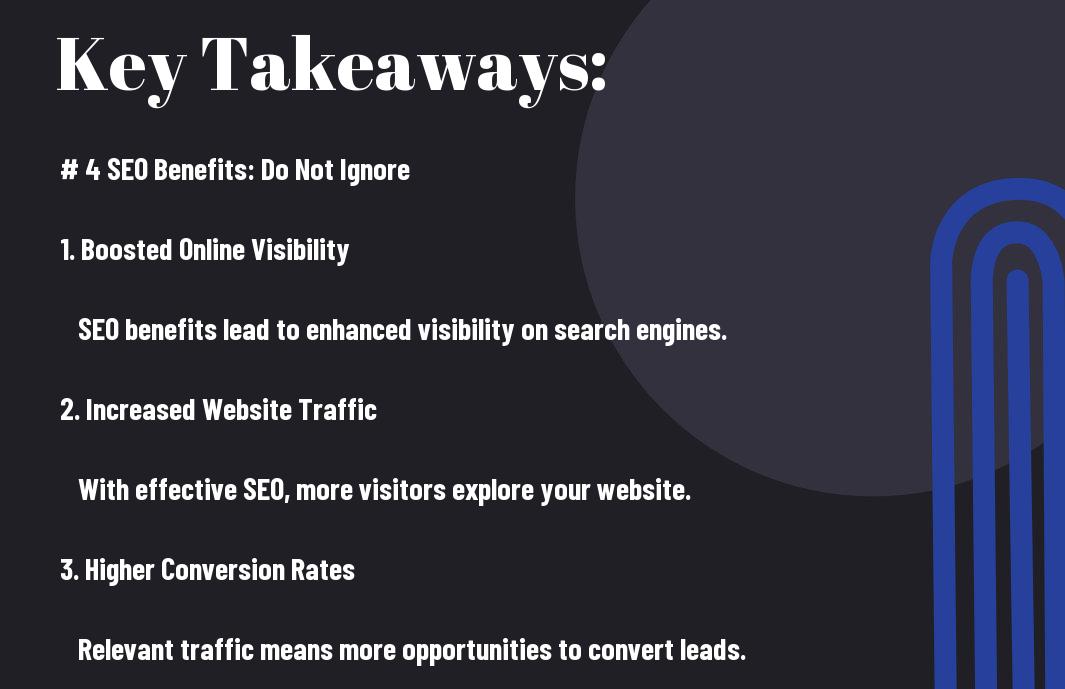
What Are SEO Benefits and Why Do They Matter?
Search engine optimisation (SEO) is the practice of improving a website so that it ranks higher in unpaid — or “organic” — search results on platforms like Google and Bing. The SEO benefits a business receives from this process are wide-ranging. They include more website visitors, lower marketing costs, stronger brand recognition, and sustained revenue growth over time.
However, many business owners treat SEO as an optional add-on rather than a foundational strategy. This is a costly mistake. Consider that over 68% of all online experiences begin with a search engine query, and the first five organic results on Google receive approximately 67.6% of all clicks. In other words, if your business does not rank, it is largely invisible.
Furthermore, unlike paid advertising — which stops generating traffic the moment your budget runs out — SEO builds compounding value over time. As a result, every dollar invested in SEO continues to work long after the initial effort. This guide covers every significant SEO benefit in depth, so you can make a fully informed decision about your digital strategy.
Key SEO Benefits at a Glance:
- Increased organic traffic — more visitors without paying per click
- Enhanced brand visibility — appear where your customers are searching
- Lower customer acquisition costs — reduce reliance on expensive paid ads
- Long-term ROI — rankings compound in value over months and years
- Stronger credibility and trust — high rankings signal authority to users
- Better user experience — SEO improvements benefit real visitors too
- Competitive advantage — outrank rivals and capture their market share
- Local market reach — target customers in your geographic area
- Measurable, trackable performance — data-driven decisions at every step
SEO Benefits for Visibility: How Organic Rankings Drive Traffic
The most immediate and recognisable of all SEO benefits is increased visibility in search engine results pages (SERPs). When your website appears on page one of Google for keywords your target audience is searching, you gain exposure to thousands — or even millions — of potential customers at precisely the moment they are looking for what you offer.
How Search Rankings Translate to Clicks
Search ranking position has a dramatic effect on how much traffic you receive. Specifically, the data tells a clear story:
- The first organic result on Google earns an average click-through rate (CTR) of around 27.6%
- Position 2 drops to approximately 15.8% CTR
- By position 10, CTR falls below 2.5%
- Page 2 and beyond receive less than 1% of all clicks combined
Therefore, the difference between ranking first and ranking tenth is not small — it is the difference between dominating your market and being effectively invisible. This is why securing top positions is one of the most powerful SEO benefits available to any business.
Increased Organic Traffic
Organic traffic — visitors who arrive at your site through unpaid search results — is widely considered the most valuable traffic source available online. Unlike paid traffic, organic visitors tend to have higher purchase intent and stronger trust in the results they click. Moreover, organic traffic does not disappear when you stop spending money.
As your website climbs the search rankings through effective SEO, the volume of organic traffic increases substantially. Furthermore, this traffic tends to be highly targeted — people are searching for exactly what you offer. As a result, the leads generated from organic traffic convert at higher rates than many other channels.
Featured Snippets and SERP Features
Beyond standard organic listings, SEO also helps your content appear in featured snippets (the answer boxes at the top of Google), People Also Ask sections, knowledge panels, and image carousels. These SERP features provide additional visibility — sometimes above position one. In addition, voice search results are typically drawn from featured snippets, meaning SEO also drives voice-based discovery. Capturing these positions is an increasingly important SEO benefit as search behaviour continues to evolve.

Cost-Effectiveness: One of the Most Underrated SEO Benefits
When comparing marketing channels by cost-efficiency, SEO consistently outperforms paid advertising, social media advertising, and traditional outbound marketing. The reason is straightforward: organic traffic has no ongoing per-click cost. Once your pages rank, you receive visitors without paying for each one individually.
SEO vs. Paid Advertising: A Cost Comparison
Consider a business running Google Ads for a keyword with a cost-per-click (CPC) of $5. If the site receives 2,000 visitors per month from that keyword, the monthly ad cost is $10,000. However, if the same business achieves organic ranking for that keyword through SEO, those 2,000 monthly visitors cost nothing in ongoing spend.
Specifically, the cost advantage of SEO grows over time. In the first few months, SEO requires investment in content, technical optimisation, and link building. Nevertheless, once rankings are established, the cost per visitor drops dramatically — often by 80–90% compared to paid channels. This is one of the most compelling long-term SEO benefits for businesses of any size.
Cost Comparison: SEO vs. Paid Advertising
- Paid ads: Traffic stops immediately when budget runs out
- SEO: Traffic continues long after the initial investment
- Paid ads: CPCs often rise over time as competition increases
- SEO: Cost per visitor decreases as rankings improve and stabilise
- Paid ads: Requires continuous management and budget increases
- SEO: Established rankings require only periodic maintenance
Long-Term ROI
Across all marketing channels, SEO delivers some of the strongest long-term return on investment. A well-optimised page published today can continue generating traffic and leads for months or years with minimal additional input. Consequently, the ROI from SEO compounds over time in a way that paid advertising simply cannot replicate.
For example, a blog post that ranks in position two for a high-volume keyword may generate thousands of qualified visitors every month — indefinitely. Meanwhile, a paid ad targeting the same keyword generates traffic only as long as the daily budget is funded. The long-term ROI advantage is therefore one of the most strategically significant SEO benefits a business can leverage.
Lower Customer Acquisition Costs
Customer acquisition cost (CAC) — the total spend required to win one new customer — is a critical business metric. SEO systematically reduces CAC by attracting high-intent visitors organically. Because these visitors are already searching for your product or service, the conversion rate tends to be higher. As a result, you close more customers from the same volume of traffic, which pushes CAC down further.
Moreover, lower CAC directly improves profit margins. Businesses that rely heavily on paid advertising often find their margins squeezed as ad costs rise. In contrast, those that invest in SEO build a sustainable acquisition engine that becomes cheaper to operate over time — not more expensive.
Better User Experience: An Often Overlooked SEO Benefit
Many businesses think of SEO as a technical exercise focused solely on search engines. In reality, modern SEO is fundamentally about improving the experience of real human visitors. Google’s ranking algorithms are specifically designed to reward websites that provide fast, easy-to-use, and genuinely helpful experiences.
Therefore, when you optimise your website for SEO, you simultaneously improve it for your users. This creates a virtuous cycle: better user experience leads to higher rankings, which drives more traffic, which generates more engagement signals, which further reinforces your rankings.
Page Speed and Core Web Vitals
Google’s Core Web Vitals — a set of performance metrics measuring loading speed, visual stability, and interactivity — are now direct ranking factors. A page that loads in under two seconds outperforms a three-second page in both rankings and user retention. Specifically, research by Google found that a one-second delay in page load time can reduce conversions by 20%. Improving page speed is therefore both an SEO improvement and a revenue improvement simultaneously.
Site Navigation and Structure
A logically structured website with clear menus, intuitive navigation, and well-organised content reduces bounce rates and increases the number of pages a visitor views per session. These engagement metrics signal to Google that users find your site valuable — which, in turn, supports better rankings. Furthermore, clear site architecture helps search engine crawlers index your pages more efficiently, ensuring more of your content appears in search results.
Mobile Optimisation
Google uses mobile-first indexing — meaning it primarily uses the mobile version of your website for ranking purposes. This makes mobile optimisation not optional but essential. Over 60% of all Google searches now occur on mobile devices. Moreover, over 50% of users will leave a site that doesn’t function properly on their smartphone, typically within three seconds.
A responsive design — one that automatically adapts to any screen size — is therefore critical for both user experience and SEO rankings. Businesses that have not yet optimised for mobile are losing traffic, conversions, and rankings simultaneously. Addressing this is one of the highest-impact SEO improvements available.

Credibility and Trust: How SEO Benefits Your Brand Reputation
Consumer psychology research consistently shows that users trust organic search results more than paid advertisements. When your website appears on page one of Google, particularly in positions one through three, users perceive your brand as credible, established, and authoritative. This psychological trust benefit is one of the most powerful — and most often overlooked — SEO benefits.
E-E-A-T: Experience, Expertise, Authoritativeness, and Trustworthiness
Google’s quality rating guidelines centre on a framework known as E-E-A-T — Experience, Expertise, Authoritativeness, and Trustworthiness. Websites that demonstrate these qualities rank more consistently and withstand algorithm updates more effectively. Building E-E-A-T requires publishing accurate, well-researched content, earning backlinks from credible sources, and maintaining a professional, transparent online presence.
In practice, this means that investing in SEO also means investing in your brand’s authority. Consequently, the credibility benefit of SEO extends beyond search rankings — it directly influences how potential customers perceive your business when they first encounter it.
Authority in Your Niche
When your content consistently ranks for the key terms in your industry, you establish topical authority — the perception among both users and search engines that your site is the go-to resource for your subject area. This authority builds naturally as you publish more high-quality, relevant content over time. Furthermore, topical authority is self-reinforcing: the more authoritative your site becomes, the easier it is to rank for new related keywords.
Customer Trust Signals
Trust signals are elements on your website that reinforce credibility in the mind of a visitor. These include customer reviews and testimonials, secure HTTPS connections, clear privacy policies, accurate contact information, and transparent pricing. Importantly, these same elements also influence SEO performance — search engines reward sites that exhibit trustworthiness in their content and technical setup.
Therefore, building trust signals serves a dual purpose: it reassures human visitors and simultaneously strengthens your SEO. Specifically, customer reviews can generate fresh, keyword-rich content on your pages — content that search engines actively value. Sites that earn strong reviews also see higher click-through rates in search results, which further improves rankings over time.
Competitive Advantage: How SEO Benefits Help You Outrank Rivals
In virtually every industry, the businesses appearing on page one of Google are capturing the majority of available search traffic. As a result, SEO is not merely a growth strategy — it is a competitive necessity. Businesses that invest in SEO gain measurable advantages over those that do not, including larger market share, stronger brand recognition, and lower cost of customer acquisition.
Staying Ahead of Competitors
Search rankings are not static. Competitors are continuously optimising their content and building backlinks. Consequently, maintaining strong rankings requires ongoing investment — but so does every competitor’s position. Businesses that commit to consistent SEO improvement progressively outpace those that treat it as a one-time exercise. Over time, this creates a compounding competitive gap that becomes increasingly difficult for rivals to close.
Additionally, SEO provides intelligence on competitor strategy. By analysing which keywords competitors rank for, what content they publish, and where they earn backlinks, you can identify opportunities they have missed and prioritise the areas where you can gain ground most quickly.
Niche Market Penetration
One of the most strategically powerful SEO benefits is the ability to target highly specific, lower-competition keywords within your niche. Long-tail keywords — search phrases that are longer and more specific than broad head terms — often have lower search volumes individually but collectively account for the majority of all search queries. Moreover, users searching with long-tail queries typically have higher purchase intent.
For example, instead of trying to rank for a competitive term like “marketing software,” a business might target “marketing software for small e-commerce businesses.” This targeted approach is faster to rank for, attracts more qualified visitors, and faces less direct competition. Consequently, niche keyword targeting can deliver significant traffic and revenue gains even for businesses with modest SEO budgets.
Local SEO Benefits: Reaching Customers in Your Area
For businesses that serve a specific geographic area — such as restaurants, law firms, medical practices, and service providers — local SEO benefits are particularly significant. Local SEO refers to the practice of optimising your online presence to appear in geographically targeted search results, including the Google Maps “Local Pack.”
Google Business Profile and Local Pack Rankings
The Google Local Pack — the block of three business listings that appears at the top of local search results, often above organic listings — drives enormous volumes of foot traffic and phone calls. Specifically, 46% of all Google searches have local intent, and 88% of local searches on mobile result in a call or visit within 24 hours. Appearing in the Local Pack is therefore one of the highest-value positions in all of search.
Achieving and maintaining a Local Pack position requires a well-optimised Google Business Profile, consistent NAP (Name, Address, Phone) citations across the web, genuine customer reviews, and locally relevant website content. Each of these factors is addressable through local SEO practice — making this a highly practical and accessible benefit for small and medium businesses.
Near Me Searches and Voice Search
“Near me” searches — queries like “plumber near me” or “best coffee shop near me” — have grown by over 500% in recent years. These searches are almost exclusively performed on mobile devices and have extremely high purchase intent. Optimising for near-me queries is a direct, measurable SEO benefit that translates immediately into real-world customer visits and transactions.
Measurable Results and Continuous Improvement
One advantage SEO holds over traditional marketing channels is the depth and precision of available performance data. Every aspect of your SEO performance is measurable — rankings, organic traffic volume, click-through rates, bounce rates, conversion rates, and revenue attribution can all be tracked in real time.
Analytics and Tracking Tools
The primary tools for tracking SEO performance include:
- Google Search Console — tracks keyword impressions, clicks, average position, and crawl issues
- Google Analytics 4 — measures organic traffic, user behaviour, conversions, and revenue
- Ahrefs / Semrush / Moz — third-party tools for keyword research, backlink analysis, and competitor tracking
- Rank Authority’s AI-driven dashboard — provides automated keyword tracking, content optimisation scoring, and performance alerts in one unified interface For a deeper walkthrough, see our SEO Competitor Intelligence Dashboard: Complete Guide.
By combining these tools, you gain a complete picture of how your SEO investment is performing. Moreover, this data enables precise, evidence-based decision-making rather than guesswork — which is one of the most practical SEO benefits for resource-constrained businesses.
Continuous Improvement Through Data
SEO is not a “set and forget” strategy — it is an iterative process that improves continuously as you gather more performance data. Specifically, best-practice SEO involves regular activities such as:
- A/B testing page titles and meta descriptions to improve click-through rates
- Updating and expanding existing content to maintain relevance and recapture declining rankings
- Refining keyword targeting based on emerging search trends and competitor gaps
- Building new backlinks to strengthen domain authority over time
- Fixing technical issues such as crawl errors, broken links, and duplicate content
Each improvement compounds with the others. Consequently, an SEO programme that is actively managed and data-driven will consistently outperform a static one — and the gap widens with every passing month.
Brand Awareness and Customer Loyalty as SEO Benefits
Brand awareness is not typically the first thing people associate with SEO — however, it is one of its most durable long-term benefits. Every time a user sees your website in search results — even if they do not click — they are exposed to your brand name, your URL, and your page title. Research in marketing psychology shows that repeated exposure builds familiarity, and familiarity builds trust.
The Mere Exposure Effect in Search
The mere exposure effect is a well-established psychological principle: the more frequently people encounter a brand, the more positively they evaluate it. When your site consistently appears in search results for terms relevant to your industry, users repeatedly encounter your brand — even on queries where they choose a competitor. Over time, this passive exposure builds brand recognition that pays dividends when they are ready to make a purchase decision.
Furthermore, customers who discover your business through organic search tend to exhibit higher long-term loyalty than those acquired through paid advertising. The reason is partly trust — they found you through a channel they consider objective — and partly intent alignment, since they were actively seeking what you offer. As a result, SEO-acquired customers often have lower churn rates and higher lifetime value.
SEO and Content Marketing: Amplifying Every Benefit
SEO and content marketing are deeply interdependent. Content is the vehicle through which SEO rankings are earned — and SEO is the mechanism that ensures content reaches its intended audience. When these two strategies are aligned, the combined effect is significantly greater than either delivers alone.
How Quality Content Drives SEO Rankings
Google’s algorithms are specifically designed to surface content that best satisfies the searcher’s intent. Therefore, content that is comprehensive, accurate, well-structured, and genuinely useful will consistently outrank thin, generic content — regardless of how many technical SEO tricks the latter employs.
Specifically, content earns SEO rankings by:
- Matching search intent — informational, navigational, commercial, or transactional
- Earning backlinks from other websites that reference your content as authoritative
- Generating user engagement signals like low bounce rate and high time-on-page
- Covering topics with sufficient depth and breadth to satisfy topical authority requirements
AI-Driven SEO: The Next Generation of Content Optimisation
Artificial intelligence is transforming how SEO is practised. AI-powered platforms — such as Rank Authority — can analyse thousands of data points simultaneously to identify the optimal keyword targets, content gaps, and technical improvements for your specific website. Moreover, AI tools can automate time-consuming tasks like meta tag optimisation, internal linking, and schema markup generation — freeing your team to focus on high-value creative work.
Furthermore, AI-driven SEO is adaptive. As search trends shift and algorithm updates roll out, AI systems can detect changes in ranking patterns earlier than manual monitoring allows. As a result, your SEO strategy remains proactive rather than reactive — which is a significant competitive advantage in an environment where search algorithms are updated thousands of times per year.
How to Start Capturing SEO Benefits for Your Business
Understanding the SEO benefits is the first step. However, capturing them requires a structured, systematic approach. Below is a practical step-by-step framework for getting started — whether you are new to SEO or looking to improve an existing programme.
- Conduct a Comprehensive SEO Audit — Identify your current rankings, technical issues, content gaps, and backlink profile. Tools like Google Search Console and Semrush make this straightforward.
- Define Your Target Keywords — Research the terms your ideal customers search for. Focus on a mix of high-volume head terms and specific long-tail keywords with clear purchase intent.
- Optimise Existing Pages — Update title tags, meta descriptions, headings, and body content to target your priority keywords. Ensure every page has a clear focus and satisfies search intent.
- Fix Technical SEO Issues — Address crawl errors, improve page speed, ensure mobile responsiveness, and implement HTTPS. Technical health is the foundation on which all other SEO efforts rest.
- Create High-Quality Content Consistently — Publish in-depth, useful content targeting your keyword priorities. Each new piece of content is a new opportunity to rank and attract organic traffic.
- Build Quality Backlinks — Earn links from credible, relevant websites through guest posting, digital PR, and creating content that others naturally want to reference.
- Track, Measure, and Iterate — Monitor your rankings, traffic, and conversions monthly. Use the data to identify what is working and what needs adjustment. Refine your strategy continuously.
Frequently Asked Questions About SEO Benefits
Conclusion: Why SEO Benefits Are Non-Negotiable for Modern Businesses
The full range of SEO benefits — from increased organic visibility and lower acquisition costs to stronger brand authority and compounding long-term ROI — makes search engine optimisation one of the most strategically important investments any business can make in its digital future. Furthermore, the competitive reality is stark: your rivals are already investing in SEO. Every month without a committed SEO strategy is a month in which competitors expand their lead in rankings, traffic, and market share.
However, capturing these benefits does not have to be complicated. Whether you are a small local business seeking Local Pack visibility, an e-commerce brand targeting high-intent product keywords, or a B2B company building topical authority in your niche — the foundational SEO principles are the same. Start with a clear audit, target the right keywords, publish genuinely useful content, fix your technical foundations, and track your results rigorously.
With Rank Authority’s AI-driven SEO platform, you can accelerate every step of this process — automating the technical work, surfacing the highest-value opportunities, and monitoring your progress in real time. The SEO benefits are real, measurable, and available to any business willing to commit to them. Start today, and your future self will thank you.
Start Capturing SEO Benefits Today — Free
One-Click Fully Automated SEO. Boost Rankings and Increase Traffic. Instantly Optimise Your Site.
- ✓ No Coding Required
- ✓ No Credit Card Required
- ✓ One-Click Setup

