SEO tricks are the difference between a website that quietly sits on page four of Google and one that dominates page one. In 2025, the sites winning the most organic traffic aren’t necessarily the biggest brands — they’re the ones applying the right combination of technical fixes, content tactics, and user-experience improvements consistently. This guide breaks down every SEO trick that actually moves rankings today, from quick five-minute wins to deeper technical strategies, so you can start climbing the search results this week instead of guessing what might work.
Key Takeaways
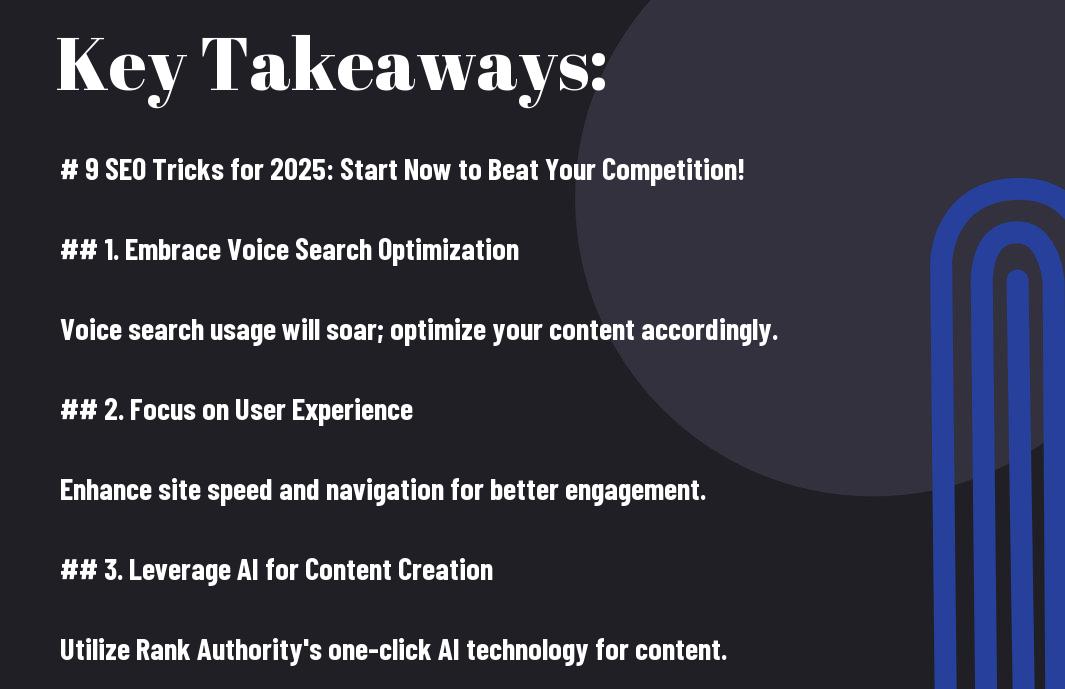
- AI-assisted SEO tricks now analyze intent, cluster keywords, and draft optimized copy far faster than manual research alone.
- Core Web Vitals and mobile-first indexing remain non-negotiable — a slow or clunky mobile site can undo every other optimization.
- Quality content backed by E-E-A-T (Experience, Expertise, Authoritativeness, Trustworthiness) still separates top-ranking pages from the rest.
- Measurement matters — the best SEO tricks are worthless if you never track whether they’re actually working.
What Are SEO Tricks, and Why Do They Matter in 2025?
In simple terms, SEO tricks are practical, repeatable tactics that help a webpage rank higher in search results without relying on paid ads. Some are quick wins, such as tightening a title tag. Others are ongoing disciplines, like earning backlinks or improving page speed. Either way, the goal is the same: make it easier for search engines to understand your content and easier for real people to enjoy using your site. As a result, both signals — machine-readable relevance and human satisfaction — combine to lift your rankings.
Search engines continuously refine how they evaluate websites, so what worked in 2021 may barely register today. Therefore, it’s worth understanding the landscape before diving into individual tactics. For a broader overview of where the industry stands right now, see our companion resource on SEO tips for 2025, which pairs well with the tricks covered here.
Key Trends Shaping SEO Strategies This Year
Several trends are dominating the conversation in 2025, including voice search optimization, mobile-first indexing, and hyper-local search intent. In particular, video content and short-form answers are gaining ground as search engines try to satisfy queries without users ever clicking a link. Consequently, businesses that adapt early — rather than reactively — tend to capture disproportionate visibility gains before their competitors catch up.
The Impact of AI and Machine Learning on SEO Tricks
Machine learning, a subset of artificial intelligence where algorithms improve automatically through data rather than explicit programming, now powers most modern ranking systems. Because of this, search engines interpret the intent behind a query far more accurately than they did five years ago. In practice, this means keyword-stuffed content no longer works — instead, you need to answer the underlying question a searcher actually has.
AI tools can also accelerate your own workflow. For example, they can surface trending keyword clusters, flag thin content, and suggest structural improvements in seconds rather than hours. As a result, teams using AI-assisted platforms often ship optimized content two to three times faster than teams relying on manual audits alone.
Quick-Win SEO Tricks You Can Implement Today
Before tackling long-term strategy, it helps to knock out the fast fixes. Below is a simple, sequential process you can complete on a single page in under an hour — then repeat across your site.
- Rewrite your title tag and meta description. Place your target keyword near the front of the title, keep it under 60 characters, and write a meta description that clearly states the page’s value so more searchers click through.
- Run a quick keyword and intent check. Search your target term yourself, review the top five results, and confirm your page matches what searchers actually expect to find before you optimize anything further.
- Fix your Core Web Vitals. Use a free tool to test load speed, visual stability, and interactivity, then compress oversized images and remove unused scripts that are slowing the page down.
- Add two or three internal links. Link to related, relevant pages on your own site using descriptive anchor text so search engines can crawl your content structure and users can explore related topics easily.
- Add structured data markup. Implement schema such as Article, FAQ, or Product markup so search engines can display rich results like star ratings, FAQs, or breadcrumbs directly in the search listing.
If you’d rather automate this entire checklist, our guide on how to improve your website’s search rankings easily walks through a repeatable system you can apply site-wide.
Core SEO Strategies for 2025
Beyond the quick fixes, sustainable rankings depend on a handful of core strategies. Specifically, search engines now prioritize technical health, page experience, and mobile compatibility more heavily than they did in prior algorithm cycles.
Mastering Core Web Vitals
Core Web Vitals are a set of page-experience metrics Google uses to measure loading speed, visual stability, and responsiveness. The three main metrics are Largest Contentful Paint (how fast the main content loads), Cumulative Layout Shift (how much the page jumps around while loading), and Interaction to Next Paint (how quickly the page responds to clicks or taps). You can review Google’s own benchmarks and thresholds directly in the official Core Web Vitals documentation. In short, a page that fails these thresholds will struggle to rank no matter how good the writing is.
Optimizing for Voice Search
Voice queries tend to be longer and more conversational than typed searches. Because of this, it helps to write in natural, question-and-answer language rather than clipped keyword phrases. Adding a clear FAQ section, using structured data, and directly answering common questions near the top of a page all improve your odds of being read aloud as a voice result.
Enhancing User Experience (UX)
User experience is about more than looks — it’s about how easily someone can find what they came for. Fast-loading pages, clear navigation, and mobile-friendly layouts all reduce bounce rate (the percentage of visitors who leave after viewing only one page). In turn, lower bounce rates and longer session times send positive engagement signals back to search engines.
Practically speaking, tools like heatmaps and A/B testing reveal exactly where users get stuck or lose interest. Additionally, clear calls-to-action and well-structured headings make content easier to scan, which keeps visitors engaged longer — one of the more underrated SEO tricks available today.

Content Is Still King
No amount of technical polish compensates for weak content. Above all, search engines want to reward pages that genuinely satisfy the searcher’s question, and that starts with quality writing.
The Importance of Quality Content and E-E-A-T
Google evaluates content using a framework called E-E-A-T — Experience, Expertise, Authoritativeness, and Trustworthiness. In other words, content written by someone with real, demonstrated experience on the topic tends to outrank generic, surface-level articles. Therefore, include author credentials, cite sources, and update older posts regularly to keep both readers and algorithms confident in your accuracy.
Video and Visual Content Optimization
Video content keeps visitors on the page longer, and longer dwell time (the amount of time a visitor spends on a page before returning to search results) is a strong engagement signal. As a result, embedding relevant videos, writing descriptive alt text for images, and using structured data markup to describe visual content are all effective SEO tricks worth prioritizing this year.
Leveraging Local SEO Tricks
Local SEO deserves its own spotlight because it captures some of the highest-intent traffic available — people searching for a solution near them, right now. For a deeper dive into building a full strategy around this, see How to Create an Effective SEO Strategy in 2025.
Importance of Local Listings
Claiming and fully completing your Google Business Profile, along with other local directories, is one of the simplest yet most overlooked SEO tricks. Accurate business hours, address, and phone number all reduce friction for nearby customers and improve your standing in local map results.
Reviews and Reputation Management
Reviews function as social proof, and search engines treat them as a trust signal too. Consequently, a steady stream of recent, genuine reviews outperforms a large batch of old ones. Respond to feedback — positive or negative — promptly, since active reputation management shows both customers and algorithms that your business is engaged and trustworthy.
Backlinking Tricks That Actually Work in 2025
Backlinks — links from other websites pointing to yours — remain one of the strongest ranking factors available. However, quality now outweighs quantity by a wide margin. For additional tactics, review this list of 12 Most Effective SEO Tips You Must Know for 2025.
Building Quality Backlinks
Guest posting on relevant industry sites, contributing to expert roundups, and earning organic mentions through genuinely useful content all build a diverse, authoritative backlink profile. In contrast, buying links or joining link farms can trigger manual penalties, so it’s rarely worth the short-term gain.
The Role of Social Signals
Shares, likes, and comments don’t directly influence rankings, but they do increase the odds that someone discovers and links to your content organically. In particular, highly shareable content — original data, useful templates, or strong opinions — tends to attract natural backlinks over time, which is exactly the kind of compounding effect the best SEO tricks rely on.
Measuring and Analyzing Your SEO Success
Every trick above is only useful if you can measure whether it’s working. For a broader checklist of ranking improvements to test, see 17 Ways to Improve SEO Rankings in 2025.
Key Metrics to Track
Organic traffic, bounce rate, average session duration, and conversion rate together paint a full picture of performance. Rather than obsessing over rankings alone, watch how these metrics move together — a rising position with a falling conversion rate, for example, signals a mismatch between your content and searcher intent.
Tools for Effective Analysis
Google Analytics, Search Console, and competitive tools all serve different purposes. For faster diagnostics, our breakdown of automated SERP analysis shows how to spot ranking opportunities without manually checking every keyword. Similarly, if you’re comparing platforms, our roundup of the best Google SEO tools to rank higher can help you choose the right stack for your budget.
Common SEO Mistakes That Cancel Out Your Tricks
Even strong SEO tricks fail when undermined by avoidable mistakes. Watch for these common pitfalls:
- Ignoring structured data. Skipping schema markup, defined by the open standard at Schema.org, means missing out on rich results that boost click-through rates.
- Duplicate or thin content. Pages that repeat the same information add no value and dilute your site’s overall authority.
- Neglecting mobile design. Since most searches now happen on phones, a clunky mobile layout undercuts every other optimization you’ve made.
- Never revisiting old content. Search rankings decay over time; refreshing statistics and examples keeps pages relevant instead of stale.
Frequently Asked Questions About SEO Tricks
What are the most effective SEO tricks for 2025?
The most effective SEO tricks for 2025 include optimizing Core Web Vitals, writing intent-matched content, earning quality backlinks, claiming local listings, adding structured data, and continuously measuring performance with analytics tools.
Do SEO tricks still work with constant algorithm updates?
Yes. While individual tactics evolve, the underlying principle — satisfy searcher intent better than competing pages — has stayed consistent, so fundamentals-based SEO tricks continue to work.
How long does it take to see results from SEO tricks?
Technical fixes can show minor improvements within days, but competitive keyword rankings typically take three to six months of consistent effort to shift meaningfully.
Can AI tools replace manual SEO work entirely?
Not entirely. AI accelerates research and drafting, but human judgment about audience, brand voice, and E-E-A-T signals still matters for sustainable rankings.
Is local SEO one of the SEO tricks small businesses should prioritize?
Absolutely. Small businesses with a limited geographic service area typically see faster returns from local listing optimization and review management than from broad national keyword targeting.
What tools help track whether SEO tricks are working?
Google Analytics, Google Search Console, and dedicated rank-tracking platforms all help confirm whether your changes are improving traffic, rankings, and conversions over time.
Final Thoughts: Put These SEO Tricks to Work Today
Ultimately, the best SEO tricks are the ones you actually implement rather than bookmark for later. Start with the quick wins — title tags, page speed, internal links — then layer in deeper work like structured data, quality backlinks, and consistent content refreshes. Above all, keep measuring your results so you know which tricks are earning their keep. With Rank Authority’s one-click AI technology, much of this process becomes automated, letting you apply these SEO tricks across your entire site without the manual grind.
Sign Up for Free!
One-Click Fully Automated SEO.
Boost Rankings, and Increase Traffic.
Instantly Optimize Your Site.
- ✔ No Coding
- ✔ No Credit Card Required
- ✔ One Click Setup