
SEO Automation Guide — By Rank Authority Editorial Team. Last updated: 2026-07-02
“The difference between a site that ranks and one that stagnates is often invisible — buried in the links you never thought to make.”
An internal link suggestion engine is an automated tool that analyzes the content across your website and intelligently recommends which pages should link to one another. Rather than manually combing through hundreds of posts to find linking opportunities, this technology does the heavy lifting — surfacing contextually relevant connections you would likely never find on your own. For any website serious about search engine optimization, understanding and deploying an internal link suggestion engine is no longer optional; it is a competitive necessity.
Quick Answer — Last updated: 2026-08-14 — Updated July 14, 2025 • Rank Authority
An internal link suggestion engine scans your site’s content, identifies topically related pages, and recommends links with optimized anchor text. It automates what would otherwise take hours of manual audit work; see our internal linking guide for practical examples. It directly improves crawlability, PageRank distribution, and organic search rankings.
What Is an Internal Link Suggestion Engine?
At its core, an internal link suggestion engine is a content intelligence system. It reads every page on your website, builds a semantic map of topics and keywords, and then cross-references that map to identify where a link from Page A to Page B would be both relevant and valuable. The best engines go further — they recommend the precise anchor text to use, flag orphaned pages that have no inbound links, and prioritize suggestions based on potential SEO impact.
According to Wikipedia’s overview of PageRank, internal links are one of the primary mechanisms through which link equity flows between pages on a domain. A well-structured internal linking network signals to search engines which pages are most important and how content is organized thematically — both critical ranking factors. For a deeper technical discussion and ranking-focused examples, reference the Complete Guide to Rankings.

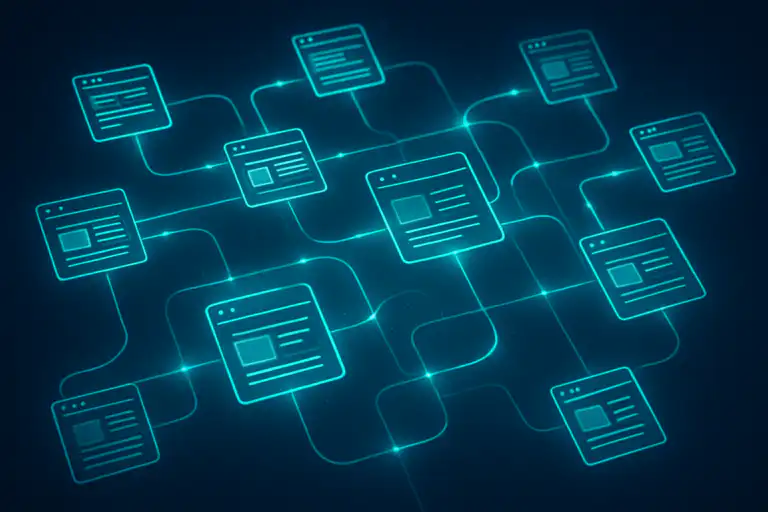
An internal link suggestion engine maps your entire site’s content graph to surface high-value linking opportunities automatically. For a deeper walkthrough, see our What Software Automates Internal Linking Effectively?.
How Does an Internal Link Suggestion Engine Work?
The process begins with a full crawl of your website — similar to how a search engine bot reads your content. The engine extracts key topics, entities, and semantic signals from each page. It then runs a matching algorithm that compares the topical fingerprint of every page against every other page, scoring potential link pairs by relevance and SEO value. See our Internal Links for SEO guide for crawl and algorithm specifics.
Modern engines layer in additional intelligence: they check whether a link already exists between two pages (avoiding duplicates), assess the authority of the linking page, evaluate whether the anchor text is already over-optimized, and even consider click-depth — how many clicks it takes to reach a page from the homepage. The result is a prioritized, actionable list of linking recommendations. See our Internal linking guide.
Without the Engine
- Manual page-by-page review
- Missed linking opportunities
- Inconsistent anchor text
- Orphaned pages go undetected
- Hours of audit time per month
With the Engine
- Automated full-site analysis
- Prioritized opportunity list
- Optimized anchor text suggestions
- Orphaned page rescue alerts
- Minutes to implement changes
Why Internal Linking Is a High-Leverage SEO Activity
Internal linking is one of the few SEO tactics that is entirely within your control. You do not need to negotiate with other websites, build outreach campaigns, or wait months for results. Every internal link you add today can begin influencing crawl behavior and PageRank distribution within days. For large sites with hundreds or thousands of pages, this represents an enormous, often untapped opportunity.
The challenge is scale. A site with 500 pages has theoretically 249,500 possible linking pairs. No human team can evaluate those manually with any consistency. That is precisely where an internal link suggestion engine delivers exponential value — it collapses that complexity into a ranked, manageable task list. For a deeper dive into foundational strategy, the guide on internal linking best practices for SEO at Rank Authority is an excellent companion resource.
For a deeper walkthrough, see our Internal Linking SEO: The Complete Guide to Rankings.

Orphaned pages — those with no inbound internal links — are automatically identified and rescued by a smart linking engine. For a deeper walkthrough, see our What Software Automates Internal Linking Effectively?.
Key Features to Look for in an Internal Link Suggestion Engine
Not all tools are created equal. When evaluating an internal link suggestion engine, these are the capabilities that separate genuinely useful platforms from superficial ones:
Semantic Content Matching
Goes beyond keyword matching to understand topical relationships between pages, ensuring suggestions are genuinely relevant rather than superficially keyword-aligned. Read the internal linking SEO guide for deeper strategy and examples.
Anchor Text Recommendations
Suggests natural, varied anchor text for each link, helping avoid over-optimization penalties while reinforcing target keyword associations.
Orphaned Page Detection
Automatically identifies pages with zero inbound internal links and surfaces the best existing pages from which to link to them.
Real-Time Alerts for New Opportunities
Every time you publish new content, the engine should flag fresh linking opportunities across your existing pages. Platforms like Rank Authority offer real-time SEO issue alerts that integrate this capability into a broader monitoring workflow. For a deeper walkthrough, see our What Software Automates Internal Linking Effectively?.
CMS Integration
The best tools integrate directly with WordPress, Shopify, or your custom CMS, allowing you to implement suggestions without switching platforms or manually editing code.
Frequently Asked Questions
Common Mistakes to Avoid When Using Link Suggestions
Even with a powerful engine, human judgment remains essential. Here are the most common pitfalls to sidestep:
For a deeper walkthrough, see our What Industries Are Most Impacted by AI Search Trends?.
- Accepting every suggestion blindly. The engine scores by relevance and authority signals, but you know your audience. Reject suggestions that would feel jarring or off-topic to a human reader.
- Ignoring anchor text diversity. If every link to a target page uses the same anchor text, it can appear manipulative to search engines. Use the engine’s varied anchor text recommendations.
- Linking from low-quality pages. A link from a thin, low-traffic page provides minimal value. Prioritize suggestions that originate from your strongest, most-visited content.
- Over-linking a single page. Piling dozens of internal links onto one page dilutes the value of each individual link. Aim for balance across your entire content library.
- Setting and forgetting. Your site evolves. Run the engine regularly to capture new opportunities created by fresh content and to catch links that may have become broken or outdated.

Reviewing link analytics regularly ensures your internal linking strategy stays aligned with site growth and content changes.
Measuring the Impact of Your Internal Linking Strategy
Once you begin implementing suggestions from your internal link suggestion engine, tracking results is essential to validate the effort and refine your approach. The key metrics to monitor include: See our internal links guide for metric examples and tracking tips.
↑
Crawl Coverage
More pages indexed by Google following improved internal link structure
↓
Bounce Rate
Relevant internal links encourage visitors to explore deeper into your site
↑
Organic Rankings
Better PageRank distribution lifts rankings for previously under-linked pages
Use Google Search Console to monitor impressions and clicks for pages that received new internal links. Google Analytics can reveal changes in pages per session and average session duration — both indicators that your link structure is guiding users more effectively through your content.
Conclusion
An internal link suggestion engine transforms one of SEO’s most impactful but labor-intensive tasks into a scalable, automated process. By intelligently connecting your content, rescuing orphaned pages, and distributing authority across your site, these tools unlock ranking potential that most websites leave entirely untapped. Whether you manage a blog with 50 posts or an enterprise site with tens of thousands of pages, the right engine turns your existing content into a compounding SEO asset — one smart link at a time. Last updated: 2026-06-02.
For a deeper walkthrough, see our How Do I Integrate AI Into My Existing SEO Strategy?.
Start with a thorough audit of your current internal link structure, implement a suggestion engine that fits your CMS, and commit to a regular review cadence. The results, measured in crawl efficiency, ranking improvements, and organic traffic growth, will speak for themselves.

