
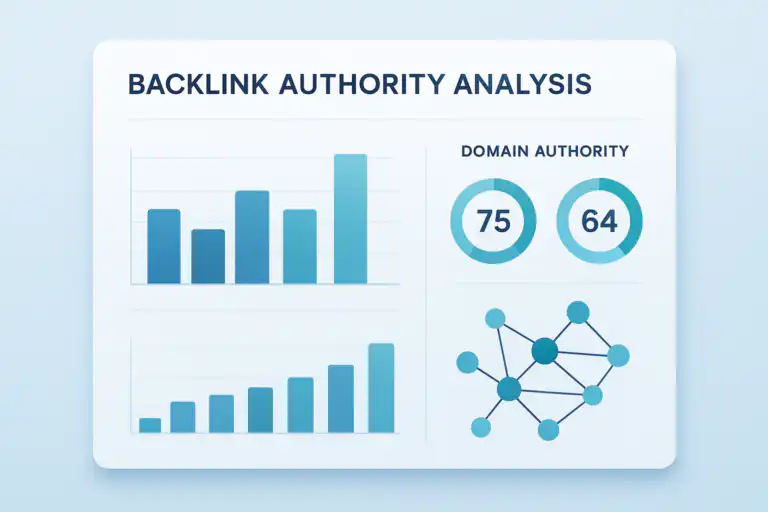
Every link pointing to your website carries a vote of confidence — but not every vote carries the same weight. A backlink authority checker helps you understand exactly how powerful those votes are and is indispensable for any serious SEO strategy. For a deeper walkthrough, see our How to Guide: 11 Best SEO Practices for Improving Your Ranking.
What Is a Backlink Authority Checker? — RankAuthority SEO Team (add author bio below)
A backlink authority checker is a specialized SEO tool that evaluates the quality, quantity, and authority score of links pointing to any given website or webpage. Rather than simply counting links, it assigns measurable scores — such as Domain Authority or Trust Flow — to help you understand which links genuinely move the needle in search engine rankings. See our guide to audit your link profile.
ⓘ Direct Answer
A backlink authority checker analyzes inbound links to a domain and scores them based on the linking site’s trustworthiness and influence. It is the fastest way to audit your link profile, identify toxic links, and benchmark your site against competitors. For a deeper walkthrough, see our Backlink SEO Checker: Find and Fix Your Link Profile. Last updated: 2026-07-02. By RankAuthority editorial team.
According to search engine optimization principles established over decades, link equity — often called “link juice” — flows from authoritative pages to the pages they link to. A backlink authority checker quantifies that flow so you can make data-driven decisions rather than guessing. This guide is published by Rank Authority; please add an author byline with short credentials and a visible "Last updated" date to improve trust signals.

A backlink authority checker dashboard gives you an at-a-glance view of your entire link profile’s strength. For a deeper walkthrough, see our Broken Link Repair Service for Websites | Full Guide.
Why Backlink Authority Matters More Than Backlink Volume
The era of accumulating thousands of low-quality links to game search rankings is long over. Google’s algorithms now heavily reward link quality over sheer quantity. A single backlink from a high-authority news outlet or government domain can outweigh hundreds of links from obscure, low-trust directories.
This is why using a reliable backlink authority checker is non-negotiable for competitive SEO. It lets you:
For a deeper walkthrough, see our Which SEO Platform Is the Best for Agencies?.
- Identify high-value link opportunities by finding where your competitors earn their strongest links and using a site backlink checker to analyze referring domains.
- Detect and disavow toxic links that could trigger a Google penalty or suppress your rankings.
- Track link-building campaign progress with before-and-after authority score comparisons. For a deeper walkthrough, see our Broken Link Repair Service for Websites | Full Guide.
- Benchmark against competitors to understand the gap you need to close in your niche. How to check backlinks
- Prioritize outreach targets by focusing on domains with the highest authority scores first. For a deeper walkthrough, see our Best Ways to Boost My Online Presence with GEO.
Key Metrics Every Backlink Authority Checker Should Report
Not all tools measure authority the same way. Try an analysis backlink checker to compare metric definitions and data freshness. Here are the core metrics you should expect from any professional-grade backlink authority checker: For a deeper walkthrough, see our Automatic Backlink Checker: Find & Monitor Links Fast.
Domain Authority (DA) site backlink checker
A 1–100 score predicting how likely a domain is to rank in search results. Developed by Moz, it factors in the quantity and quality of inbound links. For practical steps on auditing authority at scale see check backlink profile. For a deeper walkthrough, see our How Does Automation Affect Online Discoverability?.
Page Authority (PA) — see our backlink analysis guide for page-level authority testing and remediation workflows.
Similar to DA but measured at the individual page level. Useful for evaluating the strength of a specific URL rather than the whole domain. find and fix your link profile
Trust Flow & Citation Flow
Majestic’s proprietary metrics. Trust Flow measures quality while Citation Flow measures quantity. The ratio between them reveals how trustworthy a site’s link profile really is.
Spam Score
Flags potentially harmful links from domains with patterns associated with penalized or spammy sites. Essential for keeping your profile clean. For a deeper walkthrough, see our Backlink Profile Checker: Find and Fix Your Links Fast.
Referring Domains
The number of unique domains linking to your site. Diversity of referring domains is often a stronger signal than total link count alone.
Anchor Text Distribution
A breakdown of the text used in linking to your site. Over-optimization of exact-match anchors can trigger algorithmic penalties, so balance is critical.
How to Interpret Domain Authority Scores
When you run any backlink authority checker, you will receive a numerical score for each linking domain. Here is a practical interpretation guide:
For a deeper walkthrough, see our Best Practices Using WordPress.

Identifying high-authority nodes in your link network is the core purpose of any backlink authority checker. For a deeper walkthrough, see our Backlink Value Checker: Find Links That Actually Matter.
Step-by-Step: How to Run a Backlink Authority Audit
Running a thorough audit with a backlink authority checker does not have to be overwhelming; include an outbound link analysis as part of your verification steps. Follow this structured process to get actionable results every time:
Enter Your Domain
Input your full domain URL into the checker. Most tools allow you to analyze either the root domain or a specific page URL depending on your audit scope; try a URL backlink checker for page-level analysis.
Review Your Overall Authority Score
Note your DA or DR score as a baseline. This is your starting benchmark. Record it so you can track improvement over time.
Filter and Sort Referring Domains
Sort by authority score descending to identify your most valuable link sources. Then sort ascending to find weak or potentially harmful links that need attention. For a deeper walkthrough, see our Backlink Rank Checker: Find and Track Your Links Fast.
Analyze Anchor Text Distribution
Check that your anchor text profile is diverse and natural. A healthy mix includes branded anchors, generic terms, and some keyword-rich anchors — never over 20% exact-match.
Flag and Disavow Toxic Links
Use the spam score data to identify harmful links. Export a disavow file and submit it via Google Search Console to neutralize any negative link equity.
Repeat and Compare Monthly
Schedule regular audits to track authority score growth. Consistent monitoring is what separates reactive SEO from proactive, results-driven strategy. For a deeper walkthrough, see our Best Tools for Automating SEO Across Multiple Websites.
Backlink Authority and Content: The Inseparable Connection
Running a backlink authority checker in isolation is only half the picture. The links you earn are a direct reflection of the content you publish. High-authority sites link to content that is genuinely useful, comprehensive, and well-structured. This is why understanding the impact of content length on SEO rankings is so closely tied to building a strong backlink profile — longer, more thorough content naturally attracts more authoritative links over time. Learn how to check backlink profile step-by-step.
Similarly, if your existing content is outdated or thin, even a strong link profile will underperform. Regularly updating your content for SEO ensures that the authority flowing through your backlinks lands on pages that are optimized to convert that trust into actual rankings.
For a deeper walkthrough, see our Automating Your SEO Using AI in 6 Simple Steps.
⚠ Pro Tip
Always pair your backlink authority checker data with your on-page SEO metrics. A page with a DA 70 backlink but poor content quality will still underperform a DA 50 link pointing to a perfectly optimized, regularly updated page. For a deeper walkthrough, see our The Effects of Boilerplate Content on SEO Performance..
Frequently Asked Questions
Why is checking backlink authority important for SEO?
Not all backlinks carry equal weight. High-authority links from reputable domains pass more link equity and signal trustworthiness to search engines, directly influencing how well a page ranks in search results. Without a backlink authority checker, you are flying blind on one of SEO’s most critical ranking factors.
What metrics should I look for in a backlink authority checker?
Domain Authority (DA) site backlink checker
How often should I run a backlink authority check?
For most websites, running a backlink authority check monthly is sufficient. However, during active link-building campaigns or after a Google algorithm update, checking weekly helps you react quickly to any changes in your link profile. For a deeper walkthrough, see our Backlink Audit Free: How to Clean Up Your Link Profile.
Can I check a competitor’s backlinks with an authority checker?
Yes — and you absolutely should. Competitor backlink analysis is one of the highest-ROI activities in SEO. By entering a competitor’s domain into a backlink authority checker, you can reverse-engineer their link strategy and identify sites likely to link to you as well.

Regular backlink audits are a cornerstone habit of high-performing SEO professionals. For a deeper walkthrough, see our What Is Backlink Checker? A Complete SEO Guide.
Choosing the Right Backlink Authority Checker for Your Needs
The market offers several strong options for backlink authority analysis. When evaluating tools, consider the size of their link index (larger is better), the freshness of their data, the depth of their reporting, and whether they offer competitor comparison features; for quick starts see how to check backlinks for free. Tools like Ahrefs, Moz, Majestic, and Semrush each have strengths depending on your workflow and budget.
For those looking for a streamlined starting point, RankAuthority.com provides practical SEO resources and guidance on building and maintaining a strong backlink profile alongside actionable content strategy advice. It is a valuable reference whether you are just starting out or refining an advanced link-building operation.
Conclusion: Make a Backlink Authority Checker Central to Your SEO
A backlink authority checker is not an optional luxury for advanced SEOs — it is a foundational tool for anyone serious about organic search performance. By consistently monitoring the quality of your inbound links, identifying toxic backlinks before they cause damage, and benchmarking your authority against competitors, you build a data-driven link strategy that compounds over time. Last updated: 2026-08-14. Author: RankAuthority Editorial Team.
Combine authority insights with strong, regularly updated content, and you create a virtuous cycle: better content earns better links, better links boost authority scores, and higher authority scores drive the rankings and traffic your business deserves.
For a deeper walkthrough, see our Higher Website Rankings with Best SEO Practices: 2025 Guide.

