
Alli AI SEO: Complete Platform Guide — 2025 Edition — By Rank Authority Editorial Team
Alli AI SEO: The Complete Guide to Smarter, Faster Rankings
From real-time on-page automation to bulk site-wide optimization — everything you need to know about Alli AI SEO, including our Alli AI automation guide, and how to use it to dominate search results.
Alli AI SEO is an AI-powered search engine optimization platform that automates on-page changes, keyword optimization, and technical fixes across entire websites — without requiring developers or manual page-by-page edits. For content teams, agencies, and enterprise marketers navigating an increasingly competitive search landscape, understanding what Alli AI SEO offers, how it stacks up against competing tools, and how to deploy it strategically can mean the difference between stagnant rankings and measurable, compounding growth. By Rank Authority — Last updated: 2026-07-02. See Alli AI SEO automation for an in-depth automation guide.
Quick Answer
Alli AI SEO is a real-time SEO automation tool that deploys on-page optimizations directly to your website at scale. It combines AI-driven keyword recommendations, live code editing, automated internal linking, schema markup generation, and bulk page optimization into a single platform — designed to accelerate rankings without manual developer involvement. It serves agencies, e-commerce businesses, content publishers, and in-house SEO teams at any scale. Read our Best Alli AI alternative comparison if you need feature trade-offs.
What Is Alli AI SEO?
Alli AI SEO is a cloud-based platform built to solve one of the oldest frustrations in digital marketing: the lag between identifying an SEO problem and actually fixing it. Traditional SEO tools surface recommendations — but implementing those recommendations often requires developer queues, CMS access, or time-consuming manual work across dozens or hundreds of pages. For broader AI-powered SEO context see our AI-powered SEO guide.
Alli closes that loop. Its core engine can push optimizations — title tag rewrites, meta description updates, schema markup, internal linking adjustments, keyword density changes — live to your site instantly. The platform works across virtually any CMS, including WordPress, Shopify, Wix, Squarespace, Webflow, and custom-built sites, using a lightweight JavaScript snippet that typically takes fewer than ten minutes to install.
According to Wikipedia’s overview of search engine optimization, on-page factors — including title tags, headings, and content relevance — remain among the most controllable and impactful ranking signals. Alli AI SEO is built precisely around maximizing those controllable factors at scale, across sites of any size.
Founded to serve the growing demand for automated, scalable SEO execution, Alli AI has positioned itself as a bridge between insight and action — a distinction that sets it apart from tools that only advise without executing.

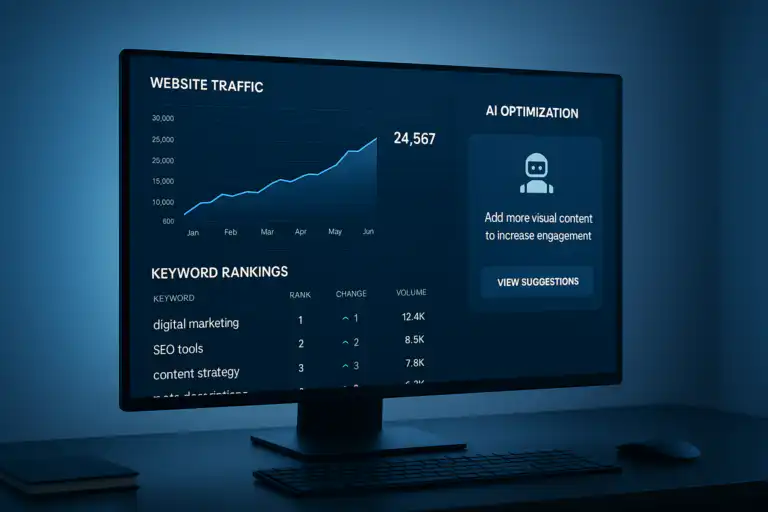
The Alli AI SEO interface surfaces real-time recommendations and deploys changes without developer intervention. For a deeper walkthrough, see our Alli AI: The Complete SEO Automation Guide (2025).
Core Features That Set Alli AI SEO Apart
The platform’s feature set is built around speed, scale, and precision. Here’s a comprehensive breakdown of every major capability that makes Alli AI SEO a serious tool for competitive search optimization:
⚡ Live Editor & Real-Time Deployment
Make changes to any on-page element — headings, body copy, meta tags, alt text — and push them live instantly. No CMS login required. No developer ticket needed. Changes reflect on your live site within seconds, collapsing the implementation gap that costs most teams weeks of ranking momentum.
📊 AI-Powered Keyword Recommendations
Alli analyzes your existing content and surfaces keyword opportunities based on current rankings, competitor gaps, and search intent signals. Rather than raw keyword lists, it delivers prioritized, actionable recommendations that tell you exactly which pages to optimize and which terms to target — reducing guesswork and accelerating decision-making. Read the complete automation guide for examples and recommended rule sets.
🔗 Automated Internal Linking
The platform automatically identifies and inserts contextually relevant internal links across your site, distributing link equity more effectively and strengthening topical authority clusters. For large sites with hundreds or thousands of pages, this feature alone can produce measurable ranking improvements by connecting content that previously lacked proper cross-linking.
📄 Bulk Page Optimization
Apply optimization rules to thousands of pages simultaneously. Define a rule set once — for example, “ensure every product page H1 contains the primary keyword and a benefit modifier” — and Alli deploys it site-wide in minutes. This is the feature that makes Alli uniquely powerful for e-commerce sites, directories, and content-heavy publishers managing large page inventories where manual work is simply not viable.
🧩 Schema Markup Automation
Generate and deploy structured data markup for articles, products, FAQs, local business listings, and more — improving your eligibility for Google rich results including featured snippets, star ratings, and knowledge panels. Alli handles the technical complexity so you don’t need a developer to manage schema at scale.
🔍 Page Speed & Technical SEO Insights
Beyond on-page content, Alli surfaces technical issues affecting crawlability and user experience — including page speed signals, broken link detection, and crawl depth alerts. These technical factors influence how Google indexes and ranks your content alongside the on-page elements Alli directly controls.
🏢 Multi-Site & Agency Management
Alli’s dashboard supports multi-site management, making it particularly well-suited for digital agencies managing client portfolios. White-label reporting options allow agencies to deliver branded analytics to clients while maintaining a centralized workflow internally.
📈 Rank Tracking & Performance Reporting
Track keyword positions over time, monitor ranking fluctuations, and correlate specific optimization actions with ranking outcomes. Alli’s reporting surfaces which changes drove improvements — enabling continuous iteration rather than one-off campaigns.
How Alli AI SEO Differs From Traditional SEO Tools
Most SEO platforms — including well-known industry names — operate as recommendation engines. They tell you what to fix. Alli AI SEO is an execution engine. It not only tells you what to fix but deploys the fix directly to your site in real time, without requiring developer involvement or CMS access for every change.
This distinction is critical for teams with limited development resources. A mid-sized content site might have hundreds of underoptimized pages sitting in a backlog, waiting for developer bandwidth that never materializes. Alli eliminates that bottleneck entirely — the gap between “identified problem” and “live fix” shrinks from weeks to minutes.
Additionally, Alli’s AI layer continuously monitors ranking changes and suggests iterative improvements — meaning your SEO strategy evolves dynamically rather than in quarterly sprints. This aligns closely with what the team at Rank Authority covers in their guide to updating content for SEO: consistent, data-driven content refreshes are among the highest-ROI activities in modern search optimization. For a deeper walkthrough, see our Alli AI: The Complete SEO Automation Guide (2024).

AI-driven automation removes the implementation bottleneck that slows most traditional SEO workflows. For a deeper walkthrough, see our Alli AI: The Complete SEO Automation Guide (2024).
Alli AI SEO vs. SEO App: Head-to-Head Comparison
Two of the more frequently compared AI-driven SEO platforms are Alli AI SEO and SEO App. Both aim to simplify search optimization, but they serve meaningfully different use cases, workflows, and user types. Understanding the distinctions helps you choose the right tool — or determine whether using both in tandem makes sense. See best Alli AI alternatives.
Key Takeaway: Execution vs. Recommendation
The fundamental difference between Alli AI SEO and SEO App is the gap between execution and recommendation. SEO App is primarily a content guidance tool — it analyzes a page and tells you what to improve, but you must implement those improvements manually in your CMS. Alli AI SEO closes that loop by deploying the changes directly, making it significantly more powerful for teams managing volume at scale.
For a solo blogger optimizing one post at a time, SEO App’s lighter interface may feel sufficient. But for agencies, e-commerce operators, and content-heavy publishers, Alli’s automation capabilities represent a fundamentally different tier of operational leverage. See our AI SEO software strategies for tactical implementation examples.
Is Alli AI SEO Suitable for Large Websites?
Yes — and this is arguably where the platform delivers its greatest value. Large websites face a unique SEO challenge: the sheer volume of pages makes manual optimization economically impractical. A 10,000-page e-commerce catalog cannot be hand-optimized one product at a time without prohibitive time and cost.
Alli’s bulk optimization engine lets you create rule sets — “for all product pages, ensure the H2 includes the primary keyword and a price-related modifier” — and apply them site-wide in minutes. This kind of programmatic SEO approach, when executed thoughtfully, can produce dramatic ranking improvements across long-tail keyword clusters with minimal ongoing effort.
Content depth is also a factor worth considering at scale. Research consistently shows that well-structured, comprehensive content tends to outperform thin pages in competitive search verticals. For a deeper look at how page depth affects performance, Rank Authority’s analysis of content length and SEO rankings provides an excellent evidence-based framework you can apply alongside Alli’s automation capabilities. For a deeper walkthrough, see our Best Alli AI Alternative for SEO in 2025.
For enterprise teams, Alli also integrates with existing workflows — connecting to Google Search Console, analytics platforms, and project management tools — so optimization data flows into your existing reporting infrastructure rather than living in an isolated silo.
Alli AI SEO Pricing: What You Get at Each Tier
Alli AI SEO offers tiered pricing designed to scale from individual site owners to large agencies managing dozens of client accounts. While exact pricing can vary and change, here’s a practical breakdown of what each tier typically delivers:
Starter Plan
Designed for individual site owners and small businesses. Includes core on-page optimization, keyword recommendations, and live deployment for a single website. Ideal for those transitioning away from manual optimization or plugin-based approaches.
Agency / Professional Plan
Supports multiple websites with expanded bulk optimization limits, automated internal linking, schema markup automation, and white-label reporting. Best suited for digital agencies managing SEO for multiple clients who need scalable, repeatable workflows.
Enterprise Plan
Unlimited or high-volume website and page counts, priority support, advanced reporting, and custom integrations. Designed for large in-house teams and enterprises managing high-traffic properties where ranking velocity has direct revenue impact.
Note: Alli AI SEO offers a free trial period that allows you to test the platform before committing to a paid plan. Verify current pricing directly on the Alli AI website, as tiers and features are updated periodically.
Who Should Use Alli AI SEO?
Alli AI SEO is particularly well-suited for:
- Digital agencies managing multiple client websites who need scalable optimization workflows without proportionally scaling headcount — Alli’s multi-site management and white-label reporting make it a natural fit.
- E-commerce businesses with large product catalogs where manual optimization is economically impractical — Alli’s bulk rule engine can standardize thousands of product pages overnight.
- Content publishers maintaining large blog archives who need a systematic way to refresh, re-optimize, and internally link aging content that has lost ranking positions over time.
- In-house SEO teams at mid-to-large companies who face developer resource constraints and need to move faster on implementation without opening up sprint cycles for every metadata change.
- Small business owners without dedicated SEO staff who want intelligent, automated guidance without a steep learning curve or the need to hire an agency for routine optimizations.
- SaaS and software companies running content-driven growth strategies who need their blog and landing pages continually optimized as keywords and competitive landscapes evolve. See our AISEO guide for tactics specific to SaaS content.
Building a Strategy Around Alli AI SEO
Technology without strategy produces noise. To get the most out of Alli AI SEO, treat it as a force multiplier for a well-defined optimization plan — not a replacement for one. Here is a practical, step-by-step framework for deploying Alli effectively:
- Audit your current rankings — Identify which pages are ranking on page two or three for high-value keywords. These are your highest-leverage targets for quick wins, since they already have some authority and need targeted on-page adjustments to cross the threshold to page one.
- Segment by page type — Group pages into categories (product, blog, landing page, category page) and create optimization rule sets appropriate to each type’s search intent. A product page and a blog post require fundamentally different optimization approaches.
- Prioritize content freshness — Use Alli’s recommendations alongside a content refresh calendar. Pages that haven’t been updated in 12+ months are often prime candidates for significant ranking recovery with relatively minimal effort.
- Build internal linking clusters — Use Alli’s automated internal linking to connect related content, strengthening topical authority signals that Google increasingly rewards. Focus on connecting cluster pages back to pillar content for maximum effect. For a deeper walkthrough, see our Best Alli AI alternative article for complementary approaches.
- Deploy schema markup strategically — Prioritize structured data for pages targeting featured snippet and rich result opportunities — FAQ pages, how-to content, product listings, and local business pages.
- Monitor and iterate monthly — Review performance data every 30 days. Alli’s reporting surfaces which changes correlated with ranking improvements, allowing you to refine your rule sets and replicate successful patterns across other page groups.
- Integrate with content creation — Use Alli’s keyword gap analysis to inform your editorial calendar, ensuring new content targets opportunities your existing pages aren’t capturing.

Tracking performance improvements is central to any successful Alli AI SEO implementation strategy. For a deeper walkthrough, see our Alli AI: The Complete SEO Automation Guide (2026).
Pros and Cons of Alli AI SEO
No platform is a perfect fit for every team. Here’s an honest assessment of where Alli AI SEO excels and where it has limitations worth understanding before you commit: For a deeper walkthrough, see our Best Alli AI Alternative for SEO in 2025.
✅ Strengths
- Real-time deployment — fastest time-to-live in the category
- Bulk optimization at scale — unmatched for large sites
- CMS-agnostic via JS snippet
- Automated internal linking saves significant manual time
- Multi-site management for agencies
- Schema markup automation without developer dependency
- Continuous AI-driven recommendations that evolve with rankings
⚠️ Limitations
- Higher price point than basic content optimization tools
- Learning curve for rule-set creation on large sites
- Not a full content creation platform — writing still required
- Backlink analysis is more limited than dedicated link tools
- Automation quality depends on the strategy guiding it
- JS snippet dependency means site performance monitoring is important
Frequently Asked Questions About Alli AI SEO
Can Alli AI SEO help with content updates for better rankings?
Absolutely. Alli AI SEO provides real-time recommendations for refreshing and updating existing content — flagging pages where keyword relevance has drifted, engagement signals have dropped, or competitors have overtaken previously held positions. Pairing Alli’s automation with a structured content refresh schedule is one of the most effective long-term ranking strategies available. The platform can identify which aging pages have the highest ranking recovery potential so you prioritize effort where it matters most.
Does Alli AI SEO work with any CMS?
Yes. Alli uses a JavaScript snippet to connect to your site, which means it works with WordPress, Shopify, Wix, Squarespace, Webflow, Magento, BigCommerce, Drupal, and most custom-built platforms. Installation typically takes under ten minutes and requires no developer involvement after the initial snippet placement. This CMS-agnostic approach is a significant advantage over tools that are built exclusively for one platform.
How quickly can I see results with Alli AI SEO?
Results vary by site authority, competition level, and the scope of changes implemented. However, because Alli deploys changes live rather than queuing them for manual implementation, the time-to-impact is significantly shorter than traditional workflows. Many users report measurable ranking movement within 4 to 8 weeks of systematic optimization. Pages targeting lower-competition keywords or sitting at the top of page two tend to see the fastest movement.
Is Alli AI SEO safe to use without risking a Google penalty?
Alli AI SEO is designed to implement white-hat, guideline-compliant optimizations. The platform does not engage in cloaking, keyword stuffing, or any practice that violates Google’s Webmaster Guidelines. That said, as with any optimization tool, the quality of outcomes depends on the strategy guiding the automation. Thoughtful, user-focused rule creation will always produce better — and safer — results than purely mechanical optimization.
How does Alli AI SEO compare to hiring an SEO agency?
Alli AI SEO is not a replacement for strategic SEO expertise, but it dramatically reduces the labor cost of implementation. Where an agency charges hourly or monthly retainer fees for work that largely involves manual optimization tasks, Alli automates those tasks — allowing you to either reduce agency spend or redirect agency time toward higher-value strategy work. Many agencies use Alli AI SEO themselves to serve clients more efficiently at scale.
Does Alli AI SEO offer a free trial?
Yes, Alli AI SEO offers a free trial that allows you to explore the platform’s core features before committing to a paid subscription. This makes it straightforward to evaluate whether the automation capabilities deliver measurable impact on your specific site before any financial investment is required.
What makes Alli AI SEO better than SEO App for agencies?
For agencies, the key differentiators are multi-site management, bulk optimization capabilities, white-label reporting, and live deployment — all areas where Alli AI SEO significantly outperforms SEO App. SEO App’s strengths lie in content optimization recommendations for individual pages, which is useful but doesn’t scale efficiently across a client portfolio. Alli’s architecture is specifically built to handle the volume and variety that agency workflows demand.
Can I use Alli AI SEO alongside other SEO tools like Ahrefs or Semrush?
Yes — and this is actually a recommended approach. Tools like Ahrefs and Semrush excel at backlink analysis, keyword research, and competitive intelligence. Alli AI SEO excels at on-page execution. Using them in combination gives you a complete picture: research and discovery from Ahrefs/Semrush, execution and automation from Alli. Many advanced SEO teams treat Alli as the implementation layer that sits on top of their research tools. For a deeper walkthrough, see our AI-powered SEO guide for broader context.
Common Mistakes to Avoid When Using Alli AI SEO
Even powerful tools produce poor results when misused. These are the most common pitfalls SEO teams encounter when deploying Alli AI SEO — and how to avoid them: For a deeper walkthrough, see our Alli AI Reviews: Is It Worth It for SEO in 2025?.
- Over-automating without reviewing outputs — Bulk optimization rules should be reviewed with sample pages before site-wide deployment. Even well-designed rules can produce awkward phrasing or unintended keyword placement in certain contexts.
- Ignoring content quality — Alli optimizes existing content, but cannot fix thin or low-value pages. Optimization amplifies what’s already there — if the underlying content is weak, optimizing it will not produce meaningful ranking gains.
- Neglecting mobile and Core Web Vitals — On-page optimization alone won’t overcome poor user experience signals. Ensure your site’s page speed and mobile usability are healthy before expecting Alli’s optimization work to reach its full potential.
- Failing to track changes — Use Alli’s built-in reporting alongside Google Search Console to correlate specific optimization actions with ranking changes. Without this tracking, you can’t distinguish what’s working from what isn’t.
- Setting rules and forgetting them — Search intent and competitive landscapes evolve. Rule sets that were optimal six months ago may need refinement. Schedule quarterly rule reviews as part of your ongoing SEO calendar.
Final Verdict
Alli AI SEO represents a genuine evolution in how optimization work gets done — collapsing the distance between insight and implementation in a way that traditional tools and recommendation-only platforms simply cannot match. For teams serious about compounding their search visibility over time, it belongs in the conversation alongside any enterprise-grade SEO platform.
Whether you’re managing ten pages or ten thousand — and whether you’re a solo operator, a growing agency, or an enterprise team — the combination of real-time deployment, AI-driven keyword recommendations, bulk automation, and automated internal linking makes Alli AI SEO one of the most operationally powerful tools available in the modern SEO stack. The gap it closes between discovery and execution is its defining advantage.
Looking to deepen your overall SEO strategy? Explore the resources at rankauthority.com for expert guidance on rankings, content strategy, technical optimization, and the latest in AI-powered SEO. We also published detailed Alli AI automation guides across our site for hands-on examples and implementation tips.
For a deeper walkthrough, see our AllIAI: The Complete Guide to AI-Powered SEO Tools.

