

Complete Strategy Guide
AI content writing for SEO is reshaping how marketers create, optimize, and scale content that ranks — and this guide covers everything you need to do it right. For a deeper walkthrough, see our How Can AI Change the Way I Do SEO?.
AI content writing for SEO is the practice of using artificial intelligence tools — particularly large language models — to research, draft, optimize, and publish web content designed to rank in search engines and attract organic traffic. As AI capabilities have matured, this approach has moved from experimental novelty to mainstream strategy, fundamentally changing the speed, scale, and sophistication with which businesses can compete for search visibility.
Quick Answer
AI content writing for SEO uses machine learning models to generate and optimize written content for search engines. When combined with human editorial oversight, it can dramatically increase content output, improve keyword targeting, and boost organic rankings — without sacrificing quality. For a deeper walkthrough, see our Can AI Generate Accurate Image Alt Text?.
What Is AI Content Writing for SEO?
AI content writing for SEO is the intersection of two powerful disciplines: artificial intelligence-driven text generation and search engine optimization strategy. Rather than replacing human writers entirely, the most effective implementations use AI as a force multiplier — handling the time-consuming groundwork of research, outlining, and first-draft generation, while human editors refine, fact-check, and inject the originality that search engines and readers reward.
According to Wikipedia’s overview of search engine optimization, SEO encompasses a broad range of techniques aimed at increasing the quantity and quality of organic traffic to a website. AI content writing plugs directly into this ecosystem by making it faster and more consistent to produce content that satisfies both search algorithms and human intent. For a deeper walkthrough, see our How Does AI Enhance Search Engine Optimization?.

AI content writing for SEO combines natural language generation with data-driven keyword strategy to produce content engineered for search visibility.
Why AI Is Changing the SEO Content Landscape
The volume of content published online every day is staggering. Competing for attention and rankings in this environment demands both consistency and quality — a combination that was historically difficult to achieve without large editorial teams. AI changes that equation significantly.
Here is why forward-thinking SEO teams are integrating AI into their content workflows: For a deeper walkthrough, see our How to Capitalize on AI for Content Marketing.
- Speed at scale: AI can produce a well-structured 1,500-word draft in minutes, allowing teams to publish more content across more target keywords without proportionally increasing headcount.
- Semantic depth: Modern AI models understand topical relationships, enabling them to naturally cover related subtopics and entities that strengthen a page’s relevance signals.
- Consistency: AI enforces structural consistency — headings, meta descriptions, internal linking patterns — across large content libraries that would otherwise drift in quality.
- Content gap analysis: AI tools can analyze competitor content and SERPs to identify topics you haven’t covered, turning gaps into ranking opportunities.
Does Google Penalize AI-Written Content?
This is one of the most common questions SEO professionals ask. The short answer: no, not inherently. Google’s ranking systems evaluate content based on quality, helpfulness, and E-E-A-T (Experience, Expertise, Authoritativeness, and Trustworthiness) — not the mechanism used to produce it.
What Google does penalize is low-quality, thin, or manipulative content — regardless of whether a human or a machine wrote it. The implication is clear: AI-generated content that is accurate, original, well-structured, and genuinely useful to readers can rank just as well as human-written content. The risk lies in publishing unedited AI output that lacks depth, accuracy, or real-world perspective. For a deeper walkthrough, see our Can AI Generate Accurate Image Alt Text?.
This is closely tied to the concept of content usefulness. If you want to understand how Google evaluates whether your content truly serves readers, the team at Rank Authority’s guide on content usefulness breaks down exactly what signals matter and why they affect rankings. For a deeper walkthrough, see our AI Content Strategy Tools: The Complete 2025 Guide.

The difference between effective and ineffective AI-generated content comes down to editorial quality, accuracy, and genuine value for the reader.
How to Use AI Content Writing for SEO Without Losing Quality
The most successful AI-assisted SEO workflows follow a structured process that keeps human judgment at the center of every publishing decision. Here is a proven framework:
The 5-Stage AI Content Workflow
Choosing the Right AI Tools for SEO Content
Not all AI writing tools are built with SEO in mind. The most effective stack typically combines a powerful language model for content generation with a dedicated SEO platform for optimization and analysis. For a deeper walkthrough, see our AI Content Optimization: Rank Faster and Smarter.
Key categories to consider:
- Large Language Models (LLMs): Tools like ChatGPT and Claude excel at drafting, rewriting, summarizing, and generating structured content at scale.
- SEO-Integrated AI Platforms: Tools like Surfer SEO and Clearscope combine AI writing assistance with real-time SERP analysis, content scoring, and NLP-based keyword recommendations.
- AI Research Tools: Platforms that automate competitive content analysis, topic clustering, and content gap identification — feeding your editorial calendar with data-backed opportunities.
For a deeper look at how AI is reshaping the broader search landscape — including tools and measurable ROI — explore Rank Authority’s guide to AI search engine optimization strategies, which covers the full stack from content creation to technical SEO. For a deeper walkthrough, see our How to Leverage AI for Content Marketing.
Frequently Asked Questions
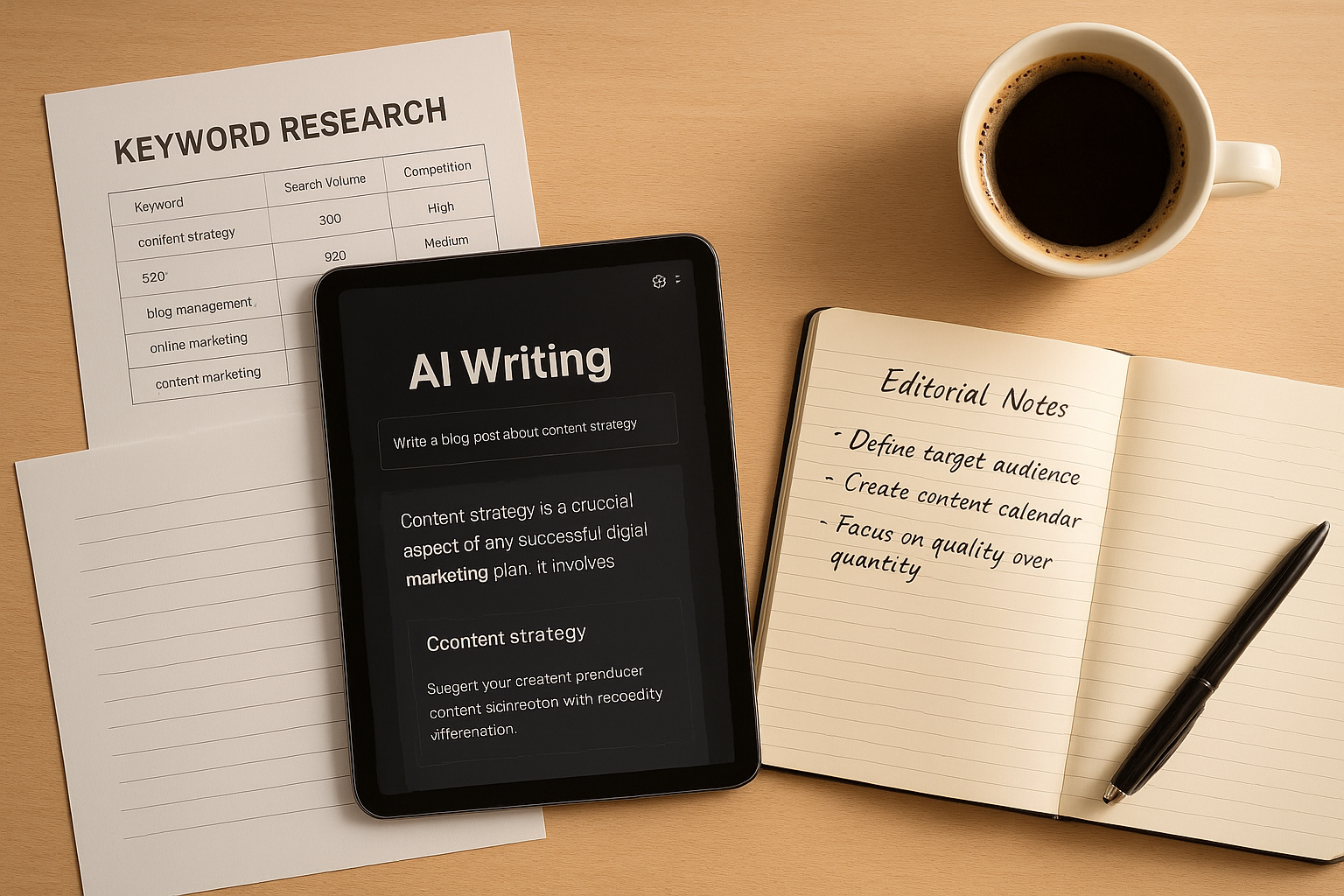
Effective AI-assisted SEO content strategy blends machine efficiency with human creativity and editorial judgment.
Common Mistakes to Avoid
Even experienced SEO teams make avoidable errors when adopting AI content writing. Watch out for these pitfalls:
- Publishing raw AI output: Unedited AI drafts often contain inaccuracies, generic phrasing, and a lack of genuine expertise. Always edit before publishing.
- Ignoring search intent: AI can generate content around a keyword without truly matching what searchers want to find. Always validate intent before and after drafting. For a deeper walkthrough, see our How Can I Use AI for Search Optimization?.
- Over-optimizing for keywords: AI tools can be prompted to stuff keywords unnaturally. Prioritize readability and semantic relevance over mechanical keyword density. For a deeper walkthrough, see our Can AI Generate Accurate Image Alt Text?.
- Neglecting E-E-A-T signals: AI cannot demonstrate lived experience or genuine expertise. Build these signals through author bios, original research, citations, and transparent sourcing.
The Future of AI Content Writing for SEO
The trajectory is clear: AI content writing for SEO will become more sophisticated, more integrated into publishing workflows, and more central to competitive content strategy. We are already seeing AI tools that can autonomously monitor rankings, identify content decay, and suggest targeted updates — closing the loop between content creation and performance measurement.
At the same time, the bar for content quality is rising. As AI makes it easier to produce adequate content at scale, the differentiator will increasingly be originality, depth, and genuine expertise — qualities that require human intelligence at the center of the process.
Conclusion
AI content writing for SEO is not a shortcut — it is a strategic accelerator. When implemented with the right workflow, the right tools, and consistent human oversight, it enables teams to produce more useful, more comprehensive, and better-optimized content than was ever possible before. The organizations that will win in search are those that treat AI as a collaborator, not a replacement, and who never lose sight of the reader behind every query.

