
Agency SEO Operations · Complete Playbook
Technical SEO Monitoring for Agencies: The Complete 2025 Guide
How to build proactive monitoring systems, tiered alert workflows, and scalable audit processes that protect every client’s rankings — and turn your agency into an indispensable partner they’ll never leave.
Technical SEO monitoring for agencies is the continuous, systematic process of auditing, tracking, and resolving technical website issues — crawl errors, indexation failures, Core Web Vitals regressions, broken internal links, structured data errors, and more — across an entire portfolio of client sites at the same time. Unlike a one-time audit, it is a living discipline that keeps organic search performance stable and defensible even as websites evolve, development teams push risky changes, and search engine algorithms shift. For agencies managing dozens or hundreds of client domains, mastering this discipline is the difference between retaining clients long-term and losing them to competitors who catch problems first.
Direct Answer
Technical SEO monitoring for agencies means continuously tracking the health of multiple client websites against critical technical signals — crawlability, indexation, page speed, structured data, and security — using automated tools, alert systems, and tiered review workflows. It enables agencies to detect and fix issues before they cause ranking drops, deliver measurable proactive value to clients, and scale that protection across an unlimited number of accounts without proportional increases in staff time.
What Is Technical SEO Monitoring for Agencies?
At its core, technical SEO monitoring for agencies is a structured, ongoing system — not a one-off deliverable. It involves deploying automated crawlers, integrating data from Google Search Console, setting threshold-based alerts, and maintaining real-time dashboards that surface critical issues across every client account in a single view. The operational goal is clear: no ranking-impacting technical problem should go undetected for more than a few hours on a high-priority site.
The scope of technical monitoring is broader than most agencies initially assume. It spans server response codes, crawl budget efficiency, canonical tag consistency, hreflang implementation for multilingual sites, XML sitemap validity, robots.txt integrity, structured data markup, mobile usability, HTTPS security, and Core Web Vitals. Each signal can independently suppress rankings — and in combination, they can devastate organic visibility overnight.
Crucially, technical SEO monitoring is distinct from working with a technical SEO agency as a client. It is the operational infrastructure that a well-run agency deploys internally to manage, protect, and demonstrate value across every account it holds. It is how agencies deliver consistent results rather than reactive scrambles.
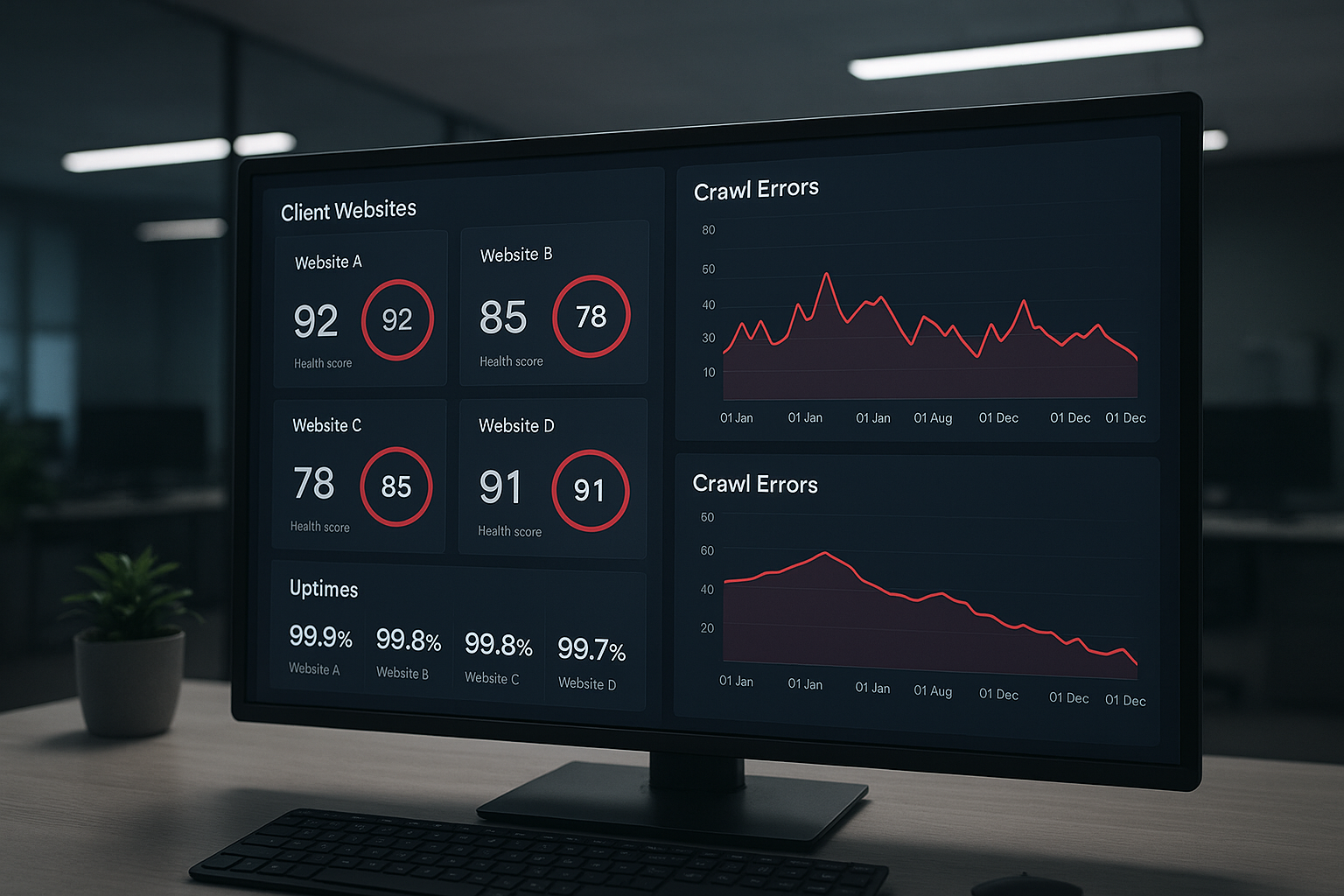
A centralized technical SEO monitoring dashboard gives agencies a real-time view of every client’s site health in one place.
Why Agencies Specifically Need Technical SEO Monitoring
Individual website owners face technical SEO challenges. Agencies face those same challenges multiplied by every client in their portfolio — simultaneously, often with no visibility into what a client’s development team is deploying on any given day. This is an entirely different operational problem, and it demands a purpose-built operational response.
Consider what is at stake: a single client who loses 40% of their organic traffic because an accidental noindex tag went undetected for three weeks is a client who is looking for a new agency. Multiply that risk across 30, 50, or 100 client domains and the agency’s business model itself is at risk without a systematic monitoring infrastructure in place.
The Agency-Specific Risk Landscape
- No visibility into client-side development changes — clients push code without notifying their SEO agency
- Portfolio scale — issues multiply across every managed domain simultaneously
- Reputational exposure — one missed critical error can end a long-term client relationship
- Reporting gaps — manual audits only catch problems that existed at the moment of the audit
- Competitor agencies who offer proactive monitoring as a selling point will poach reactive agencies’ clients
Continuous Monitoring vs. Periodic Audits: Why the Difference Is Decisive
A quarterly or even monthly manual audit is fundamentally reactive. By the time an agency discovers that a client’s development team accidentally pushed a noindex tag to production, or that a server migration broke 40% of internal links, weeks of ranking erosion may have already occurred. The financial and reputational cost of that delay is enormous — and entirely preventable.
Continuous automated monitoring flips this dynamic entirely. When alerts fire within minutes of a critical change, agencies can respond before Googlebot recrawls the affected pages. This proactive posture is a powerful client retention argument and a genuine competitive differentiator. Platforms like Rank Authority’s real-time SEO issue alerts are purpose-built for exactly this use case, delivering instant notifications when site health metrics cross predefined thresholds.
Periodic Audits
- Snapshot in time only
- Problems emerge between cycles
- Reactive — damage already done
- Hard to scale across a portfolio
- Slow client communication loop
Continuous Monitoring
- Always-on detection
- Alerts fire before rankings drop
- Proactive — prevents damage
- Scales infinitely with automation
- Demonstrates ongoing value to clients
The Critical Technical SEO Signals Every Agency Must Monitor
Not all technical issues carry equal weight. Understanding the severity hierarchy of technical signals is essential for triaging issues correctly when multiple problems surface simultaneously across a client portfolio.
Priority Tier 1: Crawlability & Indexation (Critical)
These issues can remove pages from Google’s index entirely. They demand immediate automated alerts and same-hour response.
- Accidental noindex directives pushed to production on key pages or site-wide
- robots.txt blocking of critical content or entire site sections
- Server downtime and 5xx errors preventing Googlebot from accessing pages
- Sudden drops in indexed page counts in Google Search Console
- SSL/HTTPS certificate expiry triggering browser security warnings
- Sitemap.xml failures — broken URLs, incorrect syntax, missing pages
Priority Tier 2: Performance & User Experience (High)
These signals directly influence ranking signals and user engagement. They warrant daily review and 24-hour resolution timelines.
- Core Web Vitals regressions — LCP, CLS, and INP score deterioration
- Mobile usability failures — tap target errors, viewport configuration problems
- 4xx broken link clusters emerging from CMS changes or content removals
- Redirect chain elongation — adding hops that bleed link equity and slow load times
- Mixed content warnings on HTTPS pages loading HTTP resources
Priority Tier 3: Structural SEO Health (Important)
These issues erode performance gradually. Weekly deep-crawl audits should surface them for prioritized remediation.
- Canonical tag conflicts and self-referencing failures
- Structured data / schema markup errors and missing implementations
- Duplicate title tags and missing meta descriptions at scale
- Orphaned pages receiving no internal links
- Crawl budget waste from thin, parameterized, or duplicate URLs
- Internal link equity distribution problems leaving key pages under-linked
- Hreflang implementation errors on multilingual sites
- Image alt text gaps on content-heavy pages
How to Build a Scalable Technical SEO Monitoring Workflow: Step-by-Step
The biggest operational challenge for agencies is scale. Monitoring one site manually is manageable. Monitoring 50 client sites with different CMS platforms, publishing frequencies, and technical configurations requires a structured, tiered system. Here is how to build it.
Audit Your Current Client Portfolio and Tier Your Sites
Before configuring any monitoring tool, categorize every client site by revenue impact, traffic volume, and development activity. High-traffic e-commerce clients with active development teams require the most intensive monitoring cadence. Low-traffic brochure sites with infrequent updates can operate on a lighter schedule. This tiering ensures your monitoring resources are allocated where the risk and value are highest.
Deploy Real-Time Automated Alerts for Critical Issues
Configure automated alerts for the highest-severity issues: site downtime, mass noindex deployment, sudden drops in indexed pages, SSL certificate failures, and robots.txt changes that block crawling. These alerts should reach a designated team member within minutes via Slack, email, or your project management platform. Zero manual review cycles should be required before action is taken on critical alerts. Tools like Rank Authority’s real-time alert system deliver these notifications the moment thresholds are crossed.
Establish Daily Crawl Health Summaries Across All Accounts
Each morning, a team lead should review an automated digest of crawl health changes across all client accounts. New broken links, emerging 404 clusters, pages newly blocked in robots.txt, Core Web Vitals score shifts, and new redirect chains all belong in this daily summary. Issues surfaced at this tier are triaged and assigned to the responsible specialist within 24 hours. The daily digest should be automated — not manually compiled.
Run Weekly Deep-Crawl Audits on All Client Sites
Once per week, run full deep-crawl audits on all client sites. These reviews surface slower-burning issues: internal link equity distribution problems, orphaned pages, crawl depth inefficiencies, structured data degradation, and duplicate content patterns. Schedule deep crawls for low-traffic periods — overnight or early weekend mornings — to avoid consuming server resources during peak business hours. Weekly audits feed directly into monthly client reports and quarterly strategic recommendations.
Integrate Google Search Console Data into Your Monitoring Stack
Google Search Console provides ground-truth data that no third-party crawler can replicate: actual indexation status, manual actions, Core Web Vitals field data from real users, and crawl request statistics. Integrate GSC data — ideally via API — into your central monitoring dashboard so that discrepancies between what your crawlers see and what Google actually indexes are flagged automatically. Indexation drops of more than 5% on any client site should trigger an immediate investigation workflow.
Build Client-Facing Reporting That Documents Monitoring Value
The final step is translating your monitoring data into client-facing value. Monthly reports should document not just ranking movements, but issues detected and resolved — with timelines showing how quickly your agency responded. Clients don’t need to understand canonical tags; they need to understand that your agency caught a problem that would have cost them 30% of their organic traffic and fixed it in 48 hours. This framing shifts the client relationship from vendor to trusted protector.
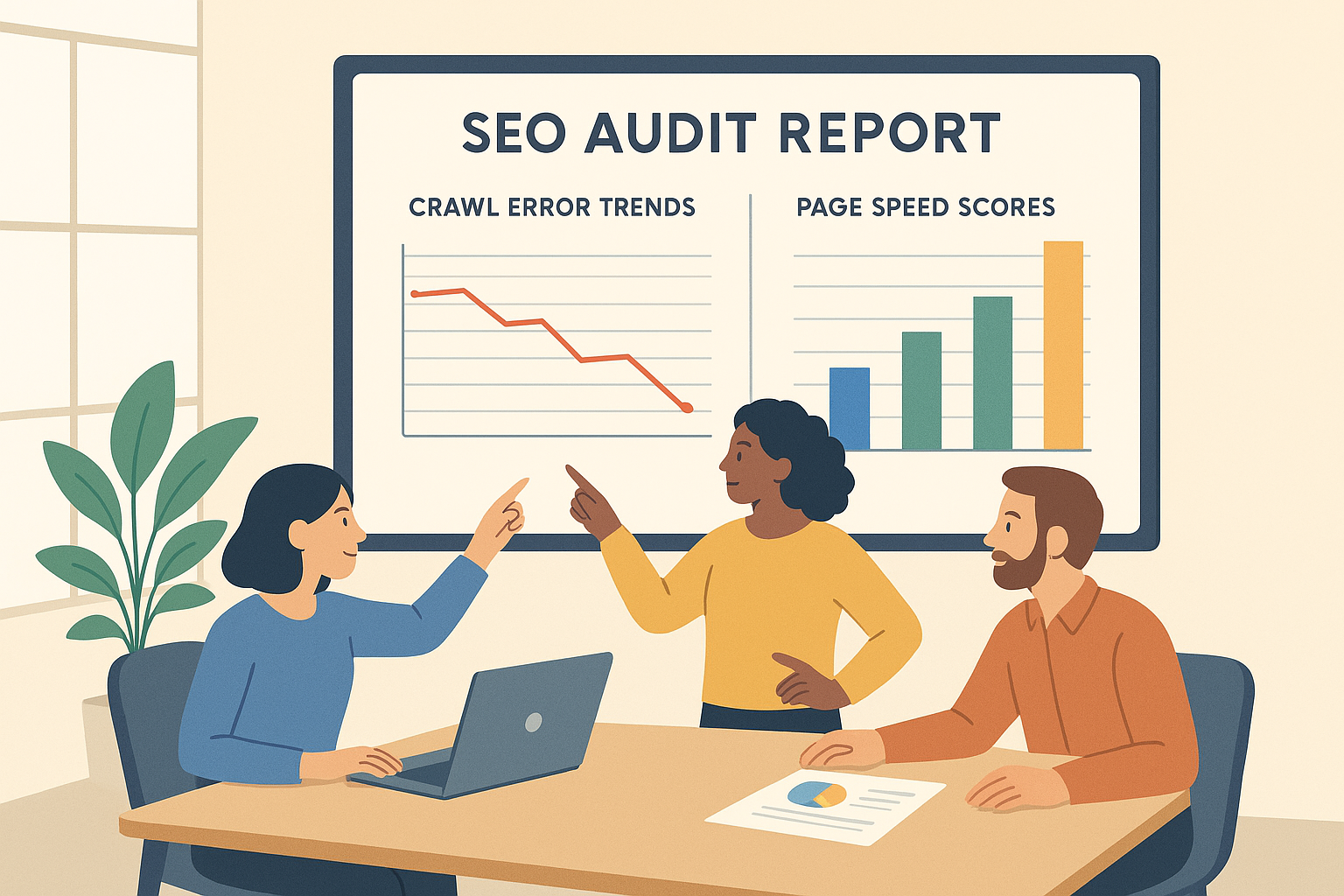
Weekly deep-crawl reviews keep agency teams aligned on client technical health and emerging issues before they escalate.
Choosing the Right Tools for Agency-Scale Technical SEO Monitoring
No single tool covers every monitoring need, but agencies should anchor their stack around a core platform that handles multi-client management natively. The right toolchain reduces manual effort, eliminates reporting gaps, and ensures no client account falls through the cracks.
Multi-Client Monitoring Platform
Rank Authority — multi-site dashboards, real-time alerts, automated health scoring, client-ready reporting For a deeper walkthrough, see our Site Health Score Checker: The Complete Guide.
Best for: continuous portfolio-wide monitoring and alert management
Deep Crawl Analysis
Screaming Frog SEO Spider — granular page-level crawl data, redirect chain mapping, response code analysis, structured data extraction
Best for: weekly deep-crawl audits and technical issue discovery
Indexation & Field Data
Google Search Console — coverage reports, Core Web Vitals field data from real users, manual action alerts, crawl statistics
Best for: ground-truth indexation data and Google-specific technical signals
Competitive Context & Broader SEO
Semrush / Ahrefs — site audit modules, keyword rank tracking, backlink health monitoring, competitor gap analysis
Best for: broader SEO intelligence beyond pure technical signals
Tool Selection Principle
The Rank Authority automated SEO platform is designed with agencies in mind — offering multi-site dashboards, automated issue detection, and client-ready reporting that eliminates hours of manual data compilation each month. The key principle for any agency stack: one platform must aggregate alerts and health scores across all client accounts so that no issue falls through the cracks between tools.
How to Set Up Technical SEO Monitoring Across a Multi-Client Agency Portfolio
The mechanics of implementing monitoring across many client accounts require deliberate configuration. Below is the operational setup sequence agencies should follow when onboarding new clients into their monitoring infrastructure.
Baseline Crawl and Health Snapshot
Before monitoring can be meaningful, you need a baseline. Run a full crawl audit on every new client site at onboarding and document existing issues, current indexation counts, Core Web Vitals scores, and structured data implementations. This baseline is your reference point — future monitoring reports measure deviation from this starting state.
Alert Threshold Configuration
Configure alert thresholds specific to each site’s profile. A site with 500 pages and a 2% 404 rate at baseline should alert if that rate jumps to 5%. An e-commerce site with 50,000 product pages needs different thresholds than a blog with 200 posts. Generic, one-size-fits-all alert thresholds generate alert fatigue — client-specific thresholds surface genuine anomalies.
Access and Integration Setup
Request Google Search Console access at onboarding — as a property owner or delegated access. Connect GSC API data to your central monitoring platform so indexation coverage data updates automatically. If the client uses Google Analytics 4, connect GA4 for organic traffic correlation data that helps diagnose whether a technical issue has already caused traffic impact.
Client Communication Protocols
Define upfront with each client how critical alerts will be communicated and who on their team needs to be looped in for development-related issues. If your agency identifies an accidental noindex push, do you contact the client’s SEO manager, their CTO, or their web developer directly? Establishing this escalation path at onboarding eliminates confusion during high-pressure incident responses.
Core Web Vitals Monitoring: The Agency Dimension
Core Web Vitals require special attention in an agency context because they sit at the intersection of technical SEO and web development — a boundary that agencies and their clients often share awkwardly. CWV scores can regress overnight when a developer adds a new third-party script, changes image loading behavior, or modifies layout rendering.
Core Web Vitals Agency Monitoring Checklist
- Monitor LCP (Largest Contentful Paint) — target under 2.5 seconds; alert when it degrades by more than 15%
- Monitor CLS (Cumulative Layout Shift) — target under 0.1; alert on any increase above 0.05 delta
- Monitor INP (Interaction to Next Paint) — target under 200ms; alert on regressions above 50ms
- Track both lab data (Lighthouse) and field data (Chrome UX Report via GSC) — they often diverge
- Segment CWV scores by device type — mobile CWV failures are more damaging than desktop for most sites
- Correlate CWV changes with deployment events to identify the causative code push
Turning Technical SEO Monitoring into a Client Retention Engine
The strategic value of technical SEO monitoring for agencies extends far beyond preventing ranking drops. When agencies consistently surface and resolve issues before clients are even aware of them, they shift the client relationship from vendor to trusted partner. Monthly reports that document issues detected and resolved — not just ranking movements — demonstrate tangible, ongoing value that justifies retainer fees and insulates the relationship from competitive pitches.
Structuring client reports around monitoring data is straightforward with the right platform. Automated health score trends, issue resolution timelines, and before-and-after crawl comparisons all translate complex technical work into clear business outcomes. Clients don’t need to understand canonical tags — they need to understand that their agency caught a problem that would have cost them 30% of their organic traffic and fixed it in 48 hours.
How to Frame Monitoring Value in Client Reports
- Issues Detected This Month: number and severity classification of issues caught by monitoring
- Issues Resolved: resolution timeline showing average hours from detection to fix
- Traffic Protection Estimate: pages affected and estimated traffic value protected
- Health Score Trend: overall site health trajectory over rolling 90-day period
- Core Web Vitals Progress: month-over-month LCP, CLS, and INP movements
- Upcoming Risks: issues currently in triage that may impact performance if unresolved
Proactive Monitoring as a Sales Differentiator
When pitching new clients, most agencies lead with keyword rankings and traffic projections. Agencies with mature monitoring infrastructure can lead with something more compelling: a demonstration of active protection. Show prospects a sample report from a current client documenting issues caught and resolved. Show them the alert system that would have caught a real-world incident at their current agency before it caused a traffic drop. This narrative converts prospects and retains existing clients simultaneously.
Common Technical SEO Monitoring Mistakes Agencies Make
Even agencies that invest in monitoring tools frequently undermine their own effectiveness through avoidable operational mistakes. Recognizing these patterns prevents them.
- Alert fatigue from undifferentiated thresholds — configuring the same alert sensitivity for every client means low-value alerts drown out critical ones. Use tiered, site-specific thresholds.
- Monitoring without a response SLA — alerts that arrive but sit unacknowledged for hours provide no value. Define maximum response times for each alert tier and enforce them.
- Relying solely on third-party crawl data — external crawlers miss what Google actually sees. GSC indexation data must be part of every agency’s monitoring stack.
- Skipping baseline documentation — without a documented baseline, monitoring data has no context. Month-two issues that existed at onboarding look like new problems without a baseline record.
- Not monitoring after client CMS migrations — migrations are the highest-risk SEO events. Monitoring cadence should double during any migration window and for 30 days afterward.
- Hiding monitoring value from clients — agencies that resolve issues silently without documenting them in client reports are throwing away retention ammunition. Every resolved issue is proof of value.
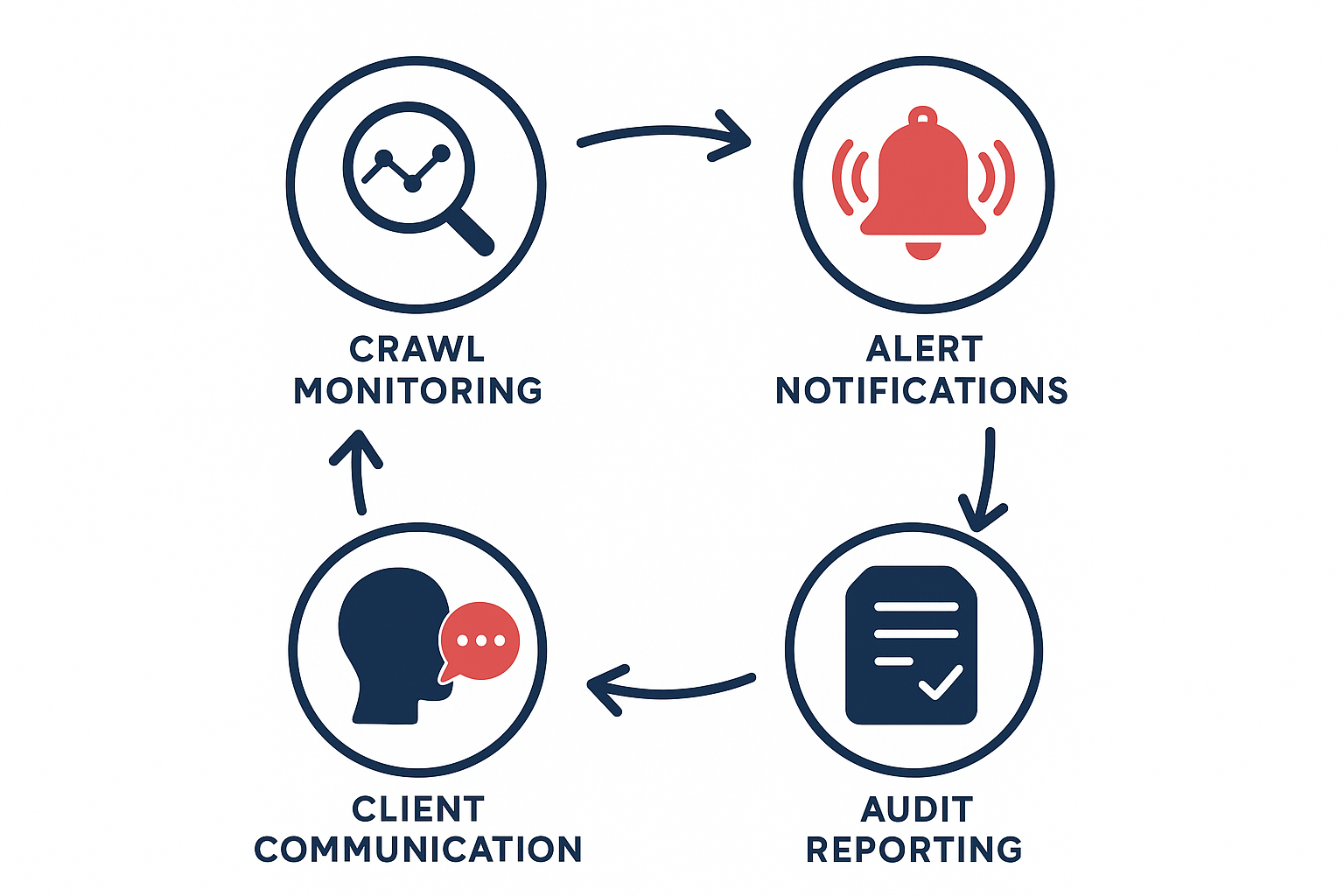
The complete technical SEO monitoring workflow — crawl, detect, alert, resolve — keeps agencies ahead of every client issue across their entire portfolio.
Frequently Asked Questions About Technical SEO Monitoring for Agencies
What is technical SEO monitoring for agencies and how does it differ from a standard audit?
Technical SEO monitoring for agencies is a continuous, always-on process of tracking technical website health signals — crawlability, indexation, Core Web Vitals, structured data, and security — across a portfolio of client sites simultaneously. It differs from a standard audit in that audits are periodic point-in-time snapshots, while monitoring is ongoing. According to Wikipedia’s overview of search engine optimization, technical factors are foundational to organic visibility — making their continuous monitoring non-negotiable for professional agency practitioners who cannot afford to discover problems only after rankings have dropped.
Why do agencies need automated SEO monitoring instead of manual audits?
Manual audits are periodic snapshots — they miss issues that emerge between review cycles. A client’s development team could deploy an accidental noindex tag, break internal linking through a CMS update, or allow an SSL certificate to expire at any point between manual audits. Automated monitoring runs continuously, catching regressions in crawlability, Core Web Vitals, structured data, and indexation the moment they occur. This allows agencies to act before rankings drop, rather than diagnosing the cause of a traffic loss after the fact. For agencies managing 10, 50, or 100+ client sites, manual auditing at sufficient frequency is simply not operationally viable.
What are the most critical technical SEO signals agencies should monitor?
The highest-priority signals are those that directly affect crawlability and indexation: server errors (5xx), accidental noindex directives, robots.txt changes that block key content, sudden drops in indexed page counts, and SSL certificate failures. These warrant real-time alerts and immediate response. The second tier includes Core Web Vitals regressions, mobile usability failures, broken link clusters (4xx errors), and redirect chain elongation. The third tier — important but slower-burning — includes canonical conflicts, structured data errors, duplicate title tags, orphaned pages, and crawl budget inefficiencies.
How often should agencies run technical SEO audits and monitoring for clients?
The monitoring cadence depends on site tier. High-priority clients with active development cycles warrant real-time automated alerts for critical issues, daily crawl health digest reviews, and weekly deep-crawl audits. Mid-tier clients with moderate update frequencies should have real-time alerts for critical issues, bi-weekly deep crawls, and monthly comprehensive reviews. Lower-tier clients on stable platforms can operate on weekly automated monitoring with monthly deep-crawl audits. In all cases, real-time alerts for the most critical issues — noindex changes, server downtime, SSL failures — should run continuously regardless of site tier or client budget level.
What tools support technical SEO monitoring for agencies at scale?
The most effective agency monitoring stacks combine a dedicated multi-client monitoring platform (such as Rank Authority) with deep-crawl tools like Screaming Frog, indexation and field data from Google Search Console, and broader competitive intelligence from Semrush or Ahrefs. The central requirement is having one platform that aggregates alerts and health scores across all client accounts so no issue falls through the cracks between tools. Standalone tools that require per-client login and manual report compilation do not scale — they create the same bottlenecks that continuous monitoring is designed to eliminate.
How do agencies communicate technical SEO monitoring value to clients who don’t understand SEO?
The most effective approach is translating technical issue resolution into business impact language. Instead of reporting “we resolved 14 canonical conflicts,” report “we identified and fixed a configuration issue that was preventing 14 product pages from ranking correctly — these pages generate an estimated $X in monthly organic revenue.” Document issues detected and resolved in every monthly report, not just ranking movements. Show clients the health score trend over time. Quantify traffic protection estimates when possible. This makes the agency’s proactive monitoring work visible and commercially meaningful to clients who cannot evaluate it technically.
What should agencies do during a client site migration to protect SEO?
Site migrations are the highest-risk SEO events an agency will manage. Monitoring intensity should be doubled or tripled during any migration window. Pre-migration, document a complete baseline crawl, indexation count, and Core Web Vitals scores. During migration, monitor crawlability and redirect chain integrity in real time. Post-migration, run daily deep-crawl comparisons against the pre-migration baseline for at least 30 days. Alert thresholds should be set more aggressively — even a 2% drop in indexed pages post-migration should trigger an immediate investigation, rather than waiting for a larger anomaly to surface.
Conclusion
Effective technical SEO monitoring for agencies is not a luxury or a premium add-on — it is the operational foundation that separates agencies that grow sustainably from those that constantly firefight. By implementing tiered alert systems, continuous crawl monitoring, structured weekly audit workflows, and client-facing reporting that documents proactive value, agencies can protect every client’s organic visibility at scale, justify long-term retainers, and build the kind of trust that makes clients not just stay — but refer others. The tools and frameworks exist today. The agencies that master technical SEO monitoring in 2025 will dominate their markets in 2026 and beyond — and the ones that don’t will keep losing clients to the agencies that do.

