
Complete Guide · 2025 Edition
Measure. Benchmark. Outrank.
An AI scorecard is a structured evaluation framework that uses artificial intelligence to automatically assess, score, and benchmark the performance of your digital content and SEO strategy against defined goals and industry best practices. As search engines grow more sophisticated, relying on gut instinct alone is no longer enough — and that’s exactly where the AI scorecard becomes indispensable.
Quick Answer
An AI scorecard uses machine learning algorithms to evaluate multiple SEO and content performance signals simultaneously, returning a unified score and a prioritized action list. It replaces hours of manual auditing with instant, data-backed insight.
What Is an AI Scorecard?
At its core, an AI scorecard is a diagnostic tool. Think of it as a report card for your website — but instead of a teacher grading essays, a trained machine learning model is evaluating dozens of interconnected performance signals at once. These signals typically span content quality, technical health, authority metrics, and user experience indicators.
For a deeper walkthrough, see our AI Search Performance Reporting for Agencies | Guide.
The concept draws from the broader field of balanced scorecards — a strategic management framework developed in the early 1990s — but applies modern AI to make scoring dynamic, continuous, and far more granular than any human analyst could achieve manually.
Where traditional audits deliver a snapshot, an AI scorecard delivers a living evaluation. It can track changes over time, detect regressions after site updates, and flag emerging opportunities before competitors capitalize on them.

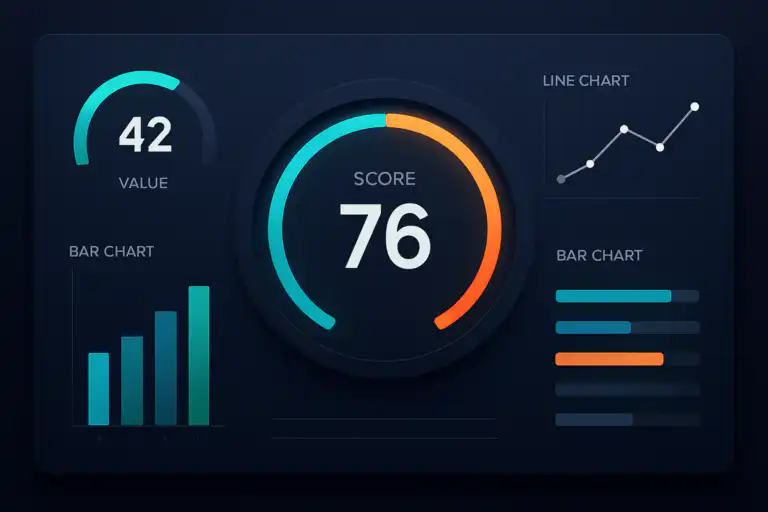
A modern AI scorecard interface consolidates dozens of SEO signals into one unified performance view. For a deeper walkthrough, see our AI Search Performance Reporting for Agencies | Guide.
How Does an AI Scorecard Work?
The mechanics behind an AI scorecard involve several processing layers. First, a data ingestion layer pulls raw signals from your website — crawl data, analytics events, backlink profiles, and on-page content. Second, a normalization layer converts these disparate data types into comparable units. Third, a weighted scoring model — trained on historical ranking data — assigns importance to each signal relative to your specific goals.
The output is typically structured into distinct scoring categories. Here’s what a standard AI scorecard framework looks like:
| Scoring Category | Key Signals Measured | Typical Weight |
|---|---|---|
| Content Quality | Depth, readability, E-E-A-T signals, keyword relevance | 30% |
| Technical Health | Core Web Vitals, crawlability, structured data, mobile UX | 25% |
| Authority & Links | Domain authority, backlink quality, internal link structure | 25% |
| User Engagement | Dwell time, bounce rate, scroll depth, CTR | 12% |
| Search Visibility | Keyword rankings, SERP features, impression share | 8% |
Why Content Quality Drives Your AI Scorecard Score
Of all the categories an AI scorecard evaluates, content quality consistently carries the heaviest weighting — and for good reason. Search engines have grown remarkably adept at identifying thin, redundant, or misleading content. A well-trained AI scoring model mirrors that capability, rewarding pages that demonstrate genuine expertise, comprehensive coverage, and clear user value.
For a deeper walkthrough, see our AI Search is Transforming the Web: New Trends Report.
One key insight from content scoring research: length alone is not a quality signal. A 500-word page that directly answers a specific query can outscore a 3,000-word page stuffed with filler. Understanding this nuance is critical. If you want to explore how content length actually correlates with ranking outcomes, RankAuthority’s analysis of content length and SEO rankings provides a data-driven breakdown that pairs well with scorecard interpretation.
Pro Insight
AI scorecards that incorporate semantic analysis can detect topical gaps — subjects your competitors cover that you don’t. Filling these gaps is often the fastest path to significant score improvements and ranking lifts.

Acting on AI scorecard recommendations systematically drives measurable ranking improvements over time.
Building an AI Scorecard Workflow That Actually Moves Rankings
Having access to an AI scorecard is only half the equation. The other half is building a repeatable workflow around it. Many teams generate a scorecard, review it once, and then let the findings gather dust. The teams that consistently outrank competitors treat their scorecard as a living operational document.
Here is a proven four-step workflow:
Score and Segment
Run your AI scorecard across the full site, then segment results by content type, funnel stage, or traffic tier. Don’t treat all pages as equal — focus remediation effort where ranking impact is highest.
Prioritize by Impact-to-Effort Ratio
Not every low-scoring signal is equally important. Use the scorecard’s weighted output to build a priority matrix. Quick technical fixes that lift multiple pages simultaneously should almost always come first.
Update and Re-Score
After implementing changes, re-run the scorecard on affected pages within two to four weeks. This closes the feedback loop and validates whether your interventions worked. For guidance on refreshing content strategically, see RankAuthority’s content updating guide.
Establish a Cadence
Build scorecard reviews into your monthly editorial calendar. Treat score regressions the same way you’d treat a drop in organic traffic — as an early warning signal requiring immediate investigation.
Frequently Asked Questions About AI Scorecards
How does an AI scorecard improve SEO performance?
An AI scorecard improves SEO performance by automatically identifying gaps in content quality, keyword usage, technical health, and backlink profiles, then generating prioritized recommendations. This allows teams to act on the highest-impact improvements first rather than guessing where to focus.
What metrics does an AI scorecard typically measure?
A typical AI scorecard measures content relevance, keyword density and placement, page load speed, mobile usability, backlink authority, structured data implementation, user engagement signals such as dwell time and bounce rate, and overall search visibility scores. For a deeper walkthrough, see our AI Search Engine Optimization: Strategies, Tools, and ROI.
How often should you run an AI scorecard audit?
Most SEO professionals recommend running an AI scorecard audit monthly for active content and quarterly for the broader site, with additional checks triggered by algorithm updates or significant traffic changes.
Is an AI scorecard suitable for small businesses?
Yes. An AI scorecard is highly suitable for small businesses because it automates complex analysis that would otherwise require a dedicated SEO team, delivering clear, actionable priorities even with limited resources and budgets. For a deeper walkthrough, see our What’s the Best AI Search Optimization Platform for Small Businesses?.

AI scorecard tools make enterprise-level SEO analysis accessible to businesses of every size. For a deeper walkthrough, see our Which Features Improve AI Search Optimization Tools?.
Common AI Scorecard Mistakes to Avoid
Even powerful tools produce poor results when misused. Here are the most common mistakes teams make when implementing an AI scorecard strategy:
For a deeper walkthrough, see our What Results Can I Expect from AI Search Tools?.
-
✕
Chasing the score, not the outcome. Optimizing purely to raise a number without tying it to actual ranking or revenue goals produces hollow results. Always anchor scorecard work to business objectives. -
✕
Ignoring industry-specific weighting. A default AI scorecard model trained on general data may not reflect the ranking factors that matter most in your niche. Customize weighting where the tool allows it.
For a deeper walkthrough, see our AI Search Visibility Tool: AEO Wins, Features, 30‑Day Plan. -
✕
Running it once and forgetting it. SEO is not a set-and-forget discipline. Competitive landscapes shift, algorithms update, and content ages. A scorecard only delivers sustained value when used consistently. -
✕
Overlooking competitor benchmarking. An AI scorecard is most powerful when scores are contextualized against competitors, not just internal history. Always compare against the pages currently ranking in your target SERPs.
Conclusion
An AI scorecard transforms SEO from a reactive discipline into a proactive, data-driven system. By continuously measuring the signals that search engines actually reward, flagging weaknesses before they cost you rankings, and delivering a clear action hierarchy, the AI scorecard is one of the highest-leverage tools available to modern digital marketers. Build it into your workflow, act on its findings consistently, and your rankings will reflect the discipline. For a deeper walkthrough, see our How Much Does AI Search Optimization Cost?.
The difference between sites that plateau and sites that compound their organic growth is rarely talent — it’s the systematic use of tools like the AI scorecard to make better decisions, faster.

