

Website SEO costs are one of the most searched — and most misunderstood — topics in digital marketing. Whether you are a small business owner exploring your options or a marketing manager justifying a budget, understanding what drives SEO pricing helps you make smarter decisions and avoid costly mistakes.
In practice, SEO pricing is not one-size-fits-all. Costs depend on your industry, your goals, your site’s current condition, and the type of provider you choose. Therefore, this guide breaks down every major pricing model and what you actually get for your money.

Understanding website SEO costs starts with knowing what services you actually need.
What Do Website SEO Costs Actually Cover?
Website SEO costs is the term used to describe all fees associated with improving a site’s visibility in organic search results. This includes everything from technical audits and keyword research to content writing, link building, and monthly reporting. Because SEO is not a single service but a collection of ongoing activities, pricing reflects the scope and depth of work involved.
According to Wikipedia’s overview of search engine optimization, SEO encompasses both technical and creative disciplines. As a result, the cost naturally varies based on how many of those disciplines your campaign requires.
Additionally, your starting point matters enormously. A brand-new website with no existing authority will require more foundational work — and therefore more budget — than an established site that simply needs ongoing maintenance and content production.
The Four Main SEO Pricing Models
Most SEO providers structure their fees in one of four ways. Understanding each model helps you compare apples to apples when evaluating quotes.
1. Monthly Retainer
A monthly retainer is the most common arrangement. You pay a fixed fee each month in exchange for a defined set of deliverables. For small businesses, retainers typically range from $500 to $2,000 per month. Mid-market companies often invest $2,000 to $5,000 monthly, while enterprise-level campaigns can exceed $10,000 per month.
2. Project-Based Pricing
Project-based pricing works well for one-time needs such as a site migration, a comprehensive audit, or a content strategy build-out. These projects typically cost between $1,000 and $30,000 depending on scope. However, this model does not provide ongoing optimization, so it is best paired with a maintenance plan afterward.
3. Hourly Consulting
Experienced SEO consultants charge $100 to $300 per hour on average. This model suits businesses that have in-house marketing teams and need expert guidance rather than full execution. Meanwhile, less experienced freelancers may charge $50 to $75 per hour, though results can be inconsistent.
4. Performance-Based Pricing
Some providers offer performance-based arrangements where fees are tied to ranking improvements or traffic milestones. Although this sounds appealing, it can incentivize short-term tactics that harm long-term rankings. Therefore, approach this model with caution and always review the methodology carefully.
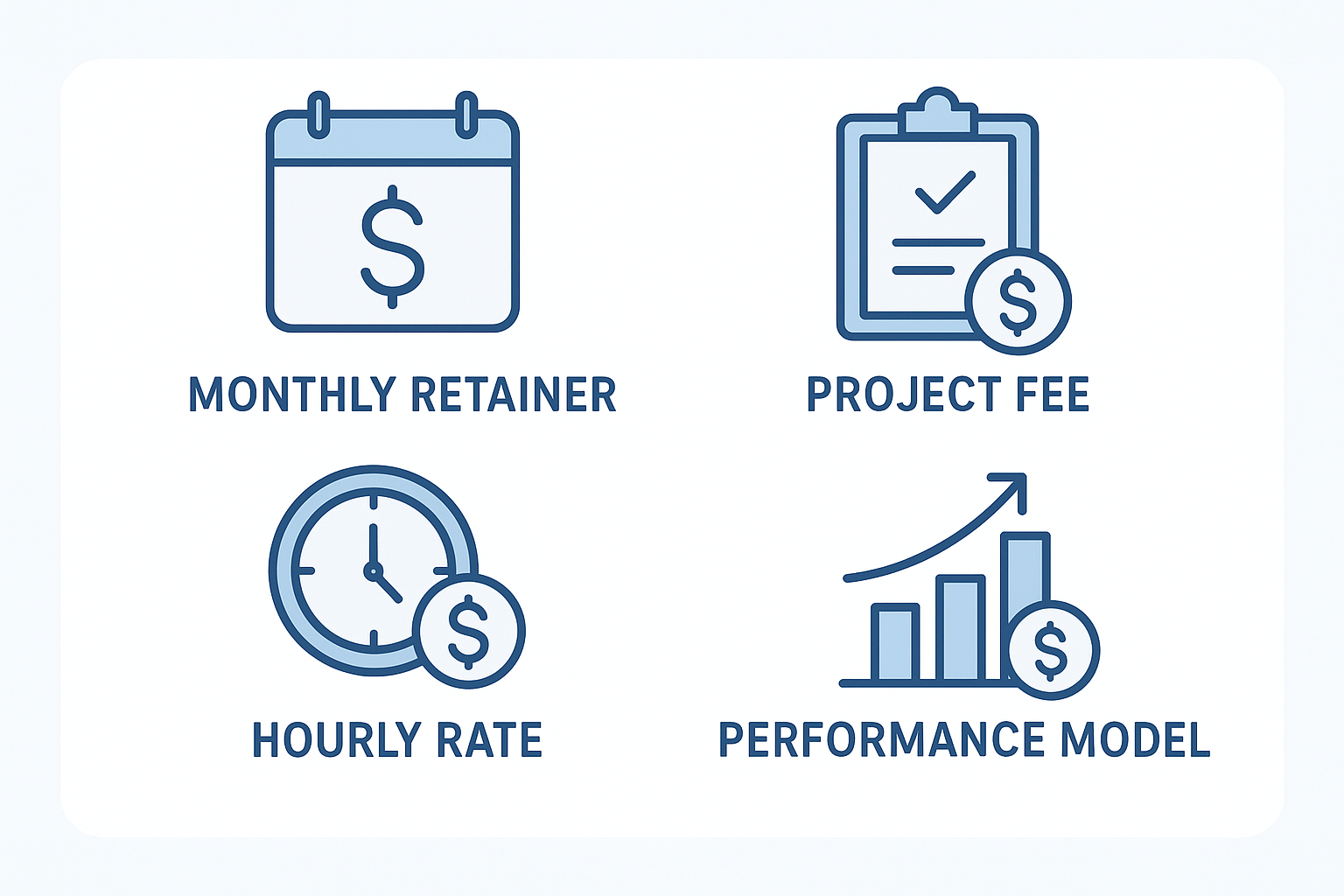
Choosing the right pricing model is just as important as choosing the right SEO provider.
What Drives the Price Up or Down?
Several concrete factors push SEO budgets higher or lower. First, industry competition is a major driver. Ranking for terms like “personal injury lawyer” or “mortgage rates” requires far more effort than ranking for niche, low-competition keywords. As a result, businesses in competitive verticals pay significantly more.
Second, your site’s technical health affects cost. A site riddled with crawl errors, duplicate content, and slow page speeds needs more remediation work before optimization can even begin. In contrast, a technically clean site allows the provider to focus immediately on content and link building.
Third, the number of target keywords and pages matters. A local plumber targeting five service pages in one city requires a much smaller investment than an e-commerce store with thousands of product pages targeting national keywords.
Local vs. National SEO Budgets
Local SEO campaigns generally cost $300 to $1,500 per month because they focus on a defined geographic area with less competition. National campaigns, however, typically start at $1,500 and can climb well past $5,000 monthly because they require broader keyword coverage and more aggressive link building.
Red Flags to Watch for When Comparing Quotes
Not all SEO providers deliver equal value, and some can actively harm your rankings. Therefore, knowing the warning signs protects your investment. Watch for these red flags:
- Guaranteed #1 rankings — No ethical provider can guarantee a specific ranking position, because Google’s algorithm is not within anyone’s control.
- Extremely low pricing — Packages under $200 per month almost always rely on automated link schemes or content farms that violate Google’s guidelines.
- No reporting or transparency — A reputable provider delivers regular reports showing keyword rankings, traffic trends, and completed deliverables.
- Vague deliverables — If a proposal cannot clearly state what work will be done each month, that is a serious concern.
For a deeper look at how to evaluate providers and set realistic expectations, Rank Authority offers practical guidance on what professional SEO services should include and how to hold providers accountable. For a deeper walkthrough, see our How Can I Use AI to Improve SEO? The Complete 2025 Guide.
How to Build a Realistic SEO Budget
Building a budget starts with defining your goals. Are you trying to generate local foot traffic, grow e-commerce revenue, or establish brand authority in a national market? Each goal implies a different level of investment and a different timeline for results.
Next, benchmark against your revenue potential. A business that earns $500,000 annually from organic search can justify investing $3,000 to $5,000 per month because the return is clear. Meanwhile, a startup with no existing traffic should start conservatively, perhaps at $750 to $1,500 per month, and scale as results materialize.
Finally, account for tools. Even if you hire an agency, you may still need subscriptions to platforms like Ahrefs or Semrush for independent performance tracking. These typically cost $100 to $400 per month depending on the plan.

A well-planned SEO budget accounts for both provider fees and supporting tools.
Getting the Most Value from Your SEO Spend
To maximize your return, treat SEO as a long-term channel rather than a quick fix. Most campaigns take three to six months to show meaningful ranking improvements, and the compounding nature of organic traffic means results accelerate over time. Additionally, combining SEO with a strong content strategy multiplies results because every new piece of optimized content becomes a permanent asset.
Communication with your provider is equally important. Request monthly reporting that includes keyword ranking changes, organic traffic trends, and a summary of completed work. Because SEO involves many moving parts, transparency ensures you can catch problems early and adjust strategy as needed.
For additional benchmarks and provider comparisons, Rank Authority is a useful resource for understanding what separates high-performing SEO campaigns from average ones.
Conclusion: Setting the Right Expectations Around Website SEO Costs
Website SEO costs range from a few hundred dollars per month for basic local campaigns to tens of thousands for competitive national strategies. The key is matching your budget to your goals, choosing a transparent provider, and committing to a realistic timeline. Because organic search compounds over time, the businesses that invest consistently and strategically are the ones that dominate their market long-term. Start with a clear scope, ask the right questions, and treat SEO as the durable growth channel it truly is.
Frequently Asked Questions About Website SEO Costs
What are typical website SEO costs per month?
Most businesses pay between $500 and $5,000 per month for professional SEO services. Small businesses often start around $500 to $1,500 monthly, while competitive industries or larger sites can push costs well above $3,000 per month.
Why do website SEO costs vary so much between providers?
Pricing varies because of differences in provider experience, scope of work, market competition, and the technical complexity of your site. An established agency with a proven track record will charge more than a freelancer just starting out.
Is paying for SEO worth it for small businesses?
Yes, SEO is generally worth the investment for small businesses because organic search traffic compounds over time and does not require ongoing ad spend. Even a modest SEO budget can deliver significant returns when the strategy is well executed.
What is included in a typical SEO service package?
A typical SEO package includes keyword research, on-page optimization, technical audits, content creation, and link building. Some providers also include local SEO, analytics reporting, and competitor analysis.
How much does a one-time SEO audit cost?
A one-time SEO audit typically costs between $500 and $5,000 depending on site size and depth of analysis. Smaller sites with fewer pages are generally on the lower end, while enterprise sites with complex structures cost more.
What is the difference between local SEO and national SEO costs?
Local SEO targets a specific geographic area and typically costs $300 to $1,500 per month. National SEO campaigns compete across broader markets and usually start at $1,500 per month, often reaching $5,000 or more.
Can I do SEO myself to save money?
Yes, you can handle basic SEO tasks yourself using free tools like Google Search Console and paid tools like Ahrefs or Semrush. However, DIY SEO requires significant time investment and a learning curve that may slow results compared to hiring a professional.
How long does it take to see results from SEO investment?
Most SEO campaigns take three to six months before showing measurable ranking improvements. Highly competitive niches may take nine to twelve months to deliver significant organic traffic gains.
What is an SEO retainer and how does it work?
An SEO retainer is a recurring monthly payment for ongoing SEO services. The provider performs agreed-upon tasks each month, such as content creation, link outreach, and technical maintenance, in exchange for a fixed fee.
Are cheap SEO services a red flag?
Very cheap SEO services, often under $200 per month, are frequently a red flag because they may rely on low-quality tactics that violate Google’s guidelines. These approaches can result in ranking penalties that are costly to recover from.
How do I evaluate whether an SEO provider is worth the cost?
Ask for case studies, check client reviews, and request a clear breakdown of deliverables before signing a contract. A trustworthy provider will set realistic expectations and explain exactly how they plan to improve your rankings.
What factors most affect website SEO costs?
The main factors are your industry’s competitiveness, your site’s current technical health, the number of target keywords, and whether you need content creation included. Geographic targeting and the provider’s experience level also play significant roles.

