
SEO quality is the measure of how completely a webpage satisfies a search engine’s ranking criteria across content depth, technical performance, and authority signals — and it is the single biggest lever you can pull for sustainable organic growth. Whether you run a niche blog or a sprawling e-commerce catalog, understanding exactly what drives quality lets you make smarter decisions with every page you publish, every backlink you pursue, and every technical fix you prioritize.
Most guides treat this topic narrowly, focusing on one slice — content, links, or site speed — and leaving readers to piece the rest together. This guide does not. Below, you’ll find a complete framework for diagnosing, fixing, and maintaining high SEO quality, including a deep dive into backlink quality management, a step-by-step improvement plan, and a FAQ section that answers the questions most other resources skip entirely.
What Is SEO Quality?
SEO quality is not a single score, a plugin reading, or a simple checklist you can tick off once and forget. Instead, it is a composite judgment that search engines form by evaluating dozens of overlapping signals every time they crawl and index a page. According to Google’s Search Central documentation, the underlying goal is to surface content that is helpful, reliable, and created primarily for people rather than for search engines.
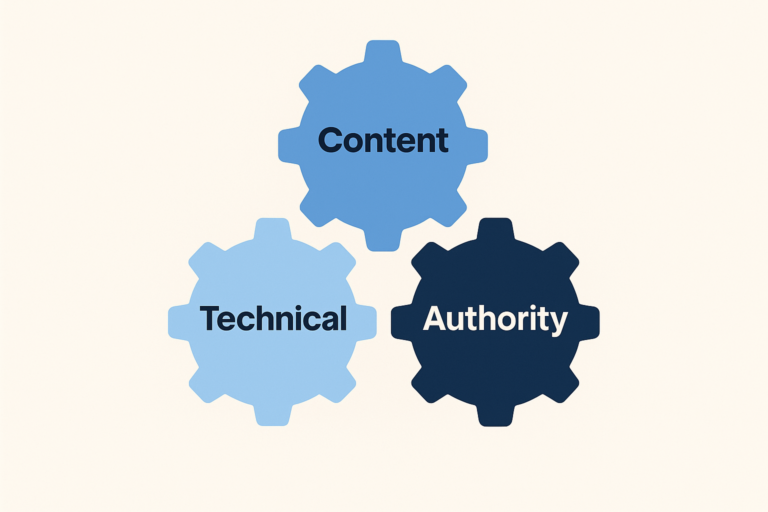
In practice, this judgment is evaluated across three broad pillars: content relevance, technical health, and off-page authority. Therefore, a weakness in any single pillar can quietly suppress your rankings even when the other two are strong. This is precisely why isolated tactics — like chasing backlinks without fixing thin content, or improving page speed while ignoring E-E-A-T — rarely produce lasting results.
For example, a page with brilliant writing but a three-second mobile load time will still struggle to rank. Meanwhile, a fast-loading page with shallow, unhelpful content won’t rank either, no matter how many backlinks point to it. In other words, SEO quality is holistic by design — and treating it that way is the fastest route to meaningful, compounding results. If you want a broader view of how these signals interact, the best ways to improve your site’s search rankings breaks down the priority order most teams get wrong.
Why Website Quality Signals Determine Your Rankings
Search engines exist to answer questions as efficiently as possible. As a result, every ranking factor — from page speed to backlink relevance — ultimately traces back to a single question: does this page genuinely serve the person searching? Quality signals are simply the proxies Google uses to answer that question at scale, across billions of pages, in milliseconds.
Consequently, pages that score well on these signals tend to earn more durable rankings. They survive algorithm updates better, because updates are usually designed to reward exactly the behaviors that high-quality pages already demonstrate. In contrast, pages propped up by manipulative tactics — keyword stuffing, link schemes, or AI-generated filler — tend to see dramatic ranking drops whenever Google refines its detection methods. Building long-term search rankings is, in essence, the practice of optimizing for real quality instead of gaming short-term signals.
The Three Pillars of a High-Quality SEO Strategy
Pillar 1 — Content Quality and E-E-A-T
Google’s quality raters evaluate content using the E-E-A-T framework — Experience, Expertise, Authoritativeness, and Trustworthiness. This framework matters for every topic, but it carries extra weight for subjects that affect a reader’s health, finances, or safety, often called “Your Money or Your Life” topics.
To demonstrate E-E-A-T convincingly, include visible author credentials, cite authoritative sources, and contribute original insight rather than simply rephrasing what competitors already published. Additionally, keeping content updated — with refreshed statistics, new examples, and corrected errors — signals to Google that your information stays accurate over time.
Content depth matters as well. However, depth does not mean word count alone. It means covering a topic thoroughly enough that a reader has no reason to bounce back to the search results for a second or third opinion.
Pillar 2 — Technical Performance and Site Health
Technical health is the foundation every other quality signal rests on. If a search engine cannot crawl and index your pages efficiently, even exceptional content remains invisible — buried, unranked, and essentially worthless from an organic traffic perspective.
Core Web Vitals — specifically Largest Contentful Paint (LCP), Interaction to Next Paint (INP), and Cumulative Layout Shift (CLS) — are now direct ranking signals, as detailed in Google’s own Core Web Vitals documentation on web.dev. As a result, site speed and visual stability are no longer “nice to have” concerns; they are baseline requirements.
Mobile-first indexing means Google primarily evaluates the mobile version of your site when assigning rankings. Therefore, a responsive layout and a fast mobile load time are non-negotiable components of overall site quality — not optional enhancements reserved for desktop-focused teams.
Pillar 3 — Off-Page Authority and Backlink Quality
Backlinks remain one of the strongest authority signals search engines use. However, not all links are equal — far from it. A single link from a highly relevant, trusted domain can carry far more ranking weight than dozens of links from low-quality directories or irrelevant guest-post farms.
In contrast, toxic or spammy backlinks can actively harm your rankings. For this reason, regular link audits are an essential — not optional — part of maintaining high SEO quality over time. Because this pillar is so frequently misunderstood, the next section walks through backlink quality management in full detail.
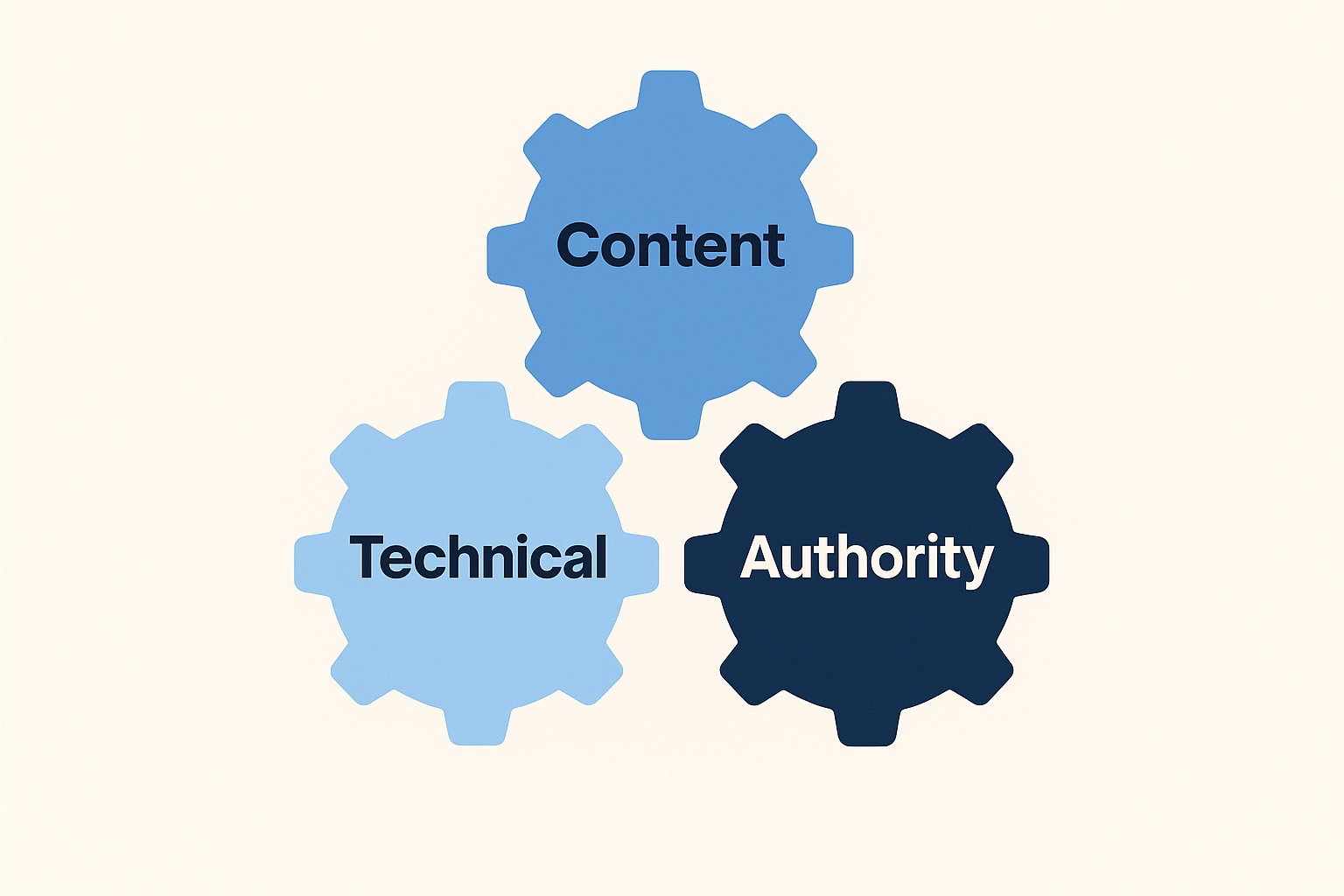
The three core pillars of SEO quality — content, technical performance, and off-page authority — must work together for strong rankings.
Backlink Quality Management: The Complete Framework
Because off-page authority is so often reduced to vague advice like “get more backlinks,” this section goes much further. Below is a full, practical framework for managing backlink quality — the metrics that matter, how to audit your profile, how to disavow safely, and how to earn links that actually move rankings.
Metrics That Define Backlink Quality
Evaluating a backlink requires looking at several metrics together, since no single number tells the full story.
- Topical relevance — a link from a site covering a related subject passes more trust than one from an unrelated niche.
- Domain authority metrics — third-party scores, such as those described in Moz’s explanation of Domain Authority, offer a useful (if imperfect) proxy for a linking domain’s overall strength.
- Placement context — editorial links embedded naturally within body content outrank links buried in footers or sidebars.
- Follow status — dofollow links pass ranking signal directly, while nofollow and sponsored links still contribute traffic and brand visibility.
- Referring domain diversity — ten links from ten unique, authoritative domains typically outweigh fifty links from a single site.
- Outbound link quality on the linking page — a page riddled with spammy outbound links tends to pass less trust, which is why outbound link quality deserves scrutiny on both sides of every link you evaluate.
How to Audit Your Backlink Profile in Five Steps
A disciplined audit process keeps your authority signals clean. Follow these steps in order:
- Export your full backlink profile using a link analysis tool such as Ahrefs, Semrush, or Google Search Console’s links report.
- Segment links by referring domain, then flag domains with suspiciously low relevance or obviously manipulative anchor text.
- Cross-check flagged domains against spam indicators, including thin content, excessive outbound links, and unnatural link velocity.
- Attempt manual outreach to request removal of clearly toxic links before resorting to disavow.
- Document your findings monthly so you can track whether your link profile is trending cleaner or riskier over time.
Building a Safe Disavow Strategy
Disavowing links should be a last resort, not a first instinct. Specifically, only disavow domains you genuinely suspect are harming your rankings — typically those involved in link schemes, private blog networks, or obvious comment spam. Because the disavow tool tells Google to ignore specific links entirely, over-disavowing can strip away authority you didn’t need to lose.
Instead, treat disavow as a targeted scalpel. First, attempt removal requests. Then, disavow only what remains unresolved after a reasonable follow-up period. Finally, re-audit quarterly, since toxic link profiles tend to accumulate gradually rather than all at once.
Earning High-Quality Backlinks Through Outreach and Digital PR
Rather than chasing volume, focus outreach efforts on a short list of highly relevant, authoritative targets. Original research, proprietary data, and expert commentary tend to earn links naturally, because journalists and bloggers need citable sources. Similarly, digital PR campaigns built around a genuinely newsworthy angle consistently outperform generic guest-post pitches.
In addition, broken-link building — finding dead links on relevant sites and suggesting your own resource as a replacement — remains an effective, white-hat tactic that most teams underuse. Above all, remember that one link from a genuinely trusted, relevant publisher is worth more than an entire month of low-effort directory submissions.
Anchor Text Diversity and Risk Management
Natural link profiles show a healthy mix of anchor text — branded terms, naked URLs, generic phrases like “click here,” and only occasionally exact-match keywords. In contrast, a profile dominated by exact-match commercial anchors is one of the clearest signals of manipulation that Google’s algorithms look for. Consequently, when building or earning links, favor natural, varied phrasing over keyword-heavy anchors every time.

Regular audits and monitoring are essential to maintaining and improving SEO quality over time. For a deeper walkthrough, see our SEO Services for Small Businesses: 2026 Buyer’s Guide to Sustainable Growth.
How to Improve SEO Quality Step by Step
Improving overall SEO quality requires a structured, repeatable process rather than one-off fixes. The following steps address each pillar systematically, in the order most teams should tackle them.
1Audit Your Content for Depth and Relevance.
Review your top landing pages and ask whether each one fully answers the target query. Additionally, check for outdated statistics, broken examples, or missing subtopics that competing pages already cover. Updating thin content is often the fastest way to see ranking improvements.
2Fix Technical Performance Issues.
Run a Core Web Vitals report inside Google Search Console, then use PageSpeed Insights to pinpoint specific failures. Common fixes include compressing images, enabling browser caching, and eliminating render-blocking scripts.
3Strengthen On-Page Signals.
Ensure every important page has a unique, descriptive title tag and meta description. Furthermore, use a logical heading hierarchy and add internal links that connect related content across your site.
4Audit and Rebuild Your Backlink Profile.
Identify your strongest competitors’ backlinks using a link analysis tool, then pursue similar, relevant placements through outreach. Meanwhile, audit your existing link profile and disavow only domains that appear genuinely spammy or manipulative.
5Add Structured Data Where It Applies.
Mark up FAQs, how-to steps, and reviews with schema so search engines can generate rich results. This often improves click-through rates even without a ranking position change.
6Monitor and Iterate Continuously.
Track rankings, click-through rates, and on-page engagement monthly. Because search algorithms evolve constantly, ongoing monitoring lets you catch quality regressions early and respond before they become ranking drops. For a deeper look at how these metrics roll up into a single picture, see how SEO scores are measured and improved.
Common Mistakes That Hurt Your Website Quality Score
Many sites unknowingly undermine their own rankings by repeating avoidable errors. Understanding these mistakes helps you prioritize improvement efforts where they’ll matter most.
Thin or duplicate content is one of the most common problems. For instance, publishing multiple pages targeting the same keyword with nearly identical content confuses search engines and splits your authority across pages instead of concentrating it on one strong result.
Ignoring structured data is another missed opportunity. Schema markup helps search engines understand your content’s context and can unlock rich results — such as FAQ dropdowns or review stars — that significantly improve click-through rates.
Neglecting internal linking leaves authority stranded on isolated pages. In contrast, a well-planned internal link structure distributes page authority across your site and helps search engines discover new content faster.
Over-disavowing links rounds out the list. Because disavow tells Google to ignore a link entirely, disavowing borderline or genuinely harmless links can quietly strip away authority you never needed to lose in the first place.
Tools and Resources for Measuring SEO Quality
Several tools make it easier to identify and fix quality issues at scale. Google Search Console provides crawl error reports, Core Web Vitals data, and manual action notifications — all for free. PageSpeed Insights, meanwhile, gives field data and lab diagnostics for any URL you test.
For backlink-specific analysis, tools like Ahrefs, Semrush, and Moz offer referring domain reports, toxic link flagging, and competitor link gap analysis. Each tool scores authority slightly differently, so cross-referencing two sources tends to produce a more reliable picture than relying on one alone.
For a broader strategic perspective, RankAuthority offers practical guidance on building and maintaining high-quality SEO strategies across competitive niches. Their resources are particularly useful for understanding how authority-building connects to content quality improvements.
Additionally, the Wikipedia overview of search engine optimization provides helpful historical context for understanding how quality signals have evolved since the early days of Google.

Using the right tools makes it far easier to identify which SEO quality signals need the most attention.
SEO Quality vs. SEO Quantity: What Actually Moves Rankings
It’s tempting to believe that publishing more pages or acquiring more links will automatically produce more rankings. However, the evidence consistently points the other way. A smaller site with focused, high-quality pages and a clean backlink profile regularly outranks a much larger site padded with thin content and low-value links.
This is because quality signals compound, while quantity without quality tends to dilute authority across too many weak assets. Specifically, ten genuinely excellent pages targeting real search intent will typically outperform one hundred mediocre pages competing against each other for the same traffic. The same logic applies to links: ten relevant, editorial backlinks beat one hundred directory submissions every time.
Conclusion: Building Lasting SEO Quality
Achieving strong, lasting SEO quality is not a one-time project — it is an ongoing commitment to serving your audience better than any competing page. By consistently improving content depth, maintaining technical performance, and earning authoritative backlinks, you build a compounding advantage that becomes harder for competitors to overcome over time.
Start with a thorough audit, fix the most critical issues first, and then establish a regular review cycle. As a result, your site will not only rank higher today but will also be better positioned to adapt whenever Google’s algorithms inevitably evolve. In the end, the investment in genuine SEO quality always pays off — and it compounds in a way that shortcuts simply cannot match.
Frequently Asked Questions About SEO Quality
What is SEO quality?
SEO quality refers to how well a webpage satisfies search engine ranking criteria across content, technical performance, and authority signals. Search engines evaluate these factors to decide whether a page deserves to rank prominently for a given query.
Why does SEO quality matter for rankings?
Search engines use quality signals to determine which pages best serve user intent. Higher quality generally leads to better visibility, more organic traffic, and stronger long-term rankings that are resistant to algorithm updates.
What is E-E-A-T and how does it relate to SEO quality?
E-E-A-T stands for Experience, Expertise, Authoritativeness, and Trustworthiness. It is the framework Google’s quality raters use to evaluate content, and improving your E-E-A-T signals directly boosts your overall SEO quality score.
How do Core Web Vitals affect SEO quality?
Core Web Vitals measure loading speed, interactivity, and visual stability. Poor scores signal a bad page experience to Google, which can lower your quality assessment and suppress rankings even when your content is strong.
What is the difference between on-page and technical SEO quality?
On-page SEO quality covers content relevance, keyword usage, headings, and internal linking. Technical SEO quality covers crawlability, site speed, mobile-friendliness, and structured data. Both dimensions are required for strong overall rankings.
How many words should a high-quality SEO article be?
There is no universal word count rule. The right length is whatever fully satisfies user intent for the target query. Comprehensive guides often exceed 1,500 words, but a well-focused 400-word answer can outrank a padded 3,000-word article if it better serves the reader.
Does link quality matter more than link quantity?
Yes, link quality consistently outweighs link quantity. A single backlink from a highly authoritative, relevant domain can be worth more than dozens of low-quality or unrelated links, and toxic links can actively harm your rankings.
How can I check my website’s SEO quality?
You can audit quality using Google Search Console, PageSpeed Insights, and third-party SEO platforms like Ahrefs, Semrush, or Moz. Resources like RankAuthority also provide practical guidance on evaluating and improving your key quality signals.
What are the most common SEO quality mistakes?
Common mistakes include thin or duplicate content, slow page load times, missing meta tags, broken internal links, ignoring mobile usability, and over-disavowing harmless backlinks. Each of these reduces your overall quality in Google’s assessment and can suppress rankings noticeably.
How long does it take to see results after improving SEO quality?
Results typically appear within four to twelve weeks after meaningful improvements. Technical fixes like speed improvements can show impact faster than content-based changes, and highly competitive niches may require six months or more to reflect gains.
Does mobile optimization affect SEO quality?
Absolutely. Google uses mobile-first indexing, meaning it primarily evaluates the mobile version of your site. A poor mobile experience directly lowers your quality assessment and can hurt rankings even on desktop searches.
What role does structured data play in SEO quality?
Structured data (schema markup) helps search engines understand your content’s context and purpose. It can unlock rich results in SERPs, improve click-through rates, and signal a higher level of content quality and organization to Google’s crawlers.
How do I know if a backlink is toxic?
A backlink is likely toxic if it comes from an irrelevant or spammy domain, sits alongside excessive outbound links, uses unnatural exact-match anchor text, or originates from a private blog network. When in doubt, attempt manual removal before adding it to a disavow file.
Should I disavow every low-quality backlink I find?
No. Most low-quality links are simply ignored by Google’s algorithms and cause no harm. Reserve disavow requests for links you have strong evidence are manipulative or part of a coordinated spam campaign, since over-disavowing can strip away authority unnecessarily.

