

SEO tools for agencies are purpose-built software platforms that help marketing teams manage search optimization across dozens of client accounts simultaneously — combining rank tracking, site auditing, backlink analysis, content optimization, and automated white-label reporting inside one unified workspace. In 2025, choosing the right agency SEO platform is no longer a nice-to-have; it is the difference between scaling profitably and drowning in manual work.
According to Statista, Google processes more than 8.5 billion searches every day. For agencies managing dozens of client websites, manually keeping pace with that volume is simply not viable. Furthermore, the explosive rise of AI answer engines — including Google’s AI Overviews, ChatGPT Search, and Bing Copilot — means agencies must now optimize for both traditional search results and generative AI surfaces at the same time.
This guide covers everything you need to evaluate, select, and get maximum value from the best SEO tools for agencies — including what features actually matter, how AI automation is reshaping agency workflows, a side-by-side platform comparison, and answers to the most common questions agencies ask before committing to a tool.
What Makes an SEO Tool Actually Built for Agencies?
Not every SEO platform is designed with agencies in mind. Individual freelancers and in-house teams have simpler, single-project needs. Agencies, however, face a fundamentally different challenge: delivering consistent, scalable, and measurable results across many clients at once — each with different industries, goals, and reporting expectations.
Therefore, the best agency-grade SEO tools share a specific set of architectural requirements. First and foremost, multi-client project isolation is essential. Your team needs to switch between client accounts instantly, with no data bleeding between projects and no risk of sharing the wrong report with the wrong stakeholder.
In addition, role-based access controls allow you to grant clients or junior staff limited visibility — so clients can log in to see their own dashboards without ever viewing another client’s data. Similarly, white-label reporting lets you present fully branded PDFs and live dashboards under your agency’s identity rather than the tool vendor’s, reinforcing your professionalism on every deliverable.
Beyond those structural requirements, the most competitive agency platforms in 2025 incorporate AI-driven automation. Specifically, automation reduces the manual effort required for tasks like crawl scheduling, keyword clustering, content gap analysis, and technical issue detection — freeing your strategists to focus on higher-value client work.
According to Wikipedia’s overview of search engine optimization, the discipline has evolved from keyword stuffing to a multi-signal, technically complex practice. As a result, tools that automate the most time-intensive parts of this process deliver a genuine operational advantage at agency scale.
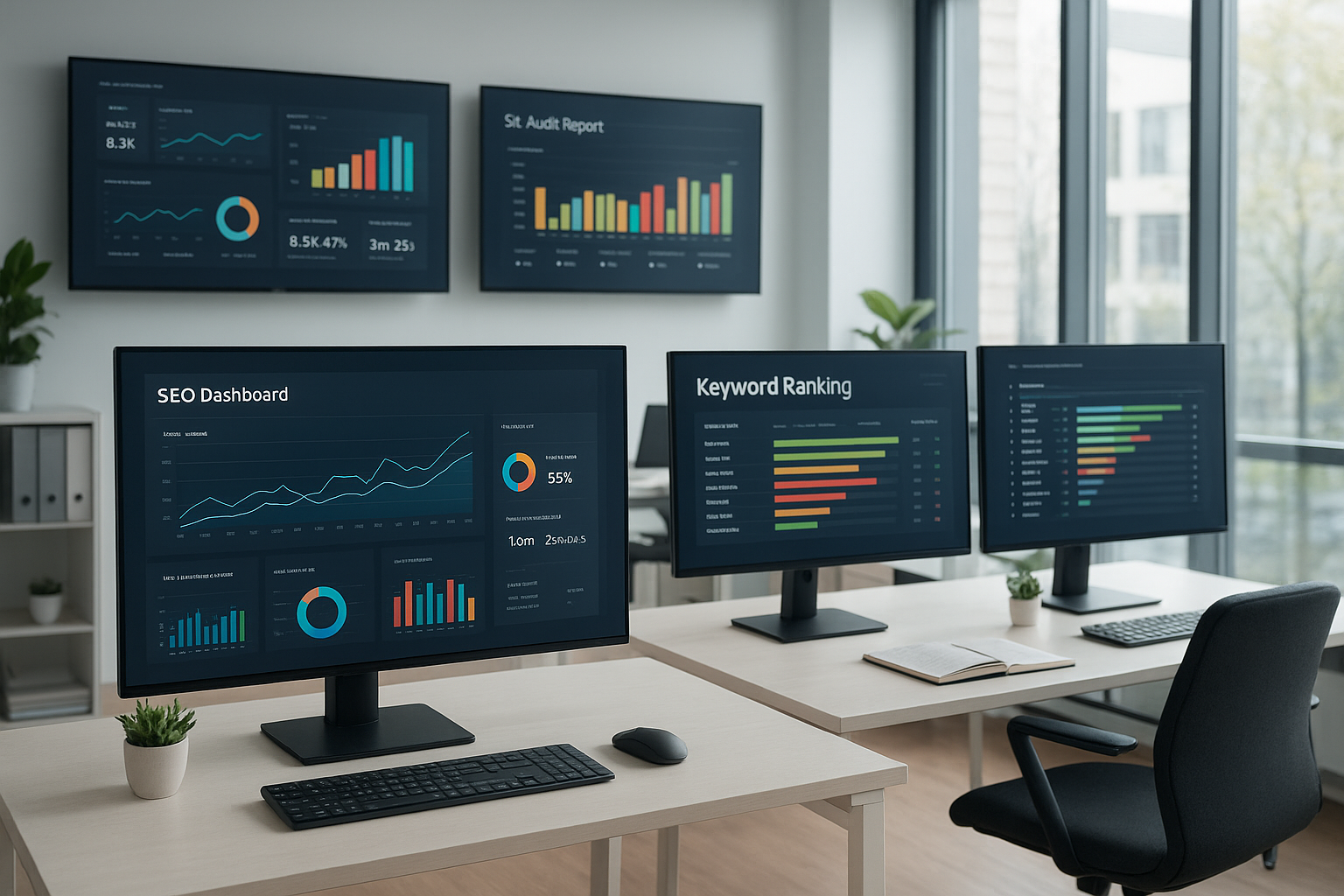
Modern SEO tools for agencies centralize multi-client data into clear, actionable dashboards.
Core Features to Prioritize When Comparing Agency SEO Platforms
When evaluating SEO tools for agencies, it is tempting to chase the platform with the longest feature list. However, the more strategic approach is to identify the capabilities that directly address your agency’s biggest bottlenecks. Here are the core features every agency evaluation should include.
Automated Site Auditing
Continuous crawling is the foundation of proactive agency SEO. Specifically, automated crawlers flag technical errors — broken links, duplicate meta tags, missing canonical tags, Core Web Vitals failures, and schema markup issues — before they compound into ranking drops. The best tools let you set crawl frequency per client and route critical alerts directly to your team via email or Slack.
Keyword Rank Tracking Across All Search Surfaces
Daily or near-real-time position monitoring across Google, Bing, and AI answer surfaces is now a standard requirement. Furthermore, tracking should include SERP feature visibility — featured snippets, People Also Ask boxes, local packs, and AI Overview inclusions — so you can show clients a complete picture of their search presence beyond just a blue-link ranking number.
Backlink Analysis and Link Opportunity Discovery
Backlink analysis tools let you monitor each client’s link profile, identify toxic or spammy links before they trigger manual actions, and benchmark link equity against top-ranking competitors. Equally important, the best platforms surface new link-building opportunities by identifying referring domains that link to competitors but not yet to your client.
AI-Powered Content Optimization Guidance
Content optimization features analyze top-ranking pages for any given keyword and generate detailed briefs covering required entities, semantic coverage, optimal word counts, heading structure, and internal linking recommendations. Consequently, writers produce on-brief content the first time — reducing revision cycles and accelerating the time from draft to published page.
White-Label Reporting and Scheduled Delivery
White-label reporting transforms raw platform data into branded, professional deliverables under your agency’s name. The best tools offer custom logo upload, brand color theming, modular report sections, and automated scheduled delivery — so clients receive polished monthly reports without any manual effort from your team.
Multi-Client Workspace With Role-Based Access
Separate project environments prevent data mixing and make client handoffs far cleaner. Role-based access specifically means you can give a client view-only access to their own dashboard while restricting them from seeing pricing, internal notes, or other client accounts. This level of control is non-negotiable as your agency scales beyond five active clients.
GEO and AEO Support for AI Search Visibility
Generative Engine Optimization (GEO) is the practice of structuring content so it appears within AI-generated search summaries produced by tools like Google AI Overviews and ChatGPT Search. Answer Engine Optimization (AEO) targets voice assistants and AI chatbots that pull direct answers from indexed content. Both are now table-stakes capabilities for agencies serving clients who want visibility across every search surface — not just traditional ranked results.
If you are unsure how to evaluate these features in practice, this guide on which SEO platform is best for agencies walks through a detailed comparison framework built specifically for agency use cases.
How to Choose and Set Up SEO Tools for Your Agency: A Step-by-Step Process
Selecting the right platform is only half the battle. Setting it up correctly determines whether it genuinely saves time or simply adds a new layer of complexity to your existing workflow. Therefore, follow these six steps to get your agency SEO tool working effectively from day one.
-
1
Audit your current agency workflows in detail.
List every SEO task your team performs weekly — rank tracking, site audits, content briefs, reporting, link prospecting — and calculate how many hours each task consumes. Specifically, note which tasks produce the most errors or cause the most client friction. This audit becomes your feature requirements document. -
2
Define your non-negotiable feature requirements.
Based on your workflow audit, build a prioritized list of must-have capabilities. For most agencies, multi-client dashboards, white-label reporting, and AI-driven content recommendations sit at the top. Furthermore, if you serve clients who rely on local search or e-commerce, add local SEO tracking and schema support to your list. -
3
Trial two or three shortlisted platforms against a real client project.
Sign up for free trials and run each tool through an actual client account — not a demo project. Evaluate crawl speed, keyword tracking accuracy, report quality, and UI clarity side by side. Consequently, you will identify friction points that only surface during real-world use, not during a vendor demo. -
4
Onboard your team and integrate your data sources.
Connect the chosen platform to Google Search Console and Google Analytics for every active client. Then run a structured onboarding session so every team member understands the core workflows, naming conventions, and reporting cadences before client accounts go live. -
5
Configure automated reporting for every active client account.
Set up white-label, scheduled reports for each client — weekly performance summaries and monthly in-depth reports are a common cadence. Specifically, automate delivery directly to client stakeholders so your team is never manually compiling or emailing data at the end of each billing cycle. -
6
Establish a quarterly platform review process.
The SEO tooling landscape evolves rapidly. Therefore, schedule a quarterly review to assess whether your chosen platform still covers all active use cases, whether new features have been released that could replace separate tools in your stack, and whether pricing still aligns with your agency’s growth trajectory. This prevents tool sprawl and keeps your operational costs predictable.
Managing Multiple SEO Clients Without the Chaos
One of the most common pain points for growing agencies is keeping client data organized and entirely separate. Consequently, the best platforms offer workspace-level isolation — where each client’s keywords, audit results, reports, and notes live in their own environment. This prevents accidental data mixing and makes client handoffs far cleaner, especially when a client changes account managers.
For a deeper look at this challenge, explore how to manage SEO for multiple clients using one tool — including which platform architectures genuinely support true client isolation at scale versus those that merely simulate it.
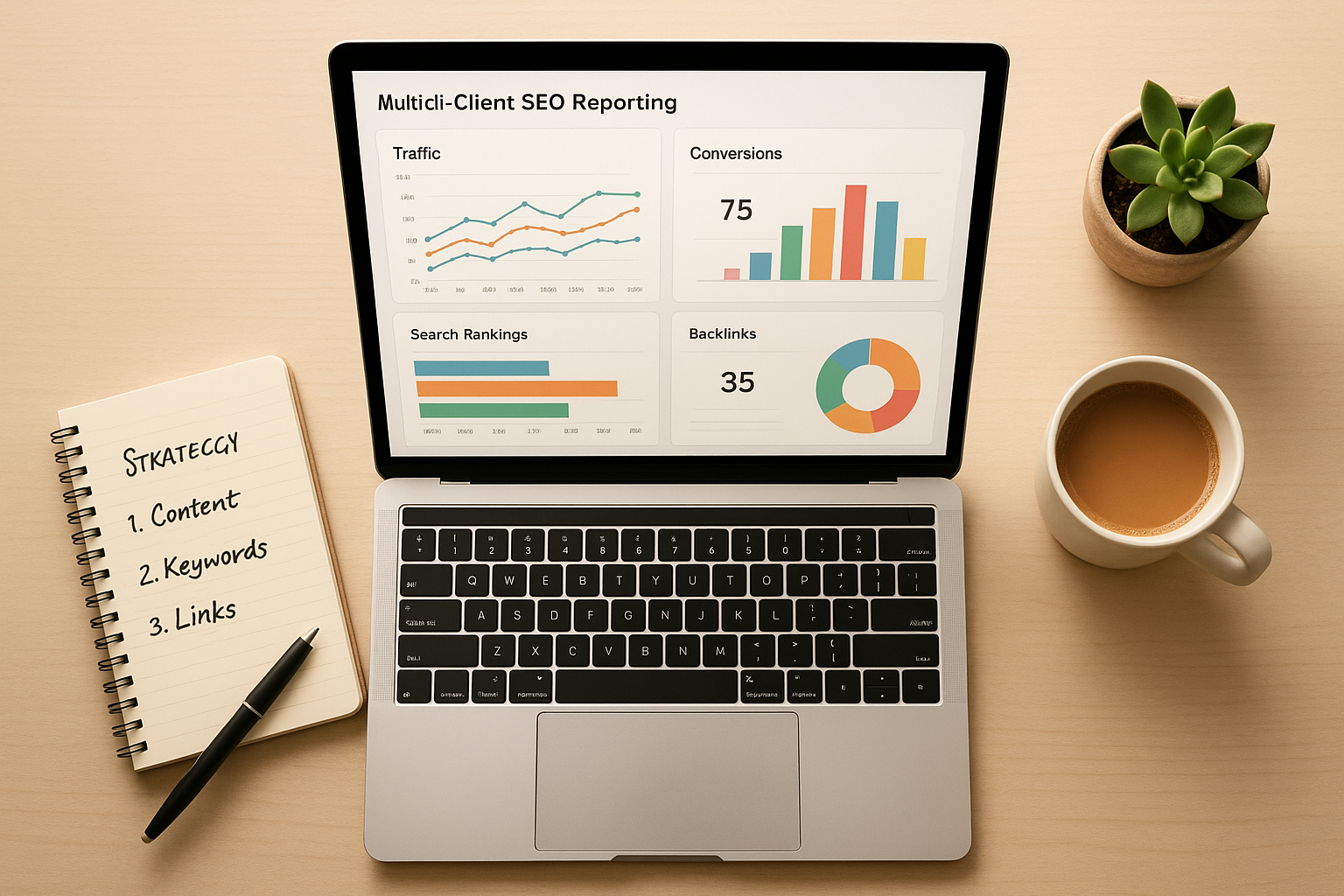
Organized, isolated multi-client reporting is a defining feature of the best SEO tools for agencies.
Why AI Automation Is Now Non-Negotiable in Agency SEO Software
The search landscape has fundamentally shifted. Generative AI — artificial intelligence that produces text, images, and answers rather than just retrieving links — is now embedded in every major search platform. For agencies, this creates two parallel optimization tracks: traditional ranked results and AI-generated answer surfaces.
Generative Engine Optimization (GEO) is the practice of structuring content so that AI systems select it as a source when generating search summaries. Similarly, Answer Engine Optimization (AEO) targets voice assistants, AI chatbots, and tools like Perplexity AI that pull direct answers from indexed web content. Both disciplines require a level of technical and structural precision that is simply not achievable manually across a large client portfolio.
This is precisely where platforms like rankauthority.com deliver a measurable operational advantage. The platform’s 1-Click AI AutoPilot technology automates the technical and strategic work of both GEO and AEO simultaneously — allowing agencies to deliver next-generation search visibility across AI and traditional surfaces without adding headcount or requiring in-house AI expertise.
How AI Automation Directly Reduces Agency Labor Costs
The operational math is straightforward. If your team spends four hours per client per month on manual rank checks, crawl reviews, and report assembly — and you manage twenty clients — that is eighty hours of labor that automation can eliminate. As a result, your team redirects those hours toward strategy, creative work, and client relationship building — activities that directly drive retention and upsells.
Specifically, AI-driven agency SEO tools automate the following high-labor workflows: scheduled site crawls with automatic issue triage, keyword clustering by search intent, competitor content gap identification, content brief generation, internal link recommendation, and monthly report compilation. Each of these would otherwise require a skilled SEO professional’s time every single month per client.
Technical SEO Monitoring at Agency Scale
Technical SEO monitoring is the backbone of any agency’s quality assurance process. Automated crawlers that run on a scheduled basis catch issues — broken internal links, duplicate meta tags, slow page load times, missing structured data, and crawl budget waste — before they escalate into ranking drops. Furthermore, real-time alerting means your team knows about a critical issue within hours, not weeks.
For agencies managing ten or more client websites, manual technical checks are simply not scalable. Therefore, investing in a platform with robust automated monitoring pays dividends in both client retention and team efficiency. You can find a comprehensive breakdown of this topic in this full guide to technical SEO monitoring for agencies.
Content Optimization: The Ongoing Advantage for Agency SEO
Beyond technical health, content remains the primary driver of organic growth. However, producing well-optimized content at scale — across multiple client industries simultaneously — requires structured, data-driven guidance. The best agency SEO platforms analyze top-ranking pages, identify content gaps against competitors, and generate detailed briefs that writers can execute quickly and accurately.
Furthermore, content optimization tools now evaluate semantic relevance, named entity coverage, structured data completeness, and internal linking density — all factors that influence both traditional rankings and AI answer inclusion. In particular, entities — named people, places, organizations, and concepts that search engines use to understand page context — are increasingly important signals for both Google’s Knowledge Graph and AI answer systems.
If you want to understand which services specifically help with this, this resource on content optimization services for your site covers the key options in detail.
Content Briefs vs. AI Content Generation: What Agencies Actually Need
There is an important distinction between content brief generation and AI content generation. A content brief gives a human writer a structured research document: target keywords, required headings, entities to include, competitor gaps to address, and word count targets. In contrast, AI content generation produces a draft automatically.
For most agencies, AI-assisted brief generation paired with skilled human writing produces the best results — combining data precision with editorial quality. Consequently, platforms that offer both capabilities give agencies the flexibility to choose the right approach for each client’s brand voice and content standards.
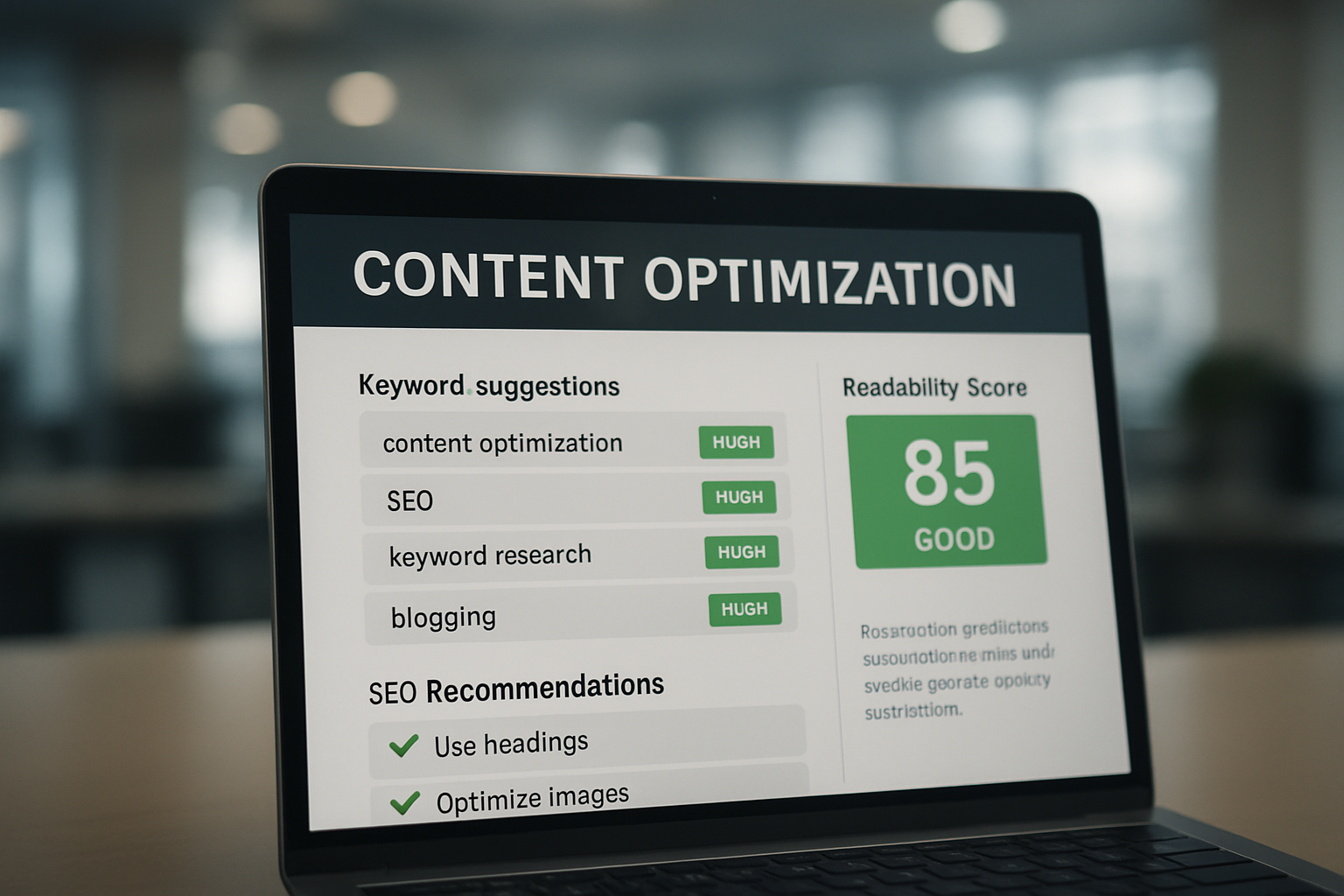
Content optimization features help agencies deliver consistent, high-quality search results for every client.
Comparing the Leading SEO Tools for Agencies in 2025
Several established and emerging platforms compete for agency business. Each has distinct strengths and meaningful limitations. Here is a direct side-by-side comparison of the most commonly evaluated agency SEO tools.
In particular, rankauthority.com stands out for agencies that need to serve clients across both traditional and AI-driven search environments. Its 1-Click AutoPilot feature removes the complexity of GEO and AEO strategy, making enterprise-level AI search optimization accessible even for smaller agencies without dedicated technical SEO specialists on staff.
Single Integrated Platform vs. Multi-Tool Agency Stack
Some agencies prefer one comprehensive platform. Others build a modular stack of specialized tools for different functions. Both approaches have merit. However, a single integrated platform reduces context-switching, simplifies billing, makes onboarding new staff faster, and provides a unified data view across all clients.
For most growing agencies, the most efficient path is starting with one strong platform and adding specialized tools only when a clear, persistent gap emerges. For more context on this decision, see this guide on managing SEO for different clients using one tool, which explores the practical trade-offs with real-world examples.
What to Look for in Agency SEO Tool Pricing
Agency SEO tool pricing typically scales along one of three models: per user seat, per number of projects or tracked domains, or per keyword volume. Understanding which model a platform uses is critical before comparing headline prices. Specifically, a platform priced at $100 per month that charges per keyword can become significantly more expensive than a $200-per-month platform with unlimited keywords once you account for a full client roster.
In general, expect to pay between $65 and $500 per month for agency-grade SEO tools depending on scale. Many platforms offer tiered plans based on number of tracked keywords and client projects, with white-label reporting sometimes available as a paid add-on rather than a standard inclusion. Therefore, always calculate total cost of ownership — not just the entry-level plan price.
Local SEO and Specialized Use Cases for Agency Tools
Many agencies serve clients who depend on local search visibility — restaurants, healthcare providers, law firms, and service businesses whose customers search within a specific geographic radius. Local SEO for agencies introduces a distinct set of tool requirements beyond standard rank tracking and site auditing.
Google Business Profile Management at Scale
For local clients, Google Business Profile (GBP) optimization directly influences visibility in the Local Pack — the map results that appear above organic listings for location-based queries. Consequently, agencies managing multiple local clients need tools that allow bulk GBP updates, review monitoring, citation consistency tracking, and local rank tracking by zip code or city.
Platforms like Moz Local and BrightLocal specialize in this use case. However, more comprehensive agency platforms like Semrush and rankauthority.com also incorporate local SEO capabilities within their broader feature sets, allowing agencies to manage local and national clients from a single tool rather than maintaining two separate subscriptions.
E-Commerce SEO: Handling Large Product Catalogs
Agencies serving e-commerce clients face a different scale challenge: clients with thousands of product pages, category pages, and filter combinations that can create massive amounts of duplicate or thin content. Therefore, agency SEO tools used for e-commerce work must handle large crawl volumes efficiently and offer specific auditing for issues like canonicalization, faceted navigation, and structured data for product schema.
In addition, shopping feed optimization and Google Merchant Center integration are increasingly relevant as e-commerce search results incorporate product listings directly into AI-generated responses. Agencies that invest in platforms with these capabilities can deliver more comprehensive value to retail clients than those relying solely on traditional SEO tools.
Measuring ROI From Your Agency SEO Tools
Justifying the cost of premium agency SEO tools requires a clear measurement framework. Specifically, the ROI of an agency SEO platform comes from two sources: increased revenue from better client results and reduced labor costs from automation.
Key Metrics to Track Platform Performance
-
▸
Hours saved per client per month — Track how many manual hours your team spent on reporting, rank checks, and audits before and after implementation. Even a two-hour reduction per client at ten clients equals twenty hours monthly — nearly a half-time employee at agency billing rates.
-
▸
Client retention rate — Agencies that deliver consistent, transparent reporting tend to retain clients longer. Furthermore, proactive technical monitoring prevents ranking drops that might otherwise prompt a client to terminate a contract.
-
▸
Average ranking improvement across client portfolio — Aggregate keyword position data across all clients gives you a portfolio-level performance view that helps identify which strategies work best across different industries.
-
▸
AI answer inclusion rate — If your platform tracks GEO and AEO performance, monitor how frequently your clients appear in AI-generated answers. This emerging metric is increasingly used by forward-thinking agencies to demonstrate differentiated value.
-
▸
Technical issue resolution time — Measure how quickly your team identifies and resolves critical technical SEO issues. Automated monitoring should reduce detection time from days to hours, significantly reducing the risk window for ranking damage.
Frequently Asked Questions About SEO Tools for Agencies
What are SEO tools for agencies?
SEO tools for agencies are software platforms built to help marketing teams manage, automate, and report on search optimization across multiple client accounts simultaneously. They typically combine rank tracking, site auditing, backlink analysis, content optimization guidance, and white-label reporting in a single workspace designed for multi-client workflows.
Which SEO tools are best for managing multiple clients?
Platforms like Semrush, Ahrefs, SE Ranking, and rankauthority.com offer multi-client dashboards that track rankings, run site audits, and generate reports for each client in separate project environments. The best choice depends on your team size, budget, number of clients, and whether you need AI-powered GEO and AEO automation built in.
Do agency SEO tools include white-label reporting?
Yes. Most leading agency SEO platforms include white-label reporting that lets you brand dashboards and PDF reports with your agency’s logo, colors, and contact details. However, some platforms include this as a paid add-on rather than a standard feature — so always confirm this before committing to a plan.
How much do SEO tools for agencies cost?
Agency SEO tool pricing typically ranges from around $65 per month for entry-level multi-client plans to over $500 per month for enterprise-grade platforms with unlimited seats and advanced AI features. Pricing models vary — some charge per keyword tracked, others per number of projects — so calculate total cost of ownership rather than comparing headline prices alone.
Can one SEO tool handle all of an agency’s needs?
A single comprehensive platform can cover the vast majority of agency needs — auditing, rank tracking, content optimization, backlink analysis, and reporting. However, some agencies supplement with one or two specialized tools for niche use cases such as dedicated local SEO citation management or enterprise link prospecting at very large scale.
What is GEO and why does it matter for agency SEO tools in 2025?
GEO stands for Generative Engine Optimization — the practice of structuring content to appear as a cited source within AI-generated search answers from tools like Google AI Overviews, ChatGPT Search, and Bing Copilot. Agencies that support GEO deliver visibility across the entire modern search landscape, not just traditional blue-link results. As a result, GEO support has become a key differentiator among leading agency SEO tools.
How do automated SEO tools reduce agency labor costs?
Automated SEO tools eliminate repetitive manual tasks like daily rank checks, scheduled site crawls, issue triage, content brief generation, and monthly report assembly. For an agency managing twenty clients, even a two-hour-per-client monthly saving equals forty hours recovered — nearly a full work week redirected toward strategic and creative work each month.
What features should I prioritize in an agency SEO platform?
Prioritize multi-client project isolation, automated site auditing with real-time alerts, keyword rank tracking across traditional and AI search surfaces, backlink analysis and disavow support, white-label reporting with scheduled delivery, and AI-driven content optimization recommendations. Support for GEO and AEO is increasingly critical as AI search continues to grow its share of total search volume.
Is technical SEO monitoring critical for agencies managing multiple clients?
Yes — technical SEO monitoring is one of the highest-leverage activities for agency quality assurance. Unresolved crawl errors, page speed issues, or broken internal links silently erode rankings over time. Automated monitoring with real-time alerting means your team catches and resolves these issues within hours rather than discovering them weeks later during a manual audit.
How do I choose between different SEO tools for my agency?
Start by auditing your current workflows and identifying your biggest time sinks and quality gaps. Then map those gaps to platform capabilities — not the other way around. Run real-client trials on two or three shortlisted tools before committing. Specifically, evaluate crawl speed, reporting flexibility, multi-client architecture, and AI capabilities side by side on identical projects.
What is the difference between AEO and traditional SEO for agencies?
Traditional SEO focuses on ranking in standard search engine result pages through keyword targeting, link building, and technical optimization. AEO — Answer Engine Optimization — targets AI-powered answer engines, voice assistants, and chatbots that pull direct responses from indexed content. Agencies that master both disciplines deliver broader, more future-proof visibility for clients across every search surface that exists today and will emerge tomorrow.
Can small agencies afford enterprise-level SEO tools?
Many enterprise platforms now offer scaled-down agency plans that are financially accessible for smaller teams. Furthermore, platforms like rankauthority.com provide risk-free trial periods, allowing small agencies to validate ROI before committing significant budget. In most cases, even a mid-tier platform pays for itself quickly if it eliminates even five hours of manual monthly labor per client.
Conclusion: Choosing the Right SEO Tools for Your Agency
In summary, the right SEO tools for agencies combine multi-client project isolation, automated technical monitoring, AI-powered content optimization, backlink analysis, and white-label reporting into a single, efficient workflow that scales with your client base. As AI search continues to capture a growing share of total search volume in 2025, platforms that support GEO and AEO give agencies a decisive, measurable edge in delivering visibility across every search surface — traditional and AI-generated alike.
Above all, the goal is to reduce manual overhead while increasing the quality, consistency, and depth of your agency’s deliverables. Whether you are evaluating Semrush, Ahrefs, or AI-first solutions like rankauthority.com, prioritize platforms that grow with your client base, adapt to the rapidly evolving search landscape, and give your team the leverage to deliver exceptional results without burning out. The agencies that invest in the right technology today are the ones that will dominate search — traditional and AI-powered — tomorrow.

