

Website performance tools AI are transforming how businesses earn and maintain top search rankings — combining real-time speed diagnostics, automated technical fixes, and AI-driven content intelligence into a single, continuous workflow. In 2025, site speed and AI search visibility are no longer separate disciplines. They are deeply intertwined ranking signals that demand a smarter, unified approach. According to Google’s Core Web Vitals documentation, performance metrics directly influence how pages rank in both traditional and AI-powered search environments.
Furthermore, research from Portent shows that a site loading in one second converts three times better than one loading in five seconds. That single data point explains why AI-powered performance tools have become a non-negotiable part of any serious digital strategy — and why businesses that ignore them are falling behind.
Quick Answer:
Website performance tools AI are platforms that apply artificial intelligence to automatically audit, diagnose, and improve a site’s speed, technical health, and search visibility — including optimization for AI-generated search results. They reduce manual effort and deliver faster, measurable ranking improvements than traditional audit tools.
What Are Website Performance Tools AI?
Website performance tools AI is a software category that applies machine learning and intelligent automation to the full spectrum of site optimization. Specifically, these tools analyze Core Web Vitals (Google’s speed and stability benchmarks), page load speed, content structure, and technical SEO signals — then generate prioritized, actionable recommendations or apply fixes automatically.
Unlike traditional audit tools that produce static one-time reports, AI-driven platforms learn continuously from your site’s real-world data. As a result, they adapt recommendations as search algorithms evolve — which is especially critical now that generative AI search engines like Google’s Search Generative Experience (SGE) and Perplexity AI are reshaping how users discover content.
In addition, modern platforms increasingly address Answer Engine Optimization (AEO) — structuring content so it appears as a cited source inside AI-generated answers, not just traditional blue-link results. This dual focus on speed and AI-answer visibility is what sets next-generation performance tools apart from legacy solutions.
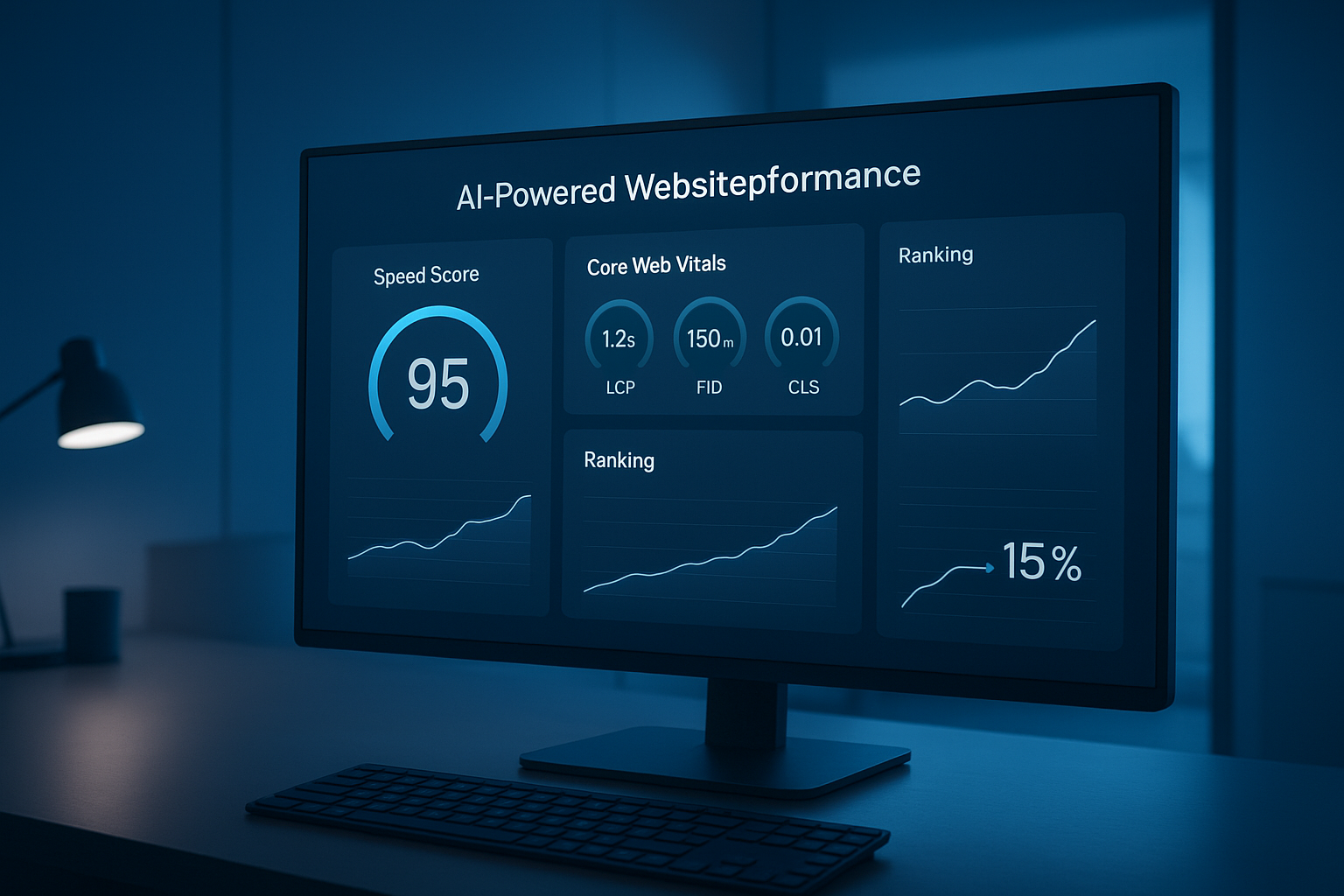
AI-powered website performance tools surface speed, ranking, and technical health data in a unified, real-time dashboard.
Why AI Search Visibility Depends on Site Performance
Search engines — both traditional and AI-powered — reward fast, stable, and well-structured websites. Google’s Core Web Vitals — Largest Contentful Paint (LCP), Interaction to Next Paint (INP), and Cumulative Layout Shift (CLS) — are confirmed ranking signals. However, AI search engines add an extra dimension: they favor content that is clearly structured, authoritative, and answers user queries directly.
Therefore, optimizing for AI search requires a dual focus. You need fast technical performance AND content that AI models can parse, cite, and surface in generated answers. Slow-loading pages are less likely to be crawled deeply, indexed thoroughly, or cited by AI engines — making performance a prerequisite, not an afterthought.
The Three Core Web Vitals Explained
- Largest Contentful Paint (LCP): Measures how quickly the main visible content of a page loads. Google’s target is under 2.5 seconds. A slow LCP tells users — and AI crawlers — that your page is sluggish.
- Interaction to Next Paint (INP): Tracks how fast the page responds to user interactions like clicks or taps. The target is under 200 milliseconds. Poor INP signals an unresponsive, frustrating experience.
- Cumulative Layout Shift (CLS): Scores visual stability — how much elements jump around as the page loads. A CLS score below 0.1 is ideal. High CLS erodes user trust and reduces dwell time.
For a deeper look at how AI is reshaping optimization, explore our guide to intelligent SEO tools that boost rankings with AI in 2025 — covering the latest platform capabilities and use cases in detail.
Top Categories of Website Performance Tools AI
The market for AI site optimization tools has expanded rapidly. Consequently, it helps to understand the distinct categories so you can build the right stack for your goals. Each category addresses a different layer of performance — and together they create a complete optimization engine.
1. Speed and Core Web Vitals Analyzers
Tools like Google PageSpeed Insights and GTmetrix deliver foundational performance scores. However, AI-enhanced analyzers go further — they predict the ranking impact of specific fixes and prioritize them by estimated ROI, so you work on what matters most first.
Specifically, these tools identify render-blocking scripts, oversized image assets, slow server response times, and inefficient caching configurations. They then translate raw diagnostic data into plain-language action items — no developer knowledge required to understand them.
2. Automated Technical SEO Platforms
These platforms crawl your site continuously, identifying broken links, duplicate content, missing schema markup, crawl inefficiencies, and redirect chains. Importantly, AI-powered versions auto-generate fix recommendations — or apply them directly — without requiring developer intervention.
Moreover, continuous crawling means issues are caught as soon as they appear — not weeks later during a quarterly manual audit. This real-time vigilance is one of the clearest advantages AI platforms hold over traditional crawl tools.
3. GEO and AEO Optimization Engines
Generative Engine Optimization (GEO) and Answer Engine Optimization (AEO) tools specifically target AI search visibility. They analyze how well your content answers user queries in a format that AI models like ChatGPT, Gemini, and Perplexity can parse and cite. Platforms like rankauthority.com combine GEO, AEO, and technical performance into a single automated workflow — removing the complexity that typically requires a team of specialists.
In contrast to traditional SEO tools, GEO engines score your content against the specific patterns AI search models use to select cited sources. This includes directness of answers, structured data implementation, topical authority signals, and entity clarity.
4. Content Intelligence and Readability Platforms
AI content tools evaluate keyword density, semantic relevance, heading structure, internal linking, and readability scores. They suggest improvements that align your content with both user intent and AI parsing requirements — a critical advantage as AI-generated search results become the primary interface for many users.
Additionally, these platforms often benchmark your content against top-ranking competitors, highlighting the specific topics and depth gaps that must be addressed to move up in results.
5. Real User Monitoring (RUM) and Synthetic Testing Tools
Real User Monitoring (RUM) captures performance data from actual visitors on real devices and network conditions. This differs from synthetic tests — which simulate ideal lab conditions — because RUM reveals what genuine users actually experience. AI platforms that incorporate RUM data deliver recommendations grounded in real-world performance, not laboratory benchmarks.
Similarly, synthetic testing lets you simulate performance on specific devices or connection speeds before deploying changes. Together, RUM and synthetic testing create a complete picture of how your site performs across every user segment.
6. CDN and Infrastructure Optimization Tools
A Content Delivery Network (CDN) distributes your site’s static assets — images, scripts, stylesheets — across servers worldwide so they load from the location closest to each visitor. AI-powered CDN tools go beyond simple asset distribution. They dynamically optimize delivery routes, compress assets in real time, and adapt caching rules based on observed traffic patterns — all without manual configuration.
How to Use Website Performance Tools AI: Step-by-Step
Implementing AI performance tools effectively requires a structured approach. Specifically, follow these six steps to move from initial audit to measurable, sustained ranking improvement:
- Run a Baseline Audit. Use Google PageSpeed Insights or GTmetrix to capture your current Core Web Vitals scores. Record your LCP, INP, and CLS values as your starting benchmark — you need a clear before-picture to measure progress against.
- Identify Critical Issues. Review the audit output and isolate your top three to five high-impact problems. These typically include slow server response times (Time to First Byte above 600ms), render-blocking JavaScript, unoptimized images, and missing schema markup.
- Connect an AI Optimization Platform. Sign up for a dedicated AI platform such as rankauthority.com and integrate it with your site. This enables automated GEO, AEO, and technical SEO recommendations tailored to your specific pages and competitive landscape.
- Apply AI Recommendations. Work through the prioritized fix list generated by the platform. Where available, use 1-Click AutoPilot features to automate repetitive technical tasks — compressing images, fixing meta tags, generating schema — and accelerate implementation without developer involvement.
- Optimize Content for AI Search. Use the platform’s GEO and AEO scoring to improve your content structure. Add direct answers to common questions, implement FAQ and HowTo schema, and strengthen topical authority signals so AI search engines select your pages as cited sources.
- Monitor, Measure, and Iterate. Set up weekly automated monitoring inside your AI platform. Track ranking shifts, organic traffic changes, and Core Web Vitals improvements over time. Use real data to refine your strategy — and repeat the cycle every 30 to 60 days.
For a detailed walkthrough of this process with platform-specific examples, see our guide on how to boost website rankings efficiently with AI.

A structured six-step workflow using AI performance tools moves businesses from baseline audit to measurable ranking gains faster than manual methods allow.
Key Features to Look for in AI Performance Platforms
Not all AI optimization tools are equal. Therefore, when evaluating platforms, prioritize these capabilities to ensure you get real, measurable results — not just flashy dashboards:
- Automated crawling and continuous issue detection — real-time monitoring rather than one-time snapshots so problems are caught and fixed immediately
- GEO and AEO readiness scoring — measures how well your content performs in AI search environments, including citation eligibility in SGE and Perplexity
- Core Web Vitals integration — direct alignment with Google’s confirmed ranking signals, with clear benchmarks and progress tracking
- Schema markup automation — generates and implements structured data (FAQ, HowTo, Article) to improve rich result eligibility without manual coding
- Real User Monitoring (RUM) data — performance insights drawn from actual visitor behavior, not just synthetic lab tests
- Multi-site management dashboard — essential for agencies and businesses managing multiple web properties from a single control panel
- Transparent, explainable recommendations — AI suggestions you can understand and verify, not black-box outputs
- Risk-free trial access — allows you to validate ROI before committing to a subscription
Similarly, consider whether the platform integrates with your existing CMS and analytics setup. Friction in the implementation process directly reduces how many recommendations you actually act on — and therefore how much value the tool delivers.
For a curated comparison of leading platforms, our review of the 5 best AI optimization tools for 2025 covers pricing, features, and use cases in detail.
How AI Performance Tools Improve Page Speed Technically
Understanding what AI tools actually change under the hood helps you evaluate their impact more accurately. In particular, here are the most common technical interventions that AI-powered website performance tools apply:
Image Compression and Next-Gen Format Conversion
Oversized images are one of the most common causes of poor LCP scores. AI platforms automatically compress images without visible quality loss and convert them to next-gen formats like WebP and AVIF — which are significantly smaller than JPEG or PNG at equivalent visual quality. Additionally, they implement lazy loading so below-the-fold images only download when the user scrolls toward them.
JavaScript and CSS Minification
Minification removes unnecessary characters — whitespace, comments, long variable names — from code files without changing their function. AI tools identify which scripts are render-blocking (meaning they prevent the page from displaying until they finish loading) and either defer them or eliminate them entirely. This directly reduces Time to First Byte (TTFB) and improves INP scores.
Caching and Preloading Strategies
Effective browser caching stores static assets locally in a visitor’s browser so repeat visits load instantly. AI platforms configure cache-control headers intelligently based on asset type and update frequency. Furthermore, they implement resource preloading — signaling to the browser which assets it will need next so they download in advance, reducing perceived load time.
Server Response Time Optimization
A slow server is often the root cause of poor Core Web Vitals scores across every metric. AI performance tools diagnose server-side bottlenecks — including slow database queries, unoptimized hosting configurations, and inefficient plugins — and recommend or automate specific fixes. According to Google’s web performance guidelines, a TTFB under 800ms is the recommended threshold for strong Core Web Vitals performance.
Common Mistakes When Using AI Site Tools
Even powerful tools produce poor results when used incorrectly. In particular, avoid these frequent errors that undermine AI performance tool effectiveness:
Relying on a single tool. No single platform covers every optimization dimension. Consequently, combine a speed analyzer with an AI content platform and a technical SEO crawler for complete coverage across all ranking signals.
Ignoring mobile performance. Google uses mobile-first indexing, meaning your mobile Core Web Vitals scores carry more ranking weight than desktop scores. Always audit both environments — scores often differ significantly between them.
Applying fixes without testing. AI recommendations are data-driven but not infallible. Therefore, always test significant changes in a staging environment before pushing to production, particularly for JavaScript changes that can break functionality.
Overlooking content structure for AI citations. Speed alone won’t win AI search citations. Your content must be clearly structured with direct answers, proper heading hierarchy, and schema markup to appear in generative search results from SGE, Gemini, and Perplexity.
Treating optimization as a one-time event. Search algorithms change. New content is published by competitors. Your site evolves. AI performance tools are most valuable when used as ongoing monitoring systems — not one-off audit solutions.
To learn more about improving your broader online presence using AI, explore how to improve your online presence with AI tools — a practical guide covering both technical and content strategies.
Which AI SEO Automation Tools Handle the Heavy Lifting?
For businesses that lack the time or technical depth to manage optimization manually, automated AI SEO platforms represent the most efficient path forward. These tools handle everything from schema generation to internal link optimization — all without requiring constant human input.
Specifically, platforms built around 1-Click AutoPilot technology — like the solution offered at rankauthority.com — streamline the entire optimization cycle. They combine GEO, AEO, and technical performance into a single automated engine that works continuously in the background, surfacing new opportunities and fixing emerging issues without manual intervention.
Furthermore, agencies managing multiple client sites benefit enormously from these platforms. Automation reduces per-site management time by an estimated 60 to 80 percent, while AI-generated insights ensure each property receives tailored, context-aware recommendations rather than generic advice.
What Automation Specifically Handles
- Automated schema markup generation and deployment for FAQ, HowTo, Article, and Product types
- Internal link opportunity detection and insertion across existing content
- Meta title and description optimization aligned with current ranking signals
- Image alt-text generation using AI content understanding — not just filename guessing
- Redirect chain identification and resolution with one-click fix deployment
- Duplicate content flagging with canonicalization recommendations
- AEO content scoring with specific suggestions for improving AI citation eligibility
For a detailed look at which platforms automate SEO tasks most effectively, see which AI software automates SEO tasks best.

Modern AI optimization platforms process hundreds of performance and content signals simultaneously — far beyond what any manual audit can achieve at scale.
Website Performance Tools AI vs. Traditional SEO Tools: A Direct Comparison
Understanding the concrete differences between AI-powered tools and traditional SEO tools helps you make a more informed investment decision. The table below summarizes the key distinctions:
| Feature | Traditional SEO Tools | AI Performance Tools |
|---|---|---|
| Analysis frequency | On-demand, manual | Continuous, automated |
| Fix implementation | Requires developer | Automated or 1-click |
| AI search readiness (GEO/AEO) | Not addressed | Core feature |
| Recommendation priority | Generic importance scoring | ROI-ranked, site-specific |
| Content intelligence | Basic keyword tools | Semantic analysis + AEO scoring |
| Learning capability | Static rule sets | Adapts to algorithm changes |
| Multi-site scalability | Manual per-site effort | Centralized dashboard management |
As a result, AI-powered tools don’t just speed up existing workflows — they fundamentally expand what’s possible for teams without large technical resources. The gap between the two categories will only widen as AI search becomes the dominant discovery interface.
Frequently Asked Questions About Website Performance Tools AI
What are website performance tools AI?
Website performance tools AI are software platforms that use artificial intelligence to analyze, monitor, and improve a site’s speed, usability, and search rankings. They automate Core Web Vitals audits, content optimization, and technical SEO fixes — significantly reducing the time and expertise required to maintain strong search visibility.
How do AI-powered performance tools differ from traditional SEO tools?
Traditional tools produce static reports that require manual action, while AI-powered tools continuously learn from your site’s data and automatically recommend or apply fixes. They also address AI search visibility through GEO and AEO scoring — a capability traditional tools entirely lack.
Which website performance tools AI are best for small businesses?
Platforms like rankauthority.com offer automated GEO and AEO optimization well-suited to small businesses that lack dedicated technical teams. Google PageSpeed Insights and GTmetrix are solid free starting points for basic performance auditing — but they don’t provide AI-driven ongoing optimization.
How quickly can AI tools improve website performance?
Many AI tools surface actionable recommendations within minutes of completing an audit. However, measurable ranking improvements typically appear within 4 to 12 weeks, depending on your site’s current authority level and the competitiveness of your target keywords.
What is Core Web Vitals and why does it matter for AI tools?
Core Web Vitals are three Google metrics — LCP, INP, and CLS — that measure loading speed, interactivity, and visual stability. AI tools prioritize these signals because Google uses them as direct ranking factors. Improving these scores influences your position in both traditional search results and AI-generated answer environments.
Can AI tools automate technical SEO fixes?
Yes. Advanced platforms automatically fix issues like broken links, missing meta tags, unoptimized images, and missing schema markup — all without developer involvement. This makes them especially valuable for non-technical site owners and small teams operating without dedicated engineering resources.
What is Generative Engine Optimization (GEO)?
Generative Engine Optimization (GEO) is the practice of structuring content so it appears as a cited source in AI-generated search results from tools like ChatGPT, Google SGE, and Perplexity. It extends traditional SEO into the AI-answer landscape and is increasingly essential for content discoverability as AI search becomes mainstream.
How much do AI website performance tools typically cost?
Pricing ranges from free (Google PageSpeed Insights) to several hundred dollars per month for enterprise platforms. Most mid-tier AI SEO tools charge between $50 and $200 per month. Platforms like rankauthority.com offer a risk-free seven-day trial so you can validate ROI before committing.
What is Real User Monitoring (RUM) and why does it matter?
Real User Monitoring (RUM) captures performance data from actual visitors on real devices and real network connections — as opposed to synthetic lab tests that simulate ideal conditions. RUM data reflects what genuine users experience, making it far more reliable for identifying performance issues that synthetic tests miss, such as slow load times on mobile networks.
What common mistakes should I avoid with AI performance tools?
Avoid relying on a single tool, ignoring mobile scores, treating optimization as a one-time project, and applying AI recommendations without staging-environment testing first. Also avoid neglecting content structure — AI search citation requires more than fast page speed.
Do AI tools help with both speed and content optimization?
Yes. Modern website performance tools AI address both technical speed factors and content quality signals simultaneously. They analyze keyword relevance, semantic depth, heading structure, and readability alongside page load metrics — delivering a comprehensive, unified optimization approach.
How do I get started with AI-powered site optimization?
Start by running a free audit using Google PageSpeed Insights or GTmetrix to capture your baseline Core Web Vitals scores. Then adopt a dedicated AI optimization platform like rankauthority.com to automate ongoing improvements, track ranking progress, and optimize your content for AI search citations over time.
Are AI performance tools suitable for agencies managing multiple sites?
Absolutely. Many AI platforms offer centralized multi-site dashboards and white-label reporting, making them ideal for agencies. Automation features reduce per-site management time by an estimated 60 to 80 percent, allowing agencies to scale optimization efficiently across large client portfolios without proportionally increasing headcount.
Conclusion: Embracing Website Performance Tools AI for Lasting Visibility
Website performance tools AI represent one of the most significant shifts in how businesses approach search optimization. By combining speed analysis, technical SEO automation, GEO, AEO, and content intelligence into unified platforms, these tools remove the barriers that once made high-level optimization the exclusive domain of large teams and big budgets.
In summary, the key takeaways are clear: audit your baseline Core Web Vitals, address technical performance issues using AI-driven prioritization, optimize your content for both traditional and AI-generated search, and deploy an automated platform to sustain those improvements continuously. Consequently, businesses that adopt this approach now will hold a meaningful competitive advantage as AI search reshapes how consumers discover information.
Whether you are a small business owner, a digital marketer, or an agency managing dozens of client sites, the right combination of website performance tools AI can transform your search presence — efficiently, measurably, and at scale. Start with a free audit today, and consider a platform like rankauthority.com to automate the journey from audit to ranking dominance. Author: RankAuthority editorial team. Last updated: 2026-07-02.

