

A search optimization platform is the single most important software investment a business can make for long-term online growth. In 2025, the right platform does not just track keywords — it automates technical SEO, builds content strategy, manages AI search visibility, and scales with your business from a single unified dashboard.
According to Statista, more than 68% of all online experiences begin with a search engine query. Furthermore, AI-powered search tools now influence billions of queries every month. As a result, businesses that fail to optimize for both traditional and AI-driven search risk losing significant organic traffic to better-equipped competitors.
In this guide, you will learn exactly what a search optimization platform does, which features matter most in 2025, how to choose between leading tools, and how platforms like rankauthority.com are redefining automated SEO for the AI era — covering everything from traditional ranking signals to Generative Engine Optimization and Answer Engine Optimization. By Rank Authority Team. Last updated: 2026-08-14.
What Is a Search Optimization Platform?
A search optimization platform is a unified software environment that brings together keyword research, technical site auditing, rank tracking, content analysis, backlink intelligence, and AI search readiness into one central dashboard. Rather than managing five or six disconnected tools, marketers and business owners can control their entire search strategy from a single interface. Learn how to prioritize SEO features.
Traditionally, these platforms focused exclusively on Google and Bing rankings. However, the rise of AI-generated search results — through Google’s Search Generative Experience (SGE), Perplexity AI, ChatGPT, and Bing Copilot — has dramatically expanded what “optimization” now means. Therefore, modern platforms must also address Generative Engine Optimization (GEO) and Answer Engine Optimization (AEO), two rapidly growing disciplines focused on earning visibility inside AI-generated responses.
In short, a search optimization platform today is the operational command center for your entire search presence — across every engine, format, and AI interface your audience uses.
How Search Optimization Platforms Have Evolved
Early SEO tools focused narrowly on keyword ranking reports and basic on-page checklists. Specifically, they were built for a world where Google’s ten blue links dominated every search. That world no longer exists exclusively.
Today’s platforms must handle a far broader mandate. In addition to traditional ranking factors, they must account for structured data compliance, entity recognition, topical authority scoring, AI citation readiness, and multi-location search signals. Consequently, the gap between a capable modern platform and an outdated tool is enormous — and growing wider every quarter.
According to Search Engine Journal, AI-generated answers now appear in over 40% of Google searches across specific categories. Therefore, any platform that does not actively prepare your content for these environments is leaving a massive share of potential visibility on the table.
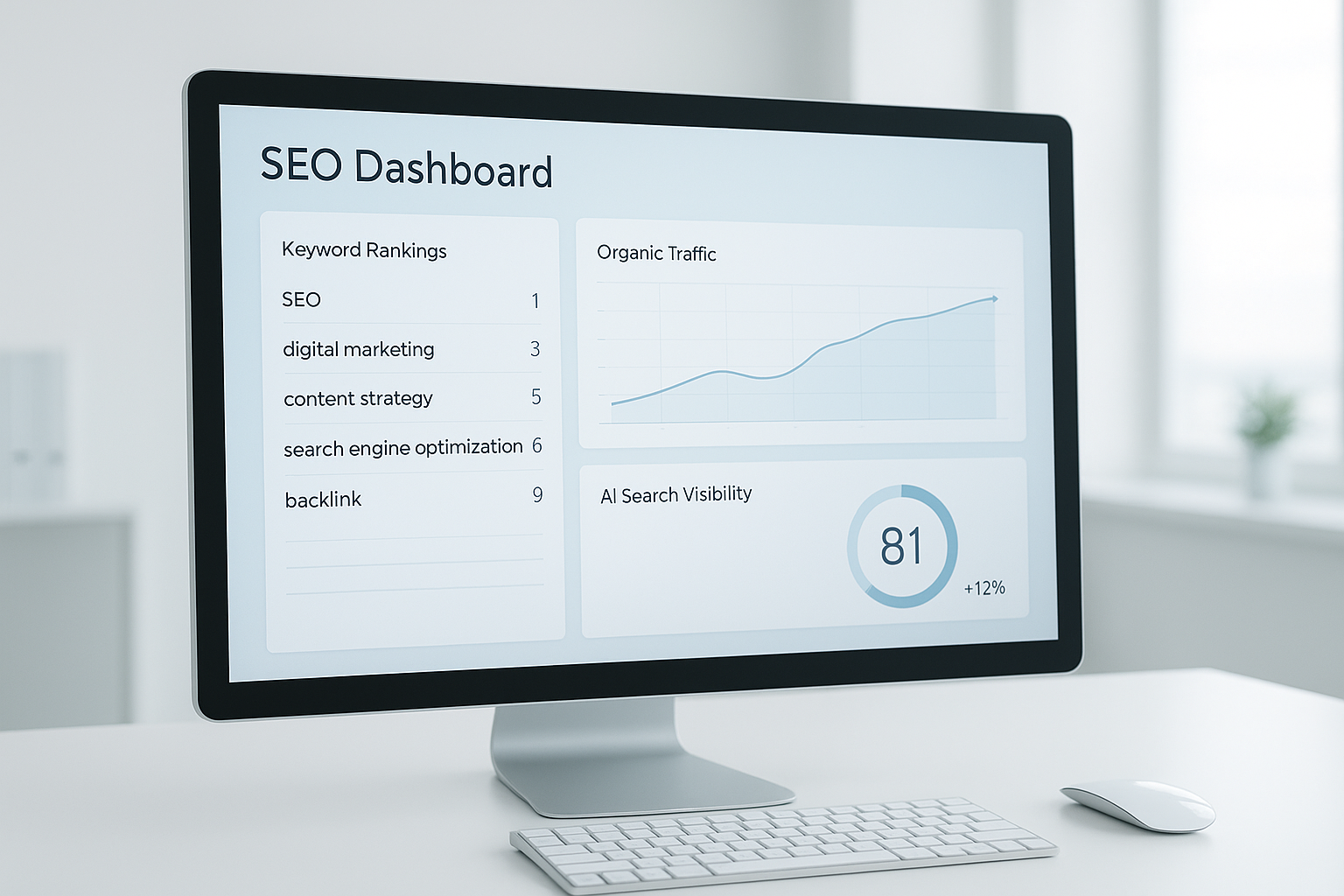
A modern search optimization platform consolidates keyword data, ranking signals, and AI search readiness into a single actionable dashboard.
Key Features to Look for in a Search Optimization Platform
Not all platforms are created equal. Specifically, the best tools share a core set of capabilities that separate them from lightweight or outdated alternatives. When evaluating your options, prioritize the features below — and pay close attention to which ones your current tool may be missing.
Core SEO Capabilities
- Automated Site Auditing: Continuously scans your website for technical issues — broken links, slow page speed, missing structured data, duplicate content, and crawl errors — and prioritizes fixes by impact.
- Keyword Research and Intent Clustering: Identifies high-value search terms and groups them by user intent, making content planning far more strategic and efficient.
- Rank Tracking Across Engines and Locations: Monitors your positions for target keywords across multiple search engines, devices, and geographic locations over time — with historical trend data.
- Backlink Analysis and Link Building: Evaluates your link profile, identifies toxic links, and surfaces actionable opportunities to build domain authority through quality inbound links.
- On-Page Content Optimization: Provides data-driven recommendations for improving page relevance, semantic keyword coverage, heading structure, readability, and internal linking.
- Competitor Analysis: Benchmarks your performance against competing domains, revealing keyword gaps, content opportunities, and backlink strategies your rivals are using successfully.
Advanced AI Search and Automation Features
- GEO and AEO Optimization: Structures and formats content so AI engines can extract, understand, and cite it within generated responses — critical for visibility in Google SGE, Perplexity, and ChatGPT.
- Automated Schema Markup Generation: Automatically generates and validates structured data (FAQ, HowTo, Article, Organization) across your site without manual coding.
- AI Content Scoring and Topical Authority: Evaluates how comprehensively your content covers a topic and identifies gaps that prevent you from earning topical authority in your niche.
- 1-Click Automation (AutoPilot): Handles repetitive, time-consuming technical tasks — meta tag fixes, schema updates, crawl error resolution — automatically and continuously.
- Multi-Site and Agency Management: Manages SEO across dozens of client websites from a single dashboard, with white-label reporting and bulk optimization capabilities.
- Local SEO Tools: Optimizes for local search queries with Google Business Profile integration, local citation tracking, and geo-targeted rank monitoring.
For a deeper breakdown of which capabilities matter most for your specific situation, explore this detailed resource on what features to look for in an SEO platform.
Why Automation Is Now Non-Negotiable
Manual SEO is increasingly impractical. Consequently, platforms that automate repetitive but critical tasks — fixing meta tags, generating schema markup, monitoring ranking fluctuations — give users a significant time and competitive advantage over those doing the same work by hand.
For example, rankauthority.com’s flagship 1-Click AI AutoPilot technology handles the complex, technical work of search optimization automatically. This means small business owners and marketers can achieve results that previously required a dedicated SEO team of three or four specialists. Moreover, the platform continuously adapts its recommendations as search algorithms evolve — so your strategy never becomes outdated. Read more about the Search Authority Platform approach.
If you are managing content across multiple pages or client sites, automation is not just convenient — it is essential. Learn more about services that help with content optimization to understand how automation fits into a broader, scalable content strategy.
GEO and AEO: The New Frontier of Search Optimization
Traditional SEO focuses on ranking within standard search engine results pages (SERPs). However, the search landscape has shifted dramatically in the past two years. AI tools like Google SGE, Perplexity, and ChatGPT now answer millions of queries directly — without users ever clicking through to a website.
What Is Generative Engine Optimization (GEO)?
Generative Engine Optimization (GEO) is the practice of structuring your content so AI systems can accurately extract, understand, and cite it within generated responses. GEO differs meaningfully from traditional SEO. Specifically, it requires a focus on entity clarity, factual density, structured formatting, and authoritative sourcing — elements that make your content machine-readable at a semantic level.
In practice, GEO means writing content that directly and clearly answers the specific questions AI models are trained to surface. Furthermore, it means ensuring your brand and domain are consistently recognized as trustworthy entities across the web — so AI systems are confident citing you over competitors.
What Is Answer Engine Optimization (AEO)?
Answer Engine Optimization (AEO) focuses on formatting content as clear, direct answers to specific questions — making it easier for voice assistants, featured snippets, and AI engines to surface your content as the authoritative response to a query.
AEO involves using structured question-and-answer content formats, deploying FAQ and HowTo schema markup, and writing in concise, factually dense language that AI systems can confidently extract. Similarly, it requires building enough topical depth across your site that AI models recognize you as an authoritative source — not just a single relevant page.
Why GEO and AEO Matter Right Now
Ignoring GEO and AEO means missing a rapidly growing share of search visibility. Research from Search Engine Journal confirms that AI-generated answers appear in over 40% of searches in certain categories. As a result, a search optimization platform that does not include GEO and AEO capabilities is already incomplete by current standards — regardless of how strong its traditional SEO features are.
Platforms like rankauthority.com are built specifically to address this shift, offering automated GEO and AEO optimization alongside traditional SEO tools in a single workflow. This dual approach ensures your content performs across every search environment — present and future.
Structured Data: The Bridge Between Content and AI Search
Schema.org structured data is the technical language that helps search engines and AI systems understand what your content means — not just what it says. A strong search optimization platform will automate the generation and validation of schema markup across your entire site, including FAQ, HowTo, Article, and Organization schema types.
In practice, proper structured data implementation helps AI engines confidently identify your content as a trustworthy, citable source. Furthermore, it is one of the highest-impact technical improvements you can make for both traditional and AI search visibility — and it is often the most neglected by businesses still relying on manual SEO processes.
How to Choose the Right Search Optimization Platform
Selecting the best platform for your needs requires a clear, structured approach. Follow these five steps to make a confident, well-informed decision — and avoid the common mistake of choosing based on price alone.
- Define your SEO goals and performance baseline. Before evaluating any tool, identify your specific objectives — whether that is increasing organic traffic, ranking for target keywords, earning AI search citations, or improving local visibility. Run a free site audit to understand your current performance baseline and the technical gaps you need to close first.
- Evaluate platforms against a comprehensive feature checklist. Compare your shortlisted platforms using the feature checklist above. Pay particular attention to whether each platform supports GEO and AEO, since AI search visibility is rapidly becoming as important as traditional rankings. Do not accept a platform that lacks these forward-looking capabilities.
- Start a free trial and run a full technical audit immediately. Sign up for a risk-free trial, connect your website, and run a comprehensive audit on day one. Review the prioritized list of issues the platform surfaces — this reveals both the platform’s analytical depth and the true technical state of your site. Platforms that surface vague, generic recommendations should be eliminated from consideration at this stage.
- Implement high-impact fixes first, then progress to content improvements. Work through the platform’s prioritized action list, beginning with critical technical fixes — page speed, crawlability errors, missing structured data, and Core Web Vitals issues. Once your technical foundation is solid, progress to on-page content improvements, internal linking optimization, and keyword targeting refinements.
- Monitor progress weekly and refine your strategy continuously. Use the platform’s rank tracking and analytics dashboards to measure improvements on a weekly cadence. Continuously adjust your keyword targeting, content depth, and link-building approach based on the data your platform surfaces — SEO compounding works fastest when strategy is actively managed rather than set and forgotten.
For a comprehensive comparison of the leading tools available today, see our best search engine optimisation tool guide for 2025.
What to Avoid When Evaluating Platforms
Several common evaluation mistakes lead businesses to choose the wrong tool. For example, many buyers focus exclusively on the size of a platform’s keyword database and ignore automation depth, AI search readiness, and workflow efficiency. Similarly, overlooking onboarding quality and customer support can mean a powerful tool never gets used to its full potential.
Additionally, avoid platforms that bundle many features at a high price without delivering genuine automation. In contrast, the best platforms make complex SEO accessible by turning expert-level decisions into guided, prioritized action steps — regardless of the user’s technical background.

Regularly reviewing your search optimization platform’s analytics is essential for refining strategy and sustaining ranking improvements. See practical tools and tactics in our ranking software tools guide.
Search Optimization Platform Pricing: What to Expect
Understanding pricing tiers before you start evaluating platforms saves significant time and prevents commitment to tools that do not fit your budget or growth stage. Costs vary widely across the market — from free entry-level tools to enterprise plans exceeding $500 per month.
Typical Pricing Tiers
- Free and Freemium Tiers ($0/month): Basic tools with limited keyword tracking, restricted audit depth, and no automation. Suitable for learning SEO fundamentals, but insufficient for consistent growth.
- Small Business Plans ($30–$150/month): The most common entry point for growing businesses. These plans typically include full site auditing, keyword research, rank tracking, and basic content guidance. Many include a risk-free trial period.
- Mid-Market Plans ($150–$350/month): Add deeper competitor analysis, backlink tracking at scale, advanced content optimization, and early-stage AI search features. Suitable for businesses managing multiple content properties.
- Agency and Enterprise Plans ($350–$500+/month): Full multi-site management, white-label reporting, API access, bulk optimization, and dedicated support. Specifically designed for agencies managing SEO across dozens of client websites simultaneously.
Most serious platforms offer a free trial — typically seven to fourteen days — that allows you to test the full feature set before committing. Consequently, there is no reason to choose a platform based on marketing alone when you can verify its value directly through hands-on use.
For a forward-looking perspective on investment, the automated SEO platform guide and playbook for 2026 outlines the capabilities and strategies that will define competitive search optimization in the years ahead.
Scaling Your SEO Strategy with the Right Platform
One of the most significant advantages of a dedicated search optimization platform is its ability to scale with your business. Whether you are managing a single blog or overseeing SEO for dozens of client websites, the right platform grows alongside your needs without proportionally increasing your workload or cost.
Scalability Features That Matter for Agencies
For agencies and digital marketing professionals in particular, multi-site management, white-label reporting, and bulk optimization features are critical differentiators. Specifically, scalable platforms allow teams to maintain consistent SEO quality across every client property — something that is nearly impossible to achieve manually at scale without burning through resources.
Additionally, automated reporting features save agencies significant time. Instead of manually compiling ranking data and performance metrics each month, platforms generate white-label reports automatically — freeing account managers to focus on strategy rather than administration.
Scaling for Growing Businesses and In-House Teams
For in-house marketing teams, scalability looks different. Specifically, it means having a platform that grows from a simple keyword tracker into a full technical and content optimization suite — without requiring a platform migration every twelve months as needs expand.
Explore how scalable search engine ranking software can help you grow rankings fast, and discover the practical strategies that leading agencies and in-house teams use to manage growth efficiently across content, technical SEO, and AI search optimization simultaneously.

Modern search optimization platforms connect your content to both traditional search engines and AI-powered answer systems simultaneously.
Common Mistakes to Avoid When Using a Search Optimization Platform
Even the most powerful search optimization platform cannot deliver results if it is used incorrectly. Therefore, understanding the most common pitfalls helps you get maximum value from your investment from day one.
- Ignoring technical audit recommendations: Many users run an audit and then focus only on content while leaving critical technical issues unresolved. Technical problems like slow page speed, crawl errors, and missing structured data suppress rankings regardless of how good your content is.
- Targeting keywords that are too competitive too early: New or low-authority sites targeting high-difficulty keywords waste months without ranking. Instead, prioritize medium-difficulty, high-intent keywords where you can realistically earn visibility in 60 to 90 days.
- Failing to update existing content: SEO is not a one-time task. Consequently, pages that earned rankings will lose them if not refreshed periodically with updated information, improved depth, and refined keyword targeting.
- Overlooking AI search optimization entirely: Businesses still treating GEO and AEO as optional extras are already falling behind. Furthermore, the share of queries answered by AI engines will only continue to grow — making this an urgent priority, not a future consideration.
- Using data without acting on it consistently: Platforms surface insights that are only valuable if acted upon. Specifically, reviewing dashboards without implementing recommendations is the single most common reason businesses see flat results despite having access to excellent tools.
Frequently Asked Questions About Search Optimization Platforms
What is a search optimization platform?
A search optimization platform is software that helps businesses improve their visibility across search engines through automated technical, content, and strategic SEO tools. These platforms centralize keyword research, site auditing, rank tracking, and AI search readiness into one dashboard — making professional-grade SEO accessible to users of any skill level.
How does a search optimization platform improve rankings?
It improves rankings by identifying and resolving technical issues, optimizing on-page content for relevance and readability, building authority signals through backlinks, and tracking keyword performance over time. Advanced platforms use AI to prioritize the highest-impact actions automatically — so your effort is always directed where it matters most.
What is the difference between GEO and traditional SEO?
Traditional SEO focuses on ranking in standard search engine results pages. In contrast, Generative Engine Optimization (GEO) targets AI-generated answers in tools like ChatGPT, Google SGE, and Perplexity. GEO requires structuring content so AI systems can extract and cite it accurately — which involves entity clarity, factual density, and structured formatting rather than standard on-page optimization alone.
What features should I look for in a search optimization platform?
Prioritize keyword research tools, automated site auditing, rank tracking across engines and locations, backlink analysis, on-page content guidance, competitor analysis, and AI search readiness features including GEO and AEO. Automation depth and ease of use are equally critical — particularly for teams without dedicated SEO specialists.
How much does a search optimization platform typically cost?
Costs range from free basic tools to enterprise plans exceeding $500 per month. Most small business-focused platforms fall between $30 and $150 per month, while agency plans typically range from $350 to $500 or more. Most serious platforms offer a risk-free free trial so you can evaluate the full feature set before committing.
Can a search optimization platform help with AI-powered search engines?
Yes. Modern platforms increasingly include AEO and GEO features designed specifically to optimize content for AI-powered search engines like Google’s Search Generative Experience, Perplexity, and Bing Copilot. These features help ensure your content appears in AI-generated answers, which represent a rapidly growing share of total search interactions.
How long does it take to see results from an SEO platform?
Most users begin to see measurable improvements within 60 to 90 days, though critical technical fixes can show results in a matter of weeks. Consistent use of the platform’s prioritized recommendations accelerates progress significantly — especially when technical and content improvements are implemented together rather than in isolation.
Is an automated SEO platform suitable for beginners?
Absolutely. Automated platforms are specifically designed to reduce the expertise barrier by handling complex technical tasks automatically and presenting recommendations as clear, prioritized action steps. Beginners can achieve professional-grade results from day one without needing deep SEO knowledge — the platform does the heavy analytical lifting for you.
What is Answer Engine Optimization (AEO)?
Answer Engine Optimization (AEO) is the practice of structuring content so it is selected as a direct answer by AI and voice search engines. It involves using clear question-and-answer formats, structured data markup, and authoritative, concise language that AI systems can confidently extract and present to users searching for specific information.
Can one platform manage SEO for multiple websites?
Yes. Many enterprise and agency-focused SEO platforms support multi-site management from a single dashboard. This is especially useful for digital marketing agencies managing SEO for multiple clients simultaneously — reducing overhead while maintaining consistent optimization quality across every property managed.
What common mistakes should I avoid when using a search optimization platform?
Common mistakes include ignoring technical audit recommendations, targeting overly competitive keywords before building domain authority, failing to refresh existing content regularly, and overlooking AI search optimization entirely. Additionally, many users consume platform data without consistently acting on it — which is the primary reason results plateau despite having access to excellent tools.
How does 1-Click AI AutoPilot technology work in a search optimization platform?
1-Click AI AutoPilot technology automates the most time-consuming SEO tasks — including technical fixes, content recommendations, schema generation, and authority-building actions — with minimal user input. It uses AI algorithms to continuously analyze and optimize a website’s search performance, making it possible to maintain strong rankings without ongoing manual intervention or specialist-level expertise.
How does local SEO fit into a search optimization platform?
Local SEO is a critical component for businesses serving specific geographic areas. A strong search optimization platform includes Google Business Profile integration, local citation tracking, geo-targeted rank monitoring, and NAP (Name, Address, Phone) consistency checks — ensuring your business appears prominently in local search results and Google Maps for relevant nearby queries.
What role does topical authority play in search optimization?
Topical authority is increasingly important for ranking in both traditional and AI search. It refers to how comprehensively a website covers a subject area — not just individual pages, but the entire content ecosystem. Modern search optimization platforms evaluate topical authority gaps and recommend content clusters that strengthen your site’s overall authority in a given niche, which in turn improves rankings for all related keywords.
Conclusion: Why the Right Platform Changes Everything
Choosing the right search optimization platform is one of the most impactful decisions a business can make in 2025. The best platforms do far more than track keywords — they automate complex technical work, guide content strategy, build authority signals, and increasingly prepare your site for the AI-powered search environments that are reshaping how consumers discover information online. This guide is authored by the RankAuthority editorial team; add a visible author byline, short bio with credentials, and a "Last updated" date near the top.
Whether you are a small business owner looking for your first SEO tool or an agency managing dozens of client sites, the core principle remains the same: consistent, data-driven optimization compounds over time. Furthermore, platforms that integrate traditional SEO with GEO and AEO capabilities position you well ahead of competitors who still treat AI search as an afterthought.
If you are ready to take your search visibility to the next level, explore what rankauthority.com offers — including a risk-free seven-day trial of its automated GEO, AEO, and traditional SEO tools. The right search optimization platform, applied consistently, is the most reliable path to sustained search authority across every engine your audience uses.

