

Artificial intelligence and SEO have become so tightly linked that it is now difficult to talk about one without the other. Search engines increasingly rely on machine learning to interpret queries, while marketers use AI tools to research, write, and optimize content faster than ever before. In this guide, we will unpack exactly how these two forces work together and what that means for your rankings in 2025.
Direct answer: Artificial intelligence and SEO work together when machine learning tools automate keyword research, content creation, and technical optimization, while search engines themselves use AI to rank and summarize results. Together they shift SEO from manual guesswork toward data-driven, continuously optimized strategy.
What Is Artificial Intelligence and SEO?
Artificial intelligence and SEO is the practice of using machine learning systems to support and accelerate search engine optimization tasks. Specifically, this includes analyzing large sets of ranking data, predicting content performance, and automating repetitive technical work.
In practical terms, an SEO specialist might once have spent hours manually reviewing page titles, meta descriptions, and backlinks. Today, AI software can scan the same site in minutes and flag exactly what needs attention, which frees teams to focus on strategy rather than repetitive checks.

Artificial intelligence and SEO increasingly rely on shared data signals to shape search visibility.
How AI-Powered SEO Is Reshaping Search in 2025
Search engines have moved well beyond simple keyword matching. Google’s systems, for instance, now use AI models to interpret intent, generate AI Overviews, and surface answers directly on the results page. In addition, platforms like ChatGPT and Perplexity are becoming search destinations in their own right.
As a result, businesses can no longer optimize for a single search box. Instead, content needs to be structured so both traditional crawlers and generative AI systems can understand, summarize, and cite it accurately. According to Gartner, traditional search engine volume could drop by as much as 25 percent by 2026 as users shift toward AI chatbots and virtual agents (Gartner). That single statistic explains why so many marketers are rethinking their approach right now.
If you want a deeper look at how these shifts affect day-to-day strategy, this piece on how AI is changing the way SEO gets done breaks down the mechanics further.
Key Benefits of AI for SEO Strategies
There are several concrete advantages to blending AI and search engine optimization into a single workflow. Above all, speed and scale stand out as the most immediate benefits for busy teams.
- Faster keyword and topic research based on real search intent patterns.
- Automated technical fixes for metadata, schema, and internal linking.
- Content drafts that can be refined instead of written from scratch.
- Continuous monitoring that flags ranking drops before they become serious.
For a more detailed breakdown of these advantages, see this resource on what benefits AI offers in SEO strategies.
Step-by-Step: Combining Artificial Intelligence and SEO
Getting started does not require a technical background. Here is a straightforward process most businesses can follow within a single afternoon.
- Audit your current SEO performance. Use an AI analytics tool to scan your site for technical errors, slow pages, and missing metadata, generating a prioritized list of fixes automatically.
- Research keywords and search intent with AI. Feed your topic into an AI keyword tool to surface intent patterns, related questions, and content gaps competitors have not addressed yet.
- Draft and optimize content. Generate a first draft with an AI writing assistant, then edit for accuracy, brand voice, and added expertise before publishing the finished page.
- Automate technical optimization. Apply an automated platform to handle internal linking, schema markup, and metadata updates across the site on an ongoing basis.
- Monitor rankings and refine. Track ranking changes weekly using AI-driven dashboards, then adjust content or technical settings based on which pages gain or lose visibility.
Consequently, this loop of audit, optimize, and monitor becomes far easier to sustain once automation handles the repetitive parts. Platforms built specifically for this purpose, such as AI AutoPilot SEO services, are designed to run this cycle continuously in the background.
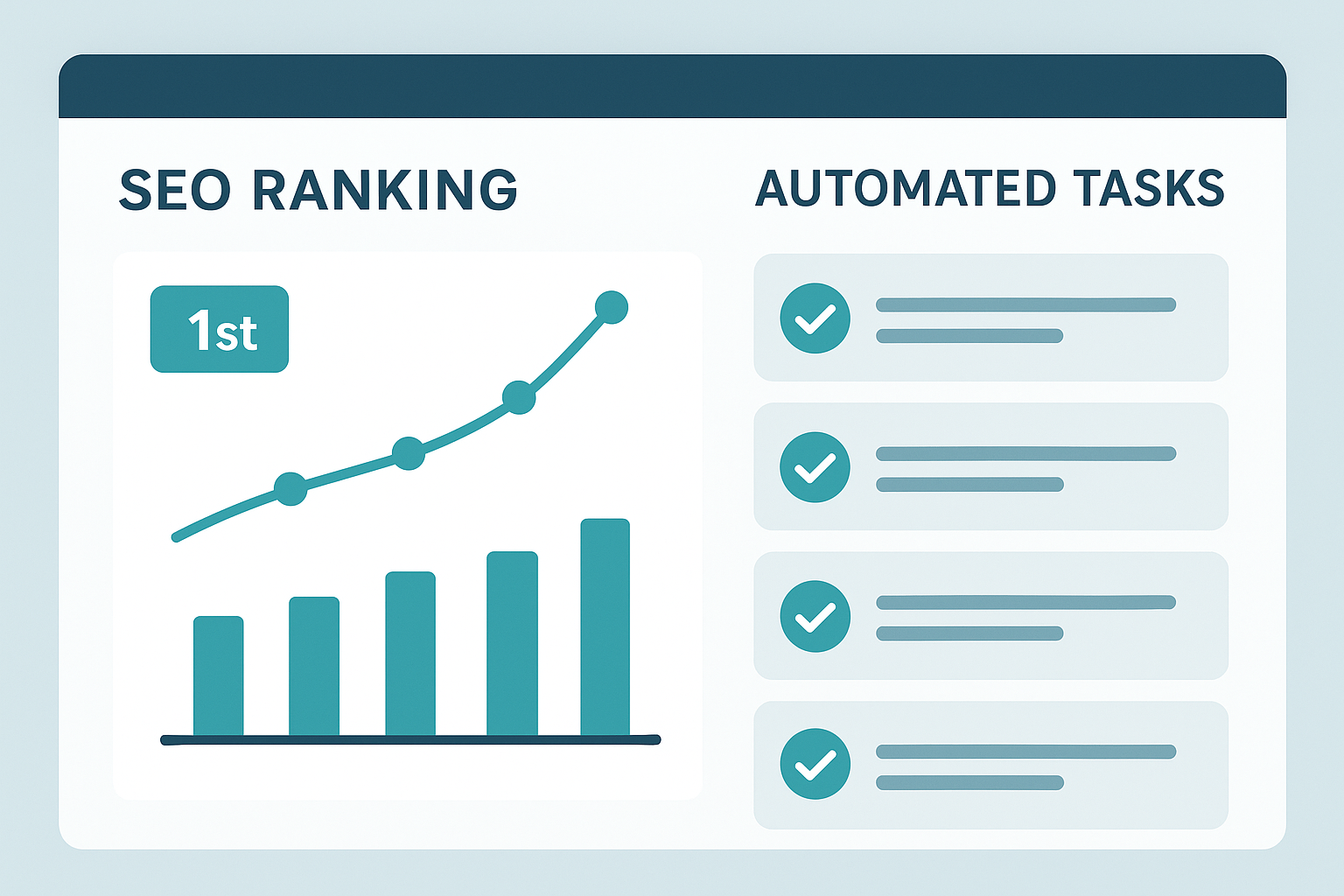
Automated dashboards make it easier to track how artificial intelligence and SEO efforts translate into ranking movement.
AI Content Writing and Search Optimization
Content remains the foundation of any optimization effort, and AI has changed how that content gets produced. In particular, AI writing tools can generate outlines, drafts, and even meta descriptions in a fraction of the time manual writing takes.
However, Google has been clear that content quality matters more than how it was created. The company’s own guidance on creating helpful, reliable content notes that AI-assisted pages must still be accurate, original, and genuinely useful to readers. For a full walkthrough of best practices, this guide on AI content writing for SEO is a useful next stop.
Common Challenges When Merging AI and SEO Automation
Despite the clear benefits, teams often run into predictable problems. For example, publishing AI drafts without editing can lead to generic or inaccurate pages that fail to rank.
Similarly, relying entirely on automation while ignoring fundamentals like page speed, mobile usability, or backlink quality tends to limit results. In contrast, businesses that treat AI as a support tool rather than a replacement for strategy typically see stronger, more sustainable growth.
Choosing the Right AI SEO Tool
Not every AI SEO tool fits every business. Small business owners typically need something simple and largely hands-off, while agencies managing multiple client sites need scale and reporting.
RankAuthority’s platform, for instance, is built around a 1-Click AI AutoPilot system that automates the technical and strategic work of GEO and AEO, backed by a seven-day risk-free trial. Whether you manage one site or dozens, this kind of tool lets you focus on running your business while the automation strengthens search authority in the background. You can learn more about the underlying technology in this overview of AI SEO software strategy and real-world results, or explore rankauthority.com directly.
For broader context on how search engines evaluate optimization signals, Wikipedia’s overview of search engine optimization remains a solid neutral reference point.

Small businesses can manage AI-driven SEO without needing a dedicated technical team.
Frequently Asked Questions About Artificial Intelligence and SEO
What is artificial intelligence and SEO?
Artificial intelligence and SEO refers to the combined use of machine learning, natural language processing, and automation to research, optimize, and monitor a website’s search rankings. Instead of manually auditing pages, AI tools analyze data patterns and suggest or apply improvements automatically.
How does AI improve SEO rankings?
AI improves rankings by analyzing large data sets faster than humans, identifying content gaps, and predicting which keywords or topics are likely to perform well. It also automates repetitive tasks like meta tag generation and internal linking.
Why is AI important for modern search optimization?
AI is important because search engines now use AI models to interpret intent and generate answers directly in results. Consequently, optimization strategies must account for how AI systems read, summarize, and cite content.
What is the difference between traditional SEO and AI-driven SEO?
Traditional SEO relies on manual keyword research and periodic audits performed by a specialist. AI-driven SEO automates much of that work using algorithms that continuously learn from ranking signals.
How much does AI SEO software typically cost?
Pricing varies widely, from free basic tools to enterprise platforms costing several hundred dollars monthly. Many providers offer a risk-free trial period so businesses can test results before committing.
How long does it take to see results from AI-powered SEO?
Most sites see measurable movement within four to twelve weeks, depending on competition and starting authority. However, AI tools often accelerate the technical and content work involved.
What are common mistakes businesses make when using AI for SEO?
A common mistake is publishing unedited AI-generated content without fact-checking or original insight. Another is relying solely on automation while ignoring fundamentals like site speed and backlink quality.
What are the best practices for combining AI and SEO strategies?
Best practices include using AI for research and drafting while keeping human review for accuracy and tone. In addition, teams should monitor AI-driven changes against real ranking data.
Can AI write SEO content that ranks well?
Yes, AI can draft SEO-friendly content that ranks well when it is edited for accuracy, originality, and helpfulness. Google rewards quality content regardless of how it was produced, provided it serves the reader.
What tools use artificial intelligence for SEO?
Tools range from keyword research assistants to fully automated platforms like RankAuthority’s 1-Click AI AutoPilot, which handles technical optimization and ongoing monitoring. Other examples include AI writing assistants and predictive analytics dashboards.
Does AI SEO work for small businesses?
Yes, small businesses often benefit the most because AI removes the need for a large in-house team or expensive agency retainer. Automated platforms let a single owner manage optimization tasks efficiently.
How does AI affect Google’s E-E-A-T guidelines?
AI does not exempt content from Google’s E-E-A-T expectations for experience, expertise, authoritativeness, and trust. As a result, AI-assisted content still needs human review and clear author or brand signals.
What is Generative Engine Optimization (GEO)?
Generative Engine Optimization, or GEO, is the practice of structuring content so AI chatbots and generative search tools can understand, summarize, and cite it accurately. It works alongside traditional SEO rather than replacing it.
Will AI replace human SEO specialists?
AI is unlikely to fully replace human specialists, but it is reshaping their role toward strategy and quality control. Above all, the combination of artificial intelligence and SEO expertise together tends to outperform either approach alone.
Final Thoughts on Artificial Intelligence and SEO
Ultimately, artificial intelligence and SEO are no longer separate disciplines but two sides of the same strategy. Search engines are already using AI to rank and summarize content, so optimization approaches that ignore this shift risk falling behind.
By combining automated research, AI-assisted writing, and continuous monitoring, businesses of any size can keep pace without needing a large technical team. Therefore, the smartest path forward is treating AI as a partner in the optimization process, one that handles repetitive work so people can focus on strategy, quality, and long-term growth.

