

An AI blog writer for SEO is a software platform that uses artificial intelligence to research, draft, and optimize blog content so it ranks in both traditional search engines and AI-powered answer engines. For small business owners, digital marketers, entrepreneurs, and agencies managing multiple sites, these tools promise to close the gap between a content idea and a published, search-ready post. However, not every AI writing tool produces content built to rank, since speed alone does not equal visibility. In this guide, we’ll explain what an AI blog writer for SEO actually does, how to evaluate one, and how platforms like Rank Authority combine automated content generation with Generative Engine Optimization (GEO) and Answer Engine Optimization (AEO) to help businesses earn citations across Google, AI Overviews, and answer engines alike.

An AI blog writer for SEO combines keyword data, structure, and optimization scoring in one workflow.
What Is an AI Blog Writer for SEO?
An AI blog writer for SEO is a tool that pairs natural language generation — technology that produces human-readable text from data and prompts — with on-page optimization rules such as keyword targeting, heading structure, internal linking, and schema markup. In short, it automates the mechanical parts of SEO content creation so writers and marketers can focus on strategy and accuracy.
Unlike a general-purpose natural language generation assistant, a true AI blog writer for SEO is built around search intent. It pulls data on ranking competitors, related questions, and semantic keywords, then structures a post to match what search engines, and increasingly AI answer engines, expect to see. For example, tools like Rank Authority’s AI Blog Builder generate posts formatted with question-based headings, structured data, and internal links automatically, which helps content qualify for featured snippets and AI-generated answers. As a result, the content is built for discoverability from the first draft, rather than optimized after the fact.
Why Businesses Are Turning to AI Content Writers for SEO
Content demands have grown faster than most internal teams can keep up with. Specifically, Content Marketing Institute’s B2B research has tracked a sharp rise in generative AI adoption among marketers, with usage climbing from roughly 11% to 29% within a single year as teams looked for ways to keep pace. Consequently, businesses that rely solely on manual content production risk falling behind competitors who publish more consistently. An AI content writer for SEO addresses this gap by producing first drafts, keyword-optimized outlines, and schema-ready posts in minutes instead of days. In addition, because search is no longer limited to ten blue links, content also needs structuring for AI Overviews and answer engines. For a deeper breakdown, see this complete guide to AI content writing for SEO.
Key Features of a High-Performing AI Writing Tool for SEO
Before comparing platforms, it helps to know which capabilities actually move the needle. Look for the following when evaluating an AI writing tool for SEO:
- Keyword and search-intent research built directly into the drafting process
- Automatic heading structure, including question-based subheadings for AI answers
- Schema markup generation for FAQs, articles, and how-to content
- Internal linking automation to strengthen topical authority
- Readability and tone scoring to keep content scannable
- AI visibility tracking to monitor citations across AI answer platforms
Before any of these features matter, though, a tool needs a solid starting point. That’s why pairing an AI writer with a structured content brief, covering target keyword, intent, and competitor gaps, tends to outperform freeform prompting alone, as explained in this guide to content briefs for SEO writers. Rank Authority also offers free diagnostic tools, including an AI Visibility Checker, through rankauthority.com, for a quick baseline before writing even starts.
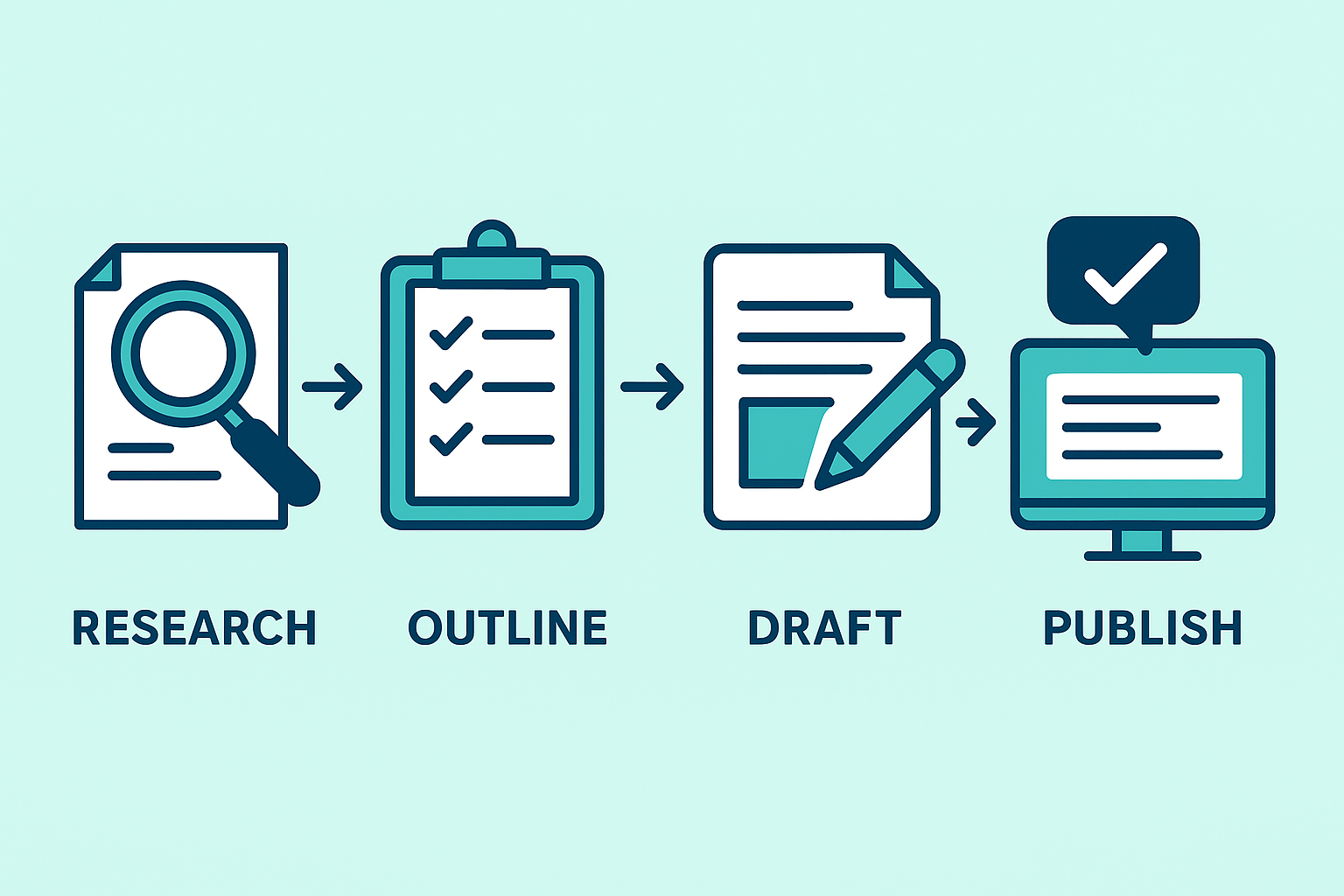
A typical workflow for turning a keyword into a published, search-ready blog post.
How an AI Blog Writer for SEO Works, Step by Step
Although interfaces differ between platforms, most tools follow a similar process. Here is how an AI blog writer for SEO typically turns a keyword into a finished post:
- Enter your target keyword or topic. The platform analyzes search intent, top-ranking competitors, and related questions to build a content brief before writing begins.
- Generate a structured outline. The system creates headings aligned with how people search, including question-based subheadings that improve eligibility for AI-generated answers.
- Draft the full blog post. Natural language generation produces body content that incorporates the target keyword and semantic variants naturally throughout the piece.
- Apply on-page SEO and schema markup. Automated optimization adds meta tags, structured data, and internal links that strengthen topical relevance across the site.
- Review, publish, and monitor performance. A human reviewer checks facts and tone before publishing, then the platform tracks rankings and AI citation activity over time.
AI Blog Writer for SEO vs. Traditional Content Writing
Neither approach fully replaces the other; in practice, most strong content strategies blend both. Still, the trade-offs are worth understanding before choosing a workflow.
| Factor | AI Blog Writer for SEO | Traditional Content Writing |
|---|---|---|
| Speed | Minutes per draft | Hours to days per draft |
| SEO structure consistency | Applied automatically | Depends on writer’s expertise |
| Scalability | High, across many pages or sites | Limited by headcount |
| Brand nuance | Requires human review | Naturally strong |
How Rank Authority’s AI Blog Builder Delivers AI Blog Writer for SEO Results
Rank Authority approaches AI blog writing as one part of a larger AI visibility strategy rather than a standalone feature. Its AI Blog Builder generates SEO- and AEO-optimized posts, while RankFast analyzes competing pages and rebuilds stronger versions designed to outrank them. In addition, RankLink automates topical siloing and internal linking so new posts strengthen existing pages instead of competing with them. Because visibility extends beyond Google, the platform also tracks AI citation performance across major answer engines, reflected in a Rank Authority Score (RA Score). For technical cleanup, 1-Click AI AutoPilot automates many fixes that would otherwise require a developer.
Agencies and freelancers managing several client sites in particular benefit from this consolidated approach, as outlined in this guide to AI SEO platforms for freelancers. It’s also worth noting that Rank Authority can submit new or updated content for indexing, but Google alone determines whether and when a page is actually indexed. Individual results vary, and reviews reflect individual user experiences rather than guaranteed outcomes for every account. Businesses can test the full platform, including the AI Blog Builder for smarter SEO content, through a seven-day trial at rankauthority.com.

Tracking AI citation activity alongside traditional rankings gives a fuller picture of search visibility.
Best Practices for Using an AI Writing Tool for SEO Content
Automation works best when paired with a few consistent habits. Above all, treat AI output as a strong first draft rather than a finished product.
- Always have a human fact-check and edit AI drafts before publishing
- Add original data, examples, or quotes to strengthen experience, expertise, authoritativeness, and trustworthiness (E-E-A-T)
- Keep schema markup updated as content changes
- Use internal links to connect new posts with existing topical clusters
- Monitor AI visibility, not just traditional keyword rankings
Common Mistakes to Avoid With AI-Generated SEO Content
Even strong tools can underperform when used carelessly. Specifically, avoid publishing drafts without review, ignoring search intent in favor of keyword repetition, and skipping schema markup entirely. The Federal Trade Commission has also published guidance on truthful AI-related claims, which is a useful reminder to stay accurate when describing AI involvement in content. Similarly, Google’s own spam policies documentation makes clear that content created primarily to manipulate rankings violates guidelines regardless of whether a human or AI produced it. As a result, quality control matters more than production speed.
Frequently Asked Questions About AI Blog Writer for SEO
What is an AI blog writer for SEO?
An AI blog writer for SEO is a software tool that uses artificial intelligence to research, draft, and optimize blog posts for search visibility. It typically handles keyword research, outline creation, drafting, and on-page optimization in a single workflow, reducing the manual work required to publish ranking content.
How does an AI blog writer for SEO improve search rankings?
It improves rankings by aligning content with search intent, structuring headings for readability, and applying technical elements like schema markup and internal links. These signals help both traditional search engines and AI answer engines understand and surface the content more easily.
Why should small businesses use an AI blog writer for SEO?
Small businesses often lack the time or in-house expertise to produce consistent, optimized content. An AI blog writer for SEO lets a single person manage a publishing schedule that would otherwise require a larger content team.
What’s the difference between an AI blog writer and a general AI content writer for SEO?
A general AI writer mainly generates readable text from a prompt. An AI content writer for SEO goes further by incorporating keyword data, competitor analysis, schema markup, and internal linking directly into the content creation process.
How much does an AI blog writer for SEO typically cost?
Pricing varies widely, from free basic tools to monthly subscriptions based on word volume or site count. Many platforms, including Rank Authority, offer a risk-free trial period so businesses can evaluate output before committing to a paid plan.
How long does it take to see results from AI-generated SEO content?
Most businesses should expect a timeline similar to traditional SEO content, typically several weeks to a few months for new pages to gain traction. Results depend on competition and publishing consistency; individual results vary.
What mistakes do businesses make when using an AI blog writer for SEO?
Common mistakes include publishing AI drafts without human review, ignoring search intent in favor of keyword repetition, and skipping schema markup. Treating AI output as a finished product rather than a strong first draft is a frequent pitfall.
What are the best practices for optimizing AI-written blog content?
Best practices include fact-checking every draft, adding original examples or data, keeping internal links current, and ensuring each post answers a specific search intent before publishing.
Can an AI blog writer for SEO help with AI search visibility, not just Google?
Yes. Platforms that combine AI writing with Generative Engine Optimization (GEO) and Answer Engine Optimization (AEO) structure content specifically to be cited by AI Overviews, chatbots, and other answer engines, not just traditional search results.
Does Google penalize AI-generated blog content?
Google’s guidance focuses on content quality and intent rather than production method. Content created primarily to manipulate rankings violates its spam policies regardless of whether a human or AI wrote it, so quality and originality matter most.
What features should I look for in an AI blog writer for SEO?
Look for built-in keyword research, question-based heading generation, automated schema markup, internal linking tools, and performance tracking across traditional and AI search results.
How does Rank Authority’s AI Blog Builder work?
The AI Blog Builder generates SEO- and AEO-optimized blog posts based on a target keyword, then applies structured headings, schema markup, and internal links automatically alongside RankFast and RankLink.
Is an AI blog writer for SEO suitable for agencies managing multiple clients?
Yes, agencies often benefit the most, since an AI blog writer for SEO can scale content production across several client accounts without a proportional increase in staff.
How do I measure the performance of an AI blog writer for SEO?
Track traditional metrics like keyword rankings and organic traffic alongside newer signals such as AI citation frequency and visibility across answer engines, ideally in one combined dashboard.
Final Thoughts on Choosing an AI Blog Writer for SEO
Choosing the right AI blog writer for SEO comes down to more than generation speed. The best tools combine keyword research, structured formatting, schema markup, and AI visibility tracking so content can compete across both traditional search and AI answer engines. In addition, pairing automation with human review keeps quality and accuracy intact as publishing volume increases. For businesses ready to streamline this process, Rank Authority’s AI Blog Builder, paired with RankFast, RankLink, and 1-Click AI AutoPilot, offers a practical starting point, including a seven-day trial at rankauthority.com. Ultimately, an AI blog writer for SEO works best as part of a broader strategy that treats content as one piece of a larger visibility system, not a shortcut around it.

