
Knowing how to use AI for contextual keyword optimization has become essential now that search engines and AI answer tools judge content by meaning, not just keyword matches. Instead of repeating a phrase as many times as possible, modern optimization relies on artificial intelligence to understand the relationships between topics, entities, and user intent. This guide walks through exactly how that process works and how to apply it to your own content.
Direct answer: Contextual keyword optimization uses AI tools to analyze search intent, related entities, and semantic relationships around a topic, then applies those insights to content structure, internal links, and schema markup. The goal is to help both traditional search engines and AI answer engines recognize your page as a complete, relevant answer.

Visualizing how AI maps related topics and entities during contextual keyword optimization.
What Is Contextual Keyword Optimization?
Contextual keyword optimization is the practice of aligning content with the full meaning and intent behind a search query rather than isolated keyword phrases. In short, it is an approach that treats keywords as signals pointing toward a broader topic, not as exact strings to repeat.
Search engines have used natural language processing for years to interpret queries this way. However, as AI-generated answers and chatbots have grown, context has become even more important. Google’s own guidance in its SEO starter guide emphasizes creating people-first content that thoroughly answers a topic, which is the foundation contextual optimization builds on.
How to Use AI for Contextual Keyword Optimization: A Step-by-Step Process
Applying AI to contextual keyword optimization follows a fairly consistent workflow, whether you manage one website or dozens of client properties. The steps below outline a practical sequence you can repeat for any page or topic cluster.
- Audit existing content for topical gaps. Run a site audit to spot pages that lack depth or miss subtopics competitors already cover.
- Map entities and related concepts. Use AI tools to surface synonyms, related questions, and named entities connected to your core topic.
- Cluster keywords by intent, not exact phrase. Group similar queries together so one well-structured page can answer several related searches.
- Apply contextual terms through automated tools. Let AI content and schema tools insert relevant terminology and structured data efficiently.
- Monitor AI visibility and refine. Track whether pages appear in AI answers and traditional rankings, then adjust underperforming content.
For example, Rank Authority’s guide on AI keyword optimization strategies for 2025 expands on how clustering and entity mapping work together before any content gets published.
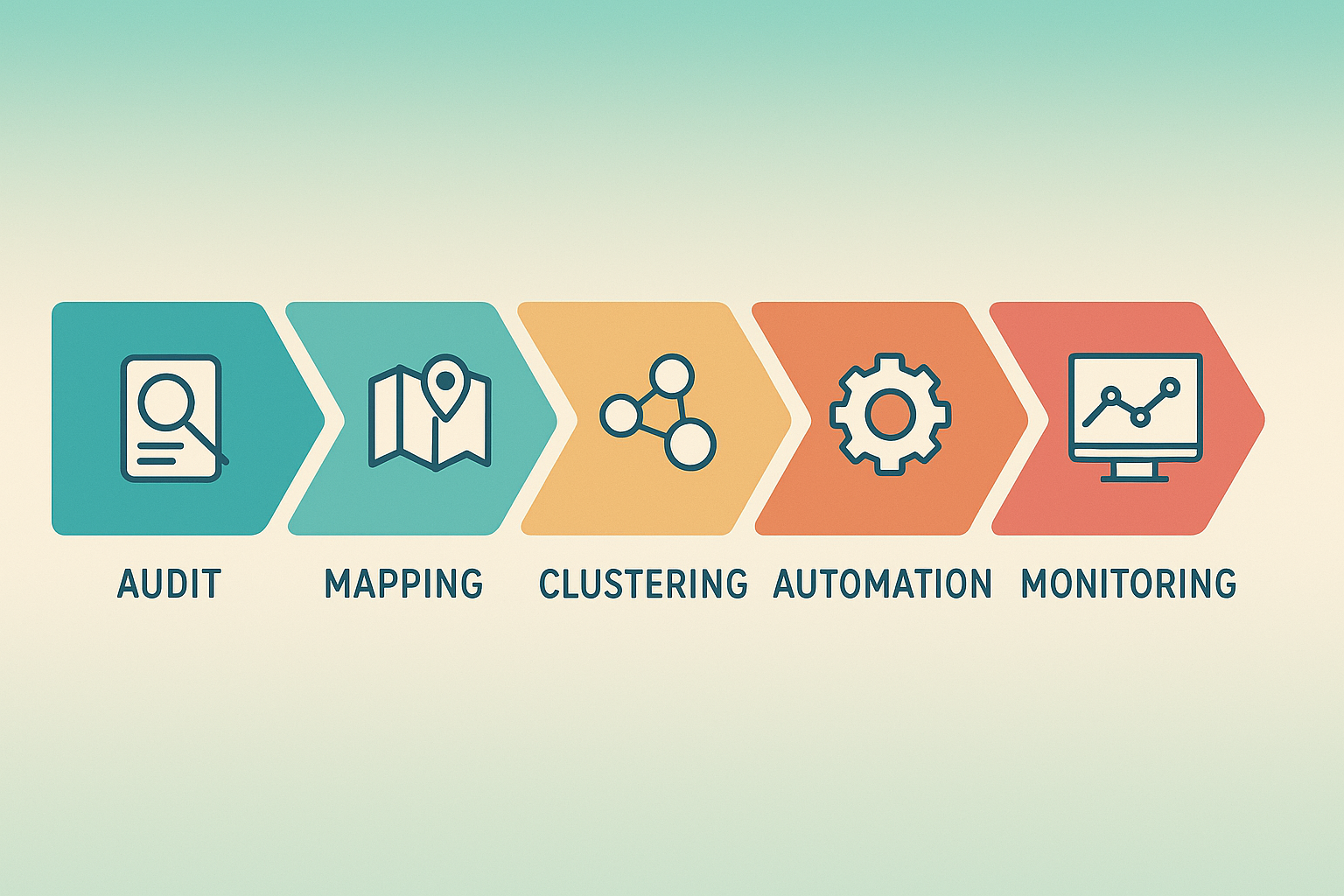
A repeatable workflow for using AI across the contextual keyword optimization process.
Why Context Beats Keyword Density in AI Search
Many site owners still believe that repeating a keyword a certain number of times improves rankings. In reality, context-aware algorithms like Google’s BERT model interpret language more like a human reader does, weighing surrounding words and intent rather than frequency alone.
Consequently, AI answer engines go a step further. They evaluate whether a page comprehensively addresses a topic before citing it in a generated response. According to data frequently cited by Search Engine Land and Internet Live Stats, Google alone processes more than 8.5 billion searches per day, which means competition for contextual relevance is intense across nearly every topic. As a result, thin or repetitive content rarely earns citations, no matter how often a keyword appears.
In contrast, pages that explain related subtopics, define terms clearly, and answer follow-up questions tend to perform better in both traditional rankings and AI-generated summaries. This is also the logic behind Rank Authority’s approach to AI-driven keyword gap analysis, which identifies missing subtopics rather than just missing phrases.
Tools and Techniques for AI-Driven Contextual Optimization
Several categories of AI tools support contextual keyword work, and understanding their roles helps you choose the right combination for your site.
Semantic clustering tools group related keywords by meaning rather than exact text, helping you build one comprehensive page instead of several thin ones. Automated schema generators translate your content’s structure into machine-readable markup, reinforcing context signals for both search engines and AI crawlers. AI content assistants, such as Rank Authority’s AI Blog Builder, draft SEO- and AEO-optimized articles that incorporate related terms naturally rather than forcing exact-match phrases.
Additionally, competitive tools like RankFast analyze top-ranking competitor pages and identify contextual elements you may be missing, while RankLink automates the internal linking structure that helps search engines understand topical relationships across your site. Together, these tools reduce the manual research and writing time that contextual optimization traditionally required. For a broader look at how AI insights fit into an overall strategy, see Rank Authority’s resource on utilizing AI insights for SEO strategy.
Common Mistakes to Avoid When Using AI for Keyword Context
Even with powerful tools, certain mistakes can undermine contextual optimization efforts. Being aware of them in advance helps you avoid wasted work.
- Publishing AI-generated content without human review for accuracy and brand voice.
- Focusing on related keywords while ignoring the original search intent behind the page.
- Skipping internal linking updates, which leaves topical relationships unclear to search engines.
- Over-automating without monitoring results, leading to generic content that fails to stand out.
In short, AI should accelerate the research and implementation process, but strategic oversight still matters. This balance is explored further in Rank Authority’s piece on the benefits AI offers in SEO strategy.

Monitoring AI citations and ranking changes helps confirm whether contextual optimization is working.
Measuring Results After Applying AI to Keyword Context
Once contextual changes are live, tracking results confirms whether the work is paying off. Specifically, watch three indicators: traditional ranking position changes, click-through rate shifts, and whether your pages begin appearing in AI-generated answers or overviews.
Rank Authority’s RA Score and AI visibility monitoring track these signals from a single dashboard, which removes the need to manually check multiple platforms. Individual results vary depending on site history, competition, and how consistently updates are applied. Note also that while platforms can submit updated pages for indexing, search engines like Google alone determine whether and when a page is indexed. For additional guidance on refining keyword research with AI, review Rank Authority’s article on improving keyword research using AI.
Frequently Asked Questions
What does it mean to use AI for contextual keyword optimization?
Using AI for contextual keyword optimization means letting machine learning tools analyze search intent, topic relationships, and surrounding language rather than matching exact phrases. The AI identifies related terms and entities so content answers the full scope of a query.
How is contextual keyword optimization different from traditional keyword research?
Traditional keyword research focuses on search volume and exact-match phrases. Contextual optimization instead maps relationships between topics, entities, and intent, which AI tools surface far faster than manual spreadsheets.
Why does context matter more than keyword density for AI search?
AI answer engines evaluate meaning and topical completeness rather than counting repetitions. Content that covers a topic thoroughly is more likely to be cited in AI-generated answers than content stuffed with exact phrases.
Which AI tools help with contextual keyword optimization?
Platforms combining natural language processing with SEO data, such as Rank Authority’s AI AutoPilot and AI Blog Builder, identify semantic gaps and content structure needed for AI citation. General AI writing assistants help but usually lack integrated SEO data.
How much does AI-powered keyword optimization typically cost?
Costs range from free diagnostic tools to monthly subscriptions, often between roughly $30 and several hundred dollars depending on site size. Many platforms, including Rank Authority, offer a risk-free trial before any paid commitment.
How long does it take to see results from AI keyword optimization?
Technical fixes can go live within days, but ranking and visibility changes typically take several weeks to a few months to appear. Individual results vary based on site history and competition.
What are common mistakes when optimizing keywords with AI?
Common mistakes include publishing AI output without review, chasing exact-match phrases instead of intent, and skipping internal link updates. Over-automating without monitoring can also produce generic content.
Can AI replace human SEO strategists entirely?
AI automates repetitive technical and analytical work, but strategic judgment and brand voice still benefit from human review. Most effective approaches combine automation with periodic oversight.
Does contextual keyword optimization help with AI Overviews and chatbot answers?
Yes, content with clear answers and topical depth is more likely to surface in AI Overviews and chatbot responses. This overlaps with Generative Engine Optimization (GEO) and Answer Engine Optimization (AEO).
How do I measure whether AI keyword optimization is working?
Track ranking changes, click-through rates, and whether content appears in AI-generated answers using visibility monitoring tools. Rank Authority’s RA Score offers one way to measure this progress over time.
What role does schema markup play in contextual keyword optimization?
Schema markup helps search and AI engines interpret the structured meaning behind content, reinforcing existing context signals. It supports quality content rather than replacing it.
Is AI keyword optimization suitable for small businesses with no SEO team?
Yes, automated platforms are built to reduce the expertise and time required, making contextual keyword optimization accessible without a dedicated specialist. Small business owners can start with free diagnostic tools before investing further.
Final Thoughts on Using AI for Contextual Keyword Optimization
Ultimately, learning how to use AI for contextual keyword optimization comes down to shifting focus from exact-match phrases to genuine topical depth. By mapping entities, clustering intent, and automating the technical details, businesses of any size can compete for visibility across both traditional search engines and AI answer platforms. Therefore, pairing AI automation with periodic human review, as offered through tools like those at Rank Authority, gives teams a practical path toward stronger search and AI visibility without requiring a full in-house SEO department.