
Automated AI search visibility tracking is the practice of continuously monitoring where your brand appears inside AI-generated answers and traditional search results. Instead of checking Google rankings alone, this approach follows your business across platforms like ChatGPT, Gemini, and Perplexity too. As a result, business owners finally see how often they’re cited in the answers people actually read. This guide explains what automated AI search visibility tracking measures, why it matters, and how to set it up without hiring a full SEO team.
Direct answer: Automated AI search visibility tracking is a monitoring system that scans AI answer engines and traditional search results to measure where, how often, and in what context your brand is cited, then reports the findings in one dashboard.
What Is Automated AI Search Visibility Tracking?
Automated AI search visibility tracking is the ongoing process of scanning AI answer engines and search engines to see where a brand shows up, how it’s described, and whether it’s cited as a source. Instead of manual spot-checks, software runs these scans on a schedule and compiles the results into a single score or dashboard.
In practice, this means a tool queries ChatGPT, Gemini, Perplexity, and Google’s AI Overviews with relevant questions, then records whether your business, products, or content appear in the response. Because these engines generate new answers for nearly every query, a one-time check tells very little. Consequently, tracking has to run continuously, comparing today’s citations against last week’s and flagging new competitors who start showing up in the same answers.
Why AI Visibility Monitoring Matters Right Now
Furthermore, this shift isn’t theoretical. According to a widely cited Gartner prediction, traditional search engine volume could drop by 25% by 2026 as more users turn to AI chatbots for answers instead of scrolling through links. In addition, research on large language models shows people increasingly treating AI assistants as a first stop for research and shopping questions, not just a novelty.
As a result, a brand that ranks well on Google but never appears in an AI-generated answer is already losing visibility it cannot see with traditional rank trackers. That blind spot is exactly what automated AI search visibility tracking is designed to close, and it’s why GEO and AEO are increasingly treated as core disciplines rather than side experiments. For a broader look at how these pieces fit together, this AI-powered search strategy guide walks through the fundamentals.

Reviewing automated AI search visibility tracking results on a laptop dashboard.
How Automated AI Search Visibility Tracking Works
Specifically, most tracking systems follow a similar pattern behind the scenes. First, the system builds a list of prompts and keywords relevant to your business. Then, it sends those prompts to multiple AI engines and traditional search results on a recurring schedule.
After that, the tool parses each response, checking whether your domain, brand name, or content is mentioned, linked, or cited as a source. Similarly, it tracks competitor mentions in the same answers, which helps you see who is winning the citation instead of just the click. Because manually checking dozens of prompts across several platforms every day isn’t realistic for a small team, automation is what makes consistent tracking possible. Platforms built for this purpose, such as the AI Visibility Checker, combine scanning with the technical fixes needed to improve the results, rather than just reporting a number and leaving the work to you.
Key Metrics Behind AI Search Visibility Tracking
Above all, good visibility tracking should give you more than a single number. The table below summarizes the core metrics most platforms report.
| Metric | What It Shows |
|---|---|
| Citation frequency | How often an AI engine names or links your brand in responses |
| Share of voice | Your citation rate compared to competitors on the same prompts |
| Rank Authority Score | A composite rating of technical, content, and citation health |
| Schema coverage | Percentage of pages with structured data AI engines can read |
Understanding the Rank Authority Score
The Rank Authority Score, or RA Score, condenses technical health, content quality, and AI citation presence into one benchmark. Therefore, instead of juggling separate reports, you get a single number to track month over month. In particular, this makes it easier to show whether changes to a site are moving the needle or not.
Step-by-Step: Setting Up Automated AI Visibility Monitoring
To get started, most businesses follow roughly the same sequence:
- Run a baseline scan. Check your current visibility across ChatGPT, Gemini, Perplexity, and Google before making changes, so later progress has a clear starting point.
- Schedule continuous monitoring. Set recurring scans across each AI platform and search engine you care about, since a single check goes stale within days.
- Record your Rank Authority Score. Note your starting composite score so you can measure technical, content, and citation progress over the following months.
- Deploy automated fixes. Review the gaps the scan finds, then approve fixes such as schema deployment or content restructuring through a tool like 1-Click AI AutoPilot.
- Review citation gains monthly. Check your dashboard each month to see which platforms now cite your content and where competitors gained ground.

A marketing team discussing monthly AI visibility monitoring results.
Bringing GEO, AEO, and SEO Automation Together
In particular, tracking alone only tells you where you stand; it doesn’t fix the problem. Traditional SEO automation handles the technical foundation, such as site speed, broken links, and indexing submissions. Meanwhile, Answer Engine Optimization (AEO) formats content so it can be pulled directly into featured snippets and AI answers, using clear definitions and structured lists rather than long, winding paragraphs.
On top of that, Generative Engine Optimization (GEO) focuses specifically on earning citations inside generative AI responses, often through purpose-built pages designed to be easy for AI systems to quote accurately. For a side-by-side comparison of how these pieces come together in practice, see this overview of AI solutions for search visibility and this 30-day AEO action plan.
Choosing a Platform for Automated AI Search Visibility Tracking
When comparing tools, look for platforms that monitor multiple AI engines at once, not just one chatbot. Similarly, check whether the platform can act on what it finds, rather than only producing a report you still have to interpret and fix manually.
Rank Authority, for example, pairs AI visibility monitoring with automated schema deployment, an AI Blog Builder for ongoing content, and RankFast for rebuilding underperforming competitor-style pages. A free diagnostic scan and a seven-day trial make it possible to test the approach before committing. You can review the full set of tools on the Rank Authority site, including the digital optimization toolkit built for AI-powered search.
Individual results vary. Reviews reflect individual user experiences and are not guaranteed results for all users. Automated tools can submit pages for indexing, but Google alone decides whether and when a page is indexed; see the FTC’s guidance on endorsements and testimonials for broader context on outcome-based claims.
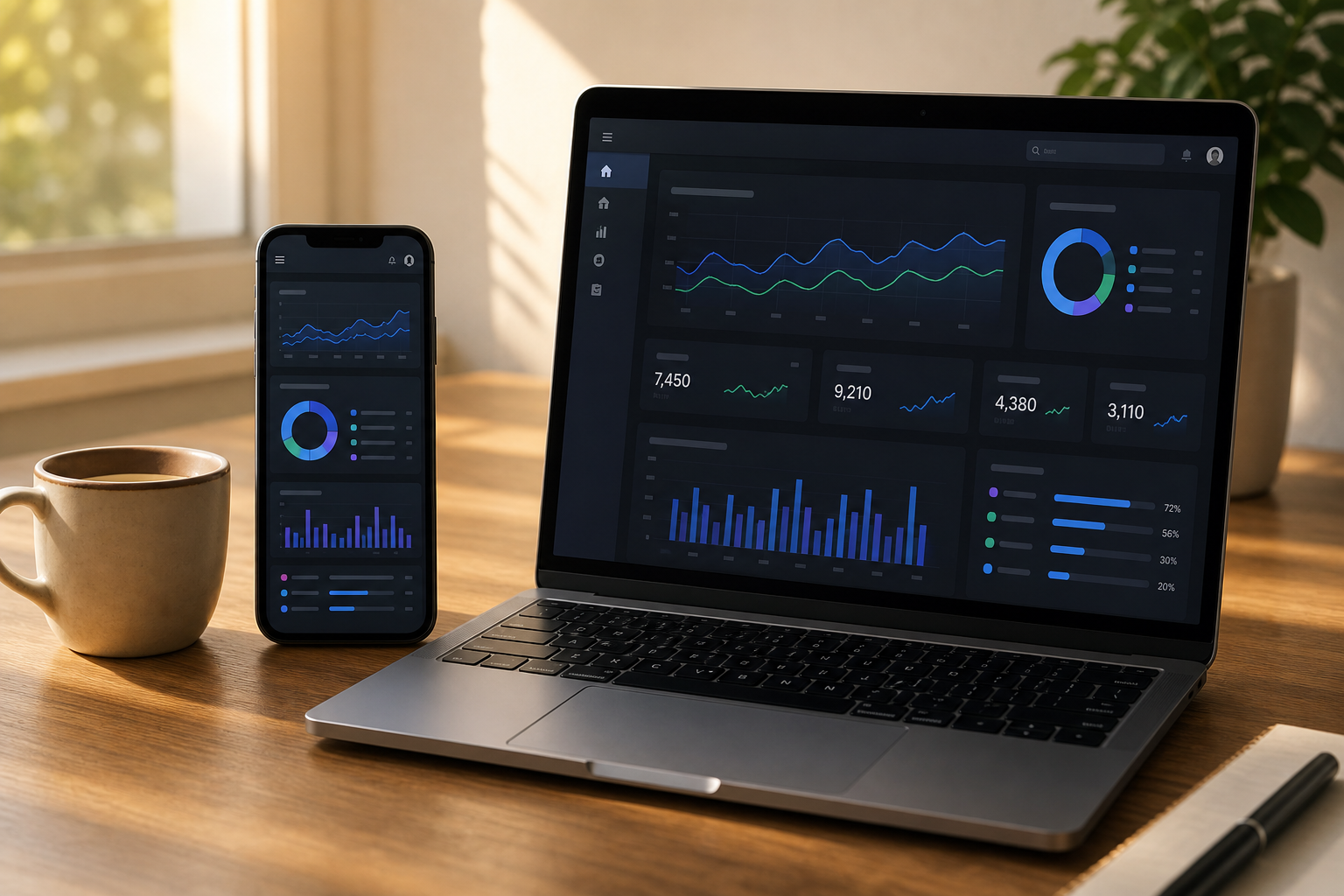
Checking automated AI search visibility tracking across devices.
Common Mistakes That Undermine AI Visibility Tracking
Even so, a few habits quietly limit results. First, many businesses track only Google rankings and ignore AI answer engines entirely, missing a growing share of search behavior. Second, skipping structured data markup, such as the formats described in Google’s structured data documentation, makes it harder for AI systems to parse your content correctly.
Third, some teams check visibility once and stop, missing the week-to-week shifts that matter most. Finally, content that answers questions indirectly, rather than stating the answer plainly near the top, tends to get skipped over by AI summarization in favor of competitors who answer more directly.
Frequently Asked Questions About Automated AI Search Visibility Tracking
What is automated AI search visibility tracking?
Automated AI search visibility tracking is software that continuously scans AI answer engines and search results to measure where, how often, and in what context a brand is cited. It replaces manual spot-checks with scheduled, repeatable monitoring across multiple platforms.
What does Rank Authority do?
Rank Authority is an AI-powered search optimization platform that automates GEO, AEO, and traditional SEO work, including visibility tracking, schema deployment, and content publishing. It combines monitoring with tools like 1-Click AI AutoPilot to act on what the tracking finds.
How is GEO different from traditional SEO?
Traditional SEO focuses on ranking in search engine result pages, while Generative Engine Optimization (GEO) focuses on getting cited inside AI-generated answers. GEO often relies on structured, citation-friendly content rather than keyword-targeted landing pages alone.
How do GEO, AEO, and SEO work together?
SEO builds the technical and authority foundation, AEO formats content so it can be pulled into featured snippets and AI answers, and GEO focuses on earning citations inside generative responses. Together, they cover both traditional clicks and AI-generated visibility.
How does 1-Click AI AutoPilot work?
1-Click AI AutoPilot scans a site for technical and on-page gaps, then lets users approve and deploy fixes without manual coding. It is designed to shorten the time between finding an issue and resolving it.
What is the Rank Authority Score?
The Rank Authority Score, or RA Score, is a composite rating that summarizes a site’s technical health, content strength, and AI citation presence in one number. It gives a quick benchmark that can be tracked over time.
How much does AI visibility tracking typically cost?
Pricing varies by platform and by how many keywords, pages, or AI engines are monitored. Many providers, including Rank Authority, offer a free trial period so businesses can evaluate visibility tracking before committing to a paid plan.
How long does it take to see AI visibility improvements?
Timelines vary based on site size, competition, and how quickly fixes are deployed, and individual results vary. Schema updates can show up within weeks, while broader citation gains often take longer to build.
What are common mistakes businesses make with AI search optimization?
Common mistakes include tracking only Google rankings, ignoring structured data, and publishing content that isn’t formatted for direct answers. Many businesses also check visibility once and stop, missing the shifts that happen week to week.
What is a GEO citation artifact?
A GEO citation artifact is a page built specifically to be easy for AI engines to extract, summarize, and cite, often using clear definitions, structured lists, and direct answers. It differs from a standard blog post that buries the key answer deep in the text.
How does automated schema markup support AI visibility?
Schema markup is structured code that helps search and AI systems understand what a page is about. Automated schema deployment keeps this information consistent and current without requiring manual markup on every page.
Does automated indexing submission guarantee faster rankings?
No. Automated tools can submit pages for indexing, but Google alone decides whether and when a page is indexed. Submission can help a page get noticed sooner, but it does not guarantee inclusion or ranking.
Who benefits most from automated AI search visibility tracking?
Small business owners, marketers, entrepreneurs, and agencies managing multiple sites tend to benefit most, since manual tracking across several AI platforms is time-consuming. Automated AI search visibility tracking removes that manual workload while still surfacing the data needed to act.
Final Thoughts
Ultimately, automated AI search visibility tracking gives businesses a clear, ongoing view of how often they’re cited across both AI answer engines and traditional search. Rather than guessing where visibility is slipping, continuous monitoring paired with GEO, AEO, and SEO automation turns that data into action. Whether you manage one website or several client properties, starting with a baseline scan and building toward consistent, automated tracking is the most reliable way to stay visible as AI search continues to reshape how people find businesses online.