

Small Business Strategy · Updated 2025 · By Rank Authority — By Elizabeth Burges, Founder at Rank Authority. Last updated 2026-04-21. · By Elizabeth Burges, SEO strategist and small-business advisor
10 Small Business Trends Every Entrepreneur Must Know in 2025
The Small Business Trends 2025 are not incremental shifts — they are structural changes reshaping how businesses find customers, build teams, deliver products, and compete online. Whether you operate a brick-and-mortar shop, a service firm, or a growing e-commerce brand, understanding which trends will dominate this year is the difference between leading your market and scrambling to catch up. This complete guide covers the 10 most important small business trends for 2025, with actionable insight on each one so you can act, not just read.

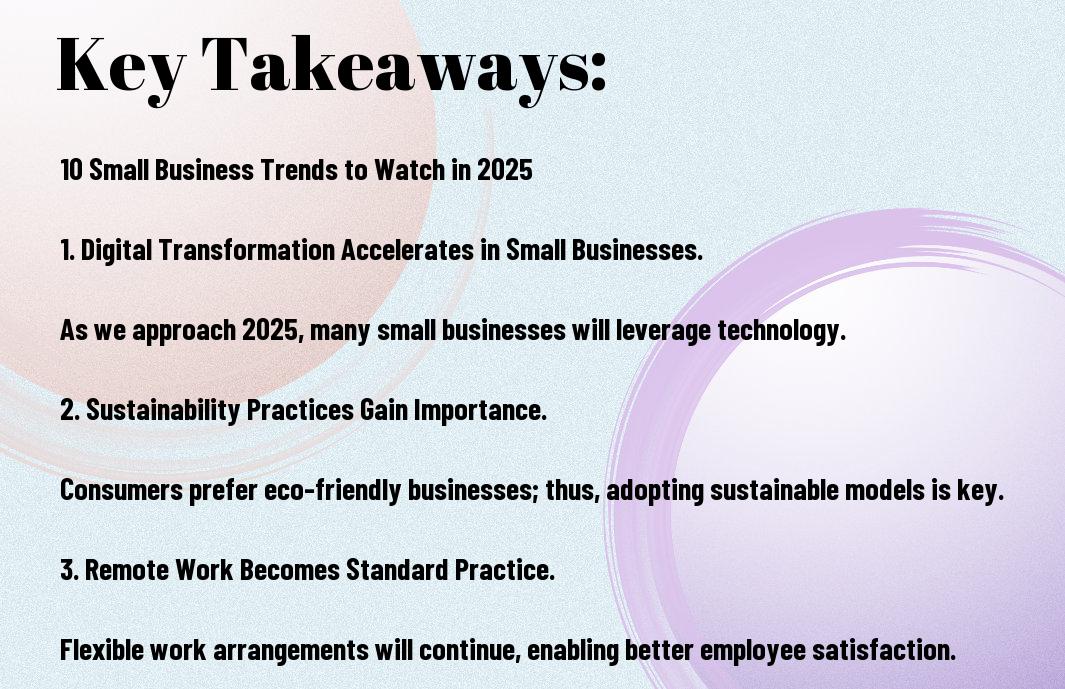
Key Takeaways
- Artificial intelligence is the most disruptive small business trend of 2025 — automating marketing, customer service, and analytics for businesses of any size.
- Sustainability has moved from a nice-to-have to a customer expectation, with green purchasing decisions now influencing the majority of buyers.
- E-commerce and omnichannel selling continue to grow, requiring small businesses to meet customers wherever they shop.
- Remote and hybrid work models are now a baseline hiring expectation, expanding the talent pool for small employers.
- Personalization at scale, driven by data and AI, is the new standard for customer experience — generic marketing no longer converts.
- Cybersecurity is a rising concern for small businesses as digital operations expand and data breach risks grow.
- Community-driven commerce and hyper-local marketing are helping small businesses compete where large brands cannot.
Why Tracking Small Business Trends in 2025 Matters More Than Ever
The pace of change in the small business environment has never been faster. Three years ago, AI tools were largely inaccessible to small operators. Today, a solo entrepreneur can deploy chatbots, run AI-assisted ad campaigns, and use predictive analytics — all for under $100 a month. Similarly, consumer expectations around sustainability, delivery speed, personalization, and digital experience have leapt forward.
Small businesses that actively monitor and adapt to small business trends grow faster, retain customers longer, and withstand economic uncertainty better than those that operate reactively. The ten trends below are not hypothetical — they are already reshaping spending, hiring, and strategy decisions across every industry sector in 2025.
Trend #1: Artificial Intelligence Becomes Accessible to Every Small Business
Of all the small business trends in 2025, artificial intelligence is the one with the widest-reaching impact. What was once enterprise-only technology is now embedded in affordable tools that any small business owner can deploy without a technical background.
AI for Customer Service and Engagement
AI-powered chatbots and virtual assistants now handle customer inquiries, order tracking, appointment booking, and complaint resolution around the clock — without adding headcount. Tools like Intercom, Tidio, and ChatGPT-based integrations and other AI-driven marketing tools allow small businesses to deliver instant, personalized responses 24/7. The result: higher customer satisfaction scores and lower support costs simultaneously.
AI-Driven Data Analytics and Decision-Making
Data analytics powered by AI gives small business owners insights that previously required a full analytics team. You can now identify which products are trending, which marketing channels produce the highest ROI, which customer segments are at risk of churning, and how to time promotions for maximum revenue impact — all from dashboards that require no data science expertise.
Ignoring AI-driven analytics in 2025 means making business decisions based on gut feeling while your competitors make them based on real-time data. The gap between those two approaches will grow wider every quarter.
AI in Marketing and Content Creation
AI is also transforming how small businesses create and distribute marketing content. From generating ad copy variants to producing SEO-optimized blog articles, AI tools dramatically reduce the time and cost of content marketing. At Rank Authority, we deploy AI-driven strategies to help small businesses rank higher in search engines, reach more customers, and grow their online visibility without inflating their marketing budgets — read about common SEO challenges and how to fix them.
Action Step: Audit your current customer-facing processes — inquiries, follow-ups, booking, content — and identify one task you can automate with an AI tool this quarter. Start there and expand.

Trend #2: The Rise of Remote and Hybrid Work Models
Remote work is no longer a pandemic-era emergency measure — it is a permanent small business trend that is rewriting the rules of talent acquisition, office overhead, and team management. In 2025, job candidates actively screen for flexibility before applying, and businesses offering hybrid or fully remote arrangements attract a significantly larger and more diverse pool of applicants.
Flexible Work Arrangements as a Competitive Advantage
For small businesses competing against large corporations for skilled workers, offering flexible work is one of the most cost-effective differentiators available. You may not match a Fortune 500 salary, but you can offer autonomy, schedule control, and work-from-home options that large bureaucratic employers struggle to deliver. This levels the talent playing field considerably.
Additionally, reduced reliance on physical office space means meaningful cost savings that can be redirected toward growth — product development, marketing, or hiring additional team members.
Technology-Driven Collaboration for Distributed Teams
Managing a remote or hybrid team effectively requires intentional use of collaboration tools. The most successful small businesses in 2025 are standardizing on integrated tech stacks that include:
- Video conferencing (Zoom, Google Meet) for team standups and client calls
- Project management platforms (Asana, ClickUp, Monday.com) for task visibility and deadlines
- Instant messaging and async communication (Slack, Microsoft Teams) for daily coordination
- Cloud-based document collaboration (Google Workspace, Notion) for knowledge management
- Time-zone coordination tools for teams spanning multiple geographies
The critical management challenge with remote teams is preventing digital burnout. Without physical boundaries between work and home, employees can slip into always-on patterns. Establishing clear communication norms, meeting-free focus blocks, and explicit off-hours expectations is not optional — it is a retention strategy.
Trend #3: Sustainability Moves from Brand Story to Business Standard
Sustainability is one of the fastest-accelerating small business trends because consumer behavior is driving it from the demand side. Across age groups — but especially among Millennials and Gen Z, who now represent the dominant share of consumer spending — purchasing decisions are increasingly shaped by a brand’s environmental and social practices.
Eco-Friendly Business Practices That Make Financial Sense
Many small businesses hesitate on sustainability because they assume it increases costs. In practice, the most impactful eco-friendly changes often reduce costs over time:
- Switching to LED lighting and energy-efficient equipment lowers utility bills
- Reducing packaging materials cuts supply costs and appeals to eco-conscious buyers
- Sourcing from local or certified sustainable suppliers reduces transportation costs and supports supply chain resilience
- Going paperless with digital invoicing and contracts reduces administrative overhead
- Offering repair, refurbishment, or take-back programs builds loyalty and differentiates your brand
Consumer Demand for Green Products Is Measurable, Not Anecdotal
Research consistently shows that a significant share of consumers — often cited at 60–70% across surveys — say they are willing to pay a premium for sustainable products or to switch from a brand that lacks credible sustainability practices to one that has them. For small businesses, this is not just a marketing angle; it is a revenue opportunity.
The risk of inaction is equally concrete: failing to address sustainability concerns can cost you market share as competitors position themselves as the greener alternative in your category.
Action Step: Choose one visible sustainability commitment — sustainable packaging, a carbon offset program, a local sourcing policy — and communicate it prominently on your website and product pages. Transparency builds trust and search visibility simultaneously.
Trend #4: Digital Transformation and the Evolution of Small Business Marketing
Digital transformation is not a project with a finish line — it is an ongoing capability-building process that is now a core small business trend in 2025. The businesses pulling ahead are those treating digital adoption as a strategic priority, not a tactical reaction to market pressure.
Social Media Evolution: Short-Form Video Dominates
Social media platforms are shifting decisively toward short-form video content — TikTok, Instagram Reels, and YouTube Shorts collectively drive enormous organic reach for businesses that use them well. In 2025, small businesses that master short, authentic video content — behind-the-scenes footage, product demonstrations, customer stories, quick tips — gain disproportionate organic visibility compared to static image posts or text-only content.
The platform algorithms reward content that drives comments, saves, and shares. Storytelling, not selling, is the creative strategy that wins on social media in 2025.
Influencer Collaborations: Micro-Influencers Outperform Celebrities
One of the most effective — and underutilized — small business marketing trends is partnership with micro-influencers (10,000–100,000 followers) rather than celebrity or macro-influencers. Micro-influencers typically deliver:
- Significantly higher engagement rates than accounts with millions of followers
- Tightly niched audiences that match specific small business target demographics
- Much lower collaboration costs — often achievable with product gifting or modest fees
- Higher perceived authenticity among followers, translating to stronger purchase intent
The critical rule: always vet influencer audience quality (check for fake followers), ensure genuine brand alignment, and structure collaborations with clear content guidelines while allowing creative latitude. A mismatched influencer partnership can damage brand trust more than no partnership at all.
Search Engine Optimization Remains the Highest-ROI Digital Channel — read our SEO secrets
For small businesses, organic search continues to deliver the best long-term return on marketing investment. Unlike paid ads that stop generating traffic the moment you stop paying, well-optimized content compounds in value over time. In 2025, local SEO, AI-powered content optimization, and semantic search alignment are the highest-leverage SEO activities for small businesses. Many teams start with affordable SEO tools to scale content and technical fixes. Rank Authority specializes in deploying AI-driven SEO strategies that help small businesses climb search rankings and build lasting organic traffic.
Trend #5: E-Commerce Expansion and Omnichannel Selling
E-commerce continues to grow as one of the most consequential small business trends, with global online retail sales projected to account for an increasing share of total retail through 2025 and beyond. But the story in 2025 is not just “sell online” — it is “sell everywhere your customers are, seamlessly.”
Omnichannel Strategy: What It Actually Means for Small Businesses
An omnichannel approach means creating a consistent, connected customer experience across every touchpoint — your website, social media shops, physical store (if applicable), marketplaces like Amazon or Etsy, email, SMS, and in-app experiences. Customers may discover your brand on Instagram, research on Google, and buy on your website. Each step of that journey must be frictionless and brand-consistent.
Key omnichannel capabilities small businesses should build in 2025:
- Unified inventory management across all sales channels to prevent overselling and stock-outs
- Consistent brand voice and visual identity across every platform
- Mobile-optimized checkout — more than half of e-commerce transactions now happen on mobile devices
- Integrated CRM data so customer service representatives see the full purchase history regardless of which channel was used
- Cross-channel loyalty programs that reward customers for engagement anywhere, not just on one channel
Subscription-Based Models: Predictable Revenue for Small Businesses
Subscription commerce is one of the most powerful small business trends for 2025 because it converts one-time buyers into recurring revenue. Subscription models are no longer limited to software or media — coffee shops, pet supply stores, fitness studios, skincare brands, and professional service firms are all deploying subscription or membership models successfully.
The financial case is compelling: customer acquisition costs are typically 5–7x higher than retention costs, and subscription models turn retention into a built-in structural feature of the business model rather than an ongoing marketing effort. Additionally, predictable monthly recurring revenue enables better cash flow planning, inventory forecasting, and hiring decisions.
Personalization is the key differentiator among subscription services — customers who receive curated recommendations based on their preferences churn at significantly lower rates than those receiving generic boxes.
Trend #6: Hyper-Personalization and Data-Driven Customer Experience
Personalization has evolved beyond inserting a customer’s first name in an email subject line. In 2025, the small business trend driving customer loyalty is hyper-personalization — using behavioral data, purchase history, and AI-driven segmentation to deliver the right message, product recommendation, or offer to the right person at the right moment.
How Small Businesses Can Implement Personalization
You do not need an enterprise tech stack to personalize effectively. With best tools for online visibility, small businesses can:
- Segment email lists by purchase behavior and send tailored product recommendations
- Trigger automated follow-up sequences based on specific customer actions (browsing, abandoning cart, completing a purchase)
- Personalize landing pages based on the traffic source or ad campaign that drove the visitor
- Use retargeting ads to serve relevant products based on on-site browsing behavior
- Offer personalized loyalty rewards based on individual purchase categories and frequency
Research consistently shows that personalized experiences increase conversion rates, average order value, and customer lifetime value. Businesses that treat every customer as an individual segment of one will outperform those that treat them as a homogeneous audience.
Trend #7: Diversity, Equity, and Inclusion in the Small Business Workplace
Diversity, equity, and inclusion (DEI) is a small business trend with compounding business benefits that go well beyond corporate social responsibility optics. Organizations with diverse teams consistently demonstrate higher creativity, better problem-solving, and stronger financial performance — advantages that are especially meaningful for small businesses competing against larger, less agile competitors.
The Business Case for Diverse Hiring Practices
Beyond the ethical imperative, diverse hiring practices deliver measurable business outcomes:
- Broader market understanding — teams that reflect your customer base understand those customers more deeply
- Reduced groupthink — diverse perspectives challenge assumptions and improve decision quality
- Expanded talent pipeline — inclusive hiring practices reach qualified candidates that uniform hiring processes systematically miss
- Stronger employer brand — candidates increasingly research company culture and DEI commitments before accepting offers
DEI’s Impact on Company Culture and Retention
For small businesses where every team member carries significant operational weight, employee retention is a critical cost factor. Inclusive cultures with psychological safety — where all employees feel heard, valued, and fairly treated — produce higher engagement, lower absenteeism, and dramatically lower turnover. Turnover is expensive: replacing a single employee typically costs 50–200% of their annual salary when recruiting, onboarding, and productivity loss are factored in.
Concrete DEI actions for small businesses include structured interview processes, mentorship programs for underrepresented staff, transparent pay bands, and regular culture surveys to measure inclusion quality — not just headcount diversity.
Trend #8: Cybersecurity Becomes a Small Business Priority
As small businesses expand their digital operations — more cloud tools, more customer data, more online transactions — cybersecurity has become a non-negotiable small business trend to address in 2025. Cybercriminals increasingly target small businesses precisely because they often lack the security infrastructure of larger organizations, yet hold valuable customer payment and personal data.
The Real Cost of a Data Breach for a Small Business
According to IBM's Cost of a Data Breach Report, the average cost of a data breach for a small business exceeds $200,000 when factoring in incident response, legal fees, regulatory fines, customer notification costs, and reputational damage. 60% of small businesses that experience a major cyberattack close within six months. These are not hypothetical risks — they are documented outcomes affecting thousands of businesses annually.
Practical Cybersecurity Steps for Small Business Owners
You do not need a dedicated IT department to dramatically reduce your cybersecurity risk. High-impact, low-cost actions include:
- Multi-factor authentication (MFA) on all business accounts — single biggest risk reducer per dollar spent
- Password manager deployment across the team to eliminate weak and reused passwords
- Regular software and firmware updates to close known security vulnerabilities
- Automated encrypted data backups stored offsite or in cloud — critical for ransomware recovery
- Employee phishing awareness training — human error is the entry point in the majority of breaches
- Cyber liability insurance as a financial backstop against breach costs
Trend #9: Community-Driven Commerce and Hyper-Local Marketing
One of the most powerful and underappreciated small business trends of 2025 is the resurgence of community-driven commerce. Consumers are increasingly turning away from faceless online retail giants and choosing to support local businesses that are embedded in their communities, share their values, and offer genuine human connection.
Why Small Businesses Win on Locality
Local and community focus is a genuine competitive moat for small businesses. Amazon cannot sponsor your neighborhood 5K. A national chain cannot know every regular customer by name. These relationship and community assets are irreplaceable — and increasingly valuable to consumers who want their money to circulate locally and support businesses they feel personally connected to.
Hyper-Local SEO and Google Business Profile Optimization
For small businesses with local service areas, local AI search guide is one of the highest-ROI marketing investments available. Optimizing your Google Business Profile, accumulating genuine customer reviews, building local citations, and creating location-specific content drives highly qualified traffic from customers who are actively searching for businesses in your area and category. Rank Authority’s AI-powered local SEO strategies are specifically designed to maximize visibility for small businesses in their local search markets.
Building a Brand Community That Markets Itself
Beyond geography, community-driven commerce includes building online brand communities — private Facebook groups, Discord servers, customer forums, loyalty clubs — where your most engaged customers connect with each other and with your brand. These communities reduce churn, generate organic word-of-mouth, provide invaluable product feedback, and create a sense of belonging that no discount or coupon can replicate.
Trend #10: Financial Technology and Alternative Funding for Small Businesses
The final entry among the small business trends reshaping 2025 is the democratization of financial technology (fintech) and access to alternative funding sources. Traditional bank financing has historically been a bottleneck for small business growth — slow, documentation-heavy, and often unavailable to newer businesses or underrepresented entrepreneurs. The fintech revolution is dismantling those barriers.
Fintech Tools Transforming Small Business Operations
Modern fintech platforms are giving small businesses capabilities previously available only to large enterprises:
- Instant invoicing and payment collection through platforms like Stripe payments platform, Square, and PayPal Business
- Real-time cash flow visibility through integrated accounting and banking platforms
- Buy-now-pay-later (BNPL) options for customers, increasing average order values
- AI-powered expense categorization and tax preparation reducing accounting costs
- Payroll automation with compliance management built in
Alternative Funding Options Small Businesses Should Know
Beyond traditional bank loans, small businesses in 2025 have access to a diverse funding landscape:
- Revenue-based financing — repayments tied to revenue, not fixed monthly amounts
- Crowdfunding platforms (Kickstarter, Indiegogo, Mainvest) for product launches and community-supported expansion
- Community Development Financial Institutions (CDFIs) — mission-driven lenders serving underrepresented business owners
- SBA microloan programs for businesses needing smaller capital amounts
- Invoice factoring for businesses with reliable receivables but inconsistent cash flow timing

How to Build Your Small Business Trends Strategy for 2025
Knowing the trends is the first step. Translating them into a prioritized action plan is where most small business owners get stuck. Here is a practical framework for acting on the small business trends most relevant to your situation: Read our guidance on SEO strategies for small businesses for practical tactics that align with this framework.
- Assess your current position — Honestly evaluate where your business stands on each trend. Which areas represent your biggest gaps? Which offer the fastest wins?
- Prioritize by impact and feasibility — Not every trend is equally relevant to every business. Prioritize the 2–3 trends where the gap is widest and the potential impact on revenue, customer retention, or competitive positioning is greatest. See our SEO action plan for prioritization tactics and 90-day milestones.
- Set 90-day milestones — Break each trend adoption into 90-day action blocks with clear, measurable goals. Avoid trying to tackle everything at once.
- Invest in the right tools — Research affordable tools in each category that fit your business size and budget. See our SEO automation guide for automation workflows and tool recommendations. Most critical technology categories now have excellent options under $50/month.
- Measure and iterate — Track the metrics that matter for each initiative — customer acquisition cost, retention rate, conversion rate, revenue per customer — and adjust your approach based on what the data shows.
Summary: The 10 Small Business Trends Shaping 2025
- Artificial Intelligence — accessible, affordable, and transformative for operations, marketing, and customer service
- Remote and Hybrid Work — expanding the talent pool and reducing overhead for businesses that embrace flexibility
- Sustainability — moving from brand story to business standard as consumer expectations harden
- Digital Transformation in Marketing — short-form video, micro-influencers, and SEO driving the most cost-effective reach
- E-Commerce and Omnichannel Selling — meeting customers everywhere they shop with consistent, seamless experiences
- Hyper-Personalization — using data and AI to deliver individualized customer experiences that drive loyalty and revenue
- Diversity, Equity, and Inclusion — building higher-performing teams and deeper market connections through inclusive practices
- Cybersecurity — protecting your digital operations, customer data, and business continuity as online exposure grows
- Community-Driven Commerce — leveraging the local and relational advantages that only small businesses can offer
- Financial Technology and Alternative Funding — accessing better tools and more flexible capital to fuel growth
The common thread across all 10 of these small business trends is adaptability. The businesses that will thrive in 2025 and beyond are not necessarily the largest or best-funded — they are the most informed and the most willing to evolve. By understanding these trends deeply and acting on them strategically, you position your business for sustained growth regardless of what the broader economic environment delivers.
At Rank Authority, we help small businesses address common SEO challenges and harness AI-driven strategies to build online visibility, rank higher in search results, and attract more customers. If you are ready to turn these trends into tangible business results, we are ready to help.

