
Quick answer: Emojis in meta descriptions do not directly affect Google’s ranking algorithm, but they can meaningfully increase click-through rates by making your search snippet more visually distinctive. Emojis in meta descriptions are Unicode characters rendered inside your HTML meta description tag — search engines display them as colorful icons in search results pages, helping your listing stand out from plain-text competitors.
Using emojis in meta descriptions has become one of the most debated tactics in modern SEO. Some brands report double-digit improvements in click-through rates; others see no change or even a slight decline. Therefore, understanding exactly when, why, and how to use them — and when to leave them out entirely — is essential before you start adding 🚀 to every snippet. This guide covers everything: from how search engines treat emoji characters, to cultural risks, compatibility issues, real data, and a step-by-step implementation framework.

What Are Meta Descriptions and Why Do They Matter for SEO?
A meta description is an HTML attribute — specifically <meta name="description" content="..."> — that provides a brief summary of a webpage’s content. Search engines like Google frequently display this text as the descriptive snippet beneath your page title in search results. Consequently, it is one of the first things a potential visitor reads before deciding whether to click.
Meta descriptions do not directly influence ranking position. However, they have a powerful indirect effect: a compelling description improves your click-through rate (CTR), and sustained improvements in CTR send positive engagement signals back to search engines. In addition, Google will sometimes rewrite your meta description if it considers yours irrelevant to the query — so writing a strong, keyword-aligned description gives you control over your own first impression.
Optimal Length and Format
Keep meta descriptions between 150 and 160 characters for desktop results. Mobile snippets can truncate earlier — around 120 characters. Therefore, front-load your most important information. Use actionable language, include your primary keyword naturally, and avoid keyword stuffing. Specifically, write for the human reader first, the search engine second.
- Character limit: 150–160 characters (desktop), ~120 characters (mobile)
- Tone: Active voice, benefit-focused, clear call to action
- Keywords: Include your target keyword once, naturally
- Uniqueness: Every page on your site needs a distinct meta description
- Accuracy: Never mislead — high bounce rates signal poor user experience
How Emojis in Meta Descriptions Actually Work
Emojis are Unicode characters — standardised symbols encoded in the UTF-8 character set. When you paste an emoji into your meta description content attribute, browsers and search engines read the Unicode code point rather than an image file. Google began rendering emoji in search snippets around 2015. However, its treatment of them has evolved considerably since then.
Specifically, Google Search Central is selective. It will render emojis in snippets when it judges them relevant, safe-for-work, and genuinely helpful to the user experience. If Google deems an emoji purely decorative or potentially confusing, it may strip it from the displayed snippet — even if it remains in your HTML. Furthermore, Google has stated that emojis carry no special ranking value; they are treated as visual content only.
How Search Engines Index Emoji Characters
From a technical standpoint, search engine crawlers read emoji characters as part of the text string in your meta description. Googlebot indexes them as Unicode, not as images. As a result, they do not contribute to keyword relevance signals in the way that words do. Bing displays emojis more liberally than Google. Yahoo and DuckDuckGo vary in their rendering. Therefore, if a significant portion of your audience uses non-Google search engines, test across platforms before committing to emoji-heavy descriptions.
Emojis in Meta Descriptions: The Real Impact on SEO and CTR
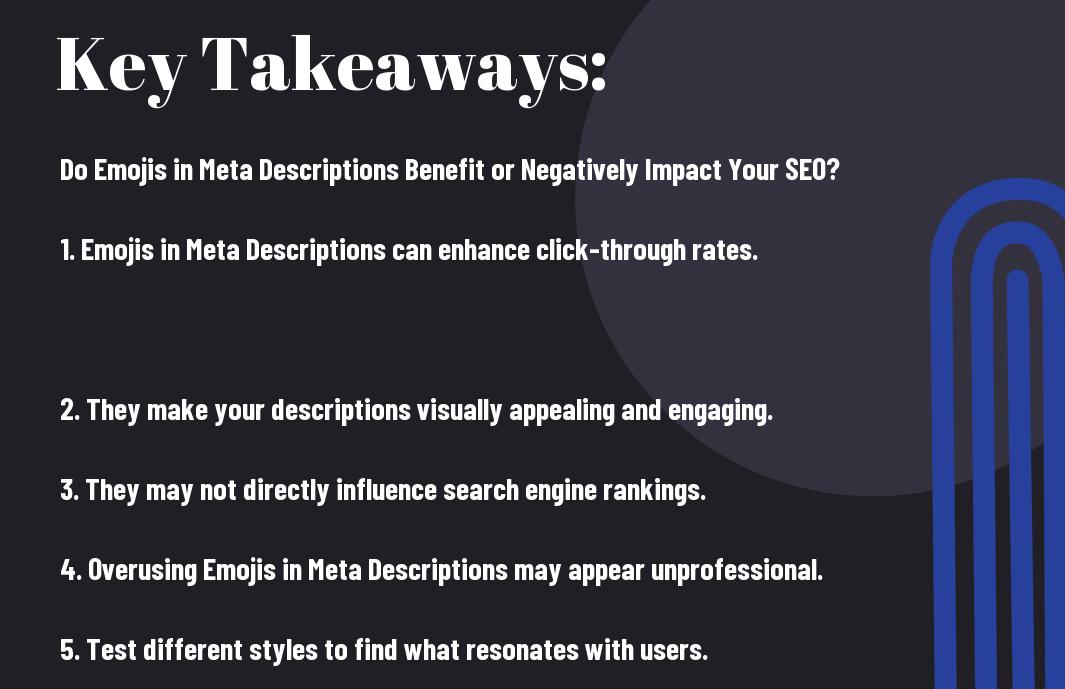
The central question most SEOs ask is simple: do emojis in meta descriptions actually improve performance? The evidence is mixed, but several patterns emerge consistently across studies and real-world tests.
CTR Data and Case Studies
Several independent analyses have tracked click-through rate changes after adding emojis to meta descriptions. The results below come from controlled tests with consistent organic positions held steady throughout: See our emoji CTR case studies for test data and results.
- Case Study 1 — E-commerce retailer: Reported a 12% increase in CTR after adding relevant product emojis (e.g., ⭐, 🛒) to category page descriptions. The improvement was most pronounced on mobile SERPs.
- Case Study 2 — SaaS company: Saw an 8% drop in CTR when emojis were removed from meta descriptions that had used them for six months — confirming that their audience had come to associate the visual cues with the brand’s listings.
- Case Study 3 — Content publisher: Experienced a consistent 15% uplift in engagement metrics — including lower bounce rate and higher pages-per-session — after implementing contextually matched emojis across blog post descriptions.
- Case Study 4 — B2B professional services: Reported no measurable CTR change and a small increase in negative brand feedback after adding emojis. This highlights that audience type is the single biggest variable.
Consequently, the data does not support a universal “always use” or “never use” conclusion. Instead, the results confirm that emojis in meta descriptions are a context-dependent tactic — effective for consumer-facing brands and casual content, neutral-to-negative for formal or B2B audiences.
Does Google Count Emojis Toward Character Limits?
Yes — each emoji counts as one or more characters toward your meta description limit, depending on the specific Unicode code point. Some complex emojis (such as skin-tone variants or multi-character sequences) can consume 2–7 characters. Therefore, always measure your description length after inserting emojis, not before. Use a pixel-width tool rather than a character counter for greater accuracy, since Google truncates based on pixel width, not character count.
Proven Benefits of Using Emojis in Meta Descriptions
When applied strategically, emojis in meta descriptions deliver several measurable and qualitative advantages. Understanding each benefit helps you decide whether the tactic aligns with your specific goals.
1. Increased Visual Differentiation in SERPs
A typical search results page is dominated by monochrome text. A single relevant emoji breaks that pattern immediately. The human eye is drawn to color and shape, so your listing receives a disproportionate share of visual attention — even before the reader processes the words. Furthermore, on mobile devices, where results are displayed in a narrower column, a well-placed emoji can act as a visual anchor that pulls the eye downward to your snippet.
2. Improved Click-Through Rates for Consumer Audiences
As the case studies above show, consumer-facing brands typically see the strongest CTR improvements. Emojis convey personality and approachability in a fraction of the space that words require. For example, a travel site using ✈️🌍 communicates adventure and movement instantly — reinforcing the emotional context of the page before the reader has read a single word.
3. Brand Personality and Recall
Consistent, recognisable emoji usage across your site’s meta descriptions creates a visual brand signature in search results. Over time, returning users begin to associate specific emojis with your brand. As a result, your listing becomes more familiar and therefore more trustworthy on repeated exposure — a compounding benefit that purely textual descriptions cannot replicate.
4. Emotional Resonance and Communication Efficiency
Emojis communicate emotion and tone in a way that is faster than prose. A ⭐⭐⭐⭐⭐ at the start of a review-page description signals quality immediately. A 🔒 conveys security for a fintech page. Similarly, a 💡 suggests insight or education for a blog post. In each case, the emoji amplifies the textual message rather than replacing it — which is precisely how they should be used.

Risks and Drawbacks You Must Not Ignore
Despite the potential upsides, emojis in meta descriptions carry real risks. Understanding these drawbacks fully is as important as understanding the benefits — particularly if you manage SEO for multiple brands or audience segments.
Compatibility and Rendering Inconsistencies
Not every device, browser, or operating system renders emoji characters identically. Older Android versions, certain Windows environments, and some screen readers either display a blank box, a raw Unicode code point (e.g., U+1F680), or an entirely different visual variant of the emoji. Consequently, a description that looks polished in Chrome on iOS may appear broken in an older browser — damaging the professional impression you intended to create.
Additionally, screen readers used by visually impaired users handle emojis inconsistently. Some read out the full Unicode description — for example, “face with tears of joy” — which can disrupt the natural flow of your meta description when spoken aloud. Therefore, accessibility is a genuine concern, particularly for organisations with legal obligations around web accessibility standards such as WCAG 2.1.
Cultural Misinterpretation Risks
Emojis do not carry universal meaning. A thumbs-up 👍 is interpreted positively in most Western cultures but is considered offensive in parts of the Middle East and West Africa. The folded-hands emoji 🙏 means “please” or “thank you” in English-speaking contexts but reads as a prayer gesture in others, and as a high-five in Japan. Furthermore, colour-based emojis carry different connotations across cultures — for example, white representing mourning in several Asian cultures.
If your site targets a global or multicultural audience, therefore, every emoji choice requires deliberate cultural vetting. A single misinterpreted emoji can alienate an entire demographic segment and reduce CTR in those regions. This risk is substantially higher than most SEO guides acknowledge.
Professionalism and Brand Alignment
For B2B companies, legal and financial services firms, healthcare providers, and other formal industries, emojis in meta descriptions frequently undermine brand credibility. A law firm with 🎉 in its meta description signals a tone mismatch that can actively reduce trust. Similarly, a hospital using 😊 in a clinical page description risks trivialising serious health content. In contrast, a consumer lifestyle brand that avoids emojis entirely may appear sterile or disconnected from its audience.
The rule, therefore, is straightforward: emojis must match your brand voice, not just the topic of the page.
Google May Strip Your Emojis Anyway
Google reserves the right to rewrite any meta description — including removing emojis it deems unhelpful. In practice, Google already rewrites meta descriptions for roughly 70% of queries, according to multiple industry studies. As a result, even a perfectly crafted emoji-enhanced description may never appear as written. This is not a reason to avoid emojis, but it is a reason to ensure your description reads well with or without them.

Emojis in Digital Marketing Beyond Meta Descriptions
The conversation about emoji usage in SEO does not stop at meta descriptions. Understanding how emojis function across the broader digital marketing landscape helps you maintain a consistent strategy.
Emojis in Title Tags
Title tags are the blue clickable headline in search results. Technically, you can insert emojis into title tags just as you can in meta descriptions. However, Google is even more aggressive about rewriting title tags than meta descriptions — and it is more likely to strip emojis from titles entirely. Furthermore, title tags carry keyword relevance weight, so replacing words with emojis can actively hurt ranking performance; see our shortening title tags split-test.
Emojis in Social Media and Email Subject Lines
In contrast to their moderate SEO impact, emojis perform demonstrably well in email marketing and social media. Studies consistently show that email subject lines containing emojis achieve open rates 20–25% higher than plain-text equivalents — particularly in B2C sectors. Similarly, social media posts with relevant emojis receive higher engagement rates. Therefore, even if you decide against using emojis in meta descriptions for your specific brand, consider leveraging them in these other channels where the evidence is stronger.
User Engagement Signals and Their Indirect SEO Value
When emojis successfully increase CTR without inflating bounce rate, the resulting engagement pattern — more clicks, longer dwell time, lower return-to-SERP rate — sends positive signals to Google’s ranking algorithms. As a result, the indirect SEO benefit of emojis is real, even though their direct ranking influence is not. This distinction is important: use emojis to earn clicks, and earn rankings by delivering on the promise those clicks represent.
How to Use Emojis in Meta Descriptions: A Step-by-Step Framework
Rather than guessing, follow a structured process. The following framework ensures you make evidence-based decisions about emoji usage rather than aesthetic ones. See results from A/B testing when evaluating snippet changes.
- Step 1 — Audit your audience and brand voice. Specifically, ask: is my primary audience consumer or professional? Is my brand tone playful, authoritative, or neutral? Only proceed with emojis if both answers align with casual-to-moderate visual communication.
- Step 2 — Select contextually relevant emojis only. The emoji must reinforce the page’s topic or emotional register. For example, a product page about fast delivery can use ⚡ or 🚚. However, do not use emojis simply because they look attractive — irrelevant emojis confuse rather than persuade.
- Step 3 — Vet every emoji for cultural safety. Cross-reference your chosen emojis against your target geographic regions. Use resources such as Emojipedia to check documented alternative interpretations before publishing.
- Step 4 — Write the description so it works without the emoji. Strip the emoji mentally and re-read the description. It must still be compelling, clear, and complete. This protects you when Google rewrites your snippet.
- Step 5 — Measure pixel width after insertion. Use a SERP snippet preview tool (such as the one in Yoast SEO or Rank Math) to confirm your description fits within the pixel-width limit after the emoji is added.
- Step 6 — Run an A/B test over at least 30 days. Split-test pages with and without emojis at equivalent ranking positions. Measure CTR via Google Search Console, not impressions alone. Furthermore, track on-site engagement metrics (bounce rate, pages per session) to ensure the emoji attracts relevant traffic, not curious misclicks.
- Step 7 — Analyse, document, and iterate. Record your results systematically. Roll out successful patterns to similar page types. Remove emojis where performance declined and document the reason — audience type, emoji choice, or page category.
Best Emojis to Use in Meta Descriptions (and Which to Avoid)
Not all emojis perform equally in search results contexts. Some are widely recognisable and visually clean at small sizes; others are ambiguous, culturally risky, or visually indistinct in monochrome rendering environments. Below is a practical guide.
High-Performing Emoji Categories
- Ratings and quality: ⭐ — universally understood, strong visual signal for review pages
- Action and speed: ⚡ 🚀 — effective for tech, SaaS, and delivery-focused pages
- Validation and trust: ✅ ✔️ — suitable for checklist, compliance, and guarantee pages
- Offers and value: 🏷️ 💰 — effective for discount, pricing, and deal pages
- Learning and insight: 💡 📚 — appropriate for educational content and guides
- Security: 🔒 🛡️ — strong for fintech, cybersecurity, and privacy pages
Emojis to Avoid in Meta Descriptions
- Face emojis with ambiguous tone: 😏 😜 😂 — subjective, easily misread, and appear unprofessional in most contexts
- Culturally variable gestures: 👍 🤞 🙏 — carry different meanings across regions
- Small or visually complex emojis: 🦋 🌸 🦔 — render poorly at small SERP font sizes
- Spam-associated emojis: 💥 🔥 repeated multiple times — associated with low-quality clickbait content
- Skin-tone variants: Multi-byte sequences that may render inconsistently across operating systems
Frequently Asked Questions About Emojis in Meta Descriptions
Do emojis in meta descriptions help SEO rankings directly?
No. Google has confirmed that emojis carry no direct ranking value. However, they can improve click-through rates, which indirectly benefits SEO performance over time by sending positive engagement signals.
Will Google always show my emoji in search results?
Not necessarily. Google selectively renders emojis and reserves the right to rewrite your meta description entirely. In practice, Google rewrites snippets for approximately 70% of searches. Therefore, always write a compelling description that functions well without any emoji present.
How many emojis should I use in a single meta description?
Use one to two emojis per description at most. Specifically, one emoji at the start and one near the call-to-action works well when both are contextually relevant. More than two risks a cluttered, spammy appearance that can actively reduce CTR.
Are emojis in meta descriptions suitable for every website?
No. Emojis work best for consumer-facing brands, lifestyle content, e-commerce, and casual editorial sites. In contrast, B2B companies, legal firms, healthcare providers, and financial services businesses generally see neutral-to-negative results. The deciding factor is always your specific audience’s expectations and your brand’s established tone.
Do emojis count toward the meta description character limit?
Yes. Each emoji counts as at least one character — and complex multi-byte emojis may count as more. Furthermore, Google truncates based on pixel width rather than character count, and emojis are typically wider than standard characters. Always use a pixel-width preview tool to verify your description fits before publishing.
Should I use emojis in title tags as well as meta descriptions?
Generally, no. Title tags carry keyword relevance weight, and Google rewrites them aggressively. Adding emojis risks losing keyword space without gaining a reliable visual benefit. In most cases, reserve emojis for meta descriptions where the rendering is more consistent and the ranking implications are lower.
Integrating Emojis Without Sacrificing SEO Quality
The most effective approach to emojis in meta descriptions is additive, not substitutive. Emojis should add a layer of visual personality on top of an already strong, keyword-aligned description — never replace the words that communicate value.
Above all, prioritise relevance. An emoji that reinforces your page’s subject — for instance, 🏠 on a real estate listing page — adds genuine communicative value. However, a random 🌟 added purely for decoration dilutes your message and signals low content quality.
Avoiding Common Mistakes
- Do not use emojis on every page: Reserve them for pages where visual differentiation in SERPs has the highest strategic value — typically high-competition landing pages and category pages.
- Do not substitute emojis for keywords: Your target keyword must still appear as text. Emojis carry no keyword weight.
- Do not ignore mobile rendering: Always preview your descriptions on both desktop and mobile SERP simulators.
- Do not use trending emojis: Cultural meaning shifts rapidly. An emoji popular this year may carry unintended associations next year. Stick to broadly recognised, stable symbols.
- Do not add emojis to descriptions that Google is already rewriting: Check Search Console to identify pages where your meta description is not being used — fixing the description’s relevance is a higher priority than adding visual elements.
Conclusion
Emojis in meta descriptions are a powerful but precision-dependent tactic. Used correctly — with the right emoji, for the right audience, on the right type of page — they can deliver measurable improvements in click-through rates and brand recall in search results. Used carelessly, they risk damaging brand credibility, confusing international audiences, or simply being stripped by Google before a single user sees them.
The key takeaway is that emojis in meta descriptions are a supplement to great writing, not a replacement for it. Your description must be compelling, keyword-aligned, and accurate first. The emoji is the final touch — a visual amplifier for a message that already works. Furthermore, A/B testing remains the only reliable way to know whether emojis help your specific audience. Start small, measure carefully, and scale what works; also review our keywords in meta descriptions guide to ensure your descriptions stay keyword-aligned.
At Rank Authority, we help you take the guesswork out of SEO decisions like this one. By combining automated optimisation with data-driven testing, you can identify exactly how emojis in meta descriptions affect your site’s performance — and continuously refine your strategy for maximum organic visibility. For a deeper walkthrough, see our Disavow: The Complete Guide to Removing Toxic Links. Last updated: 2026-07-30. Author: Rank Authority Editorial Team.

