
Suggested slug: aeo-strategy
AEO Strategy: The Complete 2025 Playbook to Win AI Answers, Citations, and Generative Search
AEO strategy playbook: The most thorough guide to building an aeo strategy that earns citations from ChatGPT, Perplexity, Google AI Overviews, voice assistants, and every major LLM — including a full framework, keyword tactics, schema implementation, measurement stack, content templates, and real workflows.
Direct Answer
An AEO strategy is the systematic, repeatable plan for earning top-of-answer visibility across AI search engines, LLM chatbots, voice assistants, and generative overviews — by mapping user question intents, crafting concise verifiable answer units (30–70 words), structuring them with schema markup, backing every claim with authoritative citations, and measuring zero-click impressions and AI attribution over time. Related background: Answer Engine Optimization. See our <a href="https://rankauthority.com/answer-engine-optimization-the-complete-guide-3">Answer Engine Optimization guide</a> for complementary tactics and examples.
Answer Engine Optimization has crossed a threshold: it is no longer a forward-looking experiment. Google AI Overviews appear on a significant share of all informational queries. ChatGPT processes hundreds of millions of queries daily. Perplexity, Claude, Gemini, and Bing Copilot are embedded into browsers, operating systems, mobile apps, and enterprise software. Voice assistants on phones and smart speakers answer questions without ever displaying a ranked list of links.
If your content isn’t structured to be cited by these systems, it doesn’t exist in the answer layer — regardless of how well it ranks in traditional search. Answer Engine Optimization
This guide is the most comprehensive aeo strategy resource available. It covers every foundational concept, the complete 7-part operational framework, step-by-step implementation workflows, keyword and content tactics, schema markup specifics, a full measurement stack, business-type adaptations, common mistakes, and a reusable QA checklist. Every section is immediately actionable.

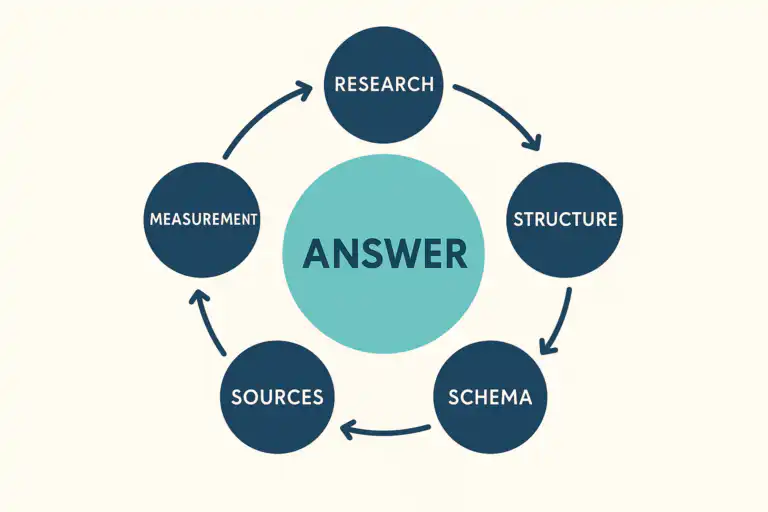
The AEO strategy flywheel: intent research → answer units → schema → authoritative sources → measurement → compounding citation share. See also AISEO 2026 Playbook.
What Is AEO Strategy? The Full Definition
An AEO strategy — Answer Engine Optimization strategy — is the repeatable, measurable system for making your content the first and safest source that AI-powered systems extract, summarize, and cite when users ask questions across any surface or device. See AEO explained for 2025.
The goal is not a click on a blue link. The goal is your brand’s phrasing, your data, your expertise being read aloud by a voice assistant, surfaced at the top of a Google AI Overview, embedded inside a ChatGPT response, or cited as the source in a Perplexity answer card. Those interactions happen whether or not the user ever visits your page — and they build trust, shape decisions, and drive commercial outcomes at scale.
An AEO strategy encompasses six core workstreams, each essential to the whole:
- Intent mapping: identifying and clustering every question your audience asks, by type and priority.
- Answer unit creation: writing 30–70 word concise, verifiable, machine-readable responses before elaborating with supporting context.
- Structured data: wrapping content in schema markup so parsers understand content type, entity, and intent.
- Source authority: citing reputable external references that make AI systems confident your claims are safe to repeat.
- Entity clarity: maintaining consistent brand, author, and topic signals across your site and every external profile.
- Measurement: tracking answer share, AI citation rate, zero-click impressions, and assisted conversions on a defined cadence.
For technical grounding in how machines connect entities and topics — the infrastructure all AEO strategy depends on — see the Knowledge Graph (Wikipedia).
Why AEO Strategy Is Business-Critical in 2025
The shift is measurable, not speculative. AI-generated answer surfaces are consuming a growing share of zero-click queries across every major search and assistant platform. Three urgent realities define why every content team needs an active aeo strategy today:
- Visibility without clicks is the new primary metric. Your brand can be seen, trusted, and acted on by thousands of users who never visit your page — but only if you are the cited source in the answer layer.
- Trust signals have replaced keyword density. AI systems select sources based on verifiability, source credibility, entity consistency, and answer clarity — not repetition of a target keyword.
- Content architecture determines extractability. Pages not structured for machine parsing will be skipped regardless of quality. Schema, answer blocks, and question-style headings are the new technical SEO.
Compounding matters here: the sites that begin earning AI citations now are building entity authority that becomes progressively harder for competitors to displace. The answer layer doesn’t reset every algorithm update — it builds on prior citation history and trust signals over time.
Companies without an active AEO strategy are ceding this increasingly influential answer layer to competitors who have one.
AEO vs. SEO vs. GEO vs. LLM Optimization: The Definitive Breakdown
These four disciplines overlap significantly but serve distinct goals and require different resource allocations. Confusing them leads to misaligned investment. Here is the clear breakdown every strategist needs:
| Discipline | Primary Target | Core Lever | Success Metric | Time Horizon |
|---|---|---|---|---|
| SEO | Ranked blue links in SERP | Keywords, backlinks, technical | Organic clicks, rank position | Weeks to months |
| GEO | AI overviews inside search engines | Structured content, authority — see SEO Content Optimization. | Overview appearances, impressions | Weeks to months |
| AEO | Direct answers across ALL AI surfaces | Answer units, schema, source trust | Answer share, AI citations, zero-click | 2–8 weeks (initial), compounds |
| LLM Optimization | Training data inclusion and recall (LLM visibility optimization) | Entity prominence, source frequency | Brand mentions in LLM outputs | Months to years |
Key distinctions your aeo strategy must internalize:
- SEO wins ranked documents. AEO wins the answer itself — including on platforms that have no ranked documents at all, like voice assistants and standalone LLM chatbots.
- GEO is AEO’s closest cousin but is limited to search engine AI surfaces. A well-executed AEO strategy achieves GEO as an automatic byproduct.
- LLM Optimization targets training data memorability — a long-horizon play requiring consistent entity prominence across the web. AEO targets live retrieval and real-time citation today.
- All four share common ground: clear content, strong entity signals, and authoritative sourcing benefit every channel simultaneously. AEO investment is almost never wasted on other channels.
💡 The AEO Keyword Dimension: What Competitors Miss
AEO strategy requires a fundamentally different approach to keywords. Traditional SEO keyword strategy targets query volume and competition scores. AEO keyword strategy targets question intent patterns — the specific phrasing AI systems receive most frequently. This means mining “what is,” “how do I,” “best X for Y,” and “X vs Y” phrasing at scale, not just head terms. Your keyword list for AEO is a question inventory, not a volume spreadsheet.

AEO strategy places your content as the safest, clearest cited source inside AI overviews across every platform and device.
How Answer Engines Actually Select Content (What Your AEO Strategy Must Account For)
To build an effective aeo strategy, you must understand what answer engines are actually doing when they select which content to surface. The selection process involves five overlapping stages — and your content must pass all of them to earn a citation.
1. Intent Recognition
AI systems classify queries into intent types: definitional (“what is”), comparative (“X vs Y”), procedural (“how to”), evaluative (“best X for Y”), and navigational. Your content must signal which type it satisfies — in the heading, the opening sentence, and the structural format of the response. Misaligned intent signals cause parsers to skip otherwise high-quality content.
2. Fact and Span Extraction
AI parsers identify “extractable spans” — self-contained sentences or short paragraphs that answer a question without requiring surrounding context. Your answer unit must make complete sense in isolation. Phrases like “as we discussed above” or “in the context of this guide” are extraction killers — they create dependency on surrounding text that AI systems cannot resolve cleanly.
3. Source Safety Assessment
Before citing any source, AI systems perform a trust assessment: Is the claim independently verifiable? Does the site have consistent author and organizational signals? Are external citations present and credible? Does the content handle sensitive topics responsibly? Pages that fail these checks are deprioritized regardless of their traditional rank position. This is why E-E-A-T and AEO are deeply intertwined.
4. Entity Resolution
Answer engines use knowledge graphs to resolve entities — your brand, your authors, your core topics. Inconsistent naming across pages (“John,” “J. Smith,” and “our founder” for the same person) causes entity resolution failures. Consistent naming, sameAs schema links, and a unified About page help machines understand exactly who you are and what you are genuinely authoritative about.
5. Recency and Freshness Signals
For time-sensitive topics, answer engines prefer recently updated content. Visible date stamps, revision notes (“Updated: Q2 2025”), and periodic content refreshes signal recency and responsible authorship. For evergreen topics, freshness still matters when examples or statistics are referenced — outdated data actively reduces citation preference even on otherwise strong pages.
AEO Keyword Strategy: How to Research and Target Questions AI Engines Answer
An AEO keyword strategy is fundamentally different from traditional SEO keyword research. Where SEO targets search volume and competition metrics, AEO targets the exact question phrasing that real users type into AI engines — and the intent pattern behind each question type.
The Five AEO Keyword Intent Patterns
Map every target question to one of these five patterns before writing your answer unit. The pattern determines the format, length, and structure of the optimal response:
| Intent Pattern | Example Phrasings | Optimal Format | Schema Type |
|---|---|---|---|
| Definitional | “What is AEO strategy?” / “Define answer engine optimization” | 1-sentence definition + qualifying detail | FAQPage, Article |
| Procedural | “How do I build an AEO strategy?” / “How to optimize for AI answers” | Numbered step list | HowTo, FAQPage |
| Comparative | “AEO vs SEO” / “AEO vs GEO — what’s the difference?” | Comparison table + 3–5 bullet distinctions | FAQPage, Article |
| Evaluative | “Is AEO worth it?” / “Best AEO tools for small business” | Verdict box + pros/cons or ranked list | FAQPage, Review |
| Measurement | “How do I measure AEO results?” / “AEO metrics and KPIs” | Named metrics table + tracking method per metric | Article, HowTo |
Where to Mine AEO Keywords and Questions
Mine questions from multiple sources simultaneously for a complete picture of what your audience is asking AI engines right now:
- SERP “People Also Ask” boxes — the most direct signal of what question formats Google surfaces for your topics
- Site search logs — questions your existing audience is already asking on your own properties
- Support tickets and sales call recordings — real natural-language phrasing from real people in your buying cycle
- Reddit, Quora, and niche community forums — unfiltered question phrasing in your domain
- Competitor FAQ sections and PAA coverage gaps — questions they’re answering that you’re not
- Direct AI chatbot prompting — type your core topic into ChatGPT, Perplexity, and Gemini; catalog every follow-up and related question surfaced
- AnswerThePublic and AlsoAsked — visual question maps showing related question clusters
- Voice search phrasing — conversational question forms that voice assistants receive, typically longer and more natural than typed queries
Clustering Your AEO Question Inventory
After mining, cluster questions into these eight intent categories — they cover the vast majority of informational, commercial, and evaluative queries your audience asks:
- Define: “What is X?” / “Define X”
- Compare: “X vs Y — which is better?”
- Choose: “Best X for [use case / audience]”
- Price: “How much does X cost?” / “Is X worth the price?”
- Troubleshoot: “Why is X not working?” / “How do I fix X?”
- Implement: “How do I set up X?” / “Step-by-step guide to X”
- Evaluate: “Is X worth it?” / “X pros and cons” / “X review”
- Govern: “Best practices for X” / “X compliance rules” / “X standards”
Each cluster becomes a content pillar with a pillar page (answering the core definitional question) and supporting cluster pages (answering every sub-question at depth). This architecture is how you build topical authority that AI systems recognize and trust.
The 7-Part AEO Strategy Framework
The following framework is the operational core of a complete aeo strategy. Each part is a discrete workstream with its own inputs, outputs, and quality criteria. Execute all seven in parallel — they are mutually reinforcing, not sequential.
Part 1: Intent Research and Question Mining
Every AEO strategy begins with knowing exactly what your audience asks and how. Mine questions from all sources listed in the keyword strategy section above. For each question, identify: the canonical phrasing, the intent category, the expected answer format, competing sources currently cited in AI responses, and the business priority of the topic.
Prioritize your question inventory by a weighted score combining: estimated query frequency, business value (conversion proximity), current AI citation gap (where competitors are cited but you are not), and content readiness (how close your existing content is to a citable answer unit).
📌 Output of Part 1:
A prioritized question inventory spreadsheet with columns: canonical question, intent category, priority score, current AI citation status (who’s cited), target cluster, assigned owner, and target publish/update date.
Part 2: Craft the Answer Unit
The answer unit is the atomic building block of AEO strategy (see our Complete AEO guide for extended examples). It is a 30–70 word direct response to a specific question, written in plain language, free of hedging, and extractable without any surrounding context. Think of it as the minimum viable answer — the one sentence or two that an AI would read aloud to a voice assistant user.
Answer unit anatomy:
- Sentence 1: Direct definition or answer. No preamble, no throat-clearing, no “great question.”
- Sentence 2: The single most important qualifying condition or distinction.
- Sentence 3 (optional): The key implication or action takeaway for the reader.
Follow the answer unit immediately with a 120–180 word expansion: supporting steps, a mini-checklist, a comparative example, or a data point. Target reading grade 8–10. Every claim must be verifiable. Avoid passive voice, vague superlatives, and any language that requires context to make sense.
❌ Weak answer unit (fails AEO — context-dependent and vague):
“In this comprehensive guide, we’ll explore the many dimensions of answer engine optimization and what it might mean for your broader digital marketing approach going forward…”
✅ Strong answer unit (wins AEO — standalone, verifiable, clear):
“An AEO strategy is the systematic plan for earning citations from AI answer engines by writing concise verifiable responses, structuring them with schema markup, and backing them with authoritative sources. Unlike traditional SEO, success is measured by answer share and AI citation rate rather than click-through rate or keyword ranking.”
Part 3: Structure with Schema Markup
Schema markup is the machine-readable translation layer between your content and AI parsers. It does not change what users see — it tells machines what your content means, who produced it, and what type of answer it contains. For AEO, prioritize these schema types in this order:
- FAQPage: wraps question-answer pairs — the single highest-impact schema type for AEO. Use on every page with a Q&A section.
- HowTo: marks up sequential process steps with names, descriptions, and step-level URLs. Critical for procedural intent queries.
- Article / BlogPosting: establishes authorship, publication date, and topic signals. Baseline requirement for editorial content.
- Organization: ties your brand to a stable entity record with consistent identity signals. Critical for entity resolution.
- sameAs: links your entity to authoritative profiles — Wikipedia, Wikidata, LinkedIn, Crunchbase. Essential for knowledge graph inclusion.
- BreadcrumbList: reinforces site hierarchy and topic relationship signals.
- SpeakableSpecification: explicitly designates which sections are suitable for voice assistant reading — uniquely relevant to AEO and frequently overlooked.
Validate all schema using Google’s Rich Results Test immediately after implementation. Fix every warning before publishing. Schema with errors is worse than no schema — it creates ambiguity that actively undermines parser confidence. See the official vocabulary at Schema.org (Wikipedia).
Part 4: Prove Claims with Authoritative Sources
AI systems are reluctant to cite sources that make unsupported claims. For every key claim in your content, provide at least one independently verifiable reference. The source hierarchy for AEO trust (highest to lowest):
- Tier 1: Government databases, academic journals, peer-reviewed research
- Tier 2: Major industry publications, established news organizations, Wikipedia
- Tier 3: Recognized industry analysts, vendor documentation, official standards bodies
- Tier 4: Your own first-party research, benchmarks, and proprietary data (valuable but requires full transparency about methodology)
Do not rely solely on self-referential citations — citing only your own content creates a closed loop that AI systems systematically distrust. Balance owned research with credible external references on every major content page. Aim for at least two independent external sources per key claim cluster.
Part 5: Design for Skimmability and Machine Parsing
Skimmability serves two audiences simultaneously: human readers who scan before committing, and AI parsers that extract the highest-signal spans first. Structural principles to apply to every page in your AEO program:
- Place your answer unit in a visually distinct bordered box within the first 200 words.
- Use descriptive, question-style H2 and H3 headings that mirror actual user queries verbatim when possible.
- Keep paragraphs to 3–5 sentences maximum. One idea per paragraph — no multi-topic paragraphs.
- Use step-numbered lists for process content; bullet lists for feature or comparison content.
- Include figure captions that expand on or restate the answer unit nearby.
- Add a key takeaways box or summary table for content exceeding 1,500 words.
- Use bold text for key terms and critical phrases — AI parsers weight bolded text as higher signal than surrounding prose.
- Use comparison tables with clear column headers for any X-vs-Y or options-evaluation content.
Part 6: Maintain Answer Safety and Content Responsibility
AI systems apply safety filters before citing any source. Content that makes overreaching claims, omits necessary conditions, or handles sensitive topics irresponsibly will be systematically deprioritized. Build answer safety into your creation workflow with these standards:
- Qualify conditions explicitly: “This applies when…” / “In most implementations…” / “As of [date]…”
- Timestamp time-sensitive claims. Prices, regulations, statistics, and platform features change. Date-stamped claims signal responsible authorship.
- Avoid definitive claims in YMYL domains (health, finance, legal) without professional citations and clear qualifiers.
- Use precise language. “Can reduce costs by up to 30% in some implementations” is safer and more credible than “saves 30%.”
- Clarify scope and applicability. State who the content applies to — and who it does not. Reducing misuse risk is something AI systems reward.
Part 7: Measure, Iterate, and Expand
An AEO strategy without measurement is just a publishing strategy. Implement a structured measurement cycle at three cadences:
- Weekly: Sample 10–20 target prompts across ChatGPT, Perplexity, and Gemini. Record which sources are cited and whether yours appears.
- Monthly: Review answer share by cluster, track AI citation trends, and measure zero-click impressions in Google Search Console.
- Quarterly: Audit entity consistency across all profiles. Refresh answer units with new examples and updated citations. Fill cluster gaps where coverage is thin.
As you earn AI citations, reinforce winning pages with fresh imagery, internal links from related cluster pages, and expanded supporting context. Pages that get cited most deserve the most investment — this is how citation share compounds.

Schema + concise answers + measurement: the three-part operational engine of every successful AEO strategy.
Step-by-Step AEO Strategy Implementation
The following six-step process turns the framework above into a working implementation timeline. Each step has a clear deliverable so your team always knows what “done” looks like.
Build Your Answer Inventory
Export your top questions from all intent research sources. For each question, create a row in your answer inventory: canonical question, 30–70 word answer unit, 150-word expansion, 2–4 external citations, target schema types, assigned owner, and review date. Prioritize questions by a weighted score of search frequency, business value, and current AI citation gap. This living document becomes the operational backbone of your aeo strategy — every sprint pulls from it, every review updates it.
Create Page-Level Answer Blocks
Insert a visually distinct answer block near the top of each page — within the first 200 words. Use a bordered box with a clear label (“Direct Answer,” “Quick Summary,” or “Key Definition”). Include the target question phrase naturally in the block. Follow with body content that expands with steps, examples, and supporting data. Keep exactly one idea per block: one question, one answer. Compound answer blocks confuse parsers and dilute extraction confidence significantly.
Add and Validate Schema Markup
Wrap FAQ sections in FAQPage schema, process steps in HowTo, and editorial content in Article or BlogPosting. Include sameAs links in your Organization schema pointing to LinkedIn, Wikipedia, Crunchbase, and other authoritative profiles. Add SpeakableSpecification to designate voice-readable sections. Validate every implementation with Google’s Rich Results Test and consult our Google AI Overviews guide for GEO-specific schema signals. Fix all warnings before publishing. Schedule schema revalidation every 90 days — schema vocabularies evolve and errors accumulate silently.
Strengthen Entity Signals and Authorship
Conduct a full entity audit: ensure your organization name, brand name, founder names, and key product names are consistent across every page on your site, every social profile, and every directory listing. Create rich author pages with credentials, expertise signals, and links to externally published work. Make your About page a single source of truth for your organizational entity. Interlink related topic cluster pages to build topical authority signals that AI systems can traverse and verify.
Build Internal Links That Mirror Question Intent
Use anchor text that mirrors the canonical questions in your intent inventory — not just head-term keywords. “What is answer engine optimization?” is a stronger AEO anchor than “AEO” alone, because it signals to parsers the precise intent relationship between linked pages. See our AEO guide for cluster examples. Link from your pillar page to every cluster sub-page, and from each cluster page back to the pillar. Build cluster maps showing how supporting pages radiate outward — this architecture makes topical authority legible to AI systems.
Set a Content Refresh Cadence
Review every answer unit quarterly at minimum. For rapidly changing topics (AI platforms, pricing, regulations), schedule monthly reviews. When updating: add the revision date visibly, update statistics and examples, strengthen citations, and add any new qualifying conditions. Add version notes at the bottom of high-traffic pages (“Last reviewed: Q2 2025 — statistics updated”). These signals help both machines detect recency and users trust that the content is current and maintained.
AEO Strategy Metrics: The Complete Measurement Stack
Traditional SEO metrics — rankings, CTR, organic sessions — are necessary but fundamentally insufficient for evaluating AEO performance. An effective aeo strategy requires a blended measurement stack that captures both machine-layer and human-layer impact. Here is the complete stack:
| Metric | What It Measures | How to Track | Target Benchmark |
|---|---|---|---|
| Answer Share | % of sampled prompts where your content is cited or echoed | Manual prompt sampling; AI monitoring tools | ≥20% of target cluster |
| AI Citation Rate | Named URL or brand mentions in AI responses | Perplexity sampling, ChatGPT manual logs, Bing Copilot | Positive trend MoM |
| Non-Click Visibility | Impressions in AI modules, voice reads | Google Search Console (AI Overview impressions filter) | +15% MoM growth |
| Assisted Conversions | Conversions following AI answer exposure in path | GA4 multi-touch attribution; CRM source tracking | +10% QoQ delta |
| Entity Coverage Depth | How fully your cluster represents subtopics vs. total mapped | Content gap audit vs. competitor and PAA landscape | ≥80% subtopic coverage |
| Prompt-to-Page Success | Rate that AI answers recommend or link your page for depth | Manual sampling; referral traffic from AI platforms in GA4 | Track trend direction |
📊 Recommended AEO Scorecard Structure
Maintain one scorecard per content cluster, updated monthly. Track these five indicators:
- Answer share: target ≥20% of sampled prompts
- AI citation rate: track trend direction month-over-month
- Zero-click impression growth: month-over-month percentage change
- Assisted conversion delta: vs. prior quarter via GA4
- Entity coverage score: intent subcategories answered ÷ total mapped × 100
AEO Content Patterns That Win AI Citations
Not all content formats are equally extractable. These patterns consistently outperform generic prose in AI citation selection across platforms:
- Definition boxes at page top: A clearly labeled “What is X” box within the first 150 words dramatically increases extraction probability for definitional queries. Label it visually — bordered, shaded, and labeled with a prefix like “Direct Answer.”
- Trade-off comparisons in 3–5 bullets: For “X vs Y” queries, a tight bullet summary outperforms paragraphs because it provides a clean, self-contained decision framework that parsers can lift verbatim.
- Numbered how-to steps: Sequential steps with clear names and short descriptions are among the most extractable content patterns for procedural intent — and they map directly to HowTo schema.
- Data-backed claims with dates and sources: “According to [Source], X increased by Y% in [Year]” is far more citation-worthy than “X has grown significantly recently.”
- Context-independent short examples: 2–3 sentence examples that can be quoted verbatim without requiring the surrounding 500 words for comprehension.
- Comparison tables with clear headers: Structured tables help AI parsers understand relationships between concepts, products, or options at a glance — and reproduce them in tabular AI responses.
- FAQ sections with FAQPage schema: The combination of structured Q&A format with matching markup is one of the most reliable AEO tactics available today — and among the easiest to implement on existing pages.
- Speakable sections explicitly designated: Using SpeakableSpecification schema to label sections written for voice reading gives AI assistants a direct signal about which content to surface in audio responses.
AEO Strategy for Voice Search and Screenless Devices
Voice search represents one of the most underserved dimensions of an aeo strategy. Voice assistants — Siri, Google Assistant, Alexa, Cortana — return exactly one answer per query. There is no second result. If you are not cited first, you are invisible.
Voice queries differ from typed queries in three important ways that your AEO strategy must account for:
- Conversational phrasing: Voice queries are typically longer and more natural than typed queries. “What’s the best way to build an AEO strategy for a small business?” rather than “AEO strategy small business.”
- Implicit local intent: Many voice queries have local or contextual intent even when not explicitly stated. AEO strategy for voice must account for contextual modifiers.
- Single-answer format: Voice assistants read one response aloud. Your answer unit must work as a spoken paragraph — no tables, no bullet lists, no “see below.” Write as you would speak.
Voice-Optimized AEO Tactics
- Write answer units in complete, spoken-language sentences — avoid fragment lists in the core answer.
- Add SpeakableSpecification schema explicitly designating your answer sections as voice-appropriate.
- Use conversational question phrasing in H2/H3 headings to match voice query patterns.
- Keep answer units between 40–60 words — the optimal length for voice reading without listener fatigue.
- Test your answer units by reading them aloud. If they sound unnatural spoken, rewrite until they don’t.
AEO Strategy by Business Type
An effective aeo strategy looks different depending on your business model, audience, and content library. For multi-location operations, review our <a href="https://rankauthority.com/ai-seo-for-multi-location-businesses-2026-playbook">multi-location AI SEO playbook</a>. Here is how to adapt the core framework for each major business type:
B2B SaaS and Technology Companies
Priority question clusters: “what is X,” “how does X work,” “X vs [competitor],” “best X for [industry].” Focus schema on Product, Organization, and HowTo. Prioritize thought-leadership content with named expert authors and strong domain expertise signals — AI systems favor authoritative voices in technical domains. Build deep cluster coverage around each product capability, not just top-level marketing claims.
E-Commerce and Retail
Priority question clusters: “how to choose X,” “best X under [price],” “how to use X,” “X size guide,” “X vs Y — which is better.” Focus schema on Product, FAQPage, and HowTo. Pair product pages with supporting educational content that answers pre-purchase questions AI systems receive constantly. Product-adjacent content (buying guides, care instructions, comparison articles) often earns more AI citations than product pages themselves.
Professional Services (Legal, Financial, Medical)
YMYL domains require the highest standard of answer safety. Prioritize Tier 1 and Tier 2 citations exclusively. Add verified professional credentials to author schema — bar number, license number, board certification. Include explicit disclaimers within answer units (“This is general information, not legal/financial/medical advice”). AI systems are particularly conservative about citing YMYL content without demonstrably strong trust signals. Invest in E-E-A-T signals aggressively — they directly determine AEO eligibility in these domains.
Publishers and Content Media
Entity authority is the primary lever — AI systems strongly prefer citing recognized publications over anonymous content. Focus on Article and NewsArticle schema with named journalists and editors. Build topical authority by fully covering clusters rather than skimming many topics shallowly. First-party research, original data, and exclusive interviews dramatically increase citation preference and are among the fastest ways for publishers to differentiate in the answer layer.
Local Businesses and Service Providers
Local AEO strategy combines entity consistency with geographic signals. Ensure your business name, address, and phone number (NAP) are identical across every platform. Use LocalBusiness schema with precise geographic coordinates. Answer locally-inflected questions your audience asks: “best [service] in [city],” “how to find [service] near me.” Claim and maintain your Google Business Profile — it feeds directly into local AI answer surfaces. Build content around neighborhood-specific questions that national competitors cannot answer as accurately as you can. See our Geotargeted AI Visibility guide for implementation steps.
Common AEO Strategy Mistakes to Avoid
These are the most frequently observed errors in organizations attempting to build an AEO strategy — and exactly why each one directly reduces AI citation probability:
- Burying the answer. Leading with brand story, category overview, or table of contents before the answer unit forces AI parsers to work harder and reduces extraction confidence. Answer first, context second — always, without exception.
- Inconsistent entity signals. Different names, URLs, and descriptions for your brand, authors, or products across your site and external profiles create entity ambiguity that AI systems resolve by deprioritizing you. Consistency is a prerequisite, not a bonus.
- Zero or self-referential citations only. Citing only your own content creates an isolated trust ecosystem. At least one independent, high-authority external source is required per major claim cluster — this is non-negotiable for AI citation selection.
- Optimizing for keywords instead of question intents. Keyword density signals are near-irrelevant for AI citation selection. Intent alignment — writing specifically for the question type and user need — is the dominant factor in the answer layer.
- Schema drift and accumulated warnings. Schema implementations that haven’t been revalidated in months frequently accumulate errors as vocabulary evolves. Broken or outdated schema creates false signals that may actively hurt more than no schema at all.
- Measuring only clicks. If your only success metric is organic CTR, you have a fundamental gap in your AEO measurement stack. Zero-click citations and AI-assisted conversions will never appear as organic sessions — but they represent real and growing commercial value.
- Treating AEO as a one-time project. Answer engine algorithms, AI models, and platform behavior evolve continuously. An AEO strategy is an ongoing operational discipline with a defined weekly and monthly cadence, not a campaign with a start and end date.
- Ignoring voice search entirely. Optimizing for text-based AI responses while neglecting voice assistant queries leaves a significant and growing share of the answer layer uncaptured. Voice queries require distinct formatting: shorter answers, conversational phrasing, and SpeakableSpecification markup.
AEO Strategy Tooling and Weekly Workflows
The tooling ecosystem for AEO is maturing rapidly. A practical, high-ROI stack can be assembled from available platforms today without enterprise-level budget:
Research and Intent Mining
- Semrush / Ahrefs: keyword clustering, PAA extraction, competitor content gap analysis
- AnswerThePublic / AlsoAsked: question maps for visual intent cluster mapping
- Reddit, Quora, Exploding Topics: real natural-language question discovery in your niche
- Optimize for ChatGPT answers / Perplexity / Gemini: direct prompt testing to identify follow-up questions and current citation gaps
Schema Implementation and Validation
- Google Rich Results Test: primary validation tool for schema correctness and warnings
- Schema.org validator: detailed vocabulary compliance checking
- Yoast SEO / RankMath / Rank Authority: CMS-integrated schema generation with validation For a deeper walkthrough, see our AEO Services for Local Businesses: The Complete Guide.
AEO Measurement and Monitoring
- Google Search Console: AI Overview impressions, zero-click data, query performance by page
- Perplexity / ChatGPT manual sampling: prompt testing for citation tracking and competitive intelligence
- GA4 with multi-touch attribution: assisted conversion tracking from AI platform referrals
- Dedicated AEO monitoring platforms: emerging tools (e.g., Profound, Ahrefs AI Content Grader) providing automated citation tracking at scale
The 60-Minute Weekly AEO Sprint
Operationalize your AEO strategy with a structured 60-minute weekly sprint that any team member can execute:
- (15 min) Draft 3 new answer units from the highest-priority items in your intent inventory.
- (15 min) Refresh 2 existing answer units — update examples, statistics, or citations flagged as stale.
- (10 min) Validate schema on any recently edited pages. Fix all warnings immediately.
- (10 min) Add or update one external citation across the highest-priority pages.
- (10 min) Sample 5 target prompts in Perplexity and ChatGPT. Record citation results in your AEO scorecard.
For streamlined AEO tooling that emphasizes answer unit creation and schema without unnecessary complexity, the AI Search Visibility Tool supports this workflow.
AEO Strategy Quick Checklist
Use this checklist to audit any existing page for AEO readiness or to QA new content before publishing. Every item represents a signal that increases AI citation probability:
📋 Per-Page AEO Checklist
- ☐ Answer unit (30–70 words) placed within first 200 words in a distinct labeled box
- ☐ Answer unit is fully extractable and makes sense without any surrounding context
- ☐ Target keyword/question phrase appears naturally in H1, H2, answer unit, and conclusion
- ☐ At least one FAQPage, HowTo, or Article schema block implemented
- ☐ Schema validated — zero warnings in Google Rich Results Test
- ☐ SpeakableSpecification markup applied to voice-appropriate answer sections
- ☐ At least 2 independent external citations for key claims — no self-referential-only loop
- ☐ Author and organization entity consistent with sitewide naming and schema sameAs links
- ☐ Time-sensitive claims date-stamped (stats, prices, regulations, platform features)
- ☐ H2 and H3 headings mirror canonical question phrasing from intent inventory
- ☐ Internal links use question-style anchor text, not just head-term keywords
- ☐ Voice-optimized: answer unit reads naturally aloud; SpeakableSpecification applied
- ☐ Page assigned to a cluster with review date logged in answer inventory
- ☐ Zero-click impressions and AI citation rate tracked in monthly cluster scorecard
Case Study: AEO Strategy in Practice (Hypothetical B2B Scenario)
To illustrate the combined impact of a full AEO strategy implementation, consider this hypothetical B2B SaaS scenario modeled on common patterns observed across implementations:
Situation: A B2B software company with 40+ product pages had strong organic rankings but near-zero presence in AI answers. The support team reported that prospects arrived with AI-influenced misconceptions about the product category, indicating that AI surfaces were actively describing the space — just without citing this company.
Implementation (8 weeks): Shipped 40 answer units across 12 cluster pages. Added FAQPage and HowTo schema. Standardized author bios and Organization schema with sameAs links to LinkedIn and Crunchbase. Cited three authoritative external sources per page. Added SpeakableSpecification to five core answer pages. Established a weekly 60-minute sprint cadence.
Results after 8 weeks:
- AI Overview citations across target prompts rose from 6% to 28%
- Zero-click impressions increased 41% month-over-month
- Assisted demo bookings up 19% quarter-over-quarter
- Schema warnings reduced to zero across all 12 cluster pages
- AI-generated product misconceptions in prospect conversations declined — verified via prompt testing
- Voice search citation appearance confirmed on 3 target queries via Siri and Google Assistant sampling
Key takeaway: The fastest gains came from retrofitting answer units onto existing, already-indexed, already-authoritative pages. Incremental content improvements to existing authority consistently outperform new page creation in the short term. Start with your best pages, not a blank slate.
Frequently Asked Questions: AEO Strategy
What is an AEO strategy?
An AEO strategy is the repeatable, measurable system for winning citations from AI answer engines — including LLM chatbots like ChatGPT, voice assistants, Google AI Overviews, and Bing Copilot — by writing concise verifiable answer units, structuring them with schema markup, supporting them with authoritative external citations, and measuring zero-click impression impact and citation rates over time. It is the Answer Engine Optimization equivalent of an SEO strategy, but targeted at the direct answer layer rather than ranked document lists.
How is AEO different from SEO?
SEO targets ranked document links in search engine result pages and measures success via click-through rate and organic sessions. AEO targets the direct answer itself — the text, voice response, or cited source that AI surfaces produce — and measures success via answer share, AI citation rate, and zero-click impressions. AEO uses answer units, schema markup, and source trust as primary levers rather than keyword density and backlink volume. You can rank #1 in SEO and have zero AEO presence; the reverse is also increasingly possible.
How long does it take to see AEO results?
Early lift in AI citation rates typically appears within 2–6 weeks for pages where answer blocks and schema are added to already-indexed, already-authoritative pages. Broader entity authority — the kind that earns consistent citations across a wide prompt landscape — compounds over 3–6 months of consistent execution. The fastest wins come from retrofitting answer units onto existing high-authority pages rather than creating entirely new content from scratch.
Do I need schema markup for an AEO strategy to work?
Schema markup is not strictly mandatory, but it is one of the highest-ROI investments in an AEO strategy. FAQPage, HowTo, Organization, and Article schema directly improve parser confidence in your content type and entity identity. SpeakableSpecification is uniquely relevant to AEO as it explicitly designates voice-readable sections. Prioritize schema implementation early — it consistently accelerates citation timelines compared to equally high-quality unstructured content.
How do I measure whether my AEO strategy is working?
Use a blended measurement approach: weekly prompt sampling (manually test 10–20 target queries in ChatGPT, Perplexity, and Gemini and record citation appearances), Google Search Console for AI Overview impressions and zero-click data, and GA4 with multi-touch attribution for assisted conversions. Maintain a monthly cluster scorecard tracking answer share, AI citation rate trend, zero-click impression growth, and entity coverage depth. Never evaluate AEO purely through organic CTR — that metric systematically undercounts answer-layer commercial value.
What is the relationship between AEO, GEO, and LLM optimization?
GEO (Generative Engine Optimization) specifically targets AI-generated overviews within traditional search engines like Google and Bing; see how to boost online presence with GEO. AEO is the broader discipline encompassing GEO plus all other AI answer surfaces: standalone chatbots, voice assistants, embedded AI in apps and operating systems, and screenless devices. LLM optimization targets training data inclusion and long-horizon brand recall within model weights. A well-executed AEO strategy achieves GEO as an automatic byproduct, and contributes positively to LLM optimization by increasing entity prominence across authoritative web content.
What is an AEO keyword strategy and how is it different from SEO keyword research?
An AEO keyword strategy targets the exact question phrasing that real users type into AI engines — and the intent pattern behind each question type. Where SEO keyword research focuses on search volume and competition scores for head terms, AEO keyword strategy builds a question inventory organized by intent type (definitional, procedural, comparative, evaluative, measurement). Every item in your AEO keyword inventory is a question with a specific expected answer format — not just a term with a volume number.
Can small businesses execute an AEO strategy without a large team?
Yes. An effective AEO strategy at small scale starts with just 5–10 answer units targeting your most important questions. A weekly 60-minute sprint — drafting 3 answer units, refreshing 2, validating schema, adding one external citation, and sampling 5 prompts — builds meaningful citation presence over 2–3 months. Focus on depth and accuracy over volume: a small number of well-structured, authoritative answer units outperforms a large library of thin, unstructured content in every AI citation selection scenario.
How does AEO strategy apply to voice search optimization?
Voice search is a critical dimension of AEO strategy because voice assistants return exactly one answer per query. To win voice citations, write answer units in conversational spoken language (40–60 words, complete sentences — no fragment lists), apply SpeakableSpecification schema to designate voice-appropriate sections, use natural conversational question phrasing in headings, and test your answers by reading them aloud. Voice queries tend to be longer and more conversational than typed queries, so your keyword inventory should include full-sentence natural-language phrasings alongside shorter typed equivalents.
Conclusion: Build the Answer, Own the Channel
Search is still where questions begin. AI answer engines are now where decisions happen. An effective aeo strategy treats every question your audience asks as a unit to research, structure, verify, and support — then measures relentlessly whether AI systems are citing you when those questions are asked.
The framework in Answer Engine Optimization is complete and immediately actionable: map intents, build your question inventory, write concise answer units, structure with schema, cite authoritative sources, design for skimmability and voice, maintain answer safety, and measure consistently. Each part reinforces the others. The more fully you execute across all seven, the faster your citation share compounds.
The competitive reality is straightforward: the sites that become the safest, clearest, most verifiable answers in their domain will be the ones AI cites next — and the ones that earn trust, authority, and commercial impact in an answer-first world. The sites that wait will find the gap increasingly difficult to close.
Start with your five most important questions. Build your first five answer units today. Validate your schema this week. Measure next month. Then iterate — every sprint compounds your answer share forward. For tooling purpose-built for this exact workflow, Rank Authority makes AEO strategy fast, simple, and measurable from day one.
Published by — Rank Authority. Last reviewed: 2026-07-02

