

Ideas for generating Fresh SEO Ideas can significantly boost your site’s performance and user engagement. In today’s competitive digital landscape, it is crucial to explore innovative approaches that will elevate your testing strategies. By implementing effective SEO techniques tailored specifically to your audience, you can enhance visibility and drive more traffic to your website. Moreover, leveraging AI tools can assist you in identifying new keywords and trends that align with your business goals. Therefore, use this guide to develop a robust framework for continuously improving your SEO efforts with Rank Authority.

Understanding SEO and Its Impact on Testing Strategies
The integration of SEO into your testing strategies opens the door to fresh SEO ideas that can enhance your online presence. Effective SEO not only drives traffic but also ensures that your content is reaching the right audience. By understanding how SEO principles apply to your testing methods, you can make informed decisions that lead to improved rankings and conversions. Ultimately, aligning your testing strategies with SEO best practices will create a more robust digital marketing approach.
Featured Snippet Testing: How It Stands Apart from Optimization
Featured snippet testing is a strategic approach that goes beyond simply refining your content to win those coveted top spots on Google. While featured snippet optimization is about making targeted updates based on best practices—like formatting your content, answering questions directly, or adding succinct summaries—testing adds a layer of experimentation and validation to the process.
Instead of assuming that any change is an improvement, featured snippet testing involves:
- Formulating hypotheses about what might secure the featured snippet
- Systematically implementing changes (like tweaking headings, lists, or definitions)
- Measuring outcomes in a controlled way to see if the changes directly result in earning the featured snippet
One key difference from general optimization is how you measure success. Unlike more nuanced SEO goals, featured snippet testing delivers a clear outcome: either your page captures the snippet, or it doesn’t. It’s a yes-or-no result, making it easy to gauge the effectiveness of your adjustments. This methodical testing empowers you to scale the number of snippets you win, providing precise feedback on what works and what doesn’t for your target queries.
The Importance of SEO in Digital Marketing
Impact your online presence by leveraging SEO in your digital marketing strategy. SEO is fundamental for driving organic traffic, enhancing visibility, and establishing credibility in your niche. When you prioritize SEO, you enable your content to rank higher in search engine results, positioning your brand as a leader in your industry. This ultimately translates to higher engagement and conversion rates.
Key SEO Metrics to Monitor
Along with understanding SEO, tracking key metrics can significantly improve your testing strategies. Regularly evaluating metrics such as organic traffic, bounce rates, and conversion rates will provide valuable insights into the effectiveness of your SEO efforts. By monitoring these metrics, you can identify which strategies are working and which need adjustments, ensuring that your approach remains agile and impactful.
Just as any SEO activity should be viewed as an investment, it’s essential to measure the returns on that investment. Every optimization, from on-page tweaks to content overhauls, becomes a test—one that demands thoughtful analysis. Even if our data analysis methods aren’t flawless, we must continually ask, “Was this worth the effort?” and “Should we keep doing it?” This mindset ensures that your SEO decisions are always driven by evidence, not guesswork.
Another vital aspect to consider is the keyword ranking for your target terms and the click-through rates (CTR) of your pages. Analyzing these metrics helps you to fine-tune your content strategy and discover fresh SEO ideas that resonate with your audience. Additionally, tools that measure backlinks and domain authority provide a comprehensive picture of your site’s performance. By routinely assessing these key performance indicators, you can ensure that your testing strategies align with your SEO objectives efficiently. Consistently optimizing based on these insights is imperative for maintaining a competitive edge.
Exploring Schema Markup Testing and Its Impact
Schema markup testing plays an essential role in shaping how search engines interpret and display your content in search results. By adding structured data (Schema) to your webpages, you provide Google, Bing, and other search engines with clear signals about your page’s content. This additional context can unlock rich snippets—enhanced visual search results such as star ratings, FAQs, recipes, or events—that often stand out and attract more user clicks.
But not all Schema markup generates rich snippets, and that’s where testing becomes valuable. Assessing the impact of different types of Schema on your pages allows you to determine:
- Whether applying Schema leads to visible rich snippets in search results
- The potential uplift in click-through rates (CTR) resulting from these enhanced listings
- How Schema markup may improve your content’s overall search visibility, even when no rich snippet appears
Regular experiments—such as comparing pages with and without structured data or testing different types of Schema (like Article, Product, or FAQ)—help reveal which formats deliver tangible results for your site. Google’s Rich Results Test and tools like SEMrush or Ahrefs can assist in tracking these changes, making it easier to optimize your approach.
Incorporating Schema testing into your SEO strategy ensures you don’t miss opportunities for increased engagement and visibility. As algorithms and search result designs evolve, continuous experimentation with structured data helps keep your content ahead of the curve.
Brainstorming Techniques for Generating SEO Ideas
Some effective brainstorming techniques help you generate Fresh SEO Ideas that can significantly enhance your testing strategies. These methods encourage creativity and allow you to uncover unique insights that could set your content apart from competitors. Whether through group discussions or individual reflection, implementing these techniques can streamline your SEO efforts and boost your site’s visibility.
Mind Mapping for SEO Strategy Development
One excellent way to develop your SEO strategy is through mind mapping. This visual tool enables you to explore interconnected ideas and concepts surrounding specific keywords or themes. By visually organizing your thoughts, you can identify gaps in your current strategy and generate Fresh SEO Ideas that align with your goals.
Utilizing Keyword Research Tools
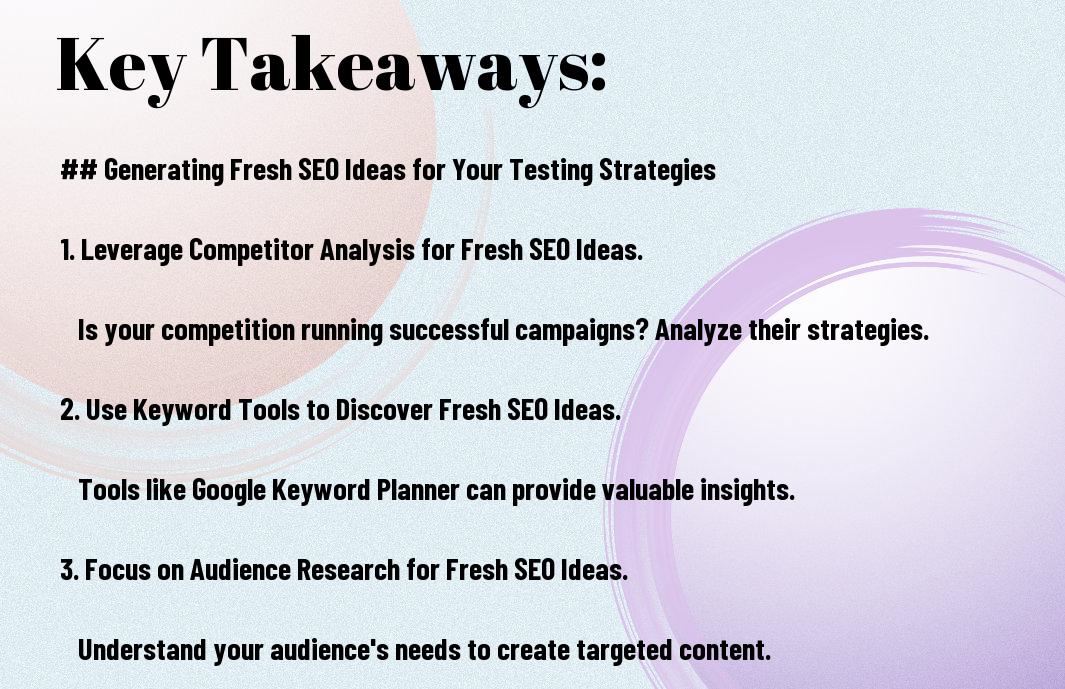
Behind every successful SEO campaign lies a solid understanding of keyword research. These tools empower you to discover valuable search terms that resonate with your audience. Moreover, they provide insights into trending topics and consumer behavior, which can spark Fresh SEO Ideas tailored to your niche.
But utilizing keyword research tools not only gives you an edge in discovering popular phrases but also highlights search volumes and competition levels. This data enables you to prioritize which keywords will yield the best results. Additionally, understanding user intent helps you create content that meets their needs effectively. By focusing on the right keywords, you can drive targeted traffic to your site, thereby elevating your online presence. Remember to regularly update your keyword list; trends change quickly, and staying current is important for long-term success! For more assistance, consider leveraging Rank Authority’s AI-driven solutions to maximize your SEO efforts.

Analyzing Competitor Strategies for Insights
Now that you’ve familiarized yourself with Fresh SEO Ideas, it’s time to look into analyzing your competitors’ strategies. By understanding what works for them, you can enhance your testing strategies effectively. Observing and leveraging their tactics will not only save you time but also help you identify trends that you may have overlooked. This competitive analysis can reveal opportunities for your business that can lead to significant growth and improved search engine rankings with Rank Authority.
Identifying Competitor Keywords
Below, you’ll find the importance of identifying competitor keywords. Conduct thorough research to uncover the keywords your competitors rank for. Utilize tools like SEMrush or Ahrefs to analyze the keyword landscape. By focusing on these keywords, you can craft content that targets the same audience, thus increasing your chances of ranking higher in search results.
Analyzing Competitor Content and Structure
An crucial step in assessing your competition involves analyzing their content and structure. This means looking at their article formats, headers, and even multimedia usage. Identify what type of content resonates with their audience and which structure seems to perform best in terms of engagement. You want to evaluate how they distribute their content and whether they incorporate effective calls-to-action.
Structure your approach by examining each competitor’s content layout. Look at the consistency in their posts and how they engage readers. If they are utilizing images, videos, and infographics, note how these elements contribute to user retention. In addition, focus on their internal linking strategy and navigation structure. This will reveal how they guide visitors through their site and maintain a competitive edge. Adopting similar techniques can boost your user experience, making it easier for visitors to navigate your content.
Experimenting with Section Layouts
When studying competitor pages, pay special attention to the arrangement of content sections. Sometimes, simply reordering sections—such as moving key information above the fold—can significantly improve user engagement and satisfaction. If you’re using a CMS with a block editor (like WordPress or Wix), running these section re-arrange tests is incredibly fast and easy. Even without a block editor, shifting sections around is usually a straightforward experiment. This hands-on approach can highlight which content truly matters to your audience and should be prioritized, echoing what competitors may be doing successfully.
All of these insights from your competitors generate Fresh SEO Ideas that can enhance your or your clients’ testing strategies, ensuring effective results with Rank Authority.
Dig Deeper: Internal Linking and Resource Investment
It’s worth noting that internal linking projects can range from quick wins to resource-intensive undertakings. For example, building a dynamic internal linking module for thousands of pages might only take a few developer hours and some database tweaks, but it can have a substantial impact on rankings and traffic—results you can measure shortly after launch.
On the other hand, manual internal linking—where you fine-tune topic clusters and painstakingly insert links one by one—can be a major time investment. Sometimes, these larger manual projects reveal that the return isn’t always worth the effort, helping you avoid repeating the same mistake next time. By paying attention to how your competitors balance automation and manual effort in their internal linking, you can make smarter decisions about your own strategy, focusing your resources where they’ll have the most impact.
All of these insights from your competitors generate Fresh SEO Ideas that can enhance your or your clients’ testing strategies, ensuring effective results with Rank Authority.
Testing and Validating SEO Ideas
All fresh SEO ideas should undergo rigorous testing and validation. This process helps you identify which strategies resonate with your audience. By implementing effective testing methods, you can ensure that your SEO efforts yield tangible results. It’s crucial to establish a clear testing framework, which can significantly enhance your decision-making capabilities, leading to optimized outcomes and maximizing the effectiveness of your campaigns.
Think of every SEO activity as an investment—one that deserves careful measurement. If an SEO idea is worth your resources, it’s also worth evaluating with a critical eye. At its core, each SEO initiative is a test, not just of tactics like title tags or meta descriptions, but of broader strategies and hypotheses. The essential questions then become: Was it worth the effort? and Should we continue investing here? By embracing this mindset, the universe of SEO experimentation expands far beyond traditional boundaries, encouraging you to treat every campaign, adjustment, or content refresh as a data-driven experiment.
The Importance of Testing Technical SEO Enhancements
Testing technical SEO improvements is essential because it ensures your efforts contribute real value instead of unnecessary busywork. Rather than rolling out changes simply because a technical audit flagged them, it’s much more effective to validate enhancements through structured testing. This approach conserves resources and helps you focus on what actually moves the needle for your site.
When you experiment with updates—such as improving Core Web Vitals, switching JavaScript frameworks, or optimizing server configuration—it’s important to determine which metrics matter most. For some projects, success might mean improved crawlability or faster page load times. For others, it could involve reducing index bloat or alleviating server strain. Not all wins are reflected in immediate traffic or click increases; sometimes the victory lies in creating a more solid foundation for future growth.
To get the most out of your technical SEO efforts, set measurable goals and track performance indicators like:
- Crawl efficiency: Are search engines finding and indexing your important pages faster?
- Page speed metrics: Do changes lead to better results in tools like Google PageSpeed Insights or GTmetrix?
- Server performance: Are server errors reduced and resource loads balanced more effectively?
- Index optimization: Is there less index bloat or fewer unnecessary pages in search results?
By tying every technical enhancement to a specific, measurable outcome, you’ll make sure your time and resources deliver true, lasting SEO benefits.
A/B Testing for SEO Strategies
Strategies for A/B testing should focus on comparing two or more variations of your SEO content. By altering elements like headlines, meta descriptions, or content formats, you can measure their impact on user engagement and search rankings. This approach allows you to determine which version aligns better with user preferences, ultimately improving your website’s performance and user experience.
Understanding URL Switch Tests and Their Impact on Keyword Rankings
Beyond headlines and content tweaks, URL structure itself can play a meaningful role in how your site performs in search rankings. URL switch tests are an advanced SEO tactic that involves modifying the web address (URL) of a page to see if it influences where that page lands in the search results.
There are typically two main approaches for these tests:
- Optimization: Adjusting URLs to include keywords or make them more concise and descriptive.
- De-optimization: Removing keywords or making the URL less targeted to observe any negative effects.
By testing both directions—making URLs more or less keyword-focused—you can gain concrete data about how much weight search engines give to URLs in their ranking algorithms. Some SEOs experiment by updating URLs to see if their ranking improves, and then reverting or further changing them to measure the impact.
However, it’s important to note that running these tests isn’t as straightforward as editing a title tag. URL changes require setting up proper redirects (301s) to ensure users and search engines don’t encounter broken links. Because of this, switching URLs can be risky and hard to undo, so it’s best approached with careful planning and executed on pages where you can track changes closely.
If you’re considering a URL switch test, prioritize precision and assess the potential SEO value before making changes. This method, when done thoughtfully and with analytics tools like Google Analytics and SEMrush to monitor the effects, can provide valuable insights into how URL structure factors into your overall SEO success.
Content Removal Testing for Deeper Insights
Another innovative approach in SEO experimentation is content removal testing. Much like conversion optimizers use “takeaway tests” to assess the true value of a page element, content removal testing in SEO involves systematically removing specific features or components—such as videos, live chat popups, product reviews, or schema markup—from a page to observe changes in performance metrics.
This strategy allows you to challenge assumptions about what actually contributes to your rankings or user engagement. For example, while conventional wisdom suggests that multimedia elements benefit SEO, sometimes taking them away is the best way to measure their true impact. By carefully monitoring traffic, conversions, or ranking shifts after removing a particular element, you gain clearer insights into what genuinely moves the needle versus what might be unnecessary clutter.
Regularly employing content removal tests helps separate SEO myths from proven tactics. This form of validation ensures your page elements are there because they work—not just because they’re “best practice.”
Testing the Impact of Site Migrations
Site migrations can be daunting undertakings, often carrying the risk of unexpected drops—or gains—in organic traffic. To accurately gauge how a migration affects your site’s SEO performance, a structured before-and-after testing approach is essential.
Begin by benchmarking your site’s key SEO metrics prior to migration. Capture data on organic traffic, keyword rankings, index coverage, and crawl errors using trusted tools like Google Analytics, Google Search Console, SEMrush, or Ahrefs. This serves as your “control” to compare against post-migration results.
Once the migration is complete, closely monitor the same set of metrics. Pay special attention to any shifts in organic traffic patterns, changes in keyword rankings, or sudden spikes in crawl errors. For larger projects, consider breaking down the analysis into segments—such as different site sections or page types—to pinpoint exactly where changes have occurred.
Remember, site migrations aren’t generally aimed at boosting SEO, but maintaining or improving performance should still be a priority. Measuring and comparing data before and after the migration ensures you can quickly identify setbacks and make the necessary adjustments, keeping your SEO health on track as your site evolves.
Measuring the Impact of Content Refresh Projects
Once you’ve updated your content, it’s essential to measure whether those changes are delivering positive results. A reliable approach is to use time-based testing, treating your original version as the control and the refreshed content as the variant. By tracking key metrics—such as organic traffic, rankings, and user engagement—over a specific period before and after the refresh, you can accurately gauge whether your updates are driving improvements.
Utilize SEO tools like Google Analytics and SEMrush to monitor these changes. Set clear benchmarks, document your pre-refresh performance data, and compare it to post-refresh results. This systematic method will help you determine if your content refresh initiative is yielding a worthwhile return on investment.
Testing Topic Clustering for SEO Impact
Another powerful way to validate your Fresh SEO Ideas is by testing topic clustering. While often discussed in theory, its direct impact on SEO performance is still ripe for deeper experimentation.
To start, topic clustering involves organizing your website’s content into interlinked groups based around related themes or “pillar” topics. You can test its effectiveness by setting up clusters around specific keyword themes and monitoring changes in rankings, organic traffic, and user engagement. Compare these clusters against areas of your site that don’t use this structure.
Here’s how to approach this systematically:
- Select a core topic and identify several related subtopics.
- Create a pillar page for the main topic and develop cluster content that links back to this pillar.
- Ensure internal linking consistency within the cluster for optimal navigation.
- Monitor performance metrics before and after implementing the cluster, using tools like Google Analytics and SEMrush to track shifts in rankings, session duration, and click-through rates.
- A/B test clusters by implementing them in some site sections while leaving others as a control group.
Give yourself several weeks to collect data, as changes may take time to reflect in search results. Comprehensive measurement ensures your investment in topic clustering pays off, both in user experience and measurable SEO gains.
Applying Time-Based SEO Testing Techniques
Alongside A/B testing, time-based SEO testing gives you another powerful method to evaluate the success of your SEO initiatives. This technique is especially useful for projects that take considerable effort or affect a large portion of your site, such as content refreshes, internal linking updates, or technical overhauls.
Using Control and Variant Periods
Time-based testing works by designating a specific time period as your “control” (before implementation) and then comparing it to a “variant” period (after your changes go live). For example:
- Refreshing Content: Launch your updated content, then monitor performance metrics—like organic traffic, rankings, or click-through rates—over the next several weeks, directly compared to similar periods before the update.
- Internal Linking Revamps: Whether building automated modules with tools or manually refining topic clusters and links in your CMS, track changes over set timeframes to see if improved navigation and connectivity lead to measurable boosts in engagement or search visibility.
- Technical Site Changes: From Core Web Vitals optimizations to server-side rendering or code base updates, apply this approach to measure not just clicks, but broader site health signals (like crawl efficiency or indexation rates).
Time-based testing shines with large or resource-intensive projects, ensuring your hard work is validated by real, actionable data—not just a hunch.
The Value of Measured Accountability
SEO often demands a notable investment—be it in content creation, dev resources, or technical upgrades. By structuring your tests around before-and-after windows, you create clear accountability. If the data doesn’t support the effort, you save your team from repeating low-ROI tactics. Meanwhile, positive results build a compelling case for future investments.
For site migrations, in particular, time-based analysis is crucial due to the high stakes and potential impact on organic performance. Even if boosting SEO isn’t the main goal, you’ll still want to compare crucial metrics pre- and post-migration, so you can respond quickly if performance unexpectedly drops.
With time-based testing, you transform every major SEO experiment into a learnable moment—empowering you to refine strategies, allocate resources smarter, and consistently drive growth.
Evaluating Risks and Considerations in SEO Testing
Testing new SEO strategies is crucial for growth—but it’s essential to balance innovation with practical risk management. Different testing methods, from URL switches to major internal linking projects, each come with unique challenges that should be carefully addressed before diving in.
Weighing the Risks of URL and Structural Tests
Some tests, such as redirecting URLs or reorganizing your site’s internal linking, can be more complex than simple content tweaks. For instance, implementing redirect-based tests often requires a more technical setup and can be difficult to roll back if results are not as expected. It’s vital to plan these tests with precision, ensuring you can monitor changes and quickly pivot if traffic drops or site performance is impacted.
Manual internal linking overhauls—like reorganizing topic clusters or painstakingly adding links by hand—can demand significant time and resources. If the results don’t match expectations, that investment may not yield the return you hoped for. On the upside, carefully monitoring performance metrics like page rankings and user engagement can reveal whether the effort was worthwhile or signal that a different approach may be needed in the future.
Challenges with Link Building and Ongoing Projects
Unlike one-time changes, link acquisition campaigns often generate results over an extended period, which makes it difficult to isolate cause and effect. Because new backlinks are acquired gradually, pinpointing the direct impact of your outreach or partnerships is challenging. To minimize confounding factors, try focusing your link-building efforts on targeted pages and monitor their progress closely, using tools from SEMrush and Ahrefs to track shifts in performance over time.
Technical SEO Testing: Beyond Clicks and Traffic
Major technical changes—like site speed optimizations, shifting from JavaScript to pre-rendered content, or enhancing Core Web Vitals—should be tested carefully, often using time-based benchmarking. These projects can affect everything from crawlability and server load to indexation, so it’s important to define clear success metrics before launch. Not every win will be immediately visible in organic traffic; sometimes, improvements in site health or crawl efficiency are valuable outcomes in themselves.
The Importance of Accountability
No matter the type of SEO test, every investment of time and resources should be held accountable to measurable outcomes. By establishing key indicators before starting and tracking them throughout, you’ll not only avoid costly missteps but also gain actionable insights to inform your next round of optimizations. Experimentation is a cornerstone of effective SEO, but a strategic approach—not just testing for the sake of it—will maximize the return on your efforts.
Increasing Confidence Through Repeated Testing
To boost your confidence in SEO test results, consistency is key. Repeating your experiments—whether it’s tweaking headlines, adjusting calls-to-action, or modifying content structure—helps ensure your findings aren’t just due to chance. By conducting multiple rounds of A/B testing and gathering larger data sets, you can more accurately determine what drives meaningful improvements.
Regularly rerun your tests using tools like Google Optimize or Optimizely to validate your outcomes. The more times you assess your SEO ideas, the clearer it becomes which changes truly move the needle. Over time, this process sharpens your strategies, giving you reliable data to guide future optimizations.
Start with Title Tag Tests
A great place to begin your SEO testing journey is with title tags. Title testing is not only a classic “SEO quick win” due to its fast execution, but it’s also an excellent way to learn the ropes of SERP analysis, intent research, and data interpretation. By experimenting with different title tag variations, you can observe how changes influence keyword rankings and click-through rates, giving you valuable insights into what resonates most with your target audience.
There’s a strong correlation between the relevance of your title tags to search intent and your rankings in the search results—often more significant than other elements like H1s, meta descriptions, or images. Testing titles is a manageable way to start, requiring far less effort than rewriting entire articles or pursuing complex outreach campaigns, yet it can deliver noticeable improvements quickly.
Expand Your Testing Scope
Once you’re comfortable with title testing, broaden your A/B testing to include other on-page elements such as meta descriptions, header structures, and even content layouts. For each variable tested, monitor key metrics like organic traffic, engagement, and conversions to pinpoint which changes drive the best results.
By systematically testing and validating these elements, you can build a data-driven SEO strategy that evolves alongside both user behavior and search engine algorithms, ensuring your site stays competitive and continues to grow.
It’s helpful to view every SEO activity as an investment—one that deserves measurement and evaluation. Each new tactic, whether it’s a tweak to your on-page content or a broader structural change, is essentially an experiment. The core questions become: “Was it worth the effort?” and “Should we keep doing it?” By treating all SEO strategies as test-worthy hypotheses, you open yourself up to a much broader range of experimentation—not just limited to title tags or meta descriptions, but encompassing any element that might influence performance.
This mindset encourages ongoing testing and learning, helping you move beyond data limitations and embrace a culture of continuous optimization within your SEO campaigns.
It’s important to move beyond the basics, too. Consider testing entire landing pages, different internal linking structures, or even multimedia placements. Don’t let your testing be limited to what’s easy—if you have a hypothesis about user behavior or the impact of a new content type, treat it as a test-worthy investment.
Tracking Performance Metrics
After implementing your SEO strategies, tracking performance metrics is crucial. This data provides insights into how well your fresh SEO ideas are performing, enabling you to make informed adjustments to your campaigns.
This tracking process involves monitoring key performance indicators (KPIs), such as organic traffic, bounce rates, and conversion rates. Focusing on these metrics allows you to gauge the success of your efforts and identify areas that need improvement. Additionally, analyzing trends over time can help you pinpoint what drives engagement and conversions. Pay attention to negative fluctuations in metrics, as they can signal potential problems that need immediate attention. By continuously adjusting your strategies based on real-time data, you can stay ahead in the competitive digital landscape, ensuring that your fresh SEO ideas lead to sustained growth.
In the end, viewing each SEO effort through the lens of experimentation allows you to unlock new possibilities, iterate purposefully, and maximize the return on your SEO investment.
Evaluating Non-SEO Activities That Impact Organic Search
Not all changes that influence your site’s organic search performance come directly from SEO initiatives. Often, projects initiated by other teams—think site-wide popups, interactive tools like calculators in your sidebar, or even heavy JavaScript tags—can unexpectedly affect how your pages perform in search results.
To assess the true impact of these non-SEO activities, treat them like any other SEO experiment:
- Monitor before-and-after metrics: Track key indicators such as organic traffic, rankings, and bounce rates when these features are introduced site-wide.
- Run A/B or split tests: Where possible, deploy the change to only a subset of pages or users, so you can directly compare performance with unaffected pages.
- Watch for unintended consequences: Since these changes may increase load times, disrupt user experience, or compete with primary calls-to-action, pay close attention to signals like increased bounce rates or drops in conversions.
By systematically evaluating these cross-departmental changes, you can determine whether they are helpful, neutral, or potentially harmful to your site’s organic visibility. This approach helps you focus your efforts where they matter most, reducing unnecessary concerns about changes that ultimately have little or no impact.
Measuring the Impact of External Link-Building Campaigns
When it comes to external link-building, quantifying its real SEO impact can be tricky. Unlike on-page tweaks or content updates, links are often acquired gradually from various sources, making it challenging to identify a precise “before and after” moment for your results.
To reliably measure the effectiveness of your link-building efforts, it’s important to control as many other variables as possible. Start by selecting a specific page to target. Direct a significant number of high-quality external links to that page and refrain from making additional changes—such as altering content or internal linking—during your evaluation period.
Recommended steps include:
- Choose a Single Target Page: Focus your campaign on one page at a time to simplify performance tracking.
- Build Links from Reputable Sources: Use tools like Moz, Ahrefs, or SEMrush to evaluate link quality and authority before outreach.
- Monitor Core Metrics: Track rankings for primary keywords, organic traffic, and changes in conversion rates related to your test page.
While this experiment won’t produce lab-grade precision, repeating the process with different pages or campaigns will gradually improve your confidence in the results. Keep in mind, you may only achieve partial certainty—about 60-70% confidence—due to the multifaceted nature of SEO, but consistency and repeated testing can bolster your trust in the outcomes.
Ultimately, even though isolating the effects of external links takes careful planning and patience, it ensures you’re making data-driven decisions about where to invest your SEO resources.

Leveraging User Feedback for SEO Enhancements
Many businesses overlook the power of user feedback when generating fresh SEO ideas. By tapping into what users are saying, you can gain valuable insights that enhance your testing strategies. Feedback can reveal areas that need improvement and highlight features that resonate well with your audience. This not only helps in optimizing your content but also increases user engagement, ultimately elevating your website’s ranking. At Rank Authority, we emphasize the importance of incorporating user input to refine your SEO tactics effectively.
Collecting Feedback Through Surveys
Against the conventional mindset, implementing surveys can yield rich data that shapes your SEO strategy. By directly asking users about their experiences and preferences, you gain insights that traditional analytics might miss. This proactive approach allows you to stay ahead of the competition by understanding the exact needs of your audience. Consider integrating short, targeted surveys that focus on specific aspects of your website or content. This will enable you to gather actionable insights for your fresh SEO ideas.
Implementing Feedback into Testing
By utilizing the feedback you’ve gathered, you can make meaningful adjustments to your testing strategies. It’s important to prioritize changes that align with user needs and preferences to drive improvement. Start small, focusing on specific elements like content structure or usability. Quick wins will provide immediate value and encourage further testing iterations. Engaging your audience through their feedback not only optimizes your SEO but also increases customer loyalty and satisfaction.
With your audience’s insights in hand, you can dive deeper into optimizing your web content and SEO performance. Consider setting up a structured plan for consistently implementing user feedback into your testing processes. This might include regularly scheduled reviews of survey results or gathering data from tools like Google Analytics. By focusing on data-driven decisions, you can ensure that your SEO strategies are sharp, relevant, and aligned with what your audience truly wants. Implementing user feedback not only brings your content closer to your audience’s needs but also boosts your visibility on the web, thereby aligning with the mission of Rank Authority to help businesses like yours rank higher.
Staying Updated with SEO Trends
Once again, generating fresh SEO ideas means staying updated with the ever-evolving trends in SEO. As algorithms and user behaviors change, you must adapt your strategies accordingly. Follow reputable sources, engage with SEO communities, and pay attention to emerging technologies affecting search engines. This ongoing education will not only keep your strategies relevant but also position you ahead of the competition.
Subscribing to SEO Newsletters
For effective SEO management, subscribing to reputable SEO newsletters is important. These newsletters often provide insights into the latest trends, algorithm updates, and expert opinions. By reading these resources, you can generate fresh SEO ideas tailored to your testing strategies while staying informed on industry shifts.
Participating in SEO-Webinars and Conferences
An excellent way to generate fresh SEO ideas is by participating in SEO webinars and conferences. Engaging with experts in real-time allows you to grasp fresh concepts and best practices directly from the source.
And, attending these events not only enhances your knowledge but also expands your professional network. You can learn from industry leaders and discover innovative testing strategies that may take your SEO to the next level. While some events may come at a cost, the insights gained can be invaluable. Online platforms often host free webinars where you can interact with experts without any financial commitment. Consequently, it’s an excellent opportunity to gather unique ideas and apply them to your strategies at Rank Authority, propelling your online presence.
Final Words
Upon reflecting, generating Fresh SEO Ideas for your testing strategies is crucial to stay ahead in the competitive online landscape. By leveraging innovative tactics and consistently analyzing your results, you can refine your approach and improve your website’s rankings. Moreover, collaborating with experts at Rank Authority can provide you with invaluable insights and AI-driven solutions tailored to your unique needs. Thus, as you implement these strategies, make sure to focus on continual learning and adaptation. This way, you will not only enhance your testing strategies but also elevate your overall SEO performance.

