
Direct Answer
Keyword gap analysis for YouTube and blogs is the process of identifying search terms your competitors rank for — on both Google and YouTube — that your content does not yet target. By systematically closing these gaps across both platforms, you capture untapped organic traffic, strengthen topical authority, and build a durable content advantage that compounds over time. For a deeper walkthrough, see our Internal Linking SEO: The Complete Guide to Rankings.
What Is Keyword Gap Analysis for YouTube and Blogs?
Keyword gap analysis for YouTube and blogs is the strategic process of comparing your existing keyword coverage — across your written blog content and your video library — against your top competitors. Its purpose is to surface high-value search terms and topics you are not yet targeting on either platform. Whether you manage a solo YouTube channel alongside a WordPress blog, or lead a content team scaling across multiple channels, understanding your keyword gaps is one of the highest-leverage activities in your SEO workflow.
Specifically, a keyword gap is any search query that sends traffic to a competitor’s blog post or YouTube video — but not to yours. This gap exists because you have either never created content around that topic, or your existing content is too thin, poorly optimised, or simply outranked. Running a structured gap analysis across both content formats simultaneously gives you a unified view of where your topical authority is weakest and where the easiest wins are hiding.
According to search engine optimisation principles, topical authority — the recognition by search engines that your site or channel thoroughly covers a subject — is built by comprehensively addressing a subject area, not by targeting isolated keywords. Keyword gap analysis is therefore the diagnostic tool that tells you exactly which pieces of your subject area are missing.

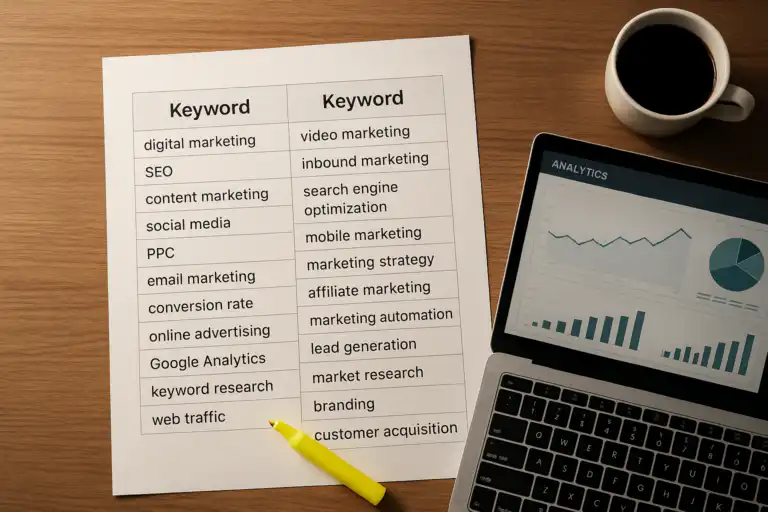
A structured keyword gap analysis spreadsheet helps visualise missing opportunities across YouTube and blog content simultaneously.
Why Keyword Gap Analysis Across Both YouTube and Blogs Matters
Most content creators treat their YouTube channel and their blog as entirely separate kingdoms. They conduct keyword research for each in isolation, using different tools, different processes, and different competitive benchmarks. However, this siloed approach leaves a significant blind spot: the overlapping keyword universe where a single topic can be addressed with both a long-form article and a companion video.
Furthermore, YouTube is the world’s second-largest search engine, processing over 3 billion searches per month. In addition, Google increasingly surfaces YouTube videos directly inside organic search results — meaning a well-optimised video can claim Google SERP real estate alongside your blog post. Consequently, a keyword gap on YouTube is simultaneously a gap in Google rankings. Treating these platforms separately means you are leaving double the organic traffic on the table.
When you run a unified keyword gap analysis across both platforms, you gain three compounding advantages:
01
Double SERP Presence
A blog post and a YouTube video targeting the same keyword can both appear on Google’s first page — effectively doubling your organic real estate for a single topic.
02
Content Repurposing ROI
Gap keywords you close on one platform immediately become candidates for repurposing on the other, maximising production ROI with minimal additional effort.
03
Internal Link Equity
Embedding your YouTube video inside the matching blog post creates powerful cross-platform signals that boost both assets in their respective algorithms.
How YouTube’s Algorithm Differs From Google — and Why It Changes Your Gap Strategy
Understanding how each platform ranks content is essential before you start your analysis. Therefore, a brief comparison prevents wasted effort.
Google’s Ranking Signals for Blog Content
Google ranks blog content based on a combination of on-page optimisation, E-E-A-T (Experience, Expertise, Authoritativeness, and Trustworthiness — Google’s quality framework for evaluating content credibility), backlink authority, and user engagement signals such as dwell time and bounce rate. Consequently, closing a blog keyword gap requires not just creating content, but producing content that earns links and satisfies search intent deeply.
YouTube’s Ranking Signals for Video Content
YouTube’s algorithm prioritises watch time (the total minutes viewers spend watching your video), click-through rate (the percentage of users who click your thumbnail after seeing it in search results), and engagement velocity (how quickly likes, comments, and shares accumulate after upload). In contrast to Google, YouTube also heavily weights session watch time — whether your video leads viewers to watch more YouTube content. As a result, a keyword gap on YouTube requires a video that hooks viewers quickly and sustains attention, not merely one with well-optimised metadata.
The Practical Implication for Gap Analysis
Specifically, when you identify a gap keyword that suits video content, the competitive barrier you need to overcome is not just rankings — it is watch time and audience retention. Therefore, your gap analysis must account for the format requirements of each platform, not treat every keyword as equally addressable across both.
Step-by-Step: How to Run a Keyword Gap Analysis for YouTube and Blogs
Follow this repeatable framework to uncover gaps across your YouTube channel and blog in one unified workflow. Each step builds directly on the previous one, so work through them in order.
Identify Your Top 3–5 Competitors on Both Platforms Separately
Search your core topic on Google and on YouTube independently. The top-ranking blogs and top-performing YouTube channels for your niche are your benchmarks. Importantly, these do not need to be the same brands — your blog competitors and YouTube competitors are often entirely different entities. For example, a software tutorial blog may compete against SaaS documentation sites on Google, but against large educational channels on YouTube. Build two separate competitor lists accordingly.
Export Competitor Keywords from Your Chosen Tools
For blog analysis, use Ahrefs or SEMrush to pull the full keyword ranking list for each competitor domain. Both platforms offer a dedicated Keyword Gap or Content Gap feature that compares multiple domains simultaneously — saving considerable manual work.
For YouTube analysis, use TubeBuddy or vidIQ to surface the tags and search terms driving views to competitor videos. Additionally, Ahrefs now offers YouTube keyword data through its Keywords Explorer, making it possible to run both analyses inside a single platform. Export all data to a spreadsheet before proceeding.
Audit Your Own Keyword Inventory on Both Platforms
Export your blog’s ranking keywords from Google Search Console and your YouTube channel’s search term data from YouTube Studio Analytics. Any keyword appearing in a competitor’s list but absent from yours is a confirmed gap. Tools like RankAuthority’s real-time SEO alerts can flag these emerging gaps automatically as competitor content climbs the rankings — so you respond in days rather than weeks.
Categorise Each Gap by Search Intent
Not all gaps are worth filling in the same way. Search intent — the underlying reason a user types a particular query — determines which content format will rank. There are four primary intent categories:
- Informational — The user wants to learn something. Both blog posts and educational YouTube videos perform well here.
- Navigational — The user is looking for a specific site or resource. Blog content with strong branding typically wins.
- Commercial investigation — The user is comparing options before buying. Long-form comparison articles and review videos both perform strongly.
- Transactional — The user is ready to act. Landing pages and product-focused blog posts typically outperform video here.
Prioritise Gaps by Volume, Difficulty, and Business Value
Score each gap keyword by monthly search volume, keyword difficulty (a 0–100 score indicating how hard it is to rank — lower is easier), and business relevance. A keyword with 800 monthly searches, a difficulty score of 18, and direct relevance to your product is far more valuable than a 10,000-search keyword with a difficulty of 82 and no commercial connection. Understanding latent semantic indexing — the way search engines group conceptually related terms — helps you cluster related gap keywords into single, comprehensive content pieces rather than producing thin one-keyword articles.
Map Each Gap to a Content Format and Production Timeline
Build a content calendar that assigns each prioritised gap keyword to either a blog post, a YouTube video, or ideally both. Mark keywords that appear on both your blog gap list and your YouTube gap list as dual-platform priorities — these deserve your highest production investment because they unlock double SERP presence. Set deadlines, assign ownership, and schedule a review cycle every 60–90 days to re-run the analysis and catch new gaps as the competitive landscape shifts.

Mapping each keyword gap to the right content format — blog, video, or both — is the critical bridge between analysis and execution.
How to Analyse a Competitor’s YouTube Channel for Keyword Gaps
YouTube keyword gap analysis requires a different approach to blog gap analysis. Specifically, you are not just looking at what keywords a channel ranks for — you are examining which topics consistently generate views, watch time, and subscriber growth for your competitors. Here is how to conduct a thorough YouTube-specific audit:
Analyse Competitor Video Metadata
Use vidIQ or TubeBuddy to inspect the titles, descriptions, and tags of your top competitor’s most-viewed videos. In addition, look at the keywords appearing in their auto-generated chapters and closed captions — YouTube’s algorithm reads these and uses them as ranking signals. Any topic cluster appearing repeatedly in their top-performing videos, but absent from your channel, is a confirmed video keyword gap.
Use YouTube’s Search Suggest for Gap Discovery
Type your core topic into the YouTube search bar without pressing enter. YouTube’s autocomplete suggestions are real search queries — specifically, the ones users search most frequently. Consequently, any suggestion you have not yet produced a video for represents a direct keyword gap. Work through the entire alphabet (type your keyword + “a”, then “b”, and so on) to build an exhaustive list of gap opportunities.
Cross-Reference with YouTube Studio’s Search Report
Inside YouTube Studio, navigate to Analytics > Reach > Traffic source: YouTube search. This report shows the exact terms viewers searched before watching your videos. Furthermore, it reveals terms with high impressions but low click-through rates — indicating that you appear in search results but your thumbnail or title is not compelling enough. These are not just keyword gaps — they are optimisation gaps that are even faster to close than creating new content.
Best Tools for Keyword Gap Analysis Across YouTube and Blogs
The right toolset makes the difference between a surface-level audit and a genuinely actionable gap analysis. Below is a comprehensive comparison of the leading platforms, including which specific features are most useful for cross-platform gap work.
Free vs Paid Tools: Which Should You Use?
For creators just starting out, Google Search Console and YouTube Studio Analytics provide free baseline data on your own keyword performance. Pairing these with the free tiers of TubeBuddy or vidIQ gives you enough information to identify meaningful gaps without any subscription cost. However, for competitive niches or established content operations, paid tools like Ahrefs or SEMrush provide significantly deeper competitor data — including historical ranking trends, search volume estimates, and keyword difficulty scores that simply are not available for free. In short, start free and invest in paid tools when the scale of your operation justifies it.
How to Fill Keyword Gaps: Turning Analysis Into Content
Identifying keyword gaps is valuable. However, the analysis only pays off when you convert those gaps into published, optimised content. Here is a practical framework for doing that efficiently.
Closing Blog Keyword Gaps
For each confirmed blog gap keyword, first determine whether you have existing content that could be updated and expanded to target it, or whether a completely new post is required. In many cases, updating an existing post is faster and more effective — because that page already has backlinks and domain authority. Specifically, look for posts ranking on page two or three for a gap keyword. Above all, make sure the new or updated content fully satisfies search intent and is objectively more thorough than the competitor page currently ranking.
Closing YouTube Keyword Gaps
For YouTube gaps, the content brief should specify the target keyword in the video title, first 150 characters of the description, and at least 2–3 tags. Furthermore, include the keyword naturally in the spoken content within the first 30 seconds — YouTube’s speech recognition reads your audio and uses it as a ranking signal. Finally, create a custom thumbnail that visually communicates the topic clearly, as click-through rate is one of YouTube’s strongest ranking factors.
The Dual-Platform Content Brief
When a gap keyword appears on both your blog and YouTube gap lists, build a single unified content brief covering both assets. The blog post and the video should complement each other — not duplicate each other. As a result, the blog post can go deeper on data, step-by-step instructions, and embedded screenshots, while the video covers the same topic in a more visual, narrative format. Embedding the video inside the blog post then creates an engagement loop: readers watch the video, increasing watch time on YouTube; viewers visit the blog for more detail, increasing dwell time on your site. Both signals improve ranking on their respective platforms simultaneously.

Visualising keyword ranking comparisons makes it easier to prioritise which gaps to close first across your blog and YouTube content.
Common Mistakes That Undermine Your Keyword Gap Analysis
Even experienced content teams fall into predictable traps when conducting a keyword gap analysis for YouTube and blogs. Here are the most costly errors to avoid:
-
▶ Comparing only against direct competitors. Some of your biggest keyword gaps are held by tangential sites — news outlets, Reddit threads, or Wikipedia articles. Therefore, include these in your analysis to find genuinely uncontested territory that even your direct rivals have not claimed.
-
▶ Ignoring search intent alignment. A keyword gap is only valuable if you can match the intent behind it. Consequently, chasing high-volume gaps with the wrong content format wastes production resources and generates poor engagement signals — which actually damages your overall rankings.
-
▶ Running the analysis once and never revisiting it. Keyword landscapes shift continuously. A gap that was too competitive six months ago may now be accessible. Build a recurring audit into your content calendar — specifically every 60–90 days.
-
▶ Treating YouTube and blog gap lists as entirely separate. The most powerful insight from a cross-platform gap analysis is identifying keywords that appear in both lists. Above all, these dual-platform gaps deserve your highest-priority content investment.
-
▶ Focusing exclusively on high-volume keywords. Long-tail keywords — specifically, phrases of four or more words with lower search volume — are often far easier to rank for and convert at a higher rate. In addition, on YouTube, long-tail searches often indicate viewers who are closer to a purchase decision. Include these in every gap audit.
How to Measure the Results of Your Keyword Gap Analysis
Executing a gap analysis is only half the work. You also need a measurement framework to know whether closing those gaps is actually moving the needle. Specifically, track the following metrics for each piece of gap-filling content you publish.
For Blog Content
- Organic impressions and clicks from Google Search Console — specifically the Queries report filtered to the target gap keyword.
- Average position for the target keyword over time — look for upward movement in the first 60–90 days after publication.
- Organic sessions from Google Analytics — confirm that ranking improvements are translating into actual visitor growth.
- Backlinks acquired — gap-filling content that addresses genuine user needs tends to attract natural links faster than generic posts.
For YouTube Content
- YouTube Search impressions and click-through rate — found in YouTube Studio under Analytics > Reach > Traffic source.
- Average view duration and audience retention percentage — these are the primary signals YouTube uses to determine whether your video deserves broader distribution.
- New subscribers generated per gap-filling video — a strong indicator that the topic attracted viewers outside your existing audience.
- Traffic from Suggested Videos — as your video performs well on a gap keyword, YouTube begins suggesting it alongside competitor videos on the same topic, compounding your reach.
Frequently Asked Questions About Keyword Gap Analysis for YouTube and Blogs
How often should you run a keyword gap analysis for your blog and YouTube channel?
Every 60 to 90 days is the recommended cadence. Search trends shift, competitors publish new content regularly, and algorithm updates can open or close keyword opportunities rapidly. Furthermore, running your analysis on a fixed schedule — rather than ad hoc — builds institutional knowledge about how your competitive landscape evolves over time.
Can keyword gap analysis improve both YouTube rankings and blog SEO simultaneously?
Yes — and this is precisely where the cross-platform approach delivers its greatest value. When you identify a shared gap keyword and create both a blog post and a YouTube video targeting that topic, you double your search presence. Embedding the video inside the blog post additionally creates a powerful engagement signal. Specifically, dwell time on your blog increases as readers watch the video, and watch time on YouTube increases as viewers arrive from your blog. Both signals are positive ranking factors on their respective platforms.
Do I need a paid tool to run an effective keyword gap analysis?
Not necessarily. Google Search Console and YouTube Studio Analytics provide free baseline data on your own keyword performance. Pairing these with the free tiers of TubeBuddy or vidIQ gives you sufficient data to identify meaningful gaps without any subscription. However, for competitive niches, paid tools like Ahrefs or SEMrush provide significantly deeper competitor insights — including historical ranking trends, keyword difficulty scores, and multi-domain comparison features that are not available for free.
What is the difference between a keyword gap and a content gap?
A keyword gap refers specifically to a search term your competitor ranks for that you do not. A content gap, however, is broader — it refers to an entire topic or user question that is not addressed anywhere in your content library, regardless of whether it corresponds to a tracked keyword. In practice, both analyses complement each other: keyword gap analysis tells you what terms to target, while content gap analysis tells you which user questions and topics to cover. Running both simultaneously produces the most complete picture of your content opportunities.
How do I find keyword gaps specific to YouTube without paid tools?
Start with YouTube’s native search autocomplete — type your core topic and systematically note every suggestion. Then open your top competitor’s channel, sort their videos by most-viewed, and note the topic patterns of their top 20 performers. Cross-reference these topics against your own upload history. Any topic appearing in their top performers that you have not covered is a confirmed gap. YouTube Studio’s Traffic Source: YouTube Search report further reveals which terms viewers are already searching before finding your channel — and which terms bring high impressions but low clicks.
Should I target the same keyword on both my blog and my YouTube channel?
Yes — when the keyword has both informational search intent and visual value, targeting it on both platforms is one of the most efficient tactics in content marketing. Your blog post and video should not duplicate each other in format; instead, they should complement each other. The blog post provides depth, data, and structured text that Google can parse and rank. The video provides the visual, step-by-step walkthrough that YouTube users prefer. Together, they establish topical authority on that keyword across two of the world’s largest search engines simultaneously.
Conclusion
Running a thorough keyword gap analysis for YouTube and blogs is one of the most efficient and high-leverage activities in your entire content strategy. By systematically identifying what your competitors rank for that you do not — across both platforms — prioritising those gaps by intent, difficulty, and business value, and mapping each one to the right content format, you build a compounding content advantage that grows more powerful with every publishing cycle. The process is not a one-time audit; it is a recurring discipline. Start with the tools you already have access to, establish a 90-day review cadence, and treat every gap as a direct invitation to claim territory your competitors have already proven is worth having. Over time, a rigorous keyword gap analysis practice transforms your content calendar from reactive to systematically dominant.
For ongoing competitive monitoring and automated SEO gap detection, explore the resources at rankauthority.com to keep your keyword strategy sharp, responsive, and ahead of the competition.

