

Keywords are the words and phrases people actually type into Google when they want an answer, a product, or a solution, and if you get them wrong, nothing else in your SEO strategy matters much. Whether you’re writing a blog post, building a landing page, or auditing an entire website, the right keywords determine whether real customers ever find you. In this guide, we go far beyond a basic definition. You’ll learn exactly what keywords are, the different types you need to know, how search intent shapes every ranking decision, and a step-by-step process for finding, placing, and measuring keywords that actually convert. Above all, this is the resource that turns keyword theory into keyword results, built on the same data-driven approach behind Rank Authority‘s AI-powered SEO platform.
What Are Keywords in SEO? A Complete Definition
In the simplest sense, keywords are the specific words or phrases people type into a search engine’s search box when looking for information, a product, or a service. Search engines like Google and Bing scan billions of pages, then match those pages against a searcher’s exact words to decide which results deserve the top spots. Consequently, every ranking decision a search engine makes starts with a keyword. According to Wikipedia’s overview of keyword research, keywords have been central to information retrieval since long before modern SEO existed, simply because they reflect how humans describe what they want. In marketing, however, a keyword is more than a word, it’s a signal of demand. For example, someone searching “best running shoes for flat feet” is telling you exactly what they need, in their own language. As a result, understanding keywords means understanding your audience’s actual vocabulary, not just the terms you assume they use internally.
In addition, keywords act as a bridge between three parties: the searcher, your content, and the search engine’s ranking algorithm. Specifically, when your page uses the same terms, related phrases, and contextual language as the query, search engines gain confidence that your page satisfies the request. Therefore, keyword strategy is not just about stuffing words onto a page, it’s about proving topical relevance in a language machines and humans both understand.
Why Keywords Still Matter More Than Ever
Despite predictions that AI-generated search results would make keywords obsolete, the opposite has happened. Search engines still rely on keywords, semantic variations, and related search terms to interpret content and match it with intent, even AI overviews pull their answers from pages that already rank for specific keywords. Furthermore, roughly two-thirds of all trackable website traffic begins with an organic or paid search click tied to a keyword, which means ignoring keyword strategy directly limits your visibility. Similarly, keywords influence far more than rankings alone: they shape your title tags, meta descriptions, headings, URL slugs, and even image alt text. Therefore, treating keywords as a single checkbox is a mistake, they’re a strategic layer that touches nearly every page element. In particular, well-chosen keywords help you understand competitors, uncover content gaps, and prioritize which pages deserve investment first.

Types of Keywords Every SEO Strategy Needs
Short-Tail vs. Long-Tail Search Terms
Short-tail keywords, sometimes called head terms, are broad phrases of one or two words, such as “shoes” or “SEO.” These generate massive search volume, but they’re also brutally competitive and vague about intent. Long-tail keywords, in contrast, are longer and more specific phrases of three or more words, like “best waterproof running shoes for winter.” Because they’re specific, long-tail keywords convert at a much higher rate, even though each individual phrase brings less traffic. Consequently, a balanced strategy blends a handful of short-tail targets with a wide net of long-tail phrases that match exactly what your audience is searching for.
Branded, Geo-Targeted, and Semantic Keywords
Branded keywords include your company or product name, such as “Rank Authority SEO tool,” and they typically convert extremely well because the searcher already knows you. Geo-targeted keywords add a location, like “SEO agency in Austin,” and they’re vital for any business competing in a specific market. Meanwhile, semantic keywords, often referred to as latent semantic indexing (LSI) terms, are conceptually related words that help search engines understand context without needing an exact keyword match. For instance, a page about “keywords” might naturally include terms like “search intent,” “SERP,” and “ranking factor.” Including these related terms, rather than repeating one phrase endlessly, is what modern topical SEO actually rewards.
| Keyword Type | What It Means | Example |
| Short-Tail | Broad, high-volume, one or two words | “marketing” |
| Long-Tail | Specific phrases, three or more words | “digital marketing for small bakeries” |
| Branded | Includes a company or product name | “Rank Authority pricing” |
| Geo-Targeted | Includes a location-based term | “plumber near Denver” |
| LSI / Semantic | Related terms that build context | “crawl budget” for a page about “keywords” |
Understanding Search Intent Behind Every Query
Above all, keywords only work when they’re matched to the right intent. Search intent describes the actual reason someone typed a query, and it falls into four broad categories. In particular, mismatching a page’s content to the wrong intent is one of the fastest ways to waste an otherwise well-researched keyword.
The Four Types of Search Intent
- Informational, the searcher wants to learn something, such as “what are keywords.”
- Navigational, the searcher wants a specific site, such as “Rank Authority login.”
- Commercial, the searcher is comparing options, such as “Semrush vs Ahrefs.”
- Transactional, the searcher is ready to act, such as “buy SEO software.”
Consequently, before you ever write a title tag, ask what stage of the journey your target keyword represents. Informational keywords deserve blog content; transactional keywords deserve a product page or landing page built to convert. Getting this alignment right is often more valuable than chasing higher search volume.
How to Find the Right Keywords for Your Website
Finding profitable keywords is a repeatable process, not guesswork. Follow these steps in order, and you’ll build a keyword list grounded in real data rather than assumptions. For a deeper walkthrough of every tool and filter, see our complete Keyword Research guide.
- Define your goals and audience. Decide which products, services, or topics matter most to your business, then describe your ideal customer in plain language before you search for a single term.
- Brainstorm seed keywords. Write down five to ten broad phrases that describe what you offer, since these seeds will expand into hundreds of related keyword suggestions.
- Run your seeds through research tools. Enter each seed keyword into Google Keyword Planner, Semrush, or Ahrefs to reveal monthly search volume, competition level, and dozens of related search terms you hadn’t considered.
- Analyze the intent behind each result. Read the top-ranking pages for every candidate keyword and note whether they are blog posts, product pages, or comparison articles, since that tells you what Google expects.
- Prioritize by relevance, volume, and difficulty. Rank your shortlist so you tackle achievable, high-relevance keywords first instead of chasing broad terms you have little chance of ranking for right away.
- Map keywords to pages and track results. Assign one primary keyword per page, publish the content, then monitor rankings and clicks in Google Search Console so you can refine your strategy over time.
In addition, tools like Google Keyword Planner, Moz’s keyword research guide, Semrush, and Ahrefs each surface slightly different data, so cross-referencing more than one source gives you a fuller picture of demand and competition. However, this data can become counterproductive if mismanaged, chasing volume alone without checking intent leads to pages that rank but never convert. With Rank Authority’s AI-driven approach, this entire research process is automated and prioritized for you.

Where to Place Keywords for Maximum SEO Impact
Keywords in Title Tags
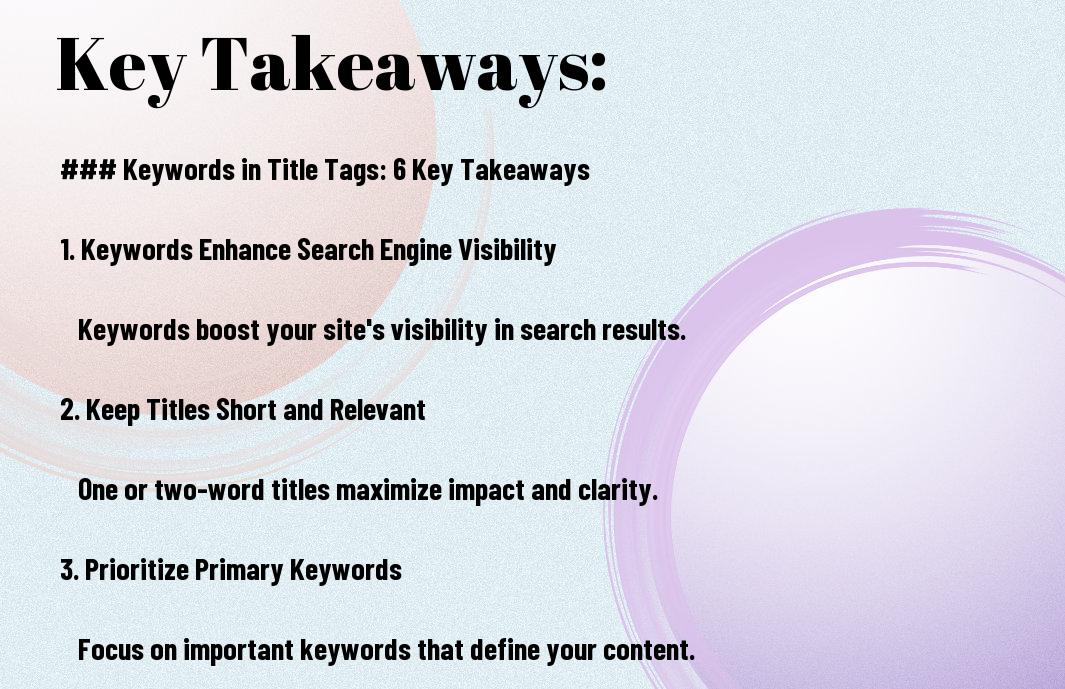
Your title tag is the first thing both users and search engines read, so it deserves your primary keyword placed as early as possible. Aim for 50 to 60 characters so the full title displays in search results. For a full breakdown of best practices, read our guide on placing keywords in your title tag, and cross-check Google’s own guidance in its official documentation on title links.
Keyword Prominence and Placement Order
Keyword prominence refers to how early a keyword appears within a title, heading, or paragraph, and search engines generally weigh earlier placement more heavily. Therefore, front-loading your most important keyword within the first few words of a sentence or heading can meaningfully improve relevance signals. Our detailed resource on keyword prominence walks through exactly how to apply this across every element of a page.
Adding Keywords to Headings and Subheadings
Beyond the title tag, your H2 and H3 subheadings are prime real estate for keywords and their variations. This is especially true for local businesses, and our guide on building local-intent keywords into headings shows exactly how to structure them. Similarly, spreading synonyms and related search terms across your subheadings, rather than repeating one exact phrase, helps search engines understand the full scope of your topic without triggering spam filters.

Common Keyword Mistakes That Hurt Rankings
Keyword Stuffing
Keyword stuffing means overloading a page with the same phrase far beyond what reads naturally. Search engines are well equipped to detect this pattern, and the penalty is often a ranking drop rather than a boost. Instead, focus on crafting content that naturally incorporates keywords while remaining genuinely useful to a human reader.
Ignoring Search Intent
Many sites still focus solely on keyword volume while ignoring what the searcher actually wants. As a result, a page might technically rank for the right term yet still fail to convert, because it answers the wrong question. In contrast, aligning every keyword with its true intent fosters better engagement, longer time on page, and ultimately stronger rankings over time.
How to Measure and Improve Keyword Performance
Tracking Keyword Metrics with Google Search Console
Google Search Console lets you analyze impressions, clicks, and click-through rate for every keyword driving traffic to your site. Specifically, this data reveals which keywords are close to page one but need a small push, and which are underperforming despite good rankings. Effective tracking gives you the evidence needed for informed decisions, rather than guesswork.
Adjusting Your Strategy Based on Data
Regularly reviewing your metrics allows you to identify underperforming keywords and pivot when necessary. If a keyword isn’t delivering results after a reasonable testing period, revising the title tag, heading structure, or supporting content can reset its trajectory. Conversely, when you notice strong engagement around a specific keyword, doubling down with related content can compound that momentum further.
Real-World Results: Keyword Optimization Case Studies
To illustrate the power of a disciplined keyword strategy, consider these examples drawn from real optimization projects:
- An e-commerce site increased organic traffic by 75% after restructuring title tags and headings around long-tail keywords.
- A blog saw a 60% rise in page views after remapping content to keyword-rich, intent-matched titles.
- A local service company achieved a 50% boost in leads by refining geo-targeted keywords across its landing pages.
Across all three examples, the underlying lesson is the same: keywords work best when they’re specific, intent-matched, and placed prominently. Furthermore, none of these results came from stuffing more keywords onto a page, they came from choosing better ones and structuring content around them thoughtfully.
Frequently Asked Questions About Keywords
What is the difference between keywords and search terms?
Keywords are the target phrases you plan and optimize for, while search terms are the exact queries real users type. In practice, one keyword can match dozens of related search terms.
How many keywords should I target per page?
Focus each page on one primary keyword, supported by two to five closely related variations and semantic terms. Spreading a single page across too many unrelated keywords dilutes its relevance for all of them.
What are LSI keywords and do they still matter?
LSI, or latent semantic indexing, keywords are conceptually related terms that reinforce topical relevance. While the original technical model is largely outdated, the underlying idea, using varied, related vocabulary instead of one repeated phrase, remains highly effective today.
How do I choose the best keywords for a small business?
Prioritize long-tail and geo-targeted keywords with clear commercial or transactional intent, since these are more achievable and convert better than broad, high-competition terms. Local businesses in particular should combine service keywords with location terms.
Is keyword density still an important ranking factor?
No single density percentage guarantees rankings. Instead, search engines reward natural, relevant keyword usage alongside supporting context and related terms, rather than a specific repetition count.
How often should I update my keyword strategy?
Review keyword performance at least quarterly, since search behavior, seasonality, and competition all shift over time. Regular audits let you catch declining keywords early and reallocate effort to rising opportunities.
Final Thoughts on Choosing the Right Keywords
Ultimately, mastering keywords means far more than picking a popular phrase and repeating it. You need to understand the different types of keywords, match every one to genuine search intent, place them prominently across your titles and headings, and continuously measure performance with real data. Consequently, businesses that treat keywords as an ongoing strategy, rather than a one-time task, consistently outrank those that don’t. At Rank Authority, we built our AI-driven platform specifically to make this process faster and more precise, from initial keyword discovery all the way through performance tracking. With the right approach to keywords, you’ll see measurably stronger visibility, more qualified traffic, and better conversions from your SEO efforts.

