
Moz website ranking refers to the set of proprietary authority scores — primarily Domain Authority (DA) and Page Authority (PA) — that Moz calculates to predict how likely a site or page is to rank well in search results. These numbers are not official Google ranking factors. However, they’ve become one of the most widely referenced shorthand metrics in the SEO industry for comparing link strength between competing domains. Below, we cover exactly how moz website ranking scores are built, what moves them, where Moz’s own tool falls short, and how to turn that data into real organic traffic growth.
Quick Answer: Moz website ranking is built on Domain Authority (DA) and Page Authority (PA), scored 1–100 on a logarithmic scale based on backlink data. Higher scores generally suggest a stronger link profile and a greater chance of ranking well, but they remain third-party estimates — not direct Google signals. For an accurate picture of SEO health, pair DA and PA with Spam Score, keyword research, and actual organic traffic data, not just a single dashboard number.
What Is Moz Website Ranking? Understanding Domain Authority and Page Authority
Moz calculates several distinct scores, but two stand out as the most actionable for day-to-day SEO work. Domain Authority (DA) measures the overall ranking strength of an entire domain, while Page Authority (PA) focuses on the strength of a single URL. Both run from 1 to 100 on a logarithmic scale, which means moving from 20 to 30 is significantly easier than moving from 70 to 80. As a result, comparing raw score differences without accounting for this curve is one of the most common misreadings of moz website ranking data.
Domain Authority (DA): The Whole-Site Score
DA predicts how an entire domain is likely to perform in search results, based primarily on backlink quantity, quality, and diversity. It is not a direct Google metric; rather, it’s Moz’s machine-learning estimate derived from its own crawl of the web’s link graph. Consequently, DA tends to correlate with ranking ability without ever being a cause of it.
Page Authority (PA): The Single-Page Score
PA narrows the same scoring logic down to one URL. This makes it far more useful than DA when you’re asking a specific question: “Can this exact page compete for this exact keyword?” A high-DA domain can still have individual pages with weak PA if those pages have few internal or external links pointing to them.
Spam Score: The Risk Indicator Most People Ignore
Beyond DA and PA, Moz also provides a Spam Score that flags potentially risky link profiles. A site with a Spam Score above 30% warrants a careful audit, because it may be attracting the kind of link patterns that trigger Google penalties. Therefore, monitoring all three metrics together — DA, PA, and Spam Score — gives a far more complete picture than looking at DA in isolation, which is exactly where our breakdown of what Moz domain ranking is and why it matters goes into more depth.
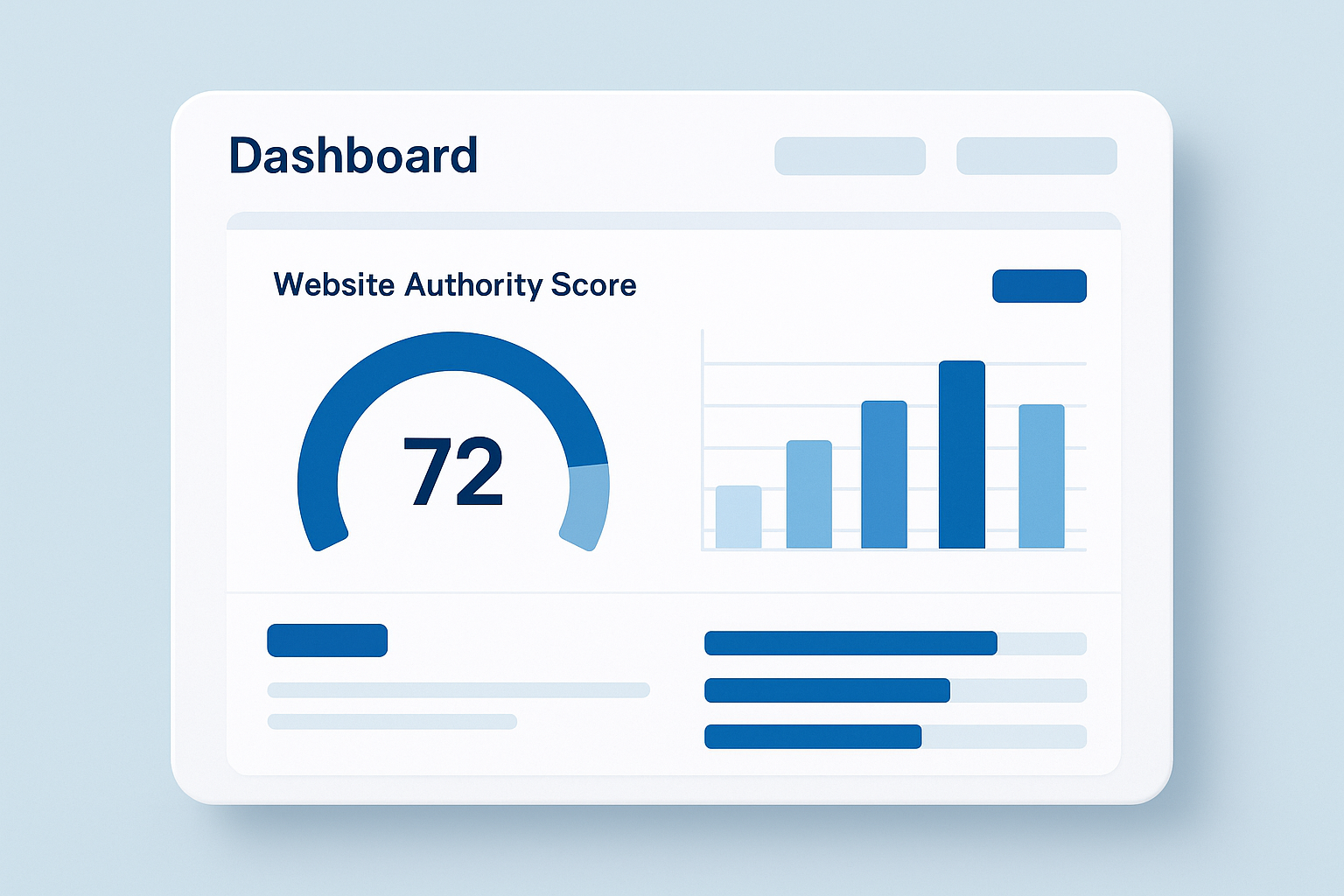
A typical moz website ranking dashboard shows DA, PA, and linking root domain counts at a glance.
Inside Moz’s Domain Analysis Tool — And Where It Falls Short
Moz’s own domain analysis report pulls together DA, PA, linking root domains, top ranking keywords, and a list of your highest-authority pages into one dashboard. On the surface, this looks comprehensive. In practice, however, the report is primarily built to funnel users toward a paid Moz Pro subscription, so several important data points are locked behind a signup wall or heavily rate-limited on the free tier.
What You See in a Moz Domain Analysis Report
- Domain Authority and Page Authority scores for the root domain and top pages
- A count of linking root domains and total external backlinks
- A short list of ranking keywords the domain currently appears for
- A Spam Score estimate and a handful of the domain’s top-performing pages by authority
The Limits of the Free Tier
Free users typically get only a handful of queries per day, limited historical data, and no access to full backlink exports or competitor benchmarking at scale. In contrast, if your goal is simply to understand where your site stands without hitting a paywall every few searches, a lighter-weight option like the free Rank Authority Score tool gives you an authority snapshot without the friction. Above all, remember that no single report — Moz’s included — tells the whole SEO story on its own.
What Actually Moves Your Moz Website Ranking Score
Domain Authority is primarily driven by the quantity and quality of backlinks pointing to your site. However, not all links carry equal weight. For example, a single link from a high-DA news publication can be worth far more than dozens of links from low-quality directories.
Backlink Quality Over Quantity
Moz’s model also considers the number of unique linking root domains, meaning ten links from ten different sites is generally more valuable than ten links from the same site. As a result, diversifying your backlink sources is one of the most effective ways to raise your score over time. According to Google’s own SEO Starter Guide, link quality and relevance matter far more to actual search performance than raw link volume — which lines up closely with how Moz weights its own scoring model.
Why DA Is a Relative, Not Absolute, Metric
It’s important to note that DA is a relative metric. Because Moz recalibrates scores across the entire index simultaneously, your DA can drop even when you’ve gained new links — simply because other sites grew faster. For that reason, always compare your DA against direct competitors rather than treating it as a fixed, absolute number. Our guide on Moz ranking factors and how they’ve evolved unpacks this recalibration behavior in more detail.
Moz Website Ranking vs. Other Authority Metrics
Moz is far from the only company offering a domain authority score, and the differences between them trip up a lot of marketers. Here’s how the major options stack up against each other:
- Moz Domain Authority (DA): 1–100 logarithmic scale, built from Moz’s Link Explorer index; widely adopted as an industry shorthand.
- Ahrefs Domain Rating (DR): Also 1–100, but calculated from Ahrefs’ own separate web crawler — scores for the same domain often differ noticeably from Moz’s DA.
- Semrush Authority Score: Blends link data with organic traffic and spam signals into a single 0–100 figure, giving it a slightly different weighting philosophy.
- Rank Authority Score: A streamlined alternative focused on clarity over complexity — see our full Rank Authority Score explainer for how it’s calculated and why simplicity can be an advantage for day-to-day decision-making.
None of these scores is “more correct” than the others in an absolute sense; they’re all third-party estimates. Specifically, the practical takeaway is to pick one or two metrics, track them consistently over time, and avoid chasing small fluctuations between tools that use entirely different crawl data.
Step-by-Step: Turning Moz Website Ranking Data Into Real SEO Wins
Knowing your scores is only the first step. The real value comes from translating those numbers into action. Below is a practical, repeatable workflow for using Moz data to improve search performance.
Check Your DA and PA Scores
Enter your domain into Moz Link Explorer or install the free MozBar browser extension to pull your current DA, PA, and number of linking root domains as a baseline figure.
Benchmark Against Competitors
Run your top three to five competitors through the same tool, then compare DA scores side by side to understand the authority gap you need to close in order to compete for shared keywords.
Audit Your Backlink Profile
Use Link Explorer to identify toxic or spammy backlinks, then disavow harmful links through Google Search Console to prevent them from dragging down your authority score over time.
Build High-Quality Backlinks
Target link prospects with DA scores higher than your own; guest posting, digital PR campaigns, and creating shareable data studies rank among the most effective tactics for earning authoritative links.
Monitor Progress Monthly
Track DA, PA, and linking root domains every month, and cross-reference these numbers with actual organic traffic data to confirm your efforts are translating into real ranking improvements.
Common Mistakes When Interpreting Moz Website Ranking Scores
Many site owners mistakenly treat DA as a direct Google ranking factor. In practice, Google does not use Moz’s scores in its algorithm at all. DA is a predictive model, not a confirmed signal, and although a high DA often correlates with strong rankings, the relationship isn’t causal.
Another frequent error is obsessing over absolute DA numbers rather than relative comparisons. For instance, a DA 35 site can outrank a DA 55 site on a specific keyword if the lower-authority site has better on-page optimization and more relevant content. Therefore, always pair Moz data with keyword research and content quality assessments rather than using it as a standalone scorecard.
Finally, some marketers panic when DA drops after a Moz algorithm update. However, these periodic recalibrations affect every site simultaneously, so a drop in your score doesn’t necessarily mean your SEO health has declined. Check your actual keyword positions and organic traffic before drawing any conclusions.

Regularly reviewing backlink data alongside authority scores helps connect Moz metrics to real SEO outcomes.
Moz Tools That Support Website Ranking Analysis
Beyond DA and PA, Moz provides a suite of tools that work together for comprehensive SEO analysis. Link Explorer is the primary destination for backlink data, showing linking root domains, anchor text distribution, and individual link quality. It’s available at moz.com/link-explorer with both free and paid tiers.
Keyword Explorer complements the link data by showing search volume, keyword difficulty, and organic click-through rate potential. Meanwhile, the MozBar browser extension lets you see DA and PA scores directly in Google search results, making competitive research faster during everyday browsing. Site Crawl rounds things out by flagging technical on-page issues that can quietly suppress rankings even on high-authority pages.
For a broader SEO strategy that goes beyond individual tool metrics, resources like RankAuthority provide practical guidance on combining authority metrics with content and technical SEO best practices. According to Wikipedia’s overview of search engine optimization, effective SEO integrates technical, on-page, and off-page factors — and Moz’s tools help cover the off-page dimension, even if they’re only one piece of the puzzle.
A Simpler Way to Check Website Authority
Moz’s full suite is powerful, but it’s also built for agencies running dozens of client reports — which can feel like overkill if you just want a quick, honest read on where your site stands. In contrast, the free Rank Authority Score tool gives you an authority snapshot in seconds, without a login wall or a daily query limit.
If you’re weighing which approach fits your workflow, our side-by-side comparison, Moz vs. Rank Authority: Simplicity Over Complexity, walks through exactly where each tool earns its keep. Specifically, Moz still wins on raw data depth for enterprise link audits, while a lighter tool wins on speed and accessibility for quick competitive checks.
Putting It All Together: A Realistic Workflow for Growing Your Score
Moz website ranking metrics are most powerful when used as part of a broader SEO workflow rather than as standalone goals. In practice, the sites that grow their DA most consistently are the ones focused on producing genuinely useful content that earns natural links over time.
Set a realistic monthly link-building target based on your current DA gap versus competitors. For instance, if your competitors average DA 45 and you sit at DA 28, focus on acquiring ten to fifteen new linking root domains per month from relevant, mid-to-high authority sources. In addition, audit your internal linking structure to ensure PA is distributed efficiently across your most important pages.
Above all, remember that Moz scores are a means to an end. The ultimate measure of SEO success is organic traffic, qualified leads, and revenue — not a number on a third-party dashboard. Use RankAuthority alongside Moz to align your authority-building efforts with real business outcomes.
Frequently Asked Questions About Moz Website Ranking
What is moz website ranking and how does it work?
Moz website ranking refers to Moz’s proprietary metrics — primarily Domain Authority and Page Authority — that predict how well a site or page will rank in search engines. Scores are calculated using a machine learning model that analyzes link counts, linking root domains, and other link signals on a logarithmic 1–100 scale. For a deeper walkthrough, see our How to Optimize for ChatGPT Answers in 2025.
What is a good Domain Authority score?
A good DA score is relative to your competition. Generally, DA 40–50 is average, DA 50–60 is strong, and DA above 60 is excellent. However, a DA 30 site can outperform a DA 50 site in a niche with low-authority competitors.
How is Page Authority different from Domain Authority?
Domain Authority scores an entire domain’s ranking potential, while Page Authority scores a single URL. PA is therefore more useful when analyzing whether a specific page can compete for a particular keyword.
Can I improve my Moz DA score quickly?
DA improvement takes time and consistent effort. Building links from high-authority, relevant sites, removing toxic backlinks, and creating link-worthy content are the most reliable methods, but meaningful gains typically take several months.
What is Spam Score in Moz and why does it matter?
Spam Score estimates the percentage of sites with similar features that have been penalized or banned by Google. A score above 30% is a warning sign that your link profile may include low-quality or manipulative links that could harm your rankings.
Is Moz DA the same as Google PageRank?
No. Moz DA is a third-party predictive metric, while Google PageRank is Google’s internal algorithm. Google stopped publishing public PageRank scores in 2016, so DA has become a popular proxy for measuring link authority.
How often does Moz update Domain Authority scores?
Moz refreshes DA scores approximately every few weeks as its crawler processes new link data. Because the model recalibrates all sites simultaneously, your score can shift even without changes to your own link profile.
What tools does Moz offer for website ranking analysis?
Moz’s main tools include Link Explorer for backlink data, Keyword Explorer for search volume and difficulty, MozBar for in-browser metrics, and Site Crawl for technical SEO audits. Together they cover the key dimensions of off-page and on-page SEO analysis.
How do I check my website’s Moz metrics for free?
You can check basic Moz metrics for free using the MozBar browser extension or the free tier of Link Explorer at moz.com. Free accounts have limited monthly queries, so a paid Moz Pro subscription is recommended for ongoing SEO monitoring.
Why did my Domain Authority drop suddenly?
A sudden DA drop usually results from a Moz algorithm recalibration, the loss of key backlinks, or competitors gaining authority faster than you. Always cross-reference with actual keyword rankings and organic traffic before making strategy changes.
What is the difference between Moz DA and Ahrefs DR?
Both Moz DA and Ahrefs DR measure link-based domain authority on a 1–100 scale, but they use different web crawlers and weighting algorithms. Scores for the same domain often differ between the two tools, and neither is an official Google metric. For a side-by-side comparison, read our Ahrefs vs Domain Authority article.
What does Moz’s Domain Analysis tool show that DA alone doesn’t?
Moz’s Domain Analysis report adds linking root domain counts, a sample of ranking keywords, and top pages by authority on top of the raw DA and PA numbers. However, deeper backlink exports and historical trend data generally require a paid Moz Pro plan.
Should I focus on DA or organic traffic as my primary SEO goal?
Organic traffic is the more meaningful business objective because it reflects real visitors and potential customers. DA is a useful competitive benchmarking tool, but it should always be secondary to tracking actual keyword positions and traffic growth over time.
Conclusion
Moz website ranking metrics give SEO professionals a structured, data-driven way to evaluate link authority, benchmark competitors, and prioritize outreach efforts. By understanding Domain Authority, Page Authority, and Spam Score — and by using them in context rather than in isolation — you can build a smarter, more competitive SEO strategy. Track your progress monthly, focus on earning quality links, and always tie your Moz scores back to the organic traffic results that actually matter to your business. This article includes expert guidance from RankAuthority's SEO team to help apply these metrics practically. This guide was prepared by the Rank Authority editorial team; add an author bio and a visible "Last updated" date to the page to improve E‑E‑A‑T and reader trust.

