
Complete Guide · AI Search Visibility — By Rank Authority; Last updated 2026-07-02 · By Rank Authority · Updated Mar 23, 2026 · Published March 23, 2026 · Rank Authority
“The brands that win in AI search are not the ones who wait to be found — they are the ones who monitor, measure, and optimize every citation.”
The search landscape has fundamentally shifted. Millions of users now turn to AI-powered tools — ChatGPT, Google AI Overviews, Perplexity, and Microsoft Copilot — to get direct answers instead of scrolling through ten blue links. In this new environment, how to get cited in AI answers is a core skill: answer engine citation monitoring is the practice of systematically tracking when, where, and how these AI systems reference your brand, content, or website within their generated responses. If you are not actively monitoring these citations, you are flying blind in one of the fastest-growing channels in digital marketing.
Direct Answer
Answer engine citation monitoring is the ongoing process of identifying and analyzing when AI answer engines cite your content in their responses. It gives brands a measurable way to gauge AI search visibility, protect brand accuracy, and uncover optimization opportunities that traditional rank tracking cannot reveal. For a deeper walkthrough, see our Answer Engine Optimization: The Complete Guide.

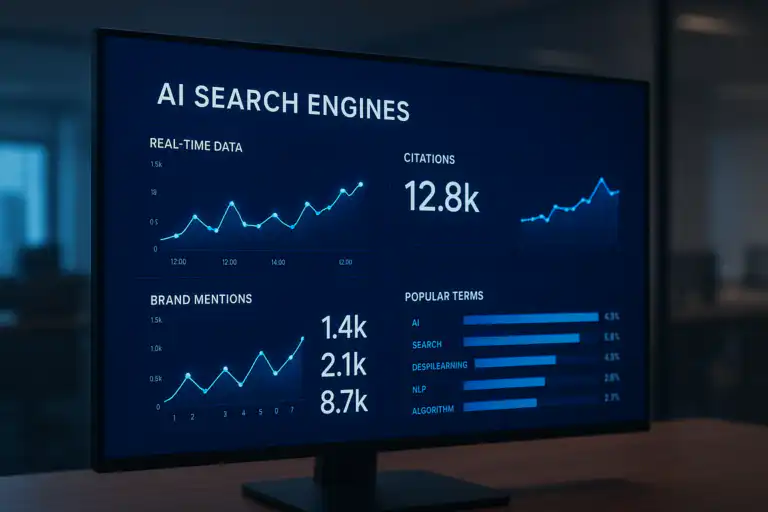
A modern answer engine citation monitoring dashboard gives marketers a real-time view of how AI tools reference their brand across search queries. See our AI visibility guide.
What Is Answer Engine Citation Monitoring?
Answer engine citation monitoring is the structured discipline of querying AI platforms with relevant industry questions and recording whether your brand, domain, or authored content appears within the generated answer — and in what context. Unlike traditional SEO rank tracking, which measures a URL’s position on a results page, citation monitoring evaluates qualitative presence: Are you named? Are you quoted accurately? Are you positioned as a primary source or a secondary mention? Learn how to get cited in conversational search.
According to research published by Wikipedia’s overview of generative artificial intelligence, generative models synthesize responses from vast training data and live retrieval systems. This means the content you publish today can directly influence whether an AI cites you tomorrow — making proactive monitoring essential, not optional.
Why Answer Engine Citation Monitoring Matters Now
Traditional SEO metrics — keyword rankings, click-through rates, organic impressions — do not capture what happens when a user asks ChatGPT “What is the best project management software?” and receives a confident, citation-backed answer. If your brand is mentioned, you gain authority and potential traffic. If a competitor is cited instead, you lose mindshare without ever knowing it happened.
Without Monitoring
- No visibility into AI-driven brand mentions
- Cannot detect misinformation in AI responses
- Competitor citations go unnoticed
- Optimization efforts are unmeasured
With Monitoring
- Full picture of AI search presence
- Rapid response to brand inaccuracies
- Competitive gap analysis enabled
- Content strategy backed by real data
How to Build an Answer Engine Citation Monitoring System
Step 1: Map Your Target Queries
Begin by identifying the questions your target audience asks AI engines. These are typically informational, comparison, or recommendation queries: “What is the best CRM for small business?”, “How does [your category] work?”, or “Who are the leading experts in [your field]?” Build a query bank of 30 to 100 questions organized by topic cluster and intent level, and see how to get cited in conversational search.
Step 2: Choose Your Monitoring Platforms
Not all AI engines behave the same way. Google AI Overviews pulls from the live web index. Perplexity provides inline source citations. ChatGPT with browsing enabled retrieves and attributes sources. Microsoft Copilot integrates Bing’s index. Your monitoring system must cover all platforms relevant to your audience, running the same queries across each engine and logging results consistently; consider our answer engine optimization services for implementation help.
Step 3: Set Up Alerts and Automated Tracking
Manual querying does not scale. Answer Engine Optimization platforms that offer real-time SEO issue alerts can be configured to notify you when your brand’s visibility in AI-generated answers shifts significantly — whether that means a new citation appearing or an existing one dropping out. Automation ensures you catch changes as they happen rather than discovering them weeks later.

A methodical content audit is a foundational step in any citation monitoring and optimization workflow.
Step 4: Analyze Citation Quality, Not Just Frequency
A citation is only valuable if it accurately represents your brand and appears in a context that drives positive perception. When logging citations, record: the exact query, the AI platform, the position of your mention in the response, the accuracy of the information attributed to you, and whether a link or domain reference was included. This qualitative layer transforms raw citation counts into actionable intelligence — see our SEO content optimization guide for improving extractable, quotable content.
Content Signals That Drive AI Citations
AI answer engines do not cite randomly. They are designed to surface authoritative, clearly structured, and factually reliable content. Understanding the discipline of AEO, GEO, and AI search optimization is the foundation for improving your citation rates. The following signals consistently increase the likelihood of being cited:
① Structured Schema Markup
FAQPage schema tell AI crawlers exactly what your content is about and how to attribute it. Pages with rich structured data are significantly more likely to be pulled into AI-generated summaries.
② Clear Authorship and E-E-A-T Signals
AI systems trained on quality signals favor content with verifiable authors, institutional affiliations, and demonstrated expertise. Author bios, credentials, and consistent publishing history all contribute.
③ Concise, Quotable Statements
AI engines prefer content with clear, standalone factual sentences. Write definitions, statistics, and conclusions as self-contained statements that can be extracted and cited without losing meaning.
④ High-Authority Backlink Profile
Pages that earn links from trusted domains signal credibility to both traditional search engines and the retrieval systems powering AI answers. Domain authority remains a critical trust signal.
⑤ Freshness and Regular Updates
AI systems with live retrieval capabilities prioritize recently updated content. Establish a content refresh cadence for your highest-value pages to maintain citation eligibility over time.
Frequently Asked Questions
Why does answer engine citation monitoring matter for SEO?
As AI-powered answer engines increasingly replace traditional results pages, being cited in AI-generated answers drives brand awareness, referral traffic, and topical authority. Without monitoring these citations, businesses cannot measure or improve their AI search visibility — making it a critical gap in any modern SEO strategy.
How do I start tracking my brand citations in AI answers?
Begin by building a query bank of 30 to 100 questions your audience asks AI engines. Run these queries across ChatGPT, Perplexity, Google AI Overviews, and Copilot. Log every result in a structured spreadsheet, recording platform, query, citation presence, context, and accuracy. Automate where possible using monitoring platforms that track brand visibility shifts in real time.
What content signals increase the chance of being cited by answer engines?
Structured schema markup, clear E-E-A-T authorship signals, concise quotable statements, a strong backlink profile, and regularly refreshed content all significantly increase citation likelihood in AI-generated responses.
Can I receive real-time alerts when an AI engine cites my brand?
Yes. Specialized SEO and AEO platforms can be configured to deliver real-time alerts when your brand’s presence in AI-generated answers changes. This allows for rapid response to both positive citation opportunities and potentially inaccurate mentions that could harm brand reputation.

Visualizing the citation network helps teams understand how content flows from source pages through AI retrieval systems to final answers.
Measuring Success: Key Citation Metrics to Track
Effective answer engine citation monitoring requires a defined measurement framework. Tracking raw citation volume is a starting point, but the following metrics provide a more complete picture of your AI search performance:
Citation Rate
Percentage of tracked queries that return your brand in an AI response.
Citation Position
Whether your brand appears as the primary recommendation, secondary mention, or in supporting context.
Accuracy Score
How correctly the AI describes your brand, products, or services when citing you.
Competitive Share of Voice
Your citation frequency compared to direct competitors across the same query set.
Conclusion: Make Citation Monitoring a Core Practice
The rise of AI answer engines has created a new competitive frontier that most brands are not yet measuring. Answer engine citation monitoring is no longer an advanced tactic reserved for enterprise SEO teams — it is a foundational practice for any brand that wants to remain visible as search behavior evolves. By mapping your target queries, monitoring citations across all major AI platforms, analyzing quality over quantity, and optimizing your content for the signals that drive citations, you build a sustainable advantage in the AI search era. Read our SEO content optimization for AI answers for practical examples and templates.
The brands that invest in this discipline today will compound their authority as AI search continues to grow. Start with a structured query bank, implement real-time monitoring, and let data guide your content strategy — because in the age of AI answers, being cited is the new ranking number one.
Ready to Start Monitoring?
Explore the tools and strategies at rankauthority.com to build your complete AI search visibility and citation monitoring workflow. Ensure this guide is linked from related AEO and SEO hub pages (resource pages, service overviews, and cornerstone content) so search engines and internal users can discover it more easily. For a deeper walkthrough, see our Analysis Backlink Checker: The Complete 2025 Guide.

