
Local SEO Action Guide
“Most local businesses are invisible online — not because of competition, but because of fixable mistakes.”
If your business serves customers in a specific city, neighborhood, or region, then priority SEO fixes for local businesses — the targeted technical and content improvements that directly increase your visibility in location-based search results — should be at the top of your growth plan. The majority of local businesses lose customers daily to competitors who have simply done the groundwork. The good news? Most of these issues are entirely fixable, often without an agency budget or developer on retainer.
Direct Answer
Priority SEO fixes for local businesses are the highest-impact changes — like claiming your Google Business Profile, standardizing your NAP data, and embedding local keywords — that rapidly improve how you rank in nearby searches. Addressing these fixes before anything else delivers the fastest return on your SEO investment.
What Are Priority SEO Fixes for Local Businesses?
Priority SEO fixes for local businesses refer to a specific set of optimizations that have an outsized effect on local search performance. Unlike general SEO — which focuses on domain authority and broad keyword rankings — local SEO is about proximity, relevance, and trust signals that tell Google you are the best answer for someone searching nearby. According to search engine optimization principles documented on Wikipedia, local search factors weight business signals differently than organic rankings, making targeted local fixes uniquely powerful.
Below, we walk through every critical fix in order of impact — so you know exactly where to start.

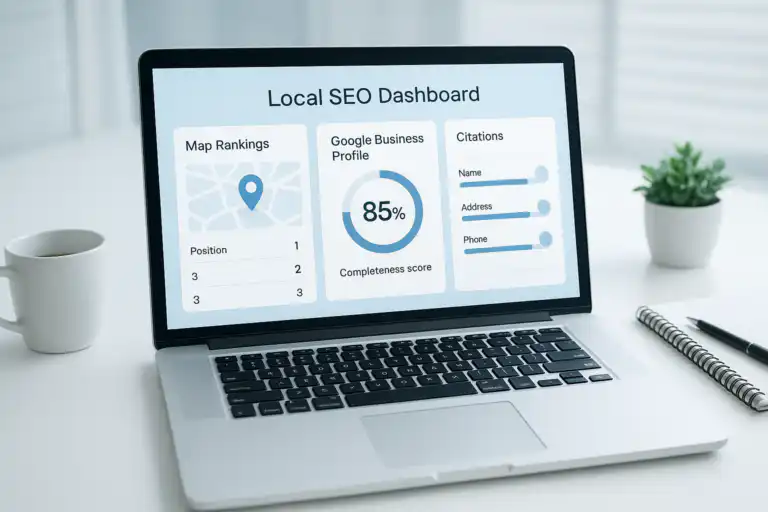
A well-configured local SEO dashboard helps identify priority SEO fixes for local businesses before they cost you customers.
Fix #1 — Claim and Fully Optimize Your Google Business Profile
Your Google Business Profile (GBP) is the single most powerful local ranking asset you control. An unclaimed or incomplete profile is the number one reason local businesses fail to appear in the local map pack — the three results that dominate the top of location-based searches.
GBP Optimization Checklist
- Claim and verify your listing via Google
- Select the most accurate primary and secondary categories
- Write a keyword-rich business description (750 characters)
- Upload high-quality photos of your storefront, interior, and team
- Add your hours, website, phone number, and service areas
- Enable messaging and respond to every review within 48 hours
- Post updates, offers, and events at least twice per month
Businesses with complete GBP profiles receive significantly more direction requests and website clicks than those with sparse listings. This is the fastest single fix available to most local businesses.
Fix #2 — Standardize Your NAP Data Across Every Directory
NAP stands for Name, Address, and Phone number. When these three pieces of information appear inconsistently across Yelp, Facebook, Apple Maps, TripAdvisor, and dozens of other directories, Google’s confidence in your business drops — and so do your rankings.
Audit every directory listing and make your NAP data byte-for-byte identical. If your storefront is “Suite 4B” on your website, it must say “Suite 4B” — not “Ste 4B” or “#4B” — everywhere else. This consistency is a foundational trust signal for local search algorithms.
Tools like Rank Authority’s real-time SEO issue alerts can flag NAP inconsistencies automatically, saving hours of manual directory checking and ensuring problems are caught before they suppress your rankings.
Fix #3 — Embed Local Intent Keywords Into Your Headings and Content
Generic service pages do not rank locally. A plumber in Austin who writes a page titled “Plumbing Services” will lose to a competitor who titles theirs “Emergency Plumber in Austin, TX — Same-Day Service.” The difference is local intent — the geographic modifier that tells Google exactly which searches your page should answer.
Every service page on your website should contain your city, neighborhood, or service area in the page title, the primary H2 heading, the opening paragraph, and naturally throughout the body copy. For a structured approach to this, explore how to properly incorporate local intent keywords into headings — a technique that directly lifts your relevance signals for location-based queries.

Mapping local intent keywords to headings is one of the most underused priority SEO fixes for local businesses with multiple service areas.
Fix #4 — Add LocalBusiness Schema Markup to Your Website
Schema markup is structured data that speaks directly to search engine crawlers in their own language. Adding LocalBusiness schema to your website tells Google your business name, address, phone, hours, geo-coordinates, and service type — all in a machine-readable format that reinforces your GBP data.
This is one of the most commonly skipped fixes and one of the most impactful. At minimum, implement the following schema properties on your homepage and contact page:
Essential Properties
- @type: LocalBusiness
- name
- address
- telephone
- openingHours
Recommended Additions
- geo (latitude/longitude)
- url
- priceRange
- aggregateRating
- areaServed
Fix #5 — Build a Review Generation System
Reviews are a direct local ranking factor and an even more direct conversion factor. Businesses with more recent, high-quality reviews consistently outrank those with fewer or older ones. Yet most local businesses leave reviews entirely to chance.
Build a simple system: send every satisfied customer a direct link to your Google review page within 24 hours of their purchase or service. Use SMS, email, or a printed card with a QR code. Aim for a minimum of five new reviews per month to maintain freshness signals. Always respond to reviews — both positive and negative — to demonstrate active engagement.
Fix #6 — Resolve Core Technical SEO Issues
Even the best local content strategy collapses on a technically broken website. The following technical problems are most damaging to local businesses and should be audited and fixed immediately:
- Page speed below 90 on mobile — use Google PageSpeed Insights to identify and compress render-blocking resources
- No HTTPS — an insecure site signals untrustworthiness to both users and Google
- Non-mobile-friendly layout — over 60% of local searches happen on mobile devices
- Broken internal links — crawl your site monthly and fix all 404 errors
- Missing or duplicate meta titles and descriptions — every page needs a unique, descriptive tag
- No XML sitemap submitted to Google Search Console — this slows crawl discovery of new pages

Mobile page speed is a non-negotiable technical requirement among priority SEO fixes for local businesses competing in mobile-first search.
Fix #7 — Earn Local Backlinks From Community Sources
Backlinks from other local websites — your chamber of commerce, local newspapers, neighborhood blogs, sponsorship pages, and business associations — carry disproportionate weight in local SEO. They signal to Google that your business is genuinely embedded in its community.
Start by joining your local chamber, sponsoring a community event, contributing a guest post to a local blog, or partnering with a complementary business for a cross-promotional feature. Each local backlink you earn compounds your authority over time.
Frequently Asked Questions
How long does it take for local SEO fixes to show results?
Most local SEO improvements begin showing measurable results within 30 to 90 days, though competitive markets may take longer. Quick wins like Google Business Profile updates can produce visibility improvements within days.
Why is NAP consistency important for local SEO?
NAP consistency — meaning your business Name, Address, and Phone number are identical across all online listings — signals trustworthiness and accuracy to search engines. Inconsistent NAP data confuses Google and can suppress your local rankings.
Does Google Business Profile affect local search rankings?
Yes. Google Business Profile is one of the most influential factors in local pack rankings. A complete, active, and well-reviewed profile significantly increases your chances of appearing in the top three local results.
What technical SEO issues hurt local businesses most?
The most damaging technical SEO issues for local businesses include slow page load speed, missing or incorrect LocalBusiness schema markup, broken links, non-mobile-friendly design, and lack of HTTPS security.
Start With the Fixes That Move the Needle Most
The priority SEO fixes for local businesses outlined in this guide are not theoretical — they are the specific, proven actions that separate visible local businesses from invisible ones. Begin with your Google Business Profile and NAP consistency, then move systematically through keyword embedding, schema markup, reviews, technical health, and link building.
You do not need to tackle everything at once. Even implementing two or three of these fixes this week will produce measurable improvements within the month. For ongoing monitoring and automated issue detection, Rank Authority provides the tools and insight local businesses need to stay ahead of algorithm changes and competitive shifts without requiring full-time SEO expertise.
Local search is not a lottery — it rewards preparation, consistency, and the willingness to fix what is broken. Start today, and your business will be the one customers find first tomorrow.

