
SEO Tools & Domain Metrics
Free DA Checker: Check Domain Authority Instantly (2025 Guide)
Everything you need to know about using a free DA checker — what it measures, how to read your score, and how to use it to outrank competitors.
Direct Answer
A free DA checker is an online tool that instantly calculates a website’s Domain Authority (DA) — a score from 1 to 100 that predicts how well a domain is likely to rank in search engines. You can check any domain right now using RankAuthority’s free domain authority checker — no login, no payment, no limits.
A free DA checker gives SEOs, bloggers, agencies, and business owners instant access to one of the most widely used metrics in search engine optimisation. In seconds, you can see exactly where your domain stands, how it compares to competitors, and which link-building opportunities are worth pursuing. Furthermore, because these tools cost nothing, there is no barrier to making DA checks a regular part of your SEO workflow.
In this guide, we cover everything you need — from what Domain Authority actually measures to step-by-step instructions for using a free DA checker, a full breakdown of the DA scoring scale, and proven tactics for improving your score over time.
What Is a Free DA Checker?
Domain Authority (DA) is a proprietary search engine ranking score developed by Moz. It predicts how likely a website is to rank prominently on search engine results pages (SERPs). The scale runs from 1 to 100 — specifically, higher numbers indicate a stronger ability to rank. A free DA checker is an online utility that retrieves this score without requiring a subscription, login, or payment of any kind.
In addition to the DA score itself, most free DA checkers surface a range of supporting metrics, including Page Authority (PA), the number of backlinks, referring domains, and a spam score. These extra data points give you a more complete picture of a domain’s health and authority at a glance.
According to Wikipedia’s overview of domain authority, DA is most powerful when used as a comparative tool — meaning it is most valuable for measuring your domain against competitors in the same niche, rather than treating any single score in isolation.

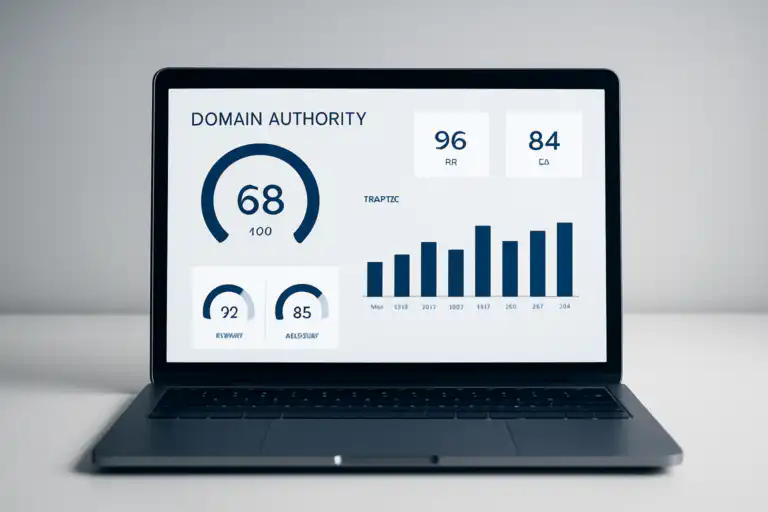
A free DA checker presents domain authority scores alongside supporting metrics — including PA, backlinks, and spam score — in a clean, readable dashboard.
How Is Domain Authority Calculated?
Moz calculates DA using a machine-learning model that analyses dozens of signals. However, the most influential factors are the quality and quantity of inbound links pointing to the domain. Specifically, links from high-authority, editorially trusted sites carry significantly more weight than links from low-quality or unrelated sources.
The DA algorithm also considers linking root domains — the number of unique websites linking to you — as a key input. For example, 100 links from 100 different domains will generally produce a higher DA than 1,000 links from the same single domain. In short, diversity of your link profile matters as much as raw link volume.
It is important to note that DA is a logarithmic scale. Consequently, moving from DA 10 to DA 30 is considerably easier than moving from DA 60 to DA 70. The higher your current score, the more sustained effort is required to push it further upward.
Why Domain Authority Matters for SEO in 2025
Google does not use Domain Authority as a direct ranking factor. However, DA functions as a reliable proxy for your site’s overall SEO strength. In practice, sites with higher DA scores tend to rank faster for competitive keywords, attract more organic traffic, and earn new backlinks more easily — creating a compounding SEO advantage over time.
Therefore, regularly using a free DA checker should be a standard part of every SEO workflow. Here are the four core use cases where DA data delivers the most value:
Competitive Analysis
Compare your DA against direct competitors to identify the authority gap you need to close in order to compete for the same keywords. For instance, if your DA is 28 and your top competitor is DA 54, you have a clear benchmark to work toward.
Link Prospecting
Before pursuing a backlink, check the DA of the linking domain. Higher-DA links pass more authority and have greater SEO impact. As a rule of thumb, prioritise outreach to domains with a DA higher than your own.
Progress Tracking
Monitor your DA monthly to measure the impact of your link-building and content campaigns over time. Similarly, tracking competitor DA reveals when rivals are accelerating their SEO investment.
Client Reporting
Agencies use DA as a clear, digestible metric when reporting SEO progress to clients who are not familiar with technical ranking signals. It provides an easy-to-understand number that demonstrates momentum.
DA vs. DR vs. Google PageRank: What’s the Difference?
Confusion between authority metrics is common. Here is a clear breakdown so you can understand what each score actually represents:
- Domain Authority (DA) — Developed by Moz. Scores 1–100. Based primarily on link profile quality and linking root domains.
- Domain Rating (DR) — Developed by Ahrefs. A similar 1–100 scale, but calculated using Ahrefs’ own link index. DR and DA often differ for the same domain.
- Google PageRank — Google’s original internal link-scoring algorithm. It is no longer publicly visible, though it still influences rankings behind the scenes.
- Page Authority (PA) — Also from Moz, but applied at the individual page level rather than the whole domain. A free DA checker typically shows both DA and PA together.
In practice, DA is the most widely referenced third-party authority metric. Therefore, it is the most useful benchmark for competitive research and link prospecting purposes.
How to Use a Free DA Checker: Step-by-Step
Using a free DA checker takes less than 60 seconds from start to results. Here is the exact process to follow:
- Navigate to the tool. Visit RankAuthority’s free DA checker. No account, email address, or credit card is required — the tool is completely open to use.
- Enter your domain. Type or paste the full domain (e.g., yourwebsite.com) into the input field. Most free DA checkers also support bulk entry — specifically, you can paste multiple domains at once to compare them simultaneously.
- Review your results. The tool returns your DA score, Page Authority (PA), number of backlinks, referring domains, and a spam score — all within seconds. Consequently, you have a complete authority snapshot without opening any paid platform.
- Benchmark your competitors. Run the same check on 3–5 competing domains. This reveals the exact authority gap you need to close in order to compete for the same keywords in your niche.
- Take action on the data. Use your DA findings to prioritise link-building targets, identify content opportunities, and shape your outreach strategy for the next 90 days.

Checking your domain authority is as simple as entering a URL. Results appear instantly with a free DA checker — no setup required. For a deeper walkthrough, see our Free Domain Rating Checker: The Complete Guide.
What Is a Good DA Score? Understanding the Full Scale
Domain Authority scores are relative, not absolute. A “good” score depends entirely on your niche and the competitors you are up against. For example, a DA of 30 may be excellent in a niche populated by small local businesses, yet the same score would put you at a severe disadvantage in a highly competitive industry like finance or health.
That said, here is a general reference scale widely used by SEO professionals to contextualise DA scores:
What DA Score Should You Actually Be Targeting?
Rather than chasing an arbitrary number, use your free DA checker to find the average DA of the top 10 results for your target keywords. That average is your real competitive benchmark. For example, if the top-ranking pages for your primary keyword all have DA scores between 35 and 50, reaching DA 45–55 puts you in a competitive position — without needing to match the DA of global media giants.
Similarly, if you notice that high-quality, long-form content from lower-DA domains is ranking above larger sites, it signals that on-page relevance and content quality are compensating for lower authority. In that case, you may be able to rank effectively even with a DA below the field average.
How to Improve Your DA Score After Checking It
Once your free DA checker reveals your current score, the next step is building a strategy to improve it. DA growth is a long-term effort. However, these five tactics consistently produce measurable results:
Earn High-Quality Backlinks
Focus on earning links from domains with a higher DA than yours. Guest posting on reputable industry publications, digital PR campaigns, and creating linkable assets — such as original research, data studies, free tools, and comprehensive guides — are the most reliable methods. Use the free backlinks checker at RankAuthority to audit your current link profile and identify gaps to fill.
Remove or Disavow Toxic Links
Spammy or low-quality backlinks drag your DA down. Consequently, you should regularly audit your backlink profile and disavow harmful links using Google Search Console. Additionally, reaching out to the linking site to request manual removal is worth attempting before using the disavow tool.
Publish Expert-Level Content That Earns Links Organically
Content that attracts backlinks naturally is the most scalable DA-building strategy. Long-form guides, original data studies, and comprehensive resource pages attract links from authoritative sources without outreach. Above all, prioritise depth and original insight over volume of publication.
Strengthen Your Internal Linking Structure
A strong internal linking structure distributes Page Authority across your site efficiently, helping individual pages rank better. Furthermore, it signals to search engines that your content is well-organised and that your domain covers topics with depth and coherence.
Fix Technical SEO Issues
Technical problems — such as broken links, slow page speed, crawl errors, and duplicate content — dilute your domain’s authority signals. Specifically, broken internal and external links waste link equity that should be flowing to your most important pages. Use Google Search Console to identify and resolve these issues regularly.
How Long Does It Take to Increase DA?
DA growth timelines vary considerably based on your starting point and the competitiveness of your niche. In general, sites with DA under 20 can see meaningful movement within 3–6 months of consistent link-building. By contrast, moving from DA 50 to DA 60 can take 12–18 months of sustained effort, because the logarithmic scale makes each additional point progressively harder to earn.
The most important habit is to check your DA monthly using a free DA checker, record the score, and compare it against the same month’s backlink acquisition data. Over time, this creates a clear picture of which activities are actually moving your authority score.
Free DA Checker vs. Paid DA Tools: Which Should You Use?
A common question is whether a free DA checker is accurate enough to rely on, or whether you need a paid platform for dependable data. The honest answer: for most use cases, a free DA checker is entirely sufficient.
Here is how they compare across the metrics that matter most:
In short: use a free DA checker for quick competitive benchmarking, link prospecting, and regular progress tracking. Upgrade to a paid tool only if you need deep historical backlink data or enterprise-level crawl reports.
Common Mistakes When Using a Free DA Checker
Even experienced SEO professionals make avoidable errors when interpreting DA data. Here are the most common mistakes — and how to avoid them:
- Treating DA as a Google ranking factor. It is not. Google does not use Moz’s DA score. However, the underlying signals that build DA — quality links and strong content — do influence Google rankings indirectly.
- Comparing DA scores across different niches. A DA of 40 in a niche of small blogs is strong. The same score in a competitive financial services niche is weak. Always benchmark DA within your specific competitive landscape.
- Checking DA too frequently. DA updates on a gradual basis. Checking daily or weekly adds no value, because meaningful movement requires weeks or months of backlink accumulation to register.
- Ignoring the spam score. Most free DA checkers also return a spam score (a measure of how many spammy signals are associated with the domain). A high spam score alongside a moderate DA indicates that the domain’s authority may be artificially inflated by low-quality links.
- Overlooking Page Authority (PA) data. DA measures the whole domain. However, for link prospecting, the PA of the specific page linking to you matters too. A link from a high-PA page on a mid-DA domain can be more valuable than a link from a low-PA page on a high-DA domain.
Frequently Asked Questions About Free DA Checkers
How accurate is a free DA checker compared to paid tools?
Free DA checkers pull from the same core Moz data sources as many paid tools. Therefore, they are accurate enough for competitive research, link prospecting, and tracking SEO progress over time. The main difference is that paid platforms offer deeper historical trend data and more granular backlink analysis — features that most users do not need for everyday DA monitoring.
Can I check multiple domains at once with a free DA checker?
Yes. Many free DA checkers support bulk domain lookups, allowing you to check multiple websites simultaneously. This is especially useful for comparing a full set of competitors or vetting a list of potential link-building partners quickly and without manual effort.
How often should I check my DA score?
Monthly checks are sufficient for most websites. DA scores change gradually as your backlink profile evolves. Therefore, checking more frequently than monthly rarely reveals meaningful movement. Track your DA changes alongside your link-building campaign data for the most actionable insights.
Does a higher DA guarantee better Google rankings?
No. DA is a predictive metric, not a direct Google ranking factor. However, the same elements that build DA — quality backlinks, strong content, and technical SEO — are precisely the elements that improve Google rankings. Think of DA as a useful proxy, not a guarantee of ranking success.
Why did my DA score drop suddenly?
DA scores can drop for several reasons. First, Moz periodically updates its algorithm, which can cause widespread score recalibrations across all domains. Second, if competitors in your niche are building links faster than you, their relative DA gains can lower yours comparatively. Third, a sudden loss of high-quality backlinks — for example, a linking domain going offline — will directly reduce your score. In all cases, use your free DA checker alongside a backlink audit to diagnose the cause.
Is DA the same as DR (Domain Rating)?
No. DA (Domain Authority) is Moz’s metric, while DR (Domain Rating) is Ahrefs’ equivalent. Both measure link-based authority on a 1–100 scale, but they use different link indexes and calculation methods. As a result, the same domain can have meaningfully different DA and DR scores. A free DA checker specifically returns Moz’s DA score, not Ahrefs’ DR.

Tracking your DA score monthly with a free DA checker reveals the cumulative impact of your link-building and content strategy over time.
Conclusion: Making the Most of a Free DA Checker
A free DA checker is one of the most accessible and immediately actionable SEO tools available — and there is no reason not to use one regularly. Whether you are a solo blogger growing your first site, a digital marketer managing a portfolio of client domains, or an agency vetting link prospects at scale, using a free DA checker costs nothing and delivers strategic clarity that can shape months of SEO work.
The key insight is not to obsess over the number itself. Instead, use your DA score as a compass — it points toward the gap between where your domain currently stands and where it needs to be to compete effectively. Furthermore, use it to guide your link-building priorities, evaluate prospects, and measure the return on your content investment over time.
Above all, combine your free DA checker data with consistent action: earn quality backlinks, remove toxic ones, publish expert content, and fix technical issues. Do those things consistently, and your DA score — along with your organic rankings — will grow steadily over time.
Start Now — It’s Free
Check your domain authority score instantly — no account required.

