
Direct Answer
An AI visibility audit is a structured process of evaluating how well your website’s content is discovered, interpreted, and cited by AI-powered search engines, large language models (LLMs), and answer engines like ChatGPT, Perplexity, and Google’s AI Overviews. Running one reveals exactly where your content falls short — and what to fix so AI systems choose your content as their answer.
Search behavior has changed permanently. Millions of queries that once sent users to a results page now end with an AI-generated answer — no click required. If your content is not being cited by AI tools, you are effectively invisible to a fast-growing segment of your audience. That is precisely why conducting a thorough AI visibility audit has become one of the most urgent tasks in modern digital marketing. Furthermore, the window for early-mover advantage is closing fast. This guide walks you through every component of a complete audit — from schema evaluation to E-E-A-T signals — so you can close the gaps and position your brand as a trusted AI source.

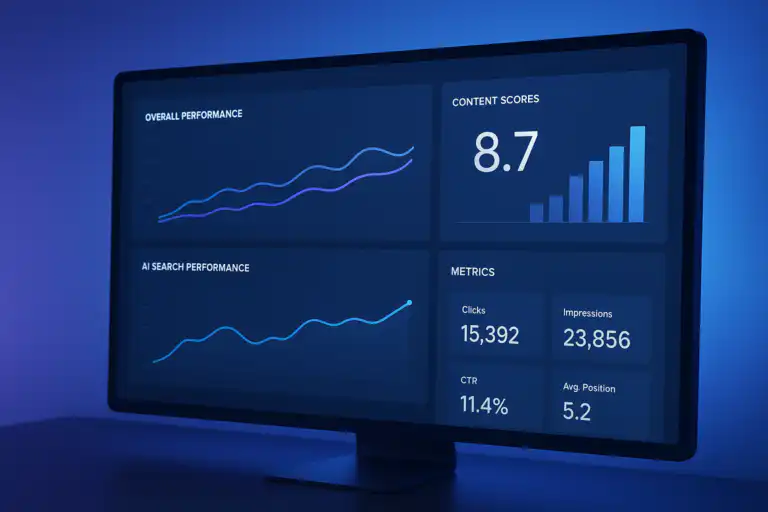
A well-structured AI visibility audit surfaces content performance gaps that traditional SEO tools simply cannot detect.
What Is an AI Visibility Audit?
An AI visibility audit is a systematic evaluation of how discoverable, understandable, and citable your content is across AI-powered search environments. Specifically, this includes large language models (LLMs — AI systems trained on vast text data to generate human-like answers), answer engines like Perplexity, and AI-generated search summaries such as Google’s AI Overviews.
In contrast to a traditional SEO audit — which focuses primarily on crawlability, backlinks, and keyword density — an AI visibility audit examines whether your content is formatted in a way that AI systems can parse, trust, and reproduce as a direct answer. The distinction matters because AI systems do not rank pages. Instead, they extract and synthesize information. Therefore, a page that ranks on page one of Google may still be completely absent from AI-generated answers if it lacks the structural and semantic signals these systems rely on.
According to research on information retrieval, systems that serve direct answers prioritize content clarity, source authority, and structural coherence above raw keyword matching. Consequently, your entire content strategy must adapt to serve this new retrieval paradigm.
AI Visibility vs. Traditional SEO: Key Differences
| Factor | Traditional SEO Audit | AI Visibility Audit |
|---|---|---|
| Primary Goal | Rank higher in search results | Get cited in AI-generated answers |
| Key Signals | Backlinks, keyword density, crawlability | Schema, entity clarity, content structure, E-E-A-T |
| Success Metric | Click-through rate, SERP position | Brand citations in AI answers |
| Content Format | Keyword-optimized paragraphs | Direct answers, structured data, clear headings |
Why Your Site Needs an AI Visibility Audit Right Now
The urgency is real. Brands that establish AI citation authority today will enjoy compounding visibility as AI search adoption grows. Those who delay will find themselves rebuilding from scratch in a landscape where the rules have already been written. Here are the core reasons to act immediately:
- Zero-click growth: AI answers increasingly resolve queries without a click. As a result, your only presence may be as a cited source inside the answer itself — making citation everything.
- LLM training signals: Content that is well-structured and frequently cited trains future model versions to associate your brand with topic authority. Therefore, early investment pays dividends across multiple model generations.
- Competitive gap: Most competitors have not yet audited for AI visibility. Consequently, this is a rare window to capture territory before they do.
- Algorithm alignment: Google’s own ranking systems increasingly favor content that also performs well in AI answer contexts. In other words, AI visibility improvements reinforce traditional SEO simultaneously.
- Brand trust signals: Being cited by AI tools positions your brand as an authoritative source, which in turn drives direct traffic and trust from new audiences.
- Answer engine market share: Platforms like Perplexity, ChatGPT Search, and Gemini are capturing a growing share of informational queries. Specifically, these platforms favor structured, credible, and recently updated content.
Key Insight: AI-generated answers now appear in over 30% of Google searches for informational queries. Furthermore, Perplexity alone processes over 10 million queries per day. If your content is not optimized for AI citation, you are already losing visibility.
How to Run an AI Visibility Audit: The Complete 9-Step Process
Below is a thorough, step-by-step framework for conducting a complete AI visibility audit. Each step addresses a distinct layer of how AI systems discover and evaluate your content. Work through them in sequence for the most comprehensive result. For a deeper walkthrough, see our AI Visibility Checker: The Complete Guide for 2025.
Step 1: Audit Schema Markup and Structured Data
Schema markup is the language AI systems use to understand what your content is about without reading every word. Think of it as metadata that tells AI systems “this section is an FAQ,” “this is a how-to guide,” or “this is a review.” Start by auditing every key page for the following schema types:
- FAQPage — for question-and-answer content sections
- HowTo — for step-by-step instructional content
- Article / BlogPosting — for editorial and informational pages
- Organization / Person — for author and brand identity pages
- BreadcrumbList — for site structure and navigation context
- Product / SoftwareApplication — for commercial or tool-focused pages
Use Google’s Rich Results Test and Schema.org validators to confirm implementation accuracy. Missing or malformed schema is one of the most common — and most fixable — reasons well-written content gets ignored by answer engines. Additionally, validate that your schema data matches the actual on-page content; inconsistency flags content as untrustworthy.
Step 2: Evaluate Direct Answer Formatting
AI systems strongly favor content that answers questions directly and early. Specifically, audit each page for a clear, concise answer within the first 100 words of each section. If your content buries the answer in background context, restructure it so the direct answer comes first, followed by elaboration. This mirrors the inverted pyramid structure used in journalism — and it is exactly what LLMs are trained to extract.
For each target page, ask these questions:
- Does the page open with a direct definition or answer?
- Is the primary answer visible without scrolling?
- Are headings written as questions or clear topic statements?
- Does each section begin with its key point — not with context?
- Are lists and tables used to present comparative or multi-part information?
In addition, consider adding a “Quick Answer” or “TL;DR” block at the top of long-form pages. This element is highly extractable by AI systems and dramatically improves your citation probability.
Step 3: Assess Entity Recognition and Brand Authority
AI systems build knowledge graphs around named entities — people, brands, products, and concepts. Entity recognition is, therefore, a foundational layer of any effective AI visibility audit. AI systems must know who you are before they can consistently cite you.
Audit how consistently your brand name, product names, and key topics are mentioned across your own content and across external sources. Specifically, check the following:
- Brand name consistency: Is your brand name identical across all pages, schema, social profiles, and third-party mentions?
- Wikipedia / Wikidata presence: Does your brand have an entity entry that AI systems can reference?
- About page completeness: Does your About page clearly describe who you are, what you do, and who you serve?
- Third-party mentions: Are you referenced in credible external publications, directories, or databases?
- Author entity markup: Are your content authors identified with Person schema and linked author profiles?
Inconsistent naming, missing About pages, or a lack of third-party mentions weakens your entity authority and reduces the likelihood that AI systems will surface your brand as a definitive source.

Entity recognition is a foundational layer of any effective AI visibility audit — AI systems must know who you are before they can cite you.
Step 4: Review Content Freshness and Update Cadence
Stale content is a significant liability in AI search. LLMs and retrieval-augmented generation (RAG) systems — which pull real-time or recently indexed content to supplement model knowledge — actively prioritize recently updated, accurate information. As part of your audit, identify pages that haven’t been updated in six months or more and flag them for review.
For each flagged page, evaluate:
- Are statistics and data points current? Replace any figures older than 12 months.
- Do internal links point to current, active pages?
- Has the topic evolved in ways not reflected in the content?
- Is the dateModified schema property updated after each content refresh?
- Does the meta description and title reflect current best practices?
A disciplined approach to updating content for SEO directly improves your AI visibility by signaling that your site maintains current, trustworthy information. Set up a recurring quarterly review schedule for all high-priority pages.
Step 5: Calibrate Content Depth and Length
Content that is too thin gets ignored. Content that is unfocused and bloated dilutes its own relevance signals. Your audit should evaluate whether each key page achieves the right depth for its topic. Research consistently shows that comprehensive, well-structured content outperforms thin pages in both traditional and AI-driven search.
However, length alone is not the goal. The ideal content satisfies every dimension of user intent for that query — no more, no less. Understanding the impact of content length on SEO rankings gives you the framework to calibrate depth without padding.
Specifically, for each page in your AI visibility audit:
- Compare your word count against the top three AI-cited sources for that topic.
- Check whether all sub-questions a user might ask about the topic are addressed.
- Identify sections where a numbered list, table, or diagram would clarify dense prose.
- Remove duplicate content or padding that does not add factual value.
Step 6: Audit Internal Linking and Topical Authority
AI systems evaluate topical authority by examining how comprehensively a site covers a subject area. A strong internal link structure that connects related content signals to both traditional search engines and AI retrieval systems that your site is a complete resource on a given topic. Moreover, well-linked topic clusters make it easier for AI crawlers to map your content relationships.
During your audit, check for:
- Orphaned pages: Pages with no internal links pointing to them are invisible to AI crawlers.
- Anchor text relevance: Are internal links using descriptive, topically relevant anchor text?
- Topic cluster completeness: Does every pillar page link to its supporting cluster content — and vice versa?
- Missing connections: Are there thematically related pages that should link to each other but don’t?
- Crawl depth: Are important pages accessible within three clicks from the homepage?
Step 7: Evaluate E-E-A-T Signals and Citation Potential
Experience, Expertise, Authoritativeness, and Trustworthiness — collectively known as E-E-A-T — are the backbone of AI citation decisions. AI systems preferentially cite content from sources that demonstrate verifiable expertise and institutional credibility. Therefore, your audit must assess these signals systematically.
Audit the following E-E-A-T elements:
- Author bios: Do all content authors have detailed bios with credentials, experience, and links to their professional profiles?
- About page: Does your About page clearly establish your organization’s expertise and mission?
- Editorial standards: Do you have a publicly visible editorial policy, fact-checking process, or content review standard?
- External backlink profile: Are you cited by authoritative third-party sources in your niche?
- Source citations: Does your own content cite credible external sources, studies, and data points?
- Privacy and transparency: Are your contact information, privacy policy, and terms of service complete and accessible?
Pages with clear authorship, verifiable credentials, and external citations are significantly more likely to be surfaced in AI-generated answers than anonymous, uncredentialed content. In fact, for YMYL (Your Money or Your Life) topics — finance, health, legal — E-E-A-T signals may be the single most important factor in AI citation decisions.
Step 8: Check Technical Accessibility for AI Crawlers
Even perfectly structured content cannot be cited if AI systems cannot access it. Technical accessibility for AI crawlers is a distinct concern from traditional Googlebot crawlability. Specifically, several AI platforms use their own crawlers — for example, PerplexityBot, GPTBot, and ClaudeBot — each with their own access rules.
During your AI visibility audit, check the following technical factors:
- robots.txt: Are AI crawlers explicitly blocked? Many sites inadvertently block GPTBot or PerplexityBot. Review and update your robots.txt to allow access.
- JavaScript rendering: Is your primary content rendered in HTML or locked behind JavaScript? LLM crawlers often cannot execute JavaScript, meaning JS-rendered content may be invisible to them.
- Page speed: Slow-loading pages are deprioritized by all crawlers. Aim for a Core Web Vitals score in the “Good” range.
- Canonical tags: Ensure canonical tags correctly point to the preferred version of each page, preventing AI systems from indexing duplicate or thin variants.
- HTTPS: All pages must be served over HTTPS. Insecure pages are treated as low-trust by AI systems.
Step 9: Measure AI Citation Presence Directly
The final step in any AI visibility audit is to directly measure your current citation presence. This means actively querying AI platforms for your brand name, your target topics, and your target questions — then recording whether your content is cited. It is a simple but powerful benchmark.
Use the following testing protocol:
- Query ChatGPT, Perplexity, Gemini, and Claude with 10-15 questions directly related to your core topics.
- Record which sources are cited in each answer. Note where competitors appear but you do not.
- Search for your brand name directly. Note how AI platforms describe you — accuracy reflects entity authority.
- Identify the gap: which topics do competitors own in AI answers that you should own?
- Repeat this test quarterly to measure improvement after implementing audit fixes.
Furthermore, tools like Brand24, Mention, and emerging AI-specific monitoring platforms can automate citation tracking across AI search environments. However, manual testing remains the most reliable method for initial baselining.

A checklist-driven approach ensures every component of the AI visibility audit is completed systematically and without gaps.
The AI Visibility Audit Checklist: At a Glance
Use this consolidated checklist to track your audit progress. Each item corresponds to a step in the process above. Specifically, work through each item page-by-page for your highest-priority content first.
✅ Schema & Structured Data
- All key pages have valid, complete schema markup
- Schema data matches visible on-page content
- Organization and Author schema implemented sitewide
✅ Content Structure & Formatting
- Direct answers appear within first 100 words of each section
- Headings written as clear topic statements or questions
- Quick Answer / TL;DR block present on long-form pages
- Tables and lists used for comparative and multi-part content
✅ Entity & Brand Authority
- Brand name consistent across all pages and external mentions
- Complete About page with Organization schema
- Author bios with credentials and Person schema
- Third-party citations and directory presence
✅ Technical AI Accessibility
- robots.txt allows GPTBot, PerplexityBot, ClaudeBot
- Primary content in HTML (not JS-rendered)
- Core Web Vitals in “Good” range
- All pages on HTTPS with correct canonical tags
✅ Freshness, Depth & E-E-A-T
- All statistics updated within the last 12 months
- Content covers all sub-questions for each target topic
- Editorial policy and fact-checking standards visible
- External backlinks from credible, relevant sources
Turning AI Visibility Audit Findings Into Action
An audit without a remediation plan is just a report. Once you have identified gaps across the nine steps above, prioritize fixes by impact and effort. Specifically, pages that already rank well in traditional search but lack schema markup are quick wins — a single afternoon of implementation can unlock AI citation potential for dozens of pages.
Content that is stale, thin, or poorly structured requires more investment. However, it also delivers the highest long-term return. Build a rolling 90-day content calendar that incorporates AI visibility improvements alongside your existing SEO work.
Prioritisation Framework: Where to Start
Not all fixes are equal. Therefore, use this priority matrix to sequence your remediation work:
- High traffic + missing schema: Fix immediately. These pages already attract users and are one schema implementation away from AI citation.
- High traffic + stale content: Update within 30 days. Fresh, accurate content on popular pages amplifies AI citation potential significantly.
- AI-cited competitor pages you don’t cover: Create new content targeting these topic gaps within 60 days.
- Technical accessibility blocks: Resolve robots.txt and JS rendering issues immediately — these block all other improvements.
- E-E-A-T gaps (missing bios, no editorial policy): Address within 30 days for YMYL content; within 90 days for all other content.
How to Track AI Visibility Progress Over Time
Track your progress by querying AI tools directly — search for your brand, your key topics, and your target questions in ChatGPT, Perplexity, and Gemini. When your content starts appearing as a cited source, you will know the audit is working. Furthermore, maintain a simple spreadsheet tracking:
- Date of each manual AI query test
- Which AI platforms cited your content
- Which queries returned competitor citations but not yours
- Changes made since the last test and their impact
In addition, monitor organic traffic changes on pages where you have implemented AI visibility improvements. Often, AI citation improvements correlate with traditional ranking improvements — because both reward the same underlying content quality signals.
Common AI Visibility Audit Mistakes to Avoid
Even experienced SEO professionals make critical errors when running their first AI visibility audit. Knowing what to avoid saves significant time and prevents you from optimizing in the wrong direction.
- Treating it like a traditional SEO audit: AI search optimization is fundamentally different from keyword ranking. Specifically, focusing only on meta tags and backlinks misses the structural and entity-level changes that drive AI citation.
- Ignoring robots.txt for AI crawlers: Many sites block GPTBot and PerplexityBot accidentally. As a result, all other optimization work is wasted if crawlers cannot access the content.
- Optimizing only for Google’s AI Overviews: Different AI platforms use different retrieval methods. Therefore, optimize for the common denominators — structure, clarity, entity authority — rather than one platform.
- Neglecting non-written content: Video transcripts, podcast show notes, and image alt text are all extractable by AI systems. Consequently, ignoring these formats leaves citation opportunities on the table.
- One-time auditing: AI search algorithms evolve rapidly. An audit conducted six months ago may already be outdated. Moreover, competitor content landscapes shift constantly — regular re-auditing is essential.
- Keyword stuffing for AI: AI systems penalize content that appears manipulative or keyword-dense. In contrast, natural, context-rich writing earns citation far more reliably.
Frequently Asked Questions About AI Visibility Audits
Why does my website need an AI visibility audit?
Traditional SEO audits focus on crawlability and keyword rankings, but AI search systems prioritize structured, authoritative, and contextually rich content. Without an AI visibility audit, you may be invisible to a growing share of users who rely on AI-generated answers rather than clicking through search results. Furthermore, competitors who optimize for AI citation now will entrench their authority before you start.
How often should I run an AI visibility audit?
At minimum, once per quarter. AI search algorithms and LLM training cycles evolve rapidly. Additionally, your content competitive landscape shifts as competitors publish new material. Regular audits ensure your content stays aligned with how these systems retrieve and surface information.
Can content length affect AI visibility?
Yes. Content that is too thin is often ignored by AI systems, while excessively long content without clear structure dilutes relevance signals. The ideal approach is well-structured, comprehensive content with clear headings, direct answers, and supporting detail — which AI systems can efficiently parse and cite.
What is the difference between an AI visibility audit and a regular SEO audit?
A regular SEO audit evaluates factors that influence search engine rankings — backlinks, keyword usage, site speed, and crawlability. An AI visibility audit, in contrast, evaluates whether your content is structured, credentialed, and formatted in a way that AI answer engines can extract, trust, and reproduce. The two audits overlap but serve different objectives.
Which AI platforms should I optimize for?
Prioritize ChatGPT (including ChatGPT Search), Google’s AI Overviews, Perplexity, Gemini, and Claude. However, because these platforms share core retrieval principles — structured content, entity authority, E-E-A-T — optimizing for the common fundamentals covers all of them simultaneously. Consequently, you do not need a separate strategy per platform.
How do I know if my AI visibility audit is working?
The clearest signal is appearing as a cited source in AI-generated answers. Query ChatGPT, Perplexity, Gemini, and Claude with your target questions quarterly and track citation frequency. Additionally, monitor branded search volume, direct traffic, and organic ranking improvements on pages where you implemented audit changes — all tend to improve together as AI visibility increases.
Ready to run your AI visibility audit?
The team at RankAuthority provides in-depth audit frameworks, implementation guides, and content strategy resources built specifically for the AI search era. Use their tools to benchmark your current AI visibility and build a clear, measurable path to improvement.
Conclusion
The rise of AI-powered search is not a future event — it is the present reality reshaping how content is discovered, consumed, and credited. Conducting a regular AI visibility audit is no longer optional for brands that want to maintain and grow their organic presence. By systematically working through the nine-step framework in this guide — covering schema markup, direct answer formatting, entity authority, content freshness, topical depth, internal linking, E-E-A-T signals, technical accessibility, and citation measurement — you give AI systems every reason to choose your content as the answer. Start with the highest-impact fixes first, build a remediation roadmap, and revisit your audit every quarter. The brands that invest in AI visibility today will be the ones that dominate AI-generated answers tomorrow.

