

Complete Strategy Guide
“The brands winning in search today aren’t just producing more content — they’re producing smarter content, guided by machine intelligence at every step.”
AI-driven content marketing is the practice of using artificial intelligence tools and machine learning algorithms to plan, create, distribute, and optimize content at scale. It is no longer a futuristic concept reserved for enterprise teams with unlimited budgets — it is a practical, measurable discipline reshaping how every serious brand competes for attention online. Whether you are building topical authority from scratch or scaling an established content operation, understanding how to harness AI at each stage of the content lifecycle is now a foundational marketing skill.
Direct Answer
AI-driven content marketing uses artificial intelligence to automate and enhance every stage of the content lifecycle — from research and creation to distribution and performance analysis. It enables brands to produce more relevant content faster, personalize experiences at scale, and make data-backed decisions that consistently improve ROI.
What Is AI-Driven Content Marketing?
AI-driven content marketing is the systematic application of artificial intelligence — including natural language processing (NLP), machine learning, and predictive analytics — across the full content marketing funnel. Rather than replacing human creativity, it amplifies it: AI handles the data-heavy, time-consuming tasks so strategists and writers can focus on insight, narrative, and brand voice.
According to Wikipedia’s overview of AI marketing, artificial intelligence in marketing encompasses any use of machine learning to analyze consumer behavior and automate marketing decisions — a definition that maps directly onto modern content operations, where audience signals, keyword data, and engagement metrics must all be processed simultaneously.
The result is a content engine that learns. Every piece of content published generates performance data. AI systems ingest that data, identify patterns, and surface actionable recommendations — creating a compounding advantage over teams still relying on intuition alone.
AI-driven content marketing connects machine intelligence directly to content planning, creation, and performance measurement.
The Five Pillars of an AI-Powered Content Strategy
Effective AI-driven content marketing is built on five interconnected capabilities. Each one delivers standalone value, but the real competitive advantage emerges when they operate as a unified system.
Pillar 01
Intelligent Topic Research
AI tools analyze search trends, competitor content gaps, and audience intent signals simultaneously — identifying topics with high potential before competitors discover them. This moves keyword research from a reactive task to a predictive advantage.
Pillar 02
Scalable Content Creation
Natural language generation (NLG) platforms assist writers in producing first drafts, outlines, and content briefs at a fraction of the traditional time investment. Human editors refine and elevate the output — combining machine speed with human judgment.
Pillar 03
Hyper-Personalization at Scale
AI enables dynamic content experiences — serving different messaging to different audience segments based on behavior, location, device, and stage in the buying journey. What was once possible only for enterprise brands is now accessible through modern SaaS platforms.
Pillar 04
Automated Distribution and Scheduling
AI-powered distribution tools determine optimal publishing times, channel mix, and promotional cadence by analyzing historical engagement patterns. This eliminates guesswork and ensures every piece of content reaches its maximum potential audience.
Pillar 05
Continuous Performance Optimization
Machine learning models continuously score content performance, flag underperforming assets, and recommend updates — transforming your content library from a static archive into a living, improving asset that compounds in value over time.
How Does AI Improve Content Marketing ROI?
The ROI case for AI-driven content marketing is grounded in three compounding efficiencies: speed, precision, and learning. Traditional content teams invest enormous time in research and ideation before a single word is written. AI compresses that cycle dramatically — freeing budget and bandwidth for higher-value creative work.
Precision improves because AI removes the subjectivity from content decisions. Instead of publishing based on gut instinct, teams publish based on predicted performance — informed by competitive analysis, search intent modeling, and audience behavior data. The result is a higher percentage of content that actually ranks, converts, and retains readers.
For a comprehensive look at the numbers behind this shift, the 2025 AI content marketing insights report from Rank Authority compiles 96 key data points showing exactly how AI adoption is reshaping content performance benchmarks across industries.
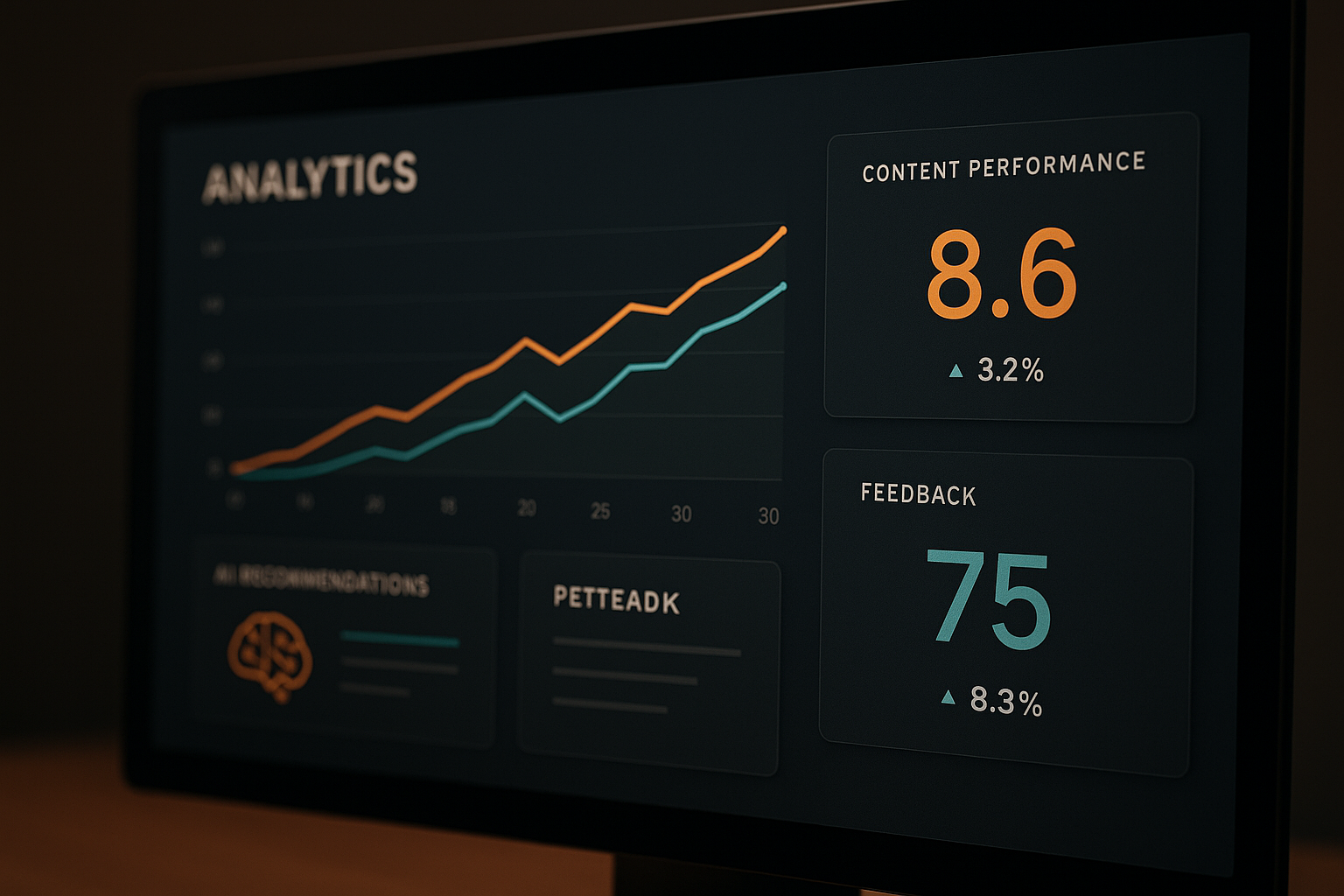
Real-time performance dashboards are a cornerstone of any mature AI-driven content marketing operation.
The Role of Supplementary Content in an AI Strategy
One area where AI delivers outsized value is in identifying and building supplementary content — the supporting articles, FAQs, glossary pages, and topic cluster pieces that strengthen a site’s topical authority without competing with its core commercial pages.
AI-powered content gap analysis can map an entire topic cluster in minutes, surfacing the exact supplementary pages needed to establish comprehensive coverage in the eyes of both search engines and readers. Understanding how to strategically deploy these assets is explored in depth in this guide to supplementary content strategy from Rank Authority. For a deeper walkthrough, see our AI-Driven Onpage SEO Audit: The Complete Guide.
When supplementary content is planned and executed through an AI-driven framework, internal linking becomes systematic rather than ad hoc — and the cumulative effect on domain authority is measurable within months, not years.
Frequently Asked Questions

Human editorial judgment remains central to every effective AI-driven content marketing workflow.
Building Your AI Content Stack: A Practical Starting Point
Transitioning to an AI-driven approach does not require replacing your entire workflow overnight. The most effective implementations begin with a single high-friction area — typically keyword research or content briefing — and expand from there as the team builds confidence and measures results.
Recommended Implementation Sequence
- Audit your current content library — identify top performers, underperformers, and coverage gaps using AI-powered analysis tools.
- Implement AI-assisted keyword and topic research — replace manual spreadsheet workflows with predictive topic modeling.
- Introduce AI content briefing — use NLP tools to generate structured briefs that give writers a clear competitive and semantic roadmap.
- Add performance monitoring automation — set up AI dashboards that flag content decay and surface update opportunities proactively.
- Layer in personalization — once the production pipeline is stable, introduce dynamic content elements for key audience segments.
Each stage builds on the last, creating a compounding content operation that becomes more efficient and more effective with every publishing cycle.
What the Data Tells Us About Adoption and Outcomes
Adoption of AI in content marketing has accelerated sharply. Teams that integrated AI tools into their content workflows report significant reductions in time-to-publish, meaningful improvements in organic click-through rates, and stronger content-to-revenue attribution — all within the first year of implementation.
The competitive gap between AI-adopters and non-adopters is widening. Brands that delay integration are not simply missing an efficiency gain — they are ceding ground to competitors who are publishing more relevant content, faster, at lower cost per piece.
The strategic imperative is clear: AI-driven content marketing is not a trend to monitor. It is a capability to build — now.
Conclusion
AI-driven content marketing represents the most significant structural shift in digital marketing since the rise of search itself. By combining machine intelligence with human creativity, brands can produce more relevant content, reach the right audiences with precision, and build compounding organic growth that traditional approaches simply cannot match. The tools are available, the data is compelling, and the competitive window for early movers remains open — but it is narrowing. Start building your AI content capability today, and let the results speak for themselves.

