

How to Optimize for ChatGPT Answers in 2025: The Complete Playbook
The search landscape has permanently changed. To optimize for ChatGPT answers — structuring and positioning your content so AI language models recognize it as authoritative and cite it in generated responses — is now one of the most critical skills in modern digital marketing.
Millions of users now bypass Google entirely, asking ChatGPT, Bing Copilot, and Google Gemini for direct answers. If your content isn’t built for AI consumption, you’re invisible to a rapidly growing, high-intent audience.
Quick Answer: To optimize for ChatGPT answers, publish content that is factually precise, structured with clear headings and explicit FAQ sections, demonstrates genuine topical authority, earns high-quality backlinks, and implements Schema.org structured data. AI models favor content that is easy to parse, trustworthy, comprehensive, and aligned with conversational user intent.
What Does It Mean to Optimize for ChatGPT Answers?
To optimize for ChatGPT answers is the deliberate practice of crafting, structuring, and positioning web content so that large language models (LLMs) like ChatGPT, Bing Copilot, Google Gemini, and Perplexity AI identify it as a reliable, citable source when composing AI-generated responses to user queries.
Unlike traditional SEO — which targets ranking algorithms through signals like backlinks and keyword density — ChatGPT optimization targets the training data preferences, retrieval logic, and authority heuristics of AI systems. These systems don’t rank pages in a list; they synthesize answers and selectively cite sources they deem trustworthy and relevant.
According to Wikipedia’s overview of generative AI, large language models synthesize responses from patterns learned across vast corpora of text. This means the quality, clarity, and credibility signals baked into your content directly influence whether an AI model draws from it — or ignores it entirely.
Why it matters now: A 2024 study by SparkToro found that over 20% of informational queries are now resolved without a click — either via AI answers or zero-click search. Brands that appear in ChatGPT answers gain an enormous trust advantage: users perceive AI-cited sources as inherently authoritative. Brands that don’t appear simply don’t exist in that conversation.
This discipline is also known by several overlapping terms: Generative Engine Optimization (GEO), Answer Engine Optimization (AEO), and AI Search Optimization. All refer to the same core goal: earning citations and visibility inside AI-generated answers rather than (or in addition to) traditional search rankings.

Understanding how AI models process and retrieve content is the foundation of any strategy to optimize for ChatGPT answers.
How ChatGPT Selects and Surfaces Content
ChatGPT operates through two distinct mechanisms that content creators must understand separately:
Mechanism 1: Training Data Inclusion
The base ChatGPT model (without Browse) draws from content that was included in its training corpus. Content that was widely cited, linked to from authoritative domains, and published before the model’s knowledge cutoff has a higher probability of being represented in training data. You cannot retroactively influence past training runs, but you can position your content to be included in future model updates by maximizing authority and crawlability now.
Mechanism 2: Retrieval-Augmented Generation (RAG)
ChatGPT with Browse capabilities, Bing Copilot, and Perplexity AI use Retrieval-Augmented Generation (RAG) — they actively retrieve live web content to supplement their base knowledge. This is where your real-time SEO and content strategy has immediate, measurable impact. The AI fetches pages, evaluates their relevance and trustworthiness, and incorporates information from those pages into its answer.
In both mechanisms, AI systems prioritize content based on overlapping signals:
- Topical AuthorityDoes your site consistently cover a subject in depth across multiple interlinked pages? AI models favor domains that demonstrate encyclopedic knowledge within a niche rather than single isolated articles.
- Content Clarity and DirectnessIs the answer to a question stated explicitly and early? AI retrieval systems reward direct, unambiguous language. Burying answers in preamble or padding is penalized.
- Structural LegibilityAre headings, lists, and paragraphs logically organized with clean HTML? Machine parsing depends heavily on semantic structure. Pages with broken or confusing markup are harder for AI systems to interpret correctly.
- Trust and E-E-A-T SignalsDoes the content cite primary sources, include author credentials, and align with established facts? The same E-E-A-T (Experience, Expertise, Authoritativeness, Trustworthiness) principles Google applies are used as implicit quality filters by AI models.
- Freshness and AccuracyIs the content recently updated and factually current? AI tools increasingly weight recency, especially for rapidly evolving topics like technology, health, and finance.
- Backlink Profile and Domain AuthorityPages cited by high-authority external sources carry stronger signals into AI retrieval systems. Earning genuine editorial backlinks from recognized publications remains one of the most powerful levers for AI visibility.
- Brand Entity StrengthAI models build semantic associations between brand names and topic clusters. Consistent, prominent brand mentions across authoritative third-party sources increase the probability of being cited in relevant queries.
For a deeper comparison of how AI search differs from traditional engines, this breakdown of ChatGPT vs. Google and Bing from Rank Authority explains the key distinctions in detail.
ChatGPT Optimization vs. Traditional SEO: Key Differences
Understanding where ChatGPT optimization diverges from traditional SEO prevents you from applying the wrong tactics and missing opportunities unique to AI search. The table below summarizes the critical differences:
| Dimension | Traditional SEO | ChatGPT / AI Optimization |
|---|---|---|
| Primary goal | Rank high in SERPs | Be cited in AI-generated answers |
| Key signals | Backlinks, keywords, page speed | E-E-A-T, topical authority, clarity, schema |
| Content format | Keyword-optimized prose | Q&A, definitions, structured lists, FAQs |
| Output | Blue link in search results | Citation or paraphrase in AI answer |
| Measurement | Rank tracking, organic traffic | AI mention tracking, brand visibility monitoring |
| Schema priority | Rich snippets, Local, Product | FAQPage, HowTo, Article, Entity markup |
Critically, these two disciplines are not mutually exclusive. A strong traditional SEO foundation — particularly domain authority and crawlability — directly supports your ability to optimize for ChatGPT answers. Think of them as layered, not competing.
10 Proven Strategies to Optimize for ChatGPT Answers
1 Write Explicit, Standalone Definitions
AI models are trained to extract definitional content. Every key concept should have a clear, self-contained definition within the first two sentences of its section. Write as if each section could be extracted as a standalone snippet — because with RAG systems, it often is. Avoid assuming the reader or the AI has prior context.
Best practice: Open every major section with a bolded sentence that directly states what the section is about. This mirrors the “answer first” format that AI answer engines prefer.
2 Structure Content Around Natural-Language Questions
ChatGPT is fundamentally a question-answering engine. Format your H2 and H3 headings as natural-language questions that reflect real user queries — the same phrases someone would type into a chat interface. Follow each question heading immediately with a direct, concise answer (2–3 sentences), then elaborate in the body paragraphs.
Use tools like AnswerThePublic, Reddit, and Quora to identify the exact phrasing people use when asking about your topic — not just the SEO keyword form. AI models are trained on conversational language, not keyword-stuffed queries.
3 Build Topical Authority With Content Clusters
A single well-written article is rarely enough to optimize for ChatGPT answers at scale. AI models assess the overall authority of an entire domain, not just individual pages. Create interconnected content clusters — a pillar page supported by multiple subtopic articles — that collectively signal deep, encyclopedic expertise.
For example, if your core topic is “email marketing,” your cluster should include dedicated pages on email subject lines, list segmentation, deliverability, A/B testing, automation sequences, and re-engagement campaigns. Each page links internally to the pillar and to one another, reinforcing topical relevance for both AI systems and traditional crawlers.
4 Implement Schema.org Structured Data Aggressively
Structured data is the clearest signal you can send to any automated system about what your content means and how it is organized. For AI optimization, prioritize these schema types:
- FAQPage: Explicitly maps questions and answers, directly aligned with how AI answer engines retrieve Q&A content.
- HowTo: Signals step-by-step instructional content — a format AI models surface frequently for procedural queries.
- Article / BlogPosting: Confirms authorship, publication date, and editorial context — all E-E-A-T signals.
- Entity markup (Thing, Organization, Person): Helps AI systems build accurate semantic associations between your brand and your topic area.
Without schema markup, AI crawlers must infer meaning from raw text alone — a far less reliable process that reduces your citation probability.
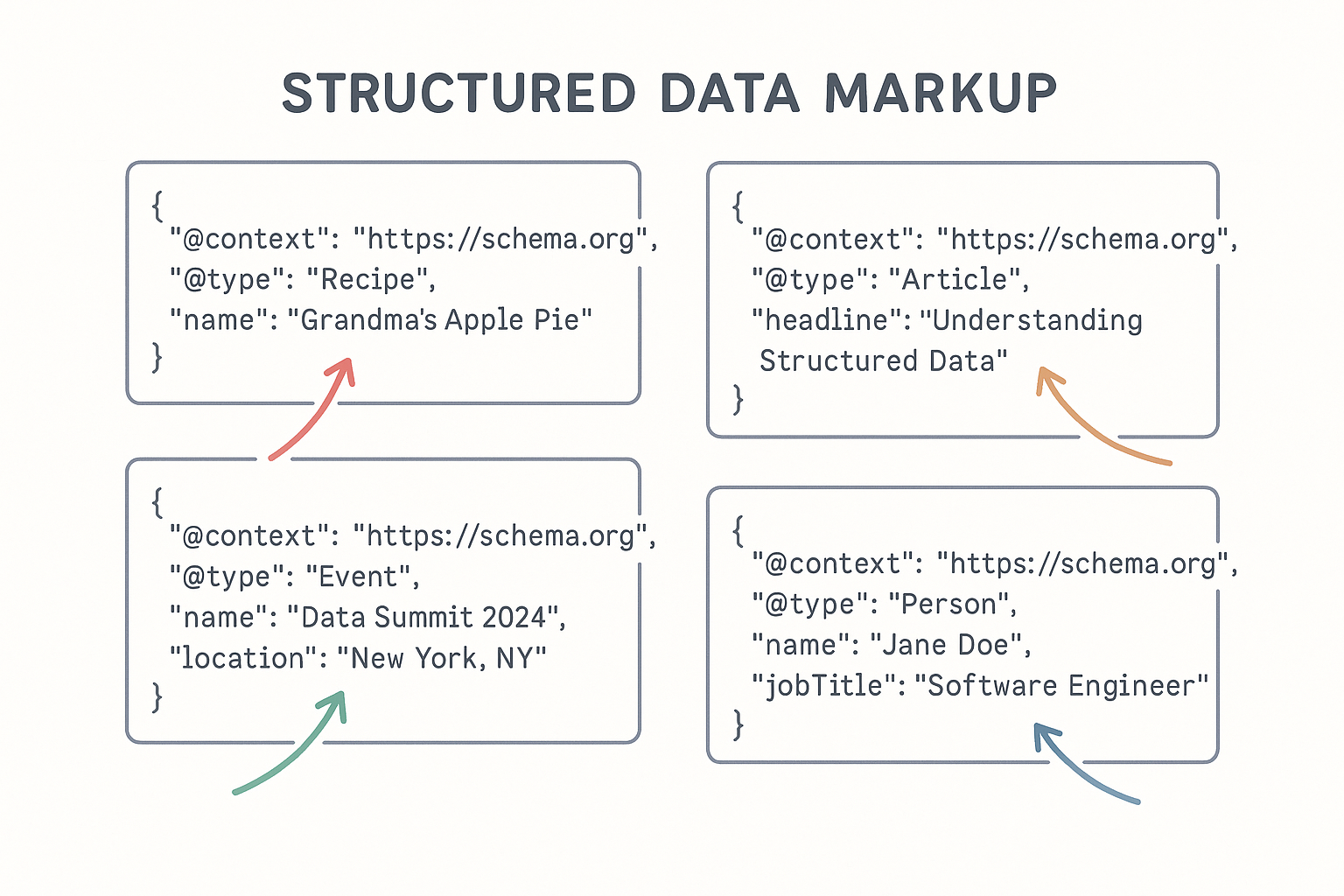
Implementing Schema.org markup is one of the most direct technical steps you can take to improve AI content retrieval.
5 Demonstrate E-E-A-T at Every Level of Your Content
Experience, Expertise, Authoritativeness, and Trustworthiness (E-E-A-T) are not just Google quality guidelines — they are the implicit quality filters AI models apply when evaluating which sources to cite. Concrete actions to strengthen E-E-A-T for AI optimization include:
- Publishing content under named authors with verifiable professional credentials and biographical pages
- Citing primary sources, studies, and data with direct links to the original research
- Earning editorial backlinks from recognized industry publications, not just directory links
- Maintaining factual accuracy and correcting errors promptly with visible update timestamps
- Including About, Contact, and Privacy pages with transparent organizational information
- Featuring real-world case studies and first-hand experience, not just theoretical overviews
6 Write in Conversational, Natural Language
ChatGPT was trained predominantly on conversational text — forum discussions, Q&A sites, blog posts, and editorial content. Content that reads naturally, avoids jargon overload, and uses active voice aligns more closely with the linguistic patterns the model learned from. Write the way a knowledgeable expert would explain something to a curious, intelligent colleague over coffee.
Avoid: dense corporate passive voice, excessive technical jargon without explanation, overly complex nested sentence structures, and keyword-stuffed phrases that read unnaturally. These patterns signal lower quality to both AI and human readers.
7 Optimize for Entity-Based Search and Brand Mentions
AI models don’t just understand keywords — they understand entities: people, organizations, products, concepts, and the relationships between them. Optimizing for entity recognition is one of the most underutilized tactics to optimize for ChatGPT answers.
Practical steps for entity optimization:
- Create and maintain a Google Knowledge Panel for your brand by claiming and verifying your Google Business Profile and linking it to your website
- Pursue Wikipedia mentions or citations where legitimately appropriate — Wikipedia is heavily weighted in LLM training data
- Earn unlinked brand mentions across authoritative publications — co-citation signals matter even without a hyperlink
- Use Organization and Person schema to formally declare your entity relationships in structured data
- Ensure your brand name, product names, and key topic associations are consistently named across all pages and third-party mentions
8 Prioritize Long-Form, Comprehensive Content
Thin content (under 800 words) rarely has enough depth to satisfy the full scope of a user’s query. AI models prefer comprehensive resources that address a topic from multiple angles — definitions, context, how-tos, comparisons, FAQs, and common mistakes. A single article that thoroughly covers a topic from end to end is more likely to be cited than five thin articles each covering a narrow slice.
Aim for content that is as long as the topic requires — not artificially padded, but genuinely comprehensive. For most high-value informational topics, this typically means 2,000–4,000 words of substantive content.
9 Regularly Refresh and Update Content
AI systems with live retrieval capabilities — Bing Copilot, ChatGPT Browse, Perplexity — strongly favor recently updated content for time-sensitive topics. A content refresh strategy isn’t optional; it’s a core part of how to optimize for ChatGPT answers over time.
Set a calendar cadence to revisit your highest-priority pages every 90 days. Update statistics, add new examples, incorporate recent developments, and revise any information that has become outdated. Always update the dateModified in your Article schema when you do.
10 Monitor, Measure, and Iterate With Real-Time Insights
Optimizing for ChatGPT answers is not a one-time task. The AI landscape evolves rapidly — models update, retrieval algorithms shift, and new AI tools emerge continuously. A proactive monitoring strategy is essential to sustaining and improving visibility.
Tools that provide real-time SEO issue alerts — like those offered by Rank Authority — can flag technical problems that prevent AI crawlers from accessing and indexing your content. Additionally, manually test your target queries in ChatGPT, Bing Copilot, and Perplexity on a regular basis to see which competitors are being cited and what content formats appear most frequently in responses.
Technical Requirements for AI Visibility
Even the best content fails to get cited if AI crawlers can’t access it reliably. Technical health is a prerequisite for AI visibility, not an afterthought. The following technical factors are directly relevant to how AI systems retrieve your pages:
Robots.txt and Crawl Access
Verify that your robots.txt does not block the major AI crawlers: GPTBot (OpenAI), CCBot (Common Crawl, used in training data), Google-Extended, and PerplexityBot. Many sites inadvertently block these bots with overly restrictive directives. If you want to be cited, you must allow access.
Page Speed and Core Web Vitals
Slow-loading pages create timeouts for automated crawlers. Target a Largest Contentful Paint (LCP) under 2.5 seconds and a Time to First Byte (TTFB) under 800ms. Pages that load in under 2 seconds across all devices signal technical health to both AI crawlers and search engines.
Clean HTML Semantics
Use proper semantic HTML: for the page title, for main sections, for subsections, for body text, and appropriate list tags. AI parsers rely on this hierarchy to understand content structure and extract relevant sections for citation.
Canonical Tags and Duplicate Content
Ensure every page has a correct rel="canonical" tag pointing to the definitive version. Duplicate content confuses AI crawlers about which page represents the authoritative source, diluting your citation potential across multiple URLs instead of concentrating it on one.
HTTPS and Security
All content must be served over HTTPS. HTTP pages are treated as untrustworthy by modern AI retrieval systems and will be deprioritized or skipped entirely. Verify your SSL certificate is valid and that there are no mixed-content warnings.
GEO, AEO, and Traditional SEO: How They Work Together
Generative Engine Optimization (GEO) and Answer Engine Optimization (AEO) are emerging disciplines that complement — rather than replace — traditional SEO. A comprehensive digital presence in 2025 requires all three working in concert, each reinforcing the others.
Traditional SEO
Targets ranking algorithms. Focuses on keywords, backlinks, and technical crawlability for search engine results pages.
GEO
Targets generative AI models like ChatGPT and Gemini. Focuses on authority signals, content depth, entity recognition, and semantic structure.
AEO
Targets answer engines and voice search assistants. Focuses on direct Q&A answers, FAQ schema, and featured snippet optimization.
The three disciplines share a common foundation: high-quality, well-structured, authoritative content. Where they diverge is in the specifics of formatting, schema usage, and the nature of queries they target. Investing in the overlapping core — comprehensive content, strong E-E-A-T, robust structured data — benefits all three simultaneously.
How to Measure ChatGPT Answer Visibility
Unlike traditional SEO where rank tracking tools give you a clear position number, measuring your visibility in AI-generated answers requires a different approach. Here’s how to build a practical measurement framework:
Manual Query Testing
Create a list of your 20–30 most important target queries. Test each one weekly in ChatGPT (Browse mode), Bing Copilot, and Perplexity AI. Record: is your brand mentioned? Is your content cited with a link? What sources are cited instead? This gives you a direct competitive benchmark.
Brand Mention Monitoring
Use tools like Mention, Brand24, or Google Alerts to track unlinked brand mentions across the web. Growth in unlinked mentions is a leading indicator of improving entity strength — which correlates with higher AI citation probability over time.
Referral Traffic From AI Sources
Monitor your Google Analytics or equivalent tool for referral traffic from chatgpt.com, bing.com, and perplexity.ai. When AI tools with Browse capabilities cite your content and users click through, it shows in referral data. Growing referral traffic from these sources is the most direct signal that your ChatGPT optimization efforts are working.
Share of Voice in AI Answers
Emerging tools like Profound, Otterly.AI, and Brand Arena are being developed specifically to track brand “share of voice” in AI-generated answers across multiple AI platforms. As this measurement category matures, integrating these tools into your analytics stack will become as standard as traditional rank tracking.

A systematic content checklist ensures every article meets the technical and editorial standards required for AI answer engine visibility.
Common Mistakes That Kill AI Visibility
Even well-resourced content strategies make avoidable errors that undermine AI visibility. These are the most damaging mistakes — and how to fix them:
- Blocking AI crawlers in robots.txt: If GPTBot, CCBot, or PerplexityBot is disallowed, you simply cannot be cited — no matter how good your content is. Audit your robots.txt immediately.
- Burying the answer: Placing the core answer deep within long introductions forces AI systems to work harder to extract it — and they often skip to more direct sources instead.
- Thin or superficial content: Short, shallow pages signal low authority. AI models prefer comprehensive resources that cover a topic from multiple angles with real depth.
- Missing or incorrect structured data: Without schema markup, AI crawlers must infer meaning from raw text — a less reliable process that reduces your citation probability significantly.
- Neglecting technical health: Slow load times, crawl errors, broken links, and HTTP (non-HTTPS) pages prevent AI crawlers from accessing and trusting your content. Regular technical audits are non-negotiable.
- Inconsistent brand and entity mentions: AI models build semantic associations between brand names and topics. Inconsistent naming, abbreviations, or sparse brand mentions across the web reduce citation probability for relevant queries.
- Never updating content: Stale content loses favor in AI retrieval systems, especially for topics that evolve. A page last updated in 2021 about AI tools will rarely be cited in 2025 answers.
- Ignoring competitor citations: Not knowing which pages ChatGPT currently cites for your target queries means you’re optimizing blind. Manual query testing is a basic requirement.
Frequently Asked Questions
What does it mean to optimize for ChatGPT answers?
To optimize for ChatGPT answers means structuring your web content so that AI language models — including ChatGPT, Bing Copilot, Perplexity, and Google Gemini — recognize it as authoritative, accurate, and citable when generating responses to user queries. It involves clear structural formatting, factual depth, strong E-E-A-T signals, Schema.org markup, and ensuring AI crawlers have unobstructed access to your pages.
Does traditional SEO help you appear in ChatGPT answers?
Traditional SEO provides a strong foundation for ChatGPT visibility — particularly domain authority, backlinks, and technical crawlability. However, appearing in AI-generated answers requires additional steps: writing in a conversational Q&A format, implementing structured data, building topical authority through content clusters, allowing AI crawlers in robots.txt, and monitoring your brand’s presence in AI answers directly.
How important is E-E-A-T for ChatGPT optimization?
E-E-A-T is critical to any strategy to optimize for ChatGPT answers. AI models are trained to favor content from credible, verifiable sources. Demonstrating real-world expertise through named authors, citing primary sources, earning editorial backlinks, and maintaining factual accuracy all increase the probability that your content is selected and cited in AI-generated responses.
What content formats work best for AI answer engines?
Concise definition paragraphs, numbered step-by-step guides, explicit FAQ sections, comparison tables, and clearly labeled headings formatted as questions all perform well. These formats allow AI models to extract and accurately surface your content in generated responses. Importantly, the answer should appear within the first 1–2 sentences of each section — not buried after long preambles.
How does structured data help optimize for ChatGPT answers?
Schema.org structured data — particularly FAQPage, HowTo, and Article schemas — explicitly tells AI crawlers the meaning, structure, and context of your content. This reduces the ambiguity in machine parsing and increases the accuracy with which AI systems can extract and incorporate your information into generated answers. Pages without structured data are less reliably understood and therefore less frequently cited.
Can I block ChatGPT from crawling my content?
Yes — you can block OpenAI’s GPTBot in your robots.txt file using the directive User-agent: GPTBot / Disallow: /. However, doing so will prevent your content from being included in ChatGPT’s training data and real-time retrieval. If your goal is to be cited in AI-generated answers, you should allow access from all major AI crawlers.
How long does it take to see results from ChatGPT optimization?
Results vary by mechanism. For retrieval-based AI tools (Bing Copilot, ChatGPT Browse, Perplexity), improvements to content quality and technical accessibility can produce visible citation results within 4–12 weeks. For base ChatGPT model training inclusion, timelines are tied to OpenAI’s model update cycles — which can be months to years. Prioritizing RAG-ready content is the fastest path to measurable results.
Conclusion: Make AI Visibility a Core Strategic Priority
The brands that will dominate the next era of information discovery are those investing now in the strategies required to optimize for ChatGPT answers. This is not a distant future concern — it is an immediate competitive reality. Every piece of content you publish is either working toward AI visibility or falling short of it.
Start with the fundamentals: allow AI crawlers in your robots.txt, ensure clean HTML semantics and fast page speeds, implement comprehensive Schema.org markup, and build genuine topical authority through interconnected content clusters. Layer in ongoing technical monitoring — tools with real-time issue alerts ensure AI crawlers always have unobstructed access to your best content.
Treat every heading as an opportunity to answer a question your audience — and an AI — is actively asking. Write with the directness, credibility, and completeness that makes your content the obvious best answer. Measure your progress through manual AI query testing, brand mention monitoring, and emerging share-of-voice tools.
The intersection of traditional SEO, GEO, and AEO is where the most durable digital authority is built.
Commit to all three, and your content will be positioned not just to rank — but to be cited, trusted, and recommended by the AI systems that are rapidly becoming the world’s primary information interface.

