AI Scorecard: The Complete Guide to Smarter SEO

Definitive Guide · 2025 Edition

AI Scorecard: The Complete Guide to Measuring, Benchmarking & Improving Performance

For SEO, Business Strategy & AI Execution — Everything You Need to Know

An AI scorecard is a structured evaluation framework that uses artificial intelligence to automatically assess, score, and benchmark performance — whether you’re measuring your AI strategy execution, your SEO content quality, your team’s AI readiness, or your organization’s ability to operationalize AI initiatives. As both search engines and businesses grow more dependent on AI-driven decision-making, the AI scorecard has become one of the most powerful tools available to leaders, marketers, and strategists alike.

Quick Answer

An AI scorecard applies machine learning and structured scoring criteria to evaluate multiple performance signals simultaneously — returning a unified score, a competitive benchmark, and a prioritized action plan. It replaces hours of manual analysis with instant, data-backed intelligence. AI scorecards are used across two major domains: SEO and digital marketing (to measure content and search performance) and business strategy and operations (to measure AI adoption, execution capability, and organizational readiness).


What Is an AI Scorecard?

At its core, an AI scorecard is a diagnostic and benchmarking instrument. It applies artificial intelligence — machine learning models, natural language processing, and pattern recognition — to evaluate performance across a defined set of dimensions, producing a structured score that tells you where you stand and what to fix first.

The concept is rooted in the broader tradition of the balanced scorecard — a strategic management framework developed by Kaplan and Norton in the early 1990s that moved business evaluation beyond purely financial metrics. The AI scorecard inherits this multi-dimensional philosophy but replaces static, periodic human reviews with continuous, automated intelligence.

Where a traditional audit delivers a one-time snapshot, an AI scorecard delivers a living, self-updating evaluation. It tracks changes over time, detects performance regressions after updates, flags emerging competitive threats, and surfaces opportunities before they become obvious to everyone else.

Crucially, AI scorecards are not a single-use tool tied to one industry or purpose. They are applied across two primary domains that this guide covers in full: SEO and digital content performance, and organizational AI execution and strategy readiness.

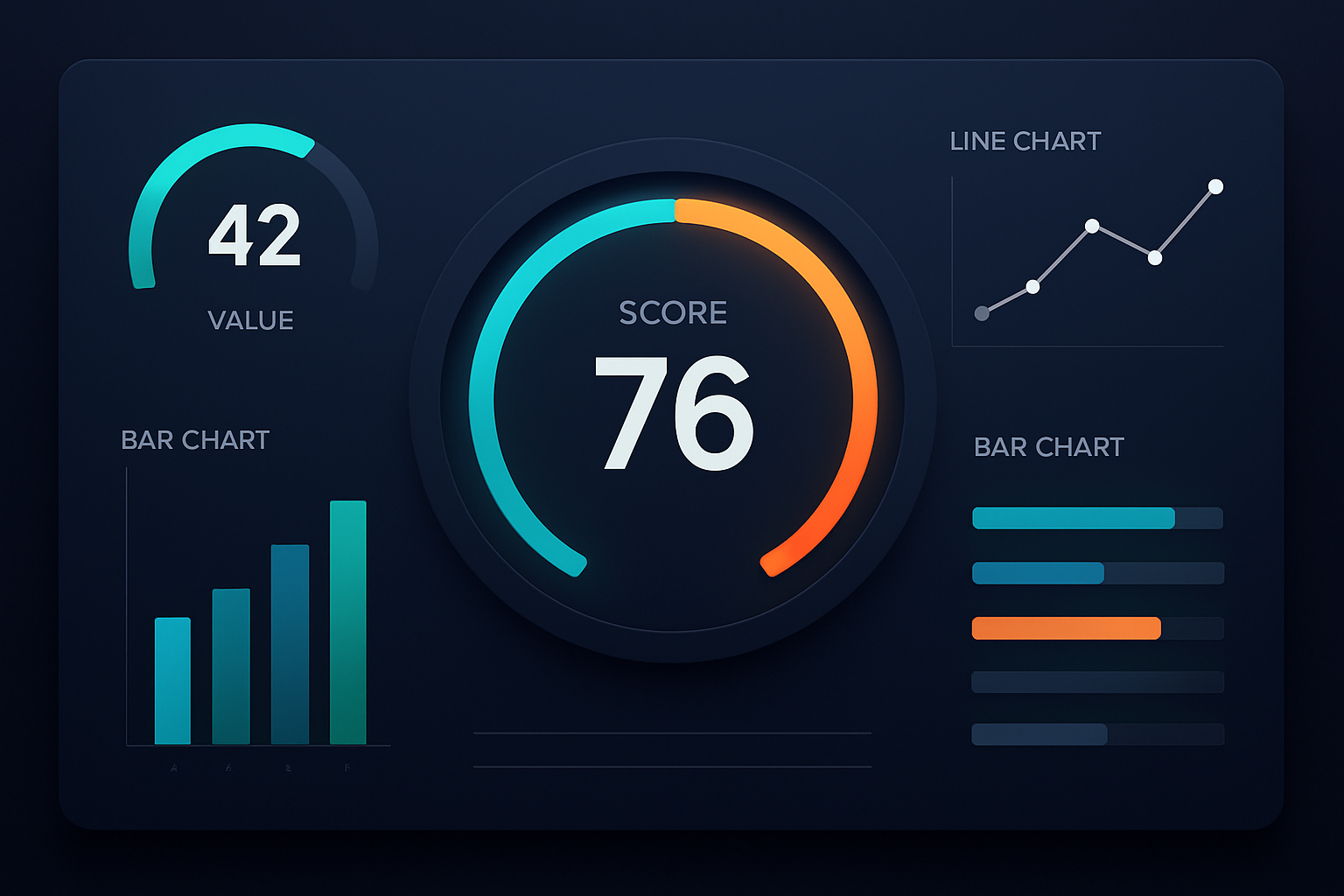
AI scorecard dashboard showing SEO performance metrics and scoring gauges

A modern AI scorecard interface consolidates dozens of performance signals into one unified, actionable view.


The Two Major Domains of the AI Scorecard

Before diving into mechanics, it’s essential to understand that the term AI scorecard encompasses two distinct but related applications. Confusing them leads to using the wrong framework for the wrong problem.

Domain 1: SEO & Content Performance AI Scorecard

Used by digital marketers, SEO professionals, and content teams to evaluate how well a website’s content, technical health, and authority signals are performing in search. The AI model evaluates dozens of ranking factors simultaneously and returns a unified performance score with prioritized recommendations.

Primary users: SEO managers, content strategists, digital marketing agencies, e-commerce operators, publishers.

Domain 2: Business AI Execution & Readiness Scorecard

Used by executives, operations leaders, and innovation teams to evaluate how effectively an organization is planning, implementing, and scaling AI initiatives. This type of AI scorecard measures strategic clarity, data infrastructure, talent capability, governance, and ROI attribution across active AI projects.

Primary users: CTOs, CDOs, innovation officers, operations leads, consultants advising on AI transformation.

Both domains share the same foundational logic: define measurable criteria, weight them by importance, score performance against those criteria, and generate a prioritized improvement roadmap. The difference lies entirely in what is being measured and why. This guide covers both comprehensively.


How an AI Scorecard Works: The Mechanics

Regardless of domain, every AI scorecard operates through the same core processing architecture. Understanding these layers helps you interpret scores accurately and extract maximum value from the output.

The Five Processing Layers of an AI Scorecard

  1. 1
    Data Ingestion: Raw signals are collected from the target system — crawl data, analytics events, backlink profiles, and on-page content for SEO scorecards; project status data, KPIs, survey inputs, and infrastructure audits for AI execution scorecards.
  2. 2
    Normalization: Disparate data types are converted into comparable, dimensionless units. A page load time measured in milliseconds and a content depth score measured in semantic coverage percentage must both reduce to a common scale before they can be combined meaningfully.
  3. 3
    Weighted Scoring Model: A machine learning model — trained on historical outcome data — assigns importance weights to each signal. Weights reflect both universal best practices and context-specific factors relevant to your industry, goals, or competitive set.
  4. 4
    Benchmarking Engine: Your score is compared against a reference set — top-ranking competitor pages for SEO scorecards, or industry peer organizations for execution scorecards. This transforms a raw score into a relative position that tells you not just how you’re doing, but how you’re doing against the competition.
  5. 5
    Prioritized Recommendation Output: The final output is not just a score — it’s a ranked action list sorted by expected impact-to-effort ratio. This is where the AI scorecard delivers its most actionable value: telling you exactly what to fix, in what order, and why.

Key Distinction

A well-designed AI scorecard doesn’t just report on what happened — it predicts what will happen if you act (or fail to act) on specific signals. Predictive scoring models represent the current frontier of AI scorecard technology.


AI Execution Scorecards: Measuring Organizational AI Readiness

The AI execution scorecard is the business strategy application of AI scoring — and it addresses one of the most persistent problems in enterprise technology: organizations invest heavily in AI initiatives but lack a rigorous, objective way to measure whether those initiatives are actually working.

An AI execution scorecard evaluates your organization’s AI maturity, the quality of your AI strategy, the operational infrastructure supporting AI deployment, and the measurable business results your AI programs are generating. It provides a holistic picture that neither a project management dashboard nor a financial report can supply on its own.

Why Organizations Need an AI Execution Scorecard

Most organizations operate in one of three states relative to their AI initiatives:

  • Over-confident: Leadership believes AI adoption is progressing well, but ground-level execution is fragmented, undocumented, and not generating measurable ROI. The absence of a scorecard means no one has a clear picture.
  • Under-confident: Significant AI capability exists but is buried in silos, invisible to stakeholders who could leverage it. A scorecard surfaces and quantifies hidden value.
  • Misaligned: AI projects are technically functioning but are not connected to strategic business objectives. The scorecard reveals this misalignment before it becomes a budget crisis.

The Six Pillars of an AI Execution Scorecard

A comprehensive AI execution scorecard evaluates performance across six interconnected pillars. Each pillar is scored independently and then weighted into a composite organizational AI score:

Pillar What It Measures Key Indicators Typical Weight
Strategic Alignment Whether AI initiatives map to defined business goals Goal linkage, executive sponsorship, roadmap clarity 20%
Data Infrastructure Quality, accessibility, and governance of data assets Data pipelines, labeling quality, data literacy rate 20%
Talent & Capability Team skills, training investment, and AI fluency Upskilling rate, AI role coverage, external partnership quality 18%
Execution & Operations Speed, quality, and repeatability of AI deployment Time-to-deploy, iteration velocity, failure rate 18%
Governance & Ethics Risk management, bias controls, regulatory compliance AI policy existence, audit frequency, incident tracking 12%
Business Impact & ROI Measurable value generated by AI investments Cost reduction, revenue lift, efficiency gains, NPS impact 12%

AI Maturity Levels: Where Does Your Organization Score?

AI execution scorecards typically map composite scores to a maturity level framework. Understanding which level your organization occupies is the starting point for targeted improvement:

Level 1 — Exploring (Score: 0–25)

AI is being investigated but no significant deployments exist. Strategy is undefined or aspirational. Data infrastructure is fragmented. Immediate priority: establish a formal AI roadmap and assess data readiness.

Level 2 — Experimenting (Score: 26–50)

Pilot projects are underway but remain siloed. Limited cross-functional coordination. ROI measurement is inconsistent. Priority: connect pilots to business outcomes and build repeatable deployment processes.

Level 3 — Scaling (Score: 51–75)

Multiple AI deployments are live and generating measurable value. Governance frameworks are partially in place. The organization is building AI fluency across teams. Priority: systematize governance and accelerate cross-functional scaling.

Level 4 — Leading (Score: 76–100)

AI is embedded in core operations and decision-making. Strong governance, measurable ROI, and continuous learning loops are in place. Priority: competitive differentiation and developing proprietary AI capabilities.


Core Dimensions Every AI Scorecard Should Measure

Whether you are building an AI scorecard for SEO or for organizational strategy, several core dimensions are universally critical. Ignoring any of them produces a score that is incomplete and potentially misleading.

1. Baseline Measurement and Benchmarking

Every AI scorecard must establish a baseline before it can measure progress. A score without context is just a number. Your baseline tells you where you started; competitive benchmarks tell you where you need to be; trend data tells you whether you are moving in the right direction. All three are required for the scorecard to be actionable.

2. Weighting by Strategic Priority

Not all dimensions are equally important to every organization or context. A fintech firm evaluating AI execution should weight governance and compliance more heavily than a content startup evaluating AI-assisted publishing workflows. Custom weighting is what separates a generic scorecard from a genuinely useful strategic instrument.

3. Qualitative and Quantitative Signal Integration

AI scorecards that rely exclusively on quantitative data miss important context that only qualitative signals can provide. Leadership alignment, team culture toward AI adoption, and the quality of strategic communication are difficult to quantify but critical to execution outcomes. Best-in-class AI scorecards integrate structured qualitative assessments alongside hard data signals.

4. Time-Series Tracking

A single scorecard snapshot is informative but not transformative. Organizations and SEO teams that run scorecards repeatedly over time gain access to trend intelligence — the ability to see whether their interventions are working, whether scores are improving or degrading, and where regression is occurring before it becomes critical.


AI Scorecards for SEO: Content and Search Performance

In the SEO context, an AI scorecard functions as an automated quality-control system for your entire content and technical stack. It ingests signals across five major scoring categories and returns a composite performance score alongside a ranked list of improvement opportunities.

Here is the standard scoring architecture for an SEO-focused AI scorecard:

Scoring Category Key Signals Measured Typical Weight
Content Quality Depth, readability, E-E-A-T signals, keyword relevance, topical coverage, semantic completeness 30%
Technical Health Core Web Vitals, crawlability, structured data, mobile UX, indexability, canonical signals 25%
Authority & Links Domain authority, backlink quality, internal link structure, anchor text distribution 25%
User Engagement Dwell time, bounce rate, scroll depth, CTR, return visitor rate 12%
Search Visibility Keyword rankings, SERP features captured, impression share, featured snippet eligibility 8%

Competitor Benchmarking Within SEO AI Scorecards

The most powerful SEO AI scorecards don’t just evaluate your site in isolation — they perform competitive gap analysis simultaneously. By scoring your content against the pages currently occupying top SERP positions for your target keywords, you receive a gap map: a precise specification of what your page is missing that top-ranking pages possess.

This is fundamentally different from generic content audits. You’re not comparing yourself to a theoretical ideal — you’re comparing yourself to the actual pages outranking you today, using the same signals Google is using to make that determination.


Why Content Quality Drives Your AI Scorecard Score

Of all the categories an AI scorecard evaluates, content quality consistently carries the heaviest weighting — and for well-documented reasons. Search engines have grown remarkably adept at identifying thin, redundant, or misleading content. A well-trained AI scoring model mirrors that capability, rewarding pages that demonstrate genuine expertise, comprehensive coverage, and clear user value.

One of the most important insights from large-scale content scoring research: length alone is not a quality signal. A 600-word page that directly and completely answers a specific, well-defined query can outscore a 4,000-word page padded with filler content and tangential information. Understanding this nuance is critical to acting correctly on scorecard recommendations.

The content quality dimension of an AI scorecard typically evaluates the following sub-factors:

  • Topical depth: Does the content cover the subject with sufficient comprehensiveness? AI models evaluate semantic coverage — the range of related concepts addressed relative to top-ranking competitors.
  • E-E-A-T signals: Experience, Expertise, Authoritativeness, and Trustworthiness indicators — including author credentials, first-person experience signals, citations, and site reputation markers.
  • Readability and structure: Flesch-Kincaid grade level, heading hierarchy, paragraph length, use of lists and tables, and logical narrative flow.
  • Keyword relevance and placement: Natural integration of the target keyword and semantic variants in the title, headings, introduction, body, and meta description.
  • Freshness and accuracy: Whether the content reflects current information, with recent examples, updated statistics, and no outdated claims that could erode trust signals.
  • Intent alignment: The degree to which the content matches the searcher’s actual underlying intent — informational, commercial, navigational, or transactional — for the target keyword.

Pro Insight

AI scorecards that incorporate semantic gap analysis can detect topical subjects your competitors address that your content completely omits. Closing these topical gaps is consistently one of the fastest paths to significant score improvement and ranking lift. To understand how content length specifically correlates with ranking outcomes, RankAuthority’s analysis of content length and SEO rankings provides a data-driven breakdown that pairs well with AI scorecard interpretation.

Checklist of AI scorecard improvement actions leading to upward SEO performance trend

Acting on AI scorecard recommendations systematically and consistently drives measurable ranking improvements over time.


AI Scorecard Scoring Models Compared

Not all AI scorecards are built the same way. Understanding the differences between scoring model architectures helps you select the right approach and correctly interpret the outputs you receive.

Rules-Based Scoring Models

These models apply a fixed set of manually defined criteria with pre-assigned weights. They are transparent, auditable, and easy to explain to non-technical stakeholders. The limitation is that rules-based models cannot adapt to changing search algorithm behavior or capture subtle, emergent ranking signals without manual updates.

Best for: Organizations that need scorecard auditability, compliance documentation, or are early in their AI scorecard adoption journey.

Machine Learning Regression Models

These models train on historical ranking or performance data to learn which signals correlate most strongly with positive outcomes. They can capture complex, non-linear relationships between signals that human-defined rules would miss. The limitation is that they require significant high-quality training data and can be opaque in their reasoning.

Best for: High-volume content operations with sufficient historical data to train reliable models and teams comfortable with probabilistic output.

Large Language Model (LLM)-Enhanced Scorecards

The most advanced AI scorecards now incorporate large language models to evaluate content quality dimensions that are inherently difficult to quantify — coherence, expertise depth, tone appropriateness, and rhetorical clarity. LLMs can assess whether a page truly addresses the searcher’s underlying intent in a way that classical NLP methods cannot.

Best for: Content-heavy organizations competing in expertise-driven niches where qualitative content differentiation is the primary ranking lever.


Building an AI Scorecard Workflow That Moves the Needle

Having access to an AI scorecard is only half the equation. The other half is building a repeatable, disciplined workflow around it. Most teams generate a scorecard, review it once, and then let the findings gather dust in a shared folder. The teams that consistently outrank competitors — and out-execute peers on AI strategy — treat their scorecard as a living operational document with executive visibility.

The Six-Step AI Scorecard Execution Workflow

  1. 1

    Score and Segment

    Run your AI scorecard across the full scope — entire site for SEO, or all active AI initiatives for execution scoring — then segment results by content type, funnel stage, traffic tier, or business unit. Do not treat all pages or projects as equal. Focus remediation effort where impact potential is highest.

  2. 2

    Benchmark Against Competitors

    Compare your scores not just against your own historical baseline, but against the specific competitors you need to beat. For SEO, this means scoring against the pages currently ranking in positions 1–3 for your target keywords. For AI execution, this means benchmarking against peers at your funding stage, industry, or operational scale.

  3. 3

    Prioritize by Impact-to-Effort Ratio

    Not every low-scoring signal is equally important to address immediately. Use the scorecard’s weighted output to build a priority matrix — organizing items by expected outcome improvement against implementation cost. Quick technical or structural fixes that lift multiple pages or projects simultaneously should almost always come first.

  4. 4

    Execute Against the Roadmap

    Convert your prioritized action list into a formal project roadmap with owners, deadlines, and success metrics. The AI scorecard should not replace your project management system — it should feed it. Every scorecard recommendation becomes a task with an expected outcome delta attached.

  5. 5

    Re-Score to Close the Feedback Loop

    After implementing changes, re-run the AI scorecard on affected pages or projects within two to four weeks. This validation step confirms whether your interventions produced the expected score improvements. For guidance on updating content strategically to maximize re-score gains, see RankAuthority’s content updating guide.

  6. 6

    Establish a Recurring Cadence

    Build scorecard reviews into your monthly editorial calendar (for SEO) or your quarterly strategic review cycle (for AI execution). Treat score regressions the same way you would treat a drop in organic traffic or a missed KPI — as an early warning signal requiring immediate root-cause investigation and a defined response plan.


AI Scorecard Tools and Platforms

The AI scorecard market has matured significantly, with purpose-built tools available for both the SEO and business execution domains. Choosing the right platform depends on your primary use case, team technical capability, and the depth of competitive benchmarking you require.

SEO AI Scorecard Platforms

Leading platforms in this category integrate automated crawling, content quality analysis, competitive gap mapping, and on-page recommendation engines. When evaluating SEO AI scorecard tools, prioritize:

  • Competitor scoring integration — can it score your page against specific SERP competitors, not just an abstract ideal?
  • Semantic gap detection — does it identify topical entities and concepts your content is missing relative to top-ranking pages?
  • E-E-A-T signal evaluation — does it assess experience and expertise indicators, not just technical and structural signals?
  • Historical trend tracking — can it show score changes over time and correlate them with ranking movements?
  • Bulk scoring capability — can it score hundreds or thousands of pages in a single run for enterprise-scale operations?

Business AI Execution Scorecard Platforms

AI execution scorecard platforms range from lightweight self-assessment frameworks (spreadsheet-based with guided scoring rubrics) to enterprise platforms that integrate with project management systems, HR data, and financial reporting to generate automated scores. Key capabilities to look for:

  • Customizable pillar weighting — your strategic priorities differ from generic industry weights.
  • Multi-source data integration — can it pull from project management, HR, financial, and analytics systems simultaneously?
  • Peer benchmarking database — does it have sufficient peer data to make competitive comparisons meaningful?
  • Qualitative input channels — does it capture structured qualitative data alongside quantitative signals?
  • Stakeholder reporting outputs — can it generate board-ready summary views alongside operational detail?

Building a Custom AI Scorecard: When to Consider It

Off-the-shelf AI scorecard solutions serve most organizations well. However, organizations with highly specialized scoring requirements, proprietary performance data, or competitive environments where off-the-shelf benchmarks don’t apply accurately should consider building custom scorecard models. Custom models require investment in data science capability but deliver superior signal accuracy for niche contexts.

Small business owner reviewing an AI scorecard report on a tablet device

AI scorecard tools make sophisticated performance evaluation accessible to organizations of every size and maturity level.


Common AI Scorecard Mistakes to Avoid

Even the most powerful AI scorecard framework produces poor results when misused. Here are the most consequential mistakes organizations and SEO teams make — and how to avoid them:

  • ✕ Chasing the score, not the outcome. Optimizing purely to raise a number without tying it to actual ranking improvement, revenue generation, or strategic goal attainment produces hollow results. The score is a proxy — always anchor scorecard work to the underlying business objectives it is meant to serve.
  • ✕ Using generic weighting for specialized contexts. A default AI scorecard model trained on general data will not reflect the ranking factors or execution priorities that matter most in your specific niche, industry, or competitive set. Invest the time to customize weighting wherever the tool allows it.
  • ✕ Running it once and treating it as complete. SEO landscapes shift, algorithm updates alter ranking factors, and AI project conditions evolve. A scorecard only delivers sustained value when it is used consistently, with a defined review cadence. One-time audits answer one-time questions; they do not build competitive advantage.
  • ✕ Ignoring competitor benchmarking. An AI scorecard is most powerful when your scores are contextualized against the specific competitors you are trying to beat — not just your own historical performance. A score of 75 looks excellent until you discover every top-ranking competitor scores 85 or above.
  • ✕ Failing to close the feedback loop. Implementing changes without re-scoring afterward means you can never confirm whether your interventions worked. Every AI scorecard workflow must include a validation step — otherwise, you’re operating blind.
  • ✕ Treating all dimensions as equally fixable in parallel. Resource constraints mean that trying to improve every dimension simultaneously dilutes effort and slows meaningful progress on any single front. Sequence your improvements deliberately using impact-to-effort prioritization.

Frequently Asked Questions About AI Scorecards

What is the difference between an AI scorecard and a traditional audit?

A traditional audit is a point-in-time manual assessment conducted periodically by a human analyst. An AI scorecard is a continuous, automated evaluation system that assesses multiple dimensions simultaneously, updates dynamically as data changes, provides competitive benchmarking in real time, and generates prioritized recommendations without human bottlenecks. The AI scorecard is faster, more comprehensive, and scalable to thousands of pages or initiatives that would be impractical to audit manually.

How does an AI scorecard improve SEO performance?

An AI scorecard improves SEO performance by automatically identifying specific gaps in content quality, keyword usage, technical health, and backlink profiles, then generating a prioritized recommendation list. This allows SEO teams to act on the highest-impact improvements first rather than guessing where to focus limited time and budget. Teams that implement AI scorecard workflows consistently see faster ranking improvement and more durable traffic growth than those relying on periodic manual audits.

What metrics does an AI scorecard typically measure?

For SEO, a typical AI scorecard measures content relevance and depth, keyword placement and semantic coverage, page load speed and Core Web Vitals, mobile usability, backlink authority and profile quality, structured data implementation, user engagement signals including dwell time and bounce rate, and overall search visibility including SERP feature capture. For AI execution, it measures strategic alignment, data infrastructure quality, talent capability, operational execution speed, governance maturity, and measurable ROI.

How often should you run an AI scorecard audit?

For SEO, most professionals recommend running an AI scorecard monthly for active high-priority content and quarterly for broader site assessment, with additional checks triggered immediately following algorithm updates or significant traffic changes. For AI execution scorecards, quarterly reviews are standard, with monthly check-ins during active transformation phases. Always run an unscheduled scorecard when you detect unexpected performance degradation.

Is an AI scorecard suitable for small businesses?

Yes. An AI scorecard is highly suitable for small businesses precisely because it automates complex analysis that would otherwise require a dedicated SEO or strategy team. By delivering clear, prioritized action plans from limited inputs, the AI scorecard levels the playing field — giving small businesses access to enterprise-grade analytical capability at a fraction of the cost of manual consulting or in-house expertise.

Can an AI scorecard measure AI strategy execution quality?

Yes. AI execution scorecards are specifically designed to evaluate how effectively an organization is planning, deploying, and scaling AI initiatives. They assess strategic alignment, data readiness, talent capability, operational execution quality, governance frameworks, and ROI attribution — delivering a composite organizational AI maturity score that identifies the highest-priority areas for improvement and benchmarks the organization against industry peers.

What is an AI maturity scorecard?

An AI maturity scorecard is a type of AI execution scorecard that specifically evaluates where an organization sits on a defined progression scale — typically from initial AI exploration through experimentation, scaling, and finally leading-edge AI adoption. Maturity scorecards map composite scores to maturity levels, each with a defined set of characteristics and a targeted improvement roadmap for advancing to the next level.


Conclusion

An AI scorecard transforms performance evaluation — whether you’re measuring search visibility or organizational AI execution — from a reactive, periodic exercise into a proactive, continuous, data-driven system. By measuring the signals that actually drive outcomes, benchmarking against real competitors, surfacing weaknesses before they become critical, and delivering a clear hierarchy of actions, the AI scorecard is one of the highest-leverage tools available to digital marketers, strategists, and organizational leaders today.

The organizations and teams that compound their performance over time are not necessarily the ones with the most resources or the largest teams. They are the ones that build systematic, scorecard-driven improvement loops — and execute against them with discipline, quarter after quarter.

Leave a Reply

Your email address will not be published. Required fields are marked *

Featured Posts

Categories

contact us
close slider

Let’s Talk AI Search

We typically respond within the hour.

Send a Message

We’ll get back to you as soon as possible.