
AI-driven backlink strategies are reshaping how SEO teams earn authority in 2025, replacing manual guesswork with data-backed precision at every stage of the link-building process. Instead of spending weeks combing spreadsheets for prospects, marketers now lean on machine learning models, natural language processing, and predictive scoring to find, qualify, and win high-value backlinks in a fraction of the time. Below, we break down exactly how these strategies work, which tools deliver the strongest results, including Semrush’s own AI Backlink Builder, and how to build a repeatable, Google-compliant workflow that keeps producing links long after a single campaign ends.
Quick Definition
AI-driven backlink strategies use artificial intelligence, machine learning, large language models, and predictive analytics, to automate prospect discovery, personalize outreach at scale, and analyze competitor link profiles. The result is more high-authority backlinks, earned in less time, with reply rates that consistently outperform manual, template-based outreach.
What Are AI-Driven Backlink Strategies, Exactly?
In simple terms, AI-driven backlink strategies are link-building methods that use artificial intelligence to automate, prioritize, and improve every stage of link acquisition, from prospect discovery through outreach, follow-up, and performance analysis. Rather than relying on a researcher scanning spreadsheets for hours, these systems apply algorithmic pattern recognition to datasets no human team could review manually.
For example, an AI model can evaluate a domain’s topical authority, estimate the likelihood of a successful outreach reply, and draft a personalized pitch email within seconds. This is possible because machine learning systems can detect complex signals across millions of data points at once, something no spreadsheet-based process could ever replicate at the same speed.
As a result, the gap between SEO teams using AI for link building and those relying purely on manual outreach is widening quickly in 2025. Whether you run a solo consultancy or an enterprise SEO program, embedding AI into your backlink workflow has moved from “nice to have” to competitive baseline.
How AI Link Building Differs From Traditional Backlink Software
Traditional backlink tools mostly report metrics, domain rating, referring domains, anchor text distribution. AI-driven tools go a step further: they interpret those metrics, predict outcomes, and generate action, such as a ranked prospect list or a ready-to-send outreach draft. In fact, this is exactly the shift Semrush made when it introduced its AI Backlink Builder app, which automatically surfaces prospects and drafts outreach copy inside its existing backlink ecosystem. That said, understanding the strategy behind the tool matters more than the tool itself, which is the focus of the rest of this guide.

AI-driven backlink strategies map link relationships across thousands of domains simultaneously, something no manual process can replicate.
Why Manual Link Building Can’t Keep Up in 2025
Before exploring how AI improves link building, it helps to understand exactly where manual methods break down. Traditional prospecting involves searching for relevant sites, checking metrics by hand, reviewing content quality, and assembling contact lists. For a single campaign, this can consume 10 to 20 hours a week, and still produce inconsistent results. For a broader look at manual tactics and where they still add value, see our guide to effective strategies for building backlinks.
Moreover, human researchers are limited by cognitive bandwidth. They can reasonably evaluate a few dozen prospects at a time, so they inevitably miss high-value opportunities buried inside competitor backlink profiles or niche-adjacent domains they never thought to check.
Outreach suffers a similar problem. Generic templates blasted to bulk lists produce reply rates under 5% in most industries. Consequently, teams spend enormous effort for modest returns, which is precisely why AI-driven approaches have gained such rapid adoption among competitive SEO operations.
The Scale Problem, By the Numbers
Manual Prospecting
- 20–50 prospects evaluated per week
- High time investment per campaign
- Inconsistent, subjective scoring
- Limited competitor gap visibility
- Low outreach reply rates (3–5%)
AI-Assisted Prospecting
- Thousands of prospects evaluated per run
- Minutes to generate ranked shortlists
- Consistent, algorithmic authority scoring
- Deep multi-competitor gap analysis
- Personalized outreach lifts reply rates 2–4×
How AI Transforms Every Stage of Link Prospecting
Prospecting is where AI-driven backlink strategies deliver the most immediate, measurable advantage. Modern AI prospecting tools ingest your target keywords, crawl competitor backlink profiles, and return a ranked list of opportunities scored by topical relevance, domain authority, estimated traffic, and historical outreach response rates. What once took days now takes minutes. If you want to see this in action on your own site first, our site backlink checker is a good starting point for auditing your existing link profile before layering AI prospecting on top.
Topical Relevance Scoring
Traditional domain authority metrics tell you how powerful a site is. However, they don’t tell you whether a link from that site will actually help your rankings for a specific keyword cluster. AI closes this gap through topical relevance scoring, assessing how closely a prospect’s content aligns with your target topic. Consequently, you pursue links that move the needle for your actual target pages, not just your overall domain metrics.
Competitor Backlink Gap Analysis
AI tools can analyze the backlink profiles of your top five to ten competitors simultaneously and flag domains that link to several of them but not to you. These gap opportunities are your highest-priority targets, since they’re sites already proven to link within your niche. In addition, AI can surface patterns in why those domains link out, so you can build content specifically designed to earn those links.
Unlinked Brand Mention Discovery
Beyond prospecting for new links, AI tools can scan the web for unlinked mentions of your brand, products, or key contributors. These are the easiest wins available, since the site already knows you exist. Therefore, a well-crafted outreach email requesting a link conversion typically earns reply rates of 20–40%, far above cold prospecting benchmarks. For a wider view of automation across this entire process, see how automated tools can improve your website’s backlinks.
Inside the Top AI Backlink Tools of 2025 (Including Semrush’s AI Backlink Builder)
The toolset for AI-powered link building has matured significantly. Below are the categories, and specific platforms, driving the strongest results for competitive SEO teams right now.
🔍 AI-Enhanced Link Analysis: Ahrefs, Semrush & the AI Backlink Builder
Ahrefs and Semrush both incorporate machine learning to surface link gap opportunities, predict domain authority trajectories, and flag toxic links before they cause harm. Semrush’s dedicated AI Backlink Builder app takes this further by automatically generating a prospect list from your domain and keywords, then drafting personalized outreach emails you can review and send from inside the same dashboard. It’s a genuinely useful starting point, though, as with any single-vendor tool, it works best as one input into a broader strategy rather than the entire strategy itself. Ahrefs’ “Link Intersect” and Semrush’s “Backlink Gap” module remain indispensable for multi-competitor analysis, and both now offer AI-generated content recommendations for linkable asset creation.
✉️ AI Outreach Personalization: Pitchbox & BuzzStream
These platforms use AI to analyze the content and editorial tone of each target website, then suggest or auto-draft personalized outreach emails referencing specific articles or themes. As a result, reply rates improve dramatically over generic bulk templates. Pitchbox, in particular, offers AI-powered sequence optimization, adjusting follow-up timing and copy based on engagement signals from prior outreach.
🤖 GPT-Based Custom Outreach Workflows
Advanced SEO teams build custom GPT pipelines that ingest a prospect’s three to five most recent articles, extract editorial themes using natural language processing, and generate outreach copy tailored to each editor. This consistently outperforms batch-template campaigns. In addition, GPT workflows can be chained with data enrichment APIs, pulling recent social posts and publication history to inform hyper-contextualized pitches that feel genuinely handcrafted.
📊 Predictive Content Gap & Linkable Asset Tools
AI tools predict which content formats and topics in your niche are statistically most likely to attract editorial links, so you can create assets strategically rather than hoping content organically goes viral. Tools like MarketMuse and Clearscope now incorporate link-prediction signals alongside topical authority scoring, helping you decide whether a data study, an interactive tool, or a comprehensive guide will earn the most links.
🔗 Real-Time Link Monitoring: Ahrefs Alerts & Mention.com
Protecting earned links matters as much as building new ones. AI-powered monitoring tools send instant alerts when a high-value backlink is lost, modified, or noindexed, triggering an automated re-outreach sequence before the ranking signal degrades. Similarly, Mention.com scans news sites, blogs, and social platforms for brand mentions without links, flagging them as immediate conversion opportunities.
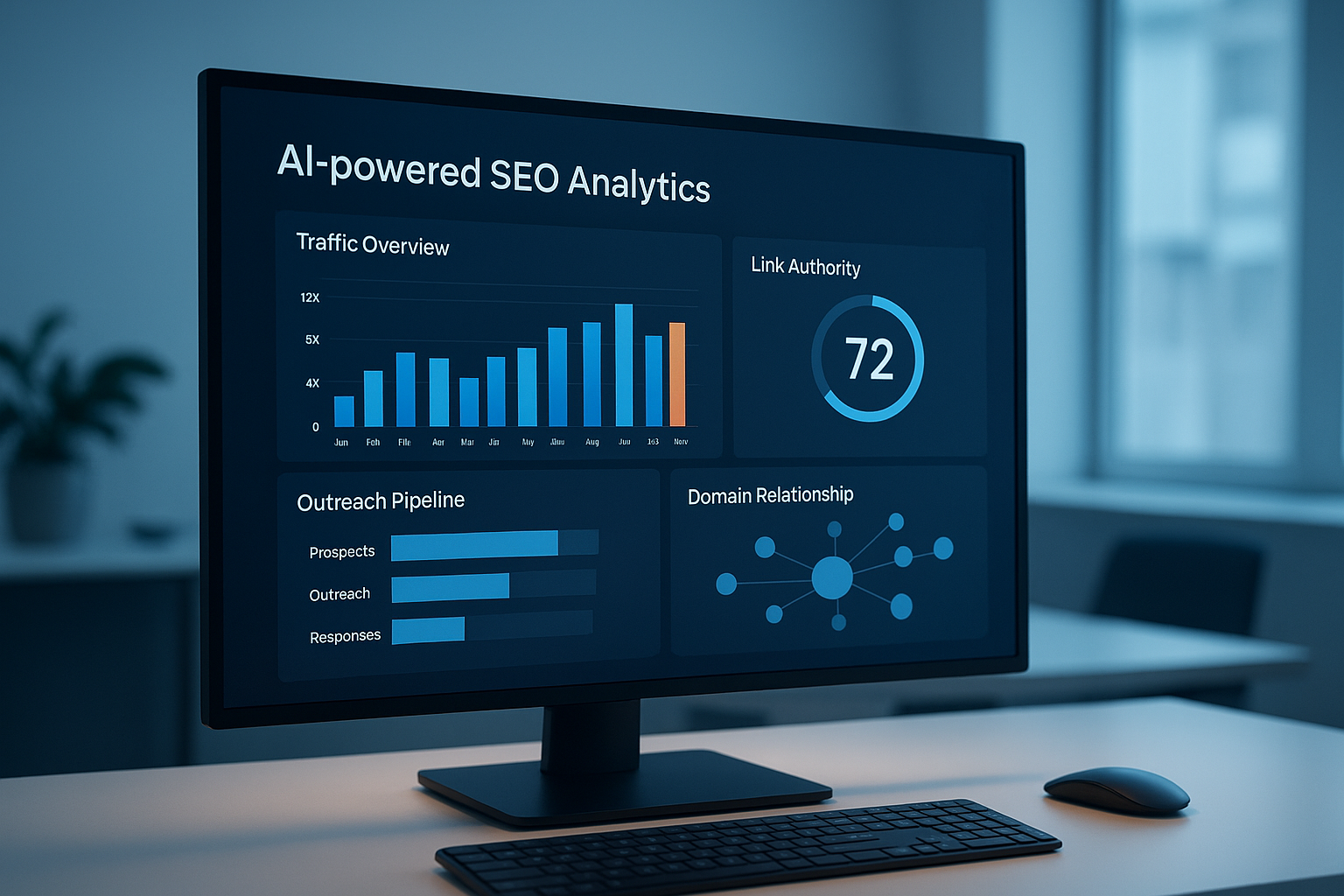
Modern AI SEO dashboards consolidate link prospecting, outreach tracking, and authority scoring into a single workflow.
How to Choose the Right AI Backlink Tool for Your Team
With so many options available, choosing between a single-vendor solution and a stack of specialized tools can feel overwhelming. In particular, evaluate any AI backlink tool, including Semrush’s AI Backlink Builder, against this checklist before committing budget:
- Prospecting depth: Does it surface hundreds or thousands of scored prospects, or just a shallow shortlist?
- Outreach personalization quality: Are drafts genuinely tailored to each site, or lightly templated?
- Stack integration: Does it connect with the backlink analytics and content tools you already use?
- Compliance and reporting: Can you track reply rates, link retention, and campaign ROI in one place?
- Human review support: Does the workflow make it easy to review AI drafts before sending, rather than encouraging blind automation?
- Pricing transparency: Is cost per prospect or per campaign clear, or bundled into an opaque subscription tier?
In practice, most competitive teams don’t rely on a single tool, they combine an analysis platform (Ahrefs or Semrush), an outreach platform (Pitchbox or BuzzStream), and a custom GPT layer for the highest-value personalization. This layered approach consistently outperforms any single-app solution, since each tool handles the part of the workflow it does best.
Building a Scalable AI-Driven Backlink Workflow
Knowing which tools exist is one thing, building a repeatable process is another. The following six-step framework is how top-performing SEO teams structure their AI-driven backlink campaigns, regardless of team size or budget.
Step-by-Step: The AI Backlink Acquisition Framework
- Define your link target profile. Use AI tools to analyze your top-ranking competitors and identify the domains, by niche, authority tier, and content format, that link to them most consistently, including patterns in linking domain age and editorial style.
- Generate and score prospects at scale. Feed your target profile into an AI prospecting tool to surface hundreds of qualified candidates, pre-scored by relevance and authority, then run a competitor gap analysis to find proven linkers in your niche.
- Create linkable assets strategically. Use AI content gap analysis to build resources, original research, data studies, comprehensive guides, or free tools, that your target domains are statistically likely to cite before a single word is written.
- Personalize outreach with AI assistance. Generate context-aware pitches for each prospect using GPT workflows that reference their actual content, recent publications, and editorial focus, then optimize subject lines using historical open-rate data.
- Pursue unlinked brand mentions first. Run an AI-powered mention scan to identify every site referencing your brand without a link, and prioritize these highest-conversion targets before cold prospecting for faster wins.
- Track, iterate, and optimize continuously. Feed outreach response data back into your AI pipeline to refine prospect scoring and email personalization, so each campaign cycle performs better than the last.
For a deeper look at how internal linking interacts with your external backlink strategy, the team at Rank Authority’s internal linking best practices guide covers how to structure your site architecture to maximize the value passed through every earned link. For a deeper walkthrough of visibility tracking after your links go live, see our AI Visibility Audit: The Complete Guide to Rankings.
Digital PR and AI: The Highest-Leverage Link Building Tactic
One of the most powerful, and most underused, applications of AI-driven backlink strategies is digital PR. Digital PR means publishing genuinely newsworthy content, such as original research or proprietary survey data, that journalists and editors naturally want to cite. AI accelerates every stage of this process.
The AI-Powered Digital PR Workflow
- Topic identification: AI tools analyze trending search queries and recent link patterns to find topics journalists are actively seeking data on.
- Asset creation support: GPT models help write survey questions and format findings into press-ready reports that maximize editorial pickup.
- Journalist targeting: AI scans recent bylines to find journalists who covered adjacent topics in the past 90 days, your highest-probability targets.
- Pitch personalization: Each journalist gets a pitch referencing their specific recent work rather than a generic press release, driving far higher response rates.
- Coverage monitoring: Post-publication, AI tools track every pickup, including unlinked citations that trigger immediate follow-up requests.
The result is a systematic way to earn editorial links from high-authority news and industry publications, links manual outreach struggles to reach at the same scale or speed.
AI-Driven Backlink Strategies by Business Type
Not every business builds links the same way, and AI adapts differently depending on your model. Below are quick-start angles for the most common use cases we see at Rank Authority.
Local SEO Backlink Strategies With AI
For local businesses, AI prospecting tools can filter by geography and local citation authority, surfacing chambers of commerce, local news sites, and regional directories worth pursuing. Similarly, unlinked mention discovery is especially valuable here, since local press frequently references businesses by name without linking. For a broader roadmap of scalable tactics that apply well to local sites too, see our guide to the best strategies for improving online backlinks easily.
E-Commerce and SaaS Backlink Strategies With AI
E-commerce and SaaS brands benefit most from AI-driven competitor gap analysis, since product and category pages typically compete against a stable set of rivals with well-documented backlink profiles. In addition, GPT-based outreach works particularly well here for pitching comparison articles, integration partners, and “best tools” roundups where a personalized, specific pitch beats a generic template every time.
Are AI-Driven Backlink Strategies Safe for Google Compliance?
This is the question every SEO professional asks before committing to an AI-powered workflow. The answer is yes, with one important distinction to understand.
Google’s link spam policies target manipulative schemes, paid links, reciprocal exchanges, and programmatically generated link networks. None of these are inherent to AI-driven backlink strategies. When AI is used to identify genuine editorial opportunities, craft authentic outreach, and earn real links based on content merit, the process is fully compliant.
⚠ Critical Distinction
AI that automates spam violates Google’s policies. AI that accelerates genuine editorial outreach does not. The intent and execution behind your strategy, not the tools you use, determine compliance.
Google’s E-E-A-T and AI Link Building
Google’s E-E-A-T framework, Experience, Expertise, Authoritativeness, Trustworthiness, evaluates link quality contextually, not just by domain authority score. According to Google’s own guidance on creating helpful, people-first content, an AI-driven approach that targets topically relevant, editorially rigorous domains is not only safe but actively aligned with what Google rewards.
In addition, the human review layer you maintain over AI-generated outreach copy matters. Before any email is sent, a team member should check it for accuracy, tone, and genuine relevance to the recipient. This quality control step preserves the authenticity that separates editorial link building from manipulative schemes.
How to Measure ROI From Your AI Backlink Campaigns
Investing in AI tooling only makes sense if you can demonstrate measurable returns. The following metrics give the clearest, most actionable picture of campaign performance across different time horizons.
- Domain rating growth, the change in overall link authority over 60–90 days post-campaign.
- New referring domains, the count of unique linking domains earned per campaign cycle.
- Keyword ranking improvements, movement on the specific target pages your links point to.
- Outreach reply and conversion rate, the percentage of emails sent that result in a live backlink, which directly measures your AI personalization quality.
- Cost per acquired link, total campaign spend divided by links earned. AI-driven campaigns typically reduce this by 40–60% versus manual agency methods.
- Referral traffic from earned links, tracked via UTM parameters or Search Console, since high-authority editorial links drive real traffic, too.
- Link retention rate at 6 and 12 months, a declining rate signals content or relevance issues worth addressing.
Pair these metrics with Google Search Console data and a regularly updated site backlink checker report to build a clear attribution model. Most well-executed AI-driven campaigns show measurable ranking movement within 60 to 90 days of link acquisition, which makes it realistic to justify investment on a quarterly basis.

Personalized AI outreach dramatically improves reply rates compared to generic link building email templates.
A Real-World Example: A 90-Day AI Backlink Campaign Walkthrough
To make this concrete, consider a mid-sized SaaS company targeting a competitive keyword cluster. In week one, the team ran an AI competitor gap analysis across five direct rivals and surfaced 340 domains that linked to at least two competitors but not to them.
Next, they scored those domains by topical relevance and filtered out low-authority sites, leaving a shortlist of 85 high-value prospects. A GPT-based workflow then drafted personalized pitches referencing each site’s most recent article on adjacent topics, alongside a newly published data study built specifically to appeal to that prospect list.
Over the following 90 days, the campaign earned 31 live backlinks, a 36% conversion rate from outreach, with domain rating climbing eight points and organic traffic to the target pages increasing by 22%. This kind of outcome, achievable in a single quarter, illustrates exactly why AI-driven backlink strategies are outperforming manual campaigns of comparable size and budget.
Common Mistakes to Avoid With AI Backlink Strategies
Even with the best AI tools available, recurring pitfalls undermine otherwise well-designed campaigns. Understanding these mistakes in advance is just as valuable as any tactical framework.
Over-Automating Without Human Review
The most common mistake is treating AI as a fully autonomous system. In practice, AI-generated outreach emails often contain subtle inaccuracies, misattributed articles or tone mismatches with the target editor’s style. Consequently, every AI-drafted email should pass through a human quality check before sending. The AI handles scale; the human ensures accuracy.
Prioritizing Quantity Over Quality
AI makes it tempting to scale outreach volume to the maximum. However, 500 mediocre links from low-relevance domains deliver less ranking value than 50 highly targeted links from topically authoritative sites. Therefore, use AI scoring to filter your prospect list aggressively, pursue quality first, then scale.
Neglecting Content Quality as the Foundation
AI outreach can get an editor’s attention, but it cannot force them to link to mediocre content. Above all, the linkable assets you create must be genuinely useful, original, and better than what already ranks.
Ignoring Link Velocity Patterns
Acquiring a large number of links in a very short window can trigger algorithmic scrutiny, even when those links are editorially earned. Google’s algorithms monitor link velocity, the rate new links appear, as a quality signal. Therefore, pace your outreach to produce a natural, steady accumulation of links over weeks and months, rather than a sudden spike.
The Future of AI-Driven Backlink Strategies
The next evolution of AI in link building extends well beyond prospecting and outreach. Emerging capabilities are already in development or early deployment across leading SEO platforms, and they’ll reshape competitive link building over the next 12 to 24 months.
What’s Coming Next
- Real-time link loss recovery: AI monitoring that detects a lost high-value link and automatically triggers a personalized re-outreach sequence before ranking signals degrade.
- Predictive link forecasting: Models that forecast which newly published content will attract links before it’s even indexed.
- Multi-modal brand mention discovery: AI that analyzes images, video transcripts, and podcast content to find unlinked references across every format.
- Autonomous link negotiation agents: AI agents that handle the full outreach-to-link cycle with minimal human involvement, reviewing and following up intelligently.
- Semantic link quality scoring: Moving beyond domain authority to assess a link’s contextual placement, proximity to relevant content, and position within the page hierarchy.
Teams that invest in AI-driven backlink infrastructure today will hold a compounding advantage as these capabilities mature. For a comprehensive look at how link building is evolving in 2025, Rank Authority’s link building for SEO 2025 guide provides a detailed roadmap of what’s working right now.
Frequently Asked Questions About AI-Driven Backlink Strategies
Conclusion — Add author bio and last-updated date below.
AI-driven backlink strategies represent the most significant shift in link-building methodology since the rise of content marketing. By combining intelligent prospecting, topical relevance scoring, digital PR amplification, and personalized outreach at scale, SEO teams earn more high-authority links in less time, while staying fully compliant with Google’s quality standards and E-E-A-T expectations.
The teams winning in organic search today aren’t working harder on link building, they’re working smarter, with AI powering every step of their acquisition pipeline. Because AI-optimized campaigns compound, every iteration improves on the last, widening the performance gap between adopters and teams still relying on manual methods.
Start with one AI tool, build a repeatable process, avoid the common mistakes outlined above, measure your ROI rigorously, and scale from there. The competitive advantage available through AI-driven backlink strategies is real, and it’s available to any team willing to build the right workflow.