
The Complete 2025 Guide to AI Content Analysis for SEO. AI content analysis for SEO shows how modern search algorithms think in concepts, not keywords.
AI Content Analysis for SEO: How to Use It to Dominate Search Rankings
AI content analysis for SEO means search algorithms now think in concepts, not keywords. The marketers pulling ahead are the ones who let AI analyze their content the same way Google does — and optimize accordingly.
AI content analysis for SEO is the practice of using artificial intelligence and machine learning to systematically evaluate, score, and optimize web content for higher search engine rankings. Unlike traditional keyword audits, AI-powered analysis examines semantic relevance, topical authority, search intent alignment, competitive content gaps, readability, and entity relationships — all simultaneously, and at a scale no human team can replicate. In 2025, it is the single most important capability separating high-growth SEO programs from stagnant ones.
For a deeper walkthrough, see our AI Citation Score Checker: The Complete 2025 Guide.
Quick Answer
AI content analysis for SEO uses machine learning and NLP to audit content against search intent, semantic coverage gaps, competitor benchmarks, and Google’s ranking signals — replacing guesswork with precise, data-driven optimization recommendations that help pages rank faster and hold positions longer. See AI driven content optimization.
What Is AI Content Analysis for SEO?
At its core, AI content analysis for SEO is the automated, data-driven evaluation of how well a piece of content satisfies both search engine ranking systems and real human readers. Where traditional SEO audits checked keyword frequency, title tags, and meta descriptions, modern AI analysis operates at an entirely different level — it maps topic clusters, identifies semantic co-occurrence patterns, benchmarks your page against every top-ranking competitor simultaneously, and predicts how Google’s neural ranking models will interpret your content. Learn how to utilize AI insights.
The technology is grounded in natural language processing (NLP) — the branch of AI that enables machines to understand, interpret, and generate human language. When Google’s systems, including BERT, MUM, and its newer Gemini-based models, process your content, they are applying NLP at planetary scale. AI content analysis tools give you a window into how those systems read and score your pages — and a direct path to improving your signal.
This is not just about checking boxes. The distinction matters because Google no longer rewards content that is merely about a keyword. It rewards content that comprehensively covers a topic, satisfies the searcher’s specific intent, and demonstrates authority across related subtopics. AI content analysis is how you systematically build and verify all three properties at once.
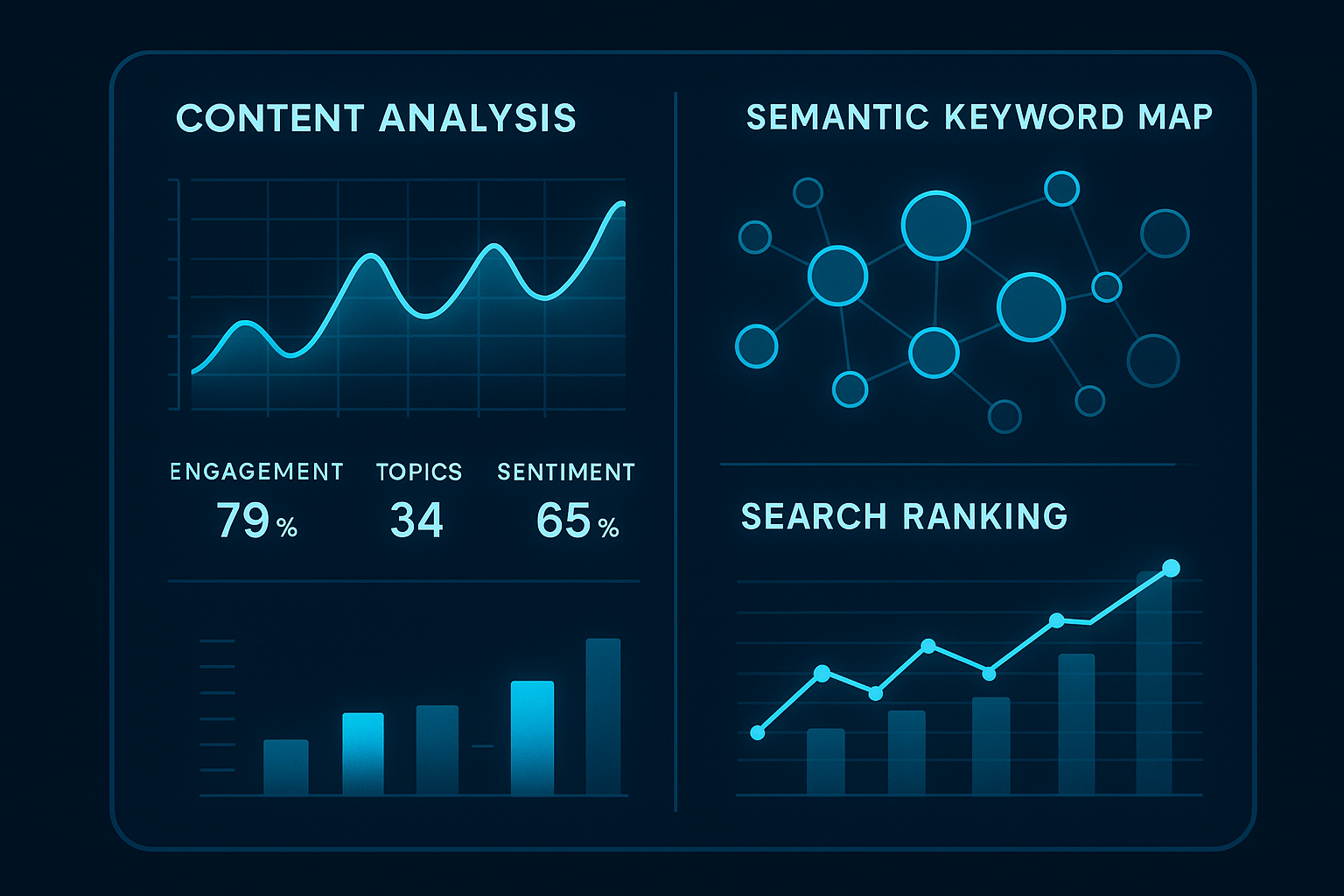
AI content analysis for SEO surfaces data-driven insights — semantic gaps, intent mismatches, and competitive benchmarks — that manual audits cannot match at scale.
How AI Analyzes Content Differently Than Traditional SEO Methods
A skilled human editor reviewing your content catches grammar issues, obvious keyword stuffing, and flow problems. An AI content analysis engine catches all of that — plus a layer of quantitative signals that are entirely invisible to human reviewers. Understanding this gap is essential for appreciating why AI-driven SEO consistently outperforms manual optimization.
Traditional / Manual Review
- Checks obvious keyword placement
- Reviews readability by subjective feel
- Compares a handful of competitors manually
- Slow, inconsistent, and impossible to scale
- Misses semantic entity relationships
- No intent classification beyond intuition
- Cannot detect content cannibalization patterns
AI Content Analysis
- Maps full semantic topic clusters and entities
- Scores readability against target audience benchmarks
- Benchmarks against all top 20–30 SERP results at once
- Processes thousands of pages in seconds
- Detects intent mismatches with precision
- Classifies query intent automatically
- Identifies cannibalization and topical gaps instantly
The practical result: teams using AI content analysis produce content that ranks faster, holds positions longer, and requires fewer reactive fixes after algorithm updates. The data layer removes subjectivity and replaces it with a measurable, repeatable optimization framework that scales.
How Google’s AI Systems Read Your Content (And Why It Changes Everything)
To use AI content analysis tools effectively, you need to understand what they are simulating. Google’s ranking infrastructure has gone through several transformative AI upgrades, each of which shifts what “optimized content” actually means.
BERT: Bidirectional Context Understanding
Launched in 2019, BERT (Bidirectional Encoder Representations from Transformers) was Google’s first major NLP deployment at scale. BERT reads words in the full context of surrounding sentences — not just left-to-right. This means modifier words like “not,” “without,” and “vs” dramatically affect how a query or document is interpreted. Content that reads naturally and contextually performs significantly better under BERT than content packed with exact-match keyword repetition.
MUM: Multimodal, Multilingual Understanding
MUM (Multitask Unified Model) is approximately 1,000 times more powerful than BERT and capable of processing text, images, and information across 75+ languages simultaneously. MUM enables Google to understand complex, multi-step queries and evaluate whether a piece of content demonstrates the kind of deep topical expertise needed to fully answer them. This is the system that rewards content depth and punishes shallow coverage.
RankBrain and Neural Matching
RankBrain uses machine learning to interpret ambiguous queries and match them to the most relevant results — even when the exact query words don’t appear in the content. Neural Matching, a complementary system, connects the deeper meaning of a page’s content to the underlying concept of a search query. Together, these systems mean that AI content analysis tools work best when they focus on conceptual completeness rather than literal keyword density.
Key Takeaway
Every AI content analysis tool worth using is essentially reverse-engineering these Google systems. They analyze what top-ranking pages cover conceptually — then show you the gaps between your content and the pages Google has already decided best answer a given query.
The 7 Core Pillars of AI-Driven SEO Content Analysis
Effective AI content analysis is not a single check — it operates across seven interconnected dimensions. Understanding each pillar helps you use tools strategically rather than just chasing a content score.
1. Semantic Relevance and Topic Coverage
AI tools map every subtopic, related entity, and supporting concept that top-ranking pages cover for a given query. If your article on “email marketing” never mentions list segmentation, deliverability, or A/B testing — topics that Google statistically associates with comprehensive coverage on this subject — the AI flags those gaps. Filling semantic coverage gaps is one of the highest-ROI optimizations available because it directly signals topical authority to Google’s ranking systems.
2. Search Intent Alignment
Not all queries want the same type of content. AI analysis classifies search intent into four primary categories — informational, navigational, commercial, and transactional — and audits whether your page’s structure, tone, format, and depth actually match what searchers want. A product comparison page written like an academic explainer will underperform regardless of how well it is technically optimized. Intent misalignment is one of the most common and most damaging SEO mistakes, and AI catches it systematically.
3. Readability and Content Experience
Google’s ranking systems reward content that real people find easy to read and understand. AI tools score sentence complexity, passive voice frequency, paragraph density, heading hierarchy, and Flesch-Kincaid reading grade against benchmarks for your specific target audience and industry. For a deeper look at how readability ties directly to ranking performance, this guide on content readability and user experience for SEO walks through the practical techniques that produce measurable results.
4. Content Usefulness and Depth
Since Google’s Helpful Content System launched — and has been progressively integrated into its core algorithm — surface-level articles have suffered significant, lasting ranking drops. AI content analysis evaluates whether your content answers specific questions, provides original insight, and goes beyond what competitors already publish. It assesses the ratio of genuinely useful information to filler. If you are uncertain whether your existing content clears this bar, this resource on why content usefulness matters offers a practical self-audit framework.
5. Entity Recognition and Knowledge Graph Alignment
Google’s Knowledge Graph connects people, places, brands, and concepts as named entities with established relationships. AI content analysis tools identify which entities are statistically co-occurring in top-ranking content for your target query — and flag any that are absent from your page. Including the right entities is not about keyword stuffing; it is about demonstrating that your content exists within the correct knowledge context. A page about “content marketing” that never mentions specific platforms, tools, or practitioners may be seen as topically thin regardless of its word count.
6. Competitive Content Gap Analysis
AI tools don’t just analyze your content in isolation — they analyze the entire competitive SERP landscape simultaneously. They identify subtopics that multiple top-ranking competitors cover but your page skips, questions that appear in “People Also Ask” boxes that your content fails to answer, and structural patterns (like FAQ sections, comparison tables, or step-by-step formats) that correlate with high rankings for a given query. This competitive layer is one of the most valuable outputs of AI content analysis because it converts competitive intelligence into a direct action list.
7. Technical Content Signals
Beyond copy quality, AI content analysis evaluates the technical signals embedded in content structure: title tag optimization, meta description relevance and click-worthiness, heading hierarchy and keyword integration in H2s and H3s, internal linking patterns, image alt text accuracy, schema markup completeness, and content freshness signals. These technical factors interact with semantic content quality — and top AI tools surface both layers in a single audit.
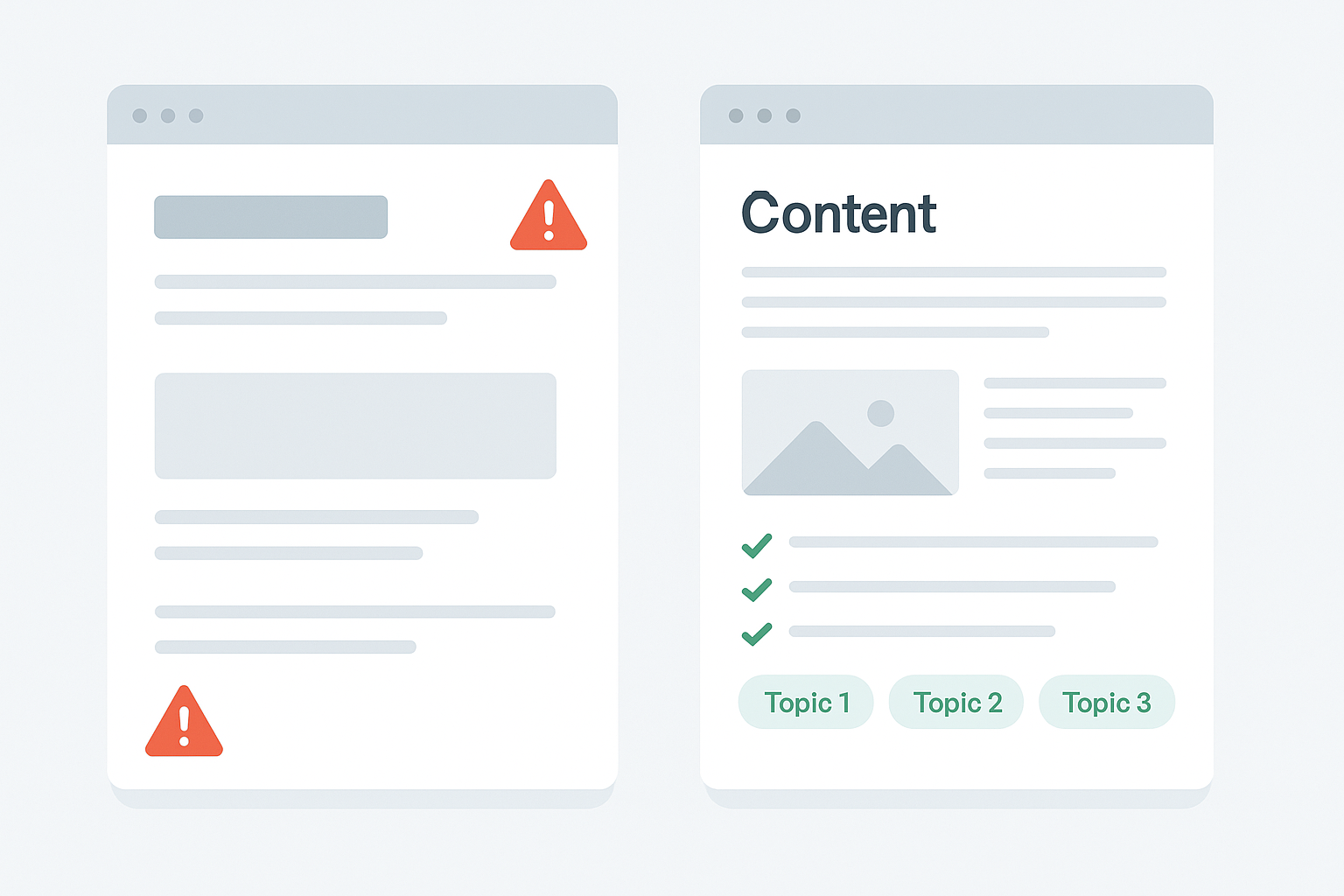
AI-driven content analysis instantly distinguishes thin content from pages with genuine topical depth, entity coverage, and user value — across all seven pillars simultaneously.
AI Content Analysis for Specific SEO Use Cases
Different SEO goals require different applications of AI content analysis. Here is how the discipline applies across the most important use cases.
New Content Creation
Before a single word is written, AI content analysis defines what a winning piece of content must include. Tools like Frase and MarketMuse generate detailed briefs specifying required subtopics, target word count ranges, semantic keywords to include, questions to answer, and heading structures that mirror high-ranking competitors. For hands-on optimization tool workflows, see AI tools for content optimization. Starting from an AI brief rather than a blank page dramatically increases the probability that a new piece ranks on its first publish.
Content Refresh and Re-Optimization
Refreshing existing content with AI analysis is often the highest-leverage activity in an SEO program. See the AI content writing guide for best practices. Pages that ranked well but have slipped typically suffer from one of three problems: competitor content has improved around them, Google’s understanding of the topic has evolved, or the page never fully covered the topic in the first place. AI tools identify exactly which gaps need filling, enabling precise, surgical updates rather than a complete rewrite. A focused content refresh based on AI recommendations can recover lost rankings within 4–8 weeks in most cases.
Content Cannibalization Detection
Content cannibalization occurs when multiple pages on your site compete for the same query, splitting ranking signals and confusing Google about which page should rank. This relates to search engine optimized content best practices. AI analysis cross-references your entire content library against a target keyword set, flags overlapping pages, and recommends whether each overlap should be merged, redirected, or differentiated. Left unaddressed, cannibalization consistently suppresses rankings across an entire content cluster.
Featured Snippet and AI Overview Optimization
Google’s featured snippets and AI Overviews (formerly SGE) pull from content that directly, concisely answers specific questions. AI content analysis tools identify the exact question formats appearing in PAA boxes and AI Overviews for your target queries — and audit whether your content answers them in a snippet-eligible format (typically a 40–60 word direct answer followed by supporting detail). Optimizing for these positions is increasingly important as AI Overviews reshape SERP real estate in 2025. See our search engine optimization practices for closely related tactics.
E-E-A-T Signal Strengthening
Google’s Quality Rater Guidelines emphasize Experience, Expertise, Authoritativeness, and Trustworthiness (E-E-A-T) as criteria for evaluating content quality. AI content analysis helps you build stronger E-E-A-T signals by identifying where content lacks first-person experience evidence, original data, expert citations, or authoritative source references. For YMYL (Your Money or Your Life) topics especially, AI-guided E-E-A-T improvements can be the deciding factor between ranking and not ranking at all. See our guide on benefits of AI in SEO to align tools with trust signals.
Top AI Tools for SEO Content Analysis in 2025
The market for AI-based SEO content tools has matured rapidly. The platforms below represent the strongest options in their respective categories — with honest assessments of where each excels and where it falls short.
Most enterprise SEO teams combine two or more of these platforms. One handles competitive benchmarking and topic mapping; another focuses on real-time writing optimization and AI-driven content optimization.
Pro Tip
Do not chase a tool’s content score as a target metric. A score of 95 in Surfer SEO does not guarantee a ranking — and a score of 72 does not mean the content will fail. The score is a directional signal, not a pass/fail threshold. Focus on whether the content genuinely answers user intent and covers the topic comprehensively.
How to Build an AI Content Analysis Workflow: Step-by-Step
Having the right tools is only half the equation. Without a repeatable process, AI content analysis produces inconsistent results. For a deeper discussion on how AI changes SEO, see how AI changes SEO. Here is a complete workflow that applies AI analysis at every stage of the content lifecycle.
- 1 Keyword and Intent Research Run your target keyword through an AI content analysis tool to identify the dominant search intent, related subtopics, and the full competitive SERP landscape. Determine what format top-ranking pages use (listicle, guide, tool comparison, etc.) and what questions they collectively answer. Build your AI content writing for SEO brief around the gaps you discover — not just the primary keyword.
-
2
Build a Data-Driven Content Brief
Generate an AI content brief specifying required headings, semantic terms to include, questions to answer, target word count range, recommended reading level, entities to mention, and internal linking opportunities. A well-constructed brief reduces revision cycles by 40–60% because writers have clear structural and topical guardrails from the start.
-
3
Real-Time Optimization During Writing
Use a live scoring tool like Surfer SEO or Clearscope while drafting. Monitor semantic term coverage, sentence complexity, and heading structure in real time. Aim for natural coverage of recommended terms — the AI score is a directional guide, not a target to game. Forcing keywords degrades quality and can trigger spam signals.
- 4 Pre-Publish Technical Content Audit Before publishing, run a final AI audit focused on technical content signals: title tag optimization, meta description relevance, heading keyword integration, schema markup completeness, internal link placements, and image alt text accuracy. These technical elements interact with semantic quality and should not be treated as an afterthought. See benefits of AI in SEO for context.
-
5
Post-Publishing Performance Monitoring
Track rankings, organic traffic, click-through rate, and engagement metrics for 4–8 weeks post-publish. If a page stalls or declines, re-run AI content analysis to identify what top-ranking competitors have added since your original publish date. Rankings changes are often traceable to a specific content gap that emerged in the competitive landscape.
-
6
Quarterly Site-Wide Content Audits
Run AI-powered audits across your entire content library every quarter. Identify cannibalization, thin pages, outdated statistics, and content that no longer aligns with current search intent. Prioritize updates based on traffic potential, competitive difficulty, and the estimated effort required to improve. Consistent audits prevent content decay and compound your SEO gains over time.
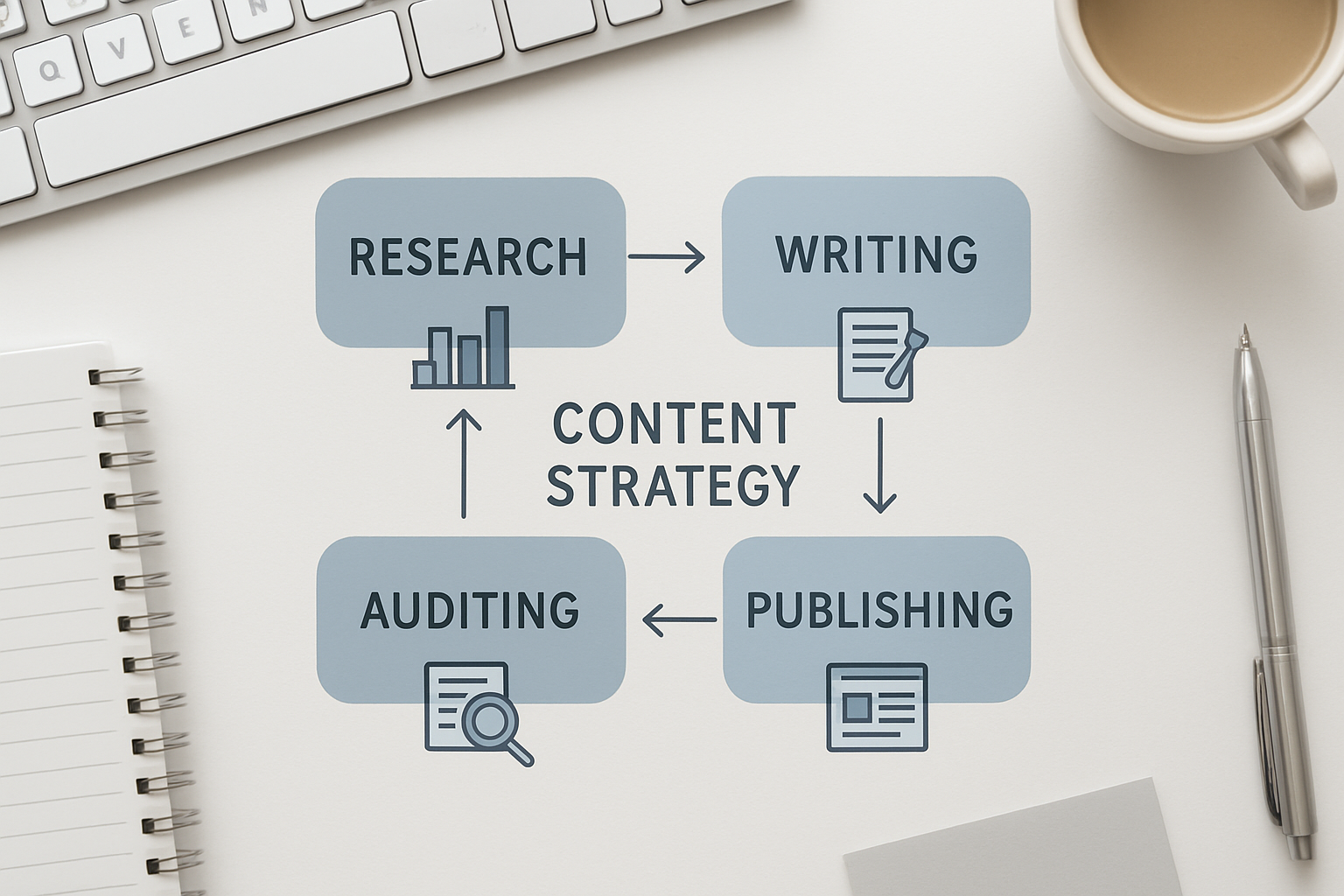
A structured six-stage workflow ensures AI content analysis improves every phase of the content lifecycle — from initial research to ongoing site-wide optimization. For an applied playbook on turning analysis into tactics, see utilize AI insights for SEO strategy.
AI Content Analysis and the Helpful Content System
Google’s Helpful Content System (HCS) — now integrated into its core ranking algorithm — evaluates content at the site level, not just the page level. A site with a significant proportion of unhelpful, thin, or AI-generated-without-review content can see ranking suppression across its entire domain, not just the individual pages that are underperforming.
AI content analysis directly addresses HCS risk in three ways:
- Depth assessment: AI tools evaluate whether content goes beyond surface-level coverage to provide genuine, original insight — the core signal HCS rewards.
- Thin content detection: Automated audits flag pages with low information density, excessive filler, or content that doesn’t satisfy user intent — the primary triggers for HCS penalties.
- Site-wide health monitoring: Regular AI audits maintain the overall content quality ratio across your domain, reducing exposure to site-level suppression even if a few pages underperform.
The key distinction is this: AI content analysis is not about making content look good to algorithms. It is about ensuring content is genuinely useful to people — and then verifying that the signals Google uses to measure usefulness are present and strong.
Common Mistakes in AI Content Analysis (And How to Avoid Them)
AI content analysis tools are powerful — but they are widely misused. These are the most common mistakes that undermine results.
Treating Content Scores as Goals Rather Than Signals
Writers who obsessively chase a high content score often produce keyword-dense, structurally over-engineered articles that read poorly. High scores indicate broad semantic coverage — they do not guarantee ranking. Content quality, user engagement, and E-E-A-T signals matter equally or more.
Applying AI Analysis Only at the Writing Stage
Many teams use AI content analysis tools only while writing, missing the equally important applications at the research, briefing, post-publish monitoring, and site audit stages. The full ROI of these tools comes from embedding them throughout the entire content lifecycle.
Ignoring Competitive Context
AI content scores are relative to the current SERP. A content score that was adequate six months ago may be below the competitive threshold today if competitors have improved their content. Regular re-analysis of published pages against the live SERP is essential — especially after significant Google algorithm updates.
Using a Single Tool for All Analysis Needs
No single AI content analysis tool captures every dimension of content quality. Surfer SEO excels at real-time scoring; MarketMuse is stronger at topical authority mapping; Frase is better for question research. The teams producing the best results use a deliberately chosen stack of complementary tools — not a single platform for everything.
Measuring the ROI of AI Content Analysis
Investing in AI content analysis tools is only justified when the results are measurable. For tracking metrics and tool ROI see AI-driven SEO analytics. Here are the key performance indicators (KPIs) that reveal whether your AI content analysis program is delivering returns.
- Organic ranking improvements: Track average position changes for target keywords 30, 60, and 90 days after AI-optimized content is published or refreshed.
- Organic traffic volume: Monitor sessions and users from organic search, segmented by content cluster to isolate the impact of AI optimization.
- Click-through rate (CTR) from Search Console: AI-optimized titles and meta descriptions typically improve CTR, reflecting better alignment with searcher intent.
- Time-on-page and scroll depth: Content that fully satisfies user intent produces longer session durations — a behavioral engagement signal that correlates with ranking stability.
- Content refresh efficiency: Measure how many revision cycles a piece requires before ranking. AI-briefed content typically requires fewer rewrites, reducing total production cost per ranking page.
- Featured snippet capture rate: Track what percentage of your AI-optimized pages capture featured snippets or appear in AI Overview citations.
Frequently Asked Questions About AI Content Analysis for SEO
What is AI content analysis for SEO and how does it work?
AI content analysis for SEO is the use of machine learning and natural language processing to systematically evaluate web content against ranking factors including semantic relevance, search intent alignment, topical coverage depth, readability, and competitive benchmarks. The tools analyze top-ranking SERP results for a target keyword, extract patterns in what they cover and how they structure information, then compare your content against those patterns to produce specific optimization recommendations.
How does AI improve SEO content analysis compared to manual methods?
AI processes thousands of data points simultaneously — semantic entity relationships, competitor topic coverage, intent classification, readability scores — in seconds, with total consistency across every page analyzed. Manual review catches surface-level issues but misses the statistical patterns across entire SERPs that AI analysis surfaces. AI removes subjectivity, scales without additional labor cost, and produces recommendations that reflect the current competitive reality rather than an editor’s intuition.
Does AI content analysis help with Google’s Helpful Content System?
Yes, directly. AI content analysis helps align pages with Google’s Helpful Content System by evaluating content depth, originality, user satisfaction signals, and information density — the precise factors HCS measures. It flags thin content, excessive filler, and pages that fail to fully satisfy search intent, which are the primary triggers for HCS-related ranking suppression. Regular site-wide AI audits also help maintain the overall content quality ratio that affects domain-level HCS scoring.
How often should I run AI content analysis on my website?
At minimum, run AI content analysis quarterly across your full content library, and on every new piece before and after publishing. High-traffic pages competing in volatile SERPs benefit from monthly analysis cycles. After any major Google algorithm update, prioritize re-analyzing your top-traffic pages against the updated competitive SERP landscape before making optimization decisions.
Can AI content analysis help with featured snippets and Google’s AI Overviews?
Yes. AI content analysis tools identify the exact question formats appearing in PAA boxes and AI Overviews for your target queries, then audit whether your content answers them in a snippet-eligible format. Optimizing for featured snippets and AI Overview citations is increasingly critical in 2025 as these features capture a growing share of SERP real estate and click volume. Content structured with direct 40–60 word answers followed by supporting detail performs best in both formats.
What is the difference between AI content analysis and AI content generation?
AI content analysis evaluates existing content against ranking signals and competitive benchmarks, providing recommendations for human writers to implement. AI content generation creates new text automatically. These are complementary but distinct capabilities — and conflating them is a common mistake. The best results come from using AI analysis to guide human-written content, not from using AI generation as a substitute for genuine expertise and original insight.
Conclusion
AI Content Analysis for SEO Is the New Baseline — Not the Competitive Advantage. Add an author byline and brief bio (name, role, key credentials) and a visible "Last updated" date near the top to strengthen E-E-A-T signals.
The competitive advantage of AI content analysis is disappearing — not because it stopped working, but because it is becoming the minimum standard. The sites consistently ranking in 2025 are running AI analysis at every stage of content production, refreshing existing pages systematically, maintaining clean content quality ratios across their domains, and using entity optimization and intent alignment as core disciplines rather than afterthoughts. Read AI SEO for content creators for practical implementation.
Adopting AI content analysis for SEO is not about replacing human creativity or expertise — it is about giving both a data-driven foundation that makes every piece of content more competitive from its first day live. Pick one tool, build a repeatable workflow, and audit consistently. The gap between organizations that have systematized AI content analysis and those that have not is compounding every quarter.
For teams ready to go deeper, Rank Authority provides advanced AI content analysis strategies and hands-on audits built around exactly these principles. The window for straightforward gains is still open — but it is closing.
For a deeper walkthrough, see our AI Blog Posts for Local Businesses: Complete Guide.

