
Definitive Guide · 2025 Edition
AI-Based Digital Marketing Solutions: The Complete 2025 Guide to Tools, Strategy, and ROI
“Businesses that leverage AI-based digital marketing solutions don’t just outperform competitors — they operate in an entirely different strategic category.”
Quick Answer
AI-based digital marketing solutions are technology systems that apply machine learning, natural language processing, predictive analytics, and automation to plan, execute, and continuously optimize marketing campaigns across every digital channel. They reduce manual workload, sharpen audience targeting, personalize customer experiences at scale, and deliver measurable improvements in conversion rates and return on investment — for businesses of every size.
The marketing landscape has undergone a structural transformation. AI-based digital marketing solutions are no longer premium add-ons reserved for enterprise teams with massive budgets — they are the operational standard for any growth-focused business in 2025. From automated paid media bidding to AI-generated content briefs, predictive lead scoring to real-time personalization engines, artificial intelligence now touches every stage of the marketing funnel. This guide breaks down exactly what these solutions are, how they work, which categories deliver the highest ROI, how to build a connected AI marketing stack, and what your business needs to do to get ahead — and stay ahead.
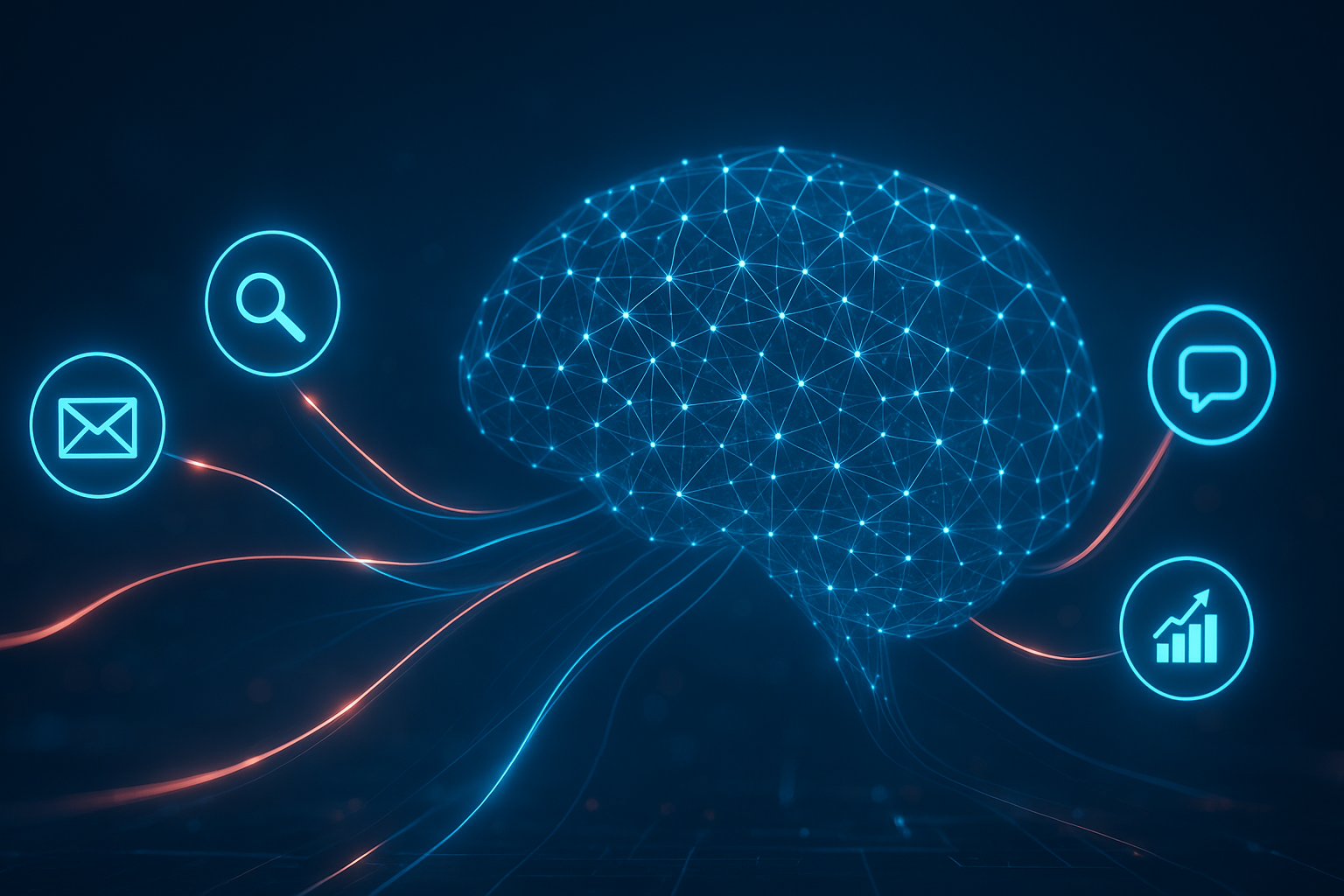
AI-based digital marketing solutions unify every channel into a single intelligent system — enabling smarter, faster, and more profitable campaign decisions.
What Are AI-Based Digital Marketing Solutions?
At their foundation, AI-based digital marketing solutions are the convergence of data science and marketing execution. Unlike traditional marketing software that executes static, manually configured rules, AI-powered platforms learn from behavioral signals, historical campaign data, real-time market conditions, and competitive landscapes to make — or recommend — autonomous decisions that improve over time.
According to Wikipedia’s overview of artificial intelligence in marketing, AI applications in this domain span predictive analytics, natural language generation, computer vision for creative testing, and programmatic media buying. Each capability addresses a specific bottleneck in the traditional marketing funnel — from awareness and discovery through conversion and long-term retention.
The key distinction between AI marketing and traditional marketing automation is adaptive intelligence. Marketing automation executes sequences you define. AI marketing continuously recalibrates those sequences based on what the data reveals — identifying patterns you would never manually detect and acting on them at a speed no human team can match.
In practical terms, this means campaigns that self-adjust bids based on real-time conversion probability, email sequences that rewrite subject lines based on individual recipient behavior, content strategies driven by predictive keyword demand rather than backward-looking volume metrics, and audience segments that update dynamically as user behavior evolves.
The Eight Core Capabilities of AI-Based Digital Marketing Solutions in 2025
Understanding where AI delivers the most measurable value helps you prioritize adoption strategically rather than chasing every new tool. These eight capabilities consistently produce the strongest performance gains across industries and business sizes.
01 — Predictive Audience Targeting
Machine learning models analyze first-party behavioral data, CRM history, and intent signals to identify which users are statistically most likely to convert — before you spend a single dollar on acquisition. This shifts budget from broad reach to high-probability prospects, dramatically reducing cost-per-acquisition while improving overall campaign quality.
02 — AI-Driven Content Creation and Optimization
Natural language processing tools generate content briefs, draft ad copy variations, optimize landing page text for search intent, and test headline performance at scale. The most effective implementations use AI to amplify human writers — accelerating production while preserving editorial quality and brand voice. AI content tools can also analyze top-ranking competitor content and surface precise optimization opportunities in minutes.
03 — Automated Bid Management and Programmatic Advertising
AI systems adjust paid media bids in milliseconds based on auction dynamics, device signals, geographic data, time-of-day patterns, user intent signals, and competitor activity — achieving efficiency levels no human campaign manager can replicate manually. Programmatic AI also automates audience segmentation, creative rotation, and frequency capping across display, video, and connected TV channels simultaneously.
04 — Personalization at Scale
Dynamic content engines serve individualized website experiences, email subject lines, product recommendations, and pricing displays based on each visitor’s behavioral profile, purchase history, and predicted lifetime value. This turns a one-size-fits-all funnel into a tailored journey for millions of users simultaneously — producing consistently higher engagement rates and repeat purchase frequency.
05 — Conversational AI and Chatbot Engagement
AI-powered chatbots and virtual assistants qualify leads, answer product questions, guide users through complex decision processes, and schedule demos or calls around the clock — compressing the sales cycle and capturing demand that would otherwise leak outside business hours. Advanced conversational AI integrates with CRM platforms to hand off enriched lead profiles to sales teams automatically.
06 — Intelligent SEO and Search Visibility
AI SEO platforms analyze ranking signals, identify content gaps, model topical authority, forecast keyword demand shifts, and optimize for both traditional search engines and the rapidly expanding landscape of AI-powered answer engines including ChatGPT, Perplexity, and Google’s AI Overviews. For a strategic deep-dive on this fast-evolving space, the 2026 AI SEO Playbook at Rank Authority is essential reading.
07 — AI-Powered Email Marketing and Marketing Automation
AI optimizes email send times for each individual subscriber, generates subject line variations, segments lists dynamically based on engagement signals, and predicts which contacts are at risk of churn — enabling proactive retention campaigns. AI-driven drip sequences adapt their content and pacing based on how each recipient interacts with previous emails, producing significantly higher open rates and click-through rates than static sequences.
08 — Social Media AI and Sentiment Analysis
AI tools monitor brand mentions, analyze sentiment across platforms in real time, identify emerging trends before they peak, and recommend optimal posting times and content formats for each channel. Sentiment analysis powered by natural language processing gives marketing teams an early warning system for reputation risks and a real-time feedback loop on campaign messaging effectiveness.

Modern marketers rely on AI-powered dashboards to surface actionable insights across every campaign channel simultaneously.
How AI-Based Digital Marketing Solutions Improve ROI
The ROI case for AI in marketing is no longer theoretical — it is documented across industries and business models. AI improves return on investment through four distinct mechanisms that compound on each other over time.
1. Spend Efficiency Through Precision Targeting
AI eliminates budget waste by concentrating media investment on the highest-probability conversion moments and audiences. Rather than applying uniform bids across a keyword list or audience segment, AI identifies micro-segments that convert at three or five times the average rate — and concentrates spend there. This alone typically reduces cost-per-acquisition by 20–40% within the first 60 days of deployment.
2. Conversion Rate Improvement Through Personalization
Personalized experiences consistently outperform generic ones across every channel. AI makes large-scale personalization economically viable — serving individualized product recommendations, landing page variants, and email content to hundreds of thousands of users simultaneously without manual intervention.
3. Speed-to-Insight and Faster Decision Cycles
Decisions that once required a week of analyst time — segmenting performance by audience, identifying creative fatigue, forecasting next-quarter demand — now surface in hours or minutes. This speed advantage allows marketing teams to capitalize on trends and correct underperforming campaigns before competitors even notice the opportunity.
4. Continuous Optimization Without Human Bottlenecks
Traditional campaign optimization is limited by human bandwidth — analysts can review data and make adjustments weekly at best. AI optimization loops run continuously, making thousands of micro-adjustments every hour across bids, creative rotation, audience targeting, and budget allocation. The cumulative effect of this continuous optimization is a campaign that measurably improves week over week without requiring proportional increases in team headcount.
Key Performance Benchmark
Brands using AI-driven personalization report up to 40% higher revenue from marketing activities compared to those using static campaign strategies — according to multiple independent industry benchmarks.
Additionally, companies that have fully integrated AI into their marketing operations report a 30% reduction in customer acquisition costs and a 25% improvement in customer lifetime value within 12 months of adoption.
How to Build an AI-Based Digital Marketing Stack: A Step-by-Step Framework
Building a connected AI marketing stack requires deliberate sequencing. The businesses that extract the most value from AI marketing don’t adopt tools randomly — they build a coherent architecture where each layer informs the others. Follow this framework to avoid the most common and costly implementation mistakes.
-
1 Audit Your Existing Data Infrastructure
AI tools are only as powerful as the data they consume. Before adopting any AI marketing platform, audit your current data sources: CRM records, website analytics, email engagement history, paid media performance data, and customer transaction history. Identify gaps in data collection, clean up inconsistencies, and establish a unified customer data foundation. Without clean, structured first-party data, even the most sophisticated AI tools will produce unreliable outputs.
-
2 Define Your Highest-Leverage Marketing Bottleneck
Don’t try to implement all eight AI marketing capabilities simultaneously. Identify the single biggest constraint in your current funnel — whether that’s lead quality, conversion rate, content production speed, or ad spend efficiency — and deploy AI there first. This focused approach produces faster, more visible ROI that builds internal confidence and budget approval for broader rollout.
-
3 Select Tools With Proven Integration Capability
The cardinal mistake in AI marketing adoption is choosing tools that operate in silos. A chatbot that doesn’t share lead data with your CRM, or an AI content tool that doesn’t feed insights into your SEO platform, creates fragmented intelligence that dramatically underperforms its potential. Evaluate every tool on its integration depth with your existing stack before evaluating its feature set. For an expert comparison of the leading platforms, the Rank Authority guide to the 5 Best AI Optimization Tools for 2025 provides hands-on evaluations across SEO, content, and paid media categories.
-
4 Establish AI Governance and Human Override Protocols
Every AI marketing deployment needs guardrails. Establish clear policies on which decisions AI can make autonomously (bid adjustments, send time optimization, audience expansion) and which require human review (brand messaging changes, creative strategy pivots, major budget reallocations). Transparency in AI decision-making logic is critical — teams that understand how the AI is making recommendations are far more effective at improving those systems over time.
-
5 Measure, Expand, and Compound
After your initial AI deployment produces measurable results, systematically expand to adjacent capabilities. Use the data and insights generated by your first AI tool to inform the configuration of the next. A connected AI marketing stack compounds its intelligence over time — each tool learns from the outputs of the others, creating a compounding performance advantage that widens the gap with competitors who are still running isolated point solutions.
AI-Based Digital Marketing Solutions by Business Type
The right AI marketing approach varies depending on your business model. Here is how AI solutions map to four common business types — with specific use cases and expected outcomes for each.
E-Commerce Businesses
E-commerce brands benefit most immediately from AI-powered product recommendations, dynamic pricing engines, and predictive inventory-linked advertising. AI personalizes every touchpoint — from homepage product displays to abandoned cart sequences — producing measurable lifts in average order value and repeat purchase frequency. AI also enables dynamic ad creative that automatically features products most likely to convert for each individual user based on their browsing and purchase history.
B2B and SaaS Companies
B2B marketers extract the highest value from AI-powered lead scoring, intent data platforms, and AI-driven account-based marketing. Predictive lead scoring models trained on your historical CRM data identify which incoming leads match your ideal customer profile and which are most likely to close — allowing sales teams to prioritize intelligently. AI-driven content personalization serves different messaging to prospects based on their industry, company size, and stage in the buying cycle.
Local and Service Businesses
Local businesses benefit from AI tools that optimize Google Business Profile performance, automate review response generation, manage hyper-local paid advertising bids, and generate locally optimized content at scale. AI scheduling and chatbot tools ensure that service inquiries are captured and followed up with instantly — even outside business hours — dramatically improving lead response rates in competitive local markets.
Small and Medium-Sized Businesses
A common misconception is that AI-based digital marketing solutions are exclusively for enterprises with large data teams and six-figure tool budgets. The reality in 2025 is the opposite. The democratization of AI has produced a generation of accessible, affordable platforms that give SMBs capabilities that would have required a full data science team just five years ago. A small e-commerce brand can now automatically generate product descriptions optimized for search intent, send behavioral email sequences triggered by individual shopping patterns, and identify which paid keywords convert best for their specific audience — all without a dedicated marketing hire. The competitive disadvantage of not adopting these tools grows every quarter.

AI-based digital marketing solutions are now accessible and affordable for small and medium-sized businesses, not just enterprise teams.
Choosing the Right AI Tools for Your Marketing Stack
The AI marketing tool landscape in 2025 is dense and competitive, and not every platform delivers equal value. Selecting the wrong tools — or the right tools in the wrong order — is one of the most common and expensive mistakes marketing leaders make during AI adoption.
Key Selection Criteria
- Integration depth: Does the tool connect natively to your CRM, analytics platform, and paid media accounts — or will you need custom development work to create data bridges?
- Transparency of AI logic: Can you understand why the AI is making specific recommendations? Black-box systems that provide outputs without explanations are difficult to improve and create brand risk.
- Human override controls: Can your team easily intervene, adjust, or override AI decisions for brand-sensitive contexts without breaking the overall optimization model?
- Data ownership and privacy compliance: Confirm that the tool’s data handling practices comply with GDPR, CCPA, and your own data governance policies. AI tools that ingest customer data must have clear, auditable data retention and deletion protocols.
- Scalability and pricing model: Evaluate whether the tool’s pricing scales in proportion to the value it delivers — or whether costs accelerate faster than ROI as your usage grows.
- Vendor stability and roadmap: The AI marketing tool landscape is evolving rapidly. Choose vendors with proven track records, strong customer retention, and publicly communicated product roadmaps aligned with where AI marketing is heading.
For a curated, hands-on evaluation of the leading platforms available right now, the Rank Authority guide to the 5 Best AI Optimization Tools for 2025 provides detailed comparisons across SEO, content creation, and paid media automation categories.
For a deeper walkthrough, see our AI-Driven Content Marketing: The Complete Guide.
AI Marketing Ethics, Privacy, and Risk Management
As AI-based digital marketing solutions become more powerful, the ethical and legal dimensions of their deployment become more consequential. Marketing leaders who ignore these considerations expose their organizations to regulatory penalties, brand reputation damage, and customer trust erosion that can permanently damage business performance.
Data Privacy and Regulatory Compliance
AI marketing systems are data-intensive by nature. Every personalization decision, predictive model, and behavioral trigger relies on customer data that must be collected, stored, and processed in compliance with applicable privacy regulations. GDPR in Europe, CCPA in California, and the growing patchwork of state-level privacy laws in the United States create a complex compliance landscape that every AI marketing deployment must navigate. Ensure consent management is integrated at the data collection layer — not retrofitted after deployment.
Avoiding AI Bias in Targeting
AI models trained on historical data can encode and amplify existing biases in your customer acquisition patterns. This is particularly relevant in audience targeting — an AI that learns from your past customer base may systematically exclude demographic groups who were underrepresented in your historical data but represent significant future market potential. Regular audits of AI targeting outputs for demographic fairness are essential.
Brand Safety and AI-Generated Content
AI content generation tools are powerful accelerators, but they require human editorial oversight to maintain brand voice consistency, factual accuracy, and compliance with advertising standards. Establish a review workflow that scales with your content volume — using AI to draft and human editors to approve — rather than publishing AI-generated content without review. This hybrid approach captures the speed benefits of AI while protecting brand integrity.
The Future of AI-Based Digital Marketing: Trends Through 2026
The trajectory of AI in digital marketing is accelerating, not stabilizing. Understanding where the technology is heading allows forward-thinking marketers to build strategies that compound advantage rather than react to change.
-
Generative AI for Hyper-Personalized Creative at Scale
Generative AI systems are rapidly advancing toward real-time production of individualized ad creative, landing pages, and video content tailored to each viewer’s profile. By 2026, the gap between brands deploying generative AI creative and those using static assets will be measurable in double-digit conversion rate differences.
-
AI Answer Engine Optimization (AEO)
As users increasingly receive answers directly from AI systems like ChatGPT, Gemini, and Perplexity — without clicking through to websites — optimizing for AI-generated answers becomes a distinct and critical marketing capability. AEO requires structuring content to be cited as authoritative source material in AI responses, which differs meaningfully from traditional SEO.
-
Autonomous AI Marketing Agents
The next generation of AI marketing platforms will move from tool-based assistance to autonomous agent-based execution — AI systems that can independently plan campaigns, allocate budgets, produce creative, execute multi-channel launches, and report on performance with minimal human input. Early versions of these agentic marketing systems are already in market with enterprise clients.
-
First-Party Data Becoming the Core Competitive Asset
As third-party cookie deprecation continues and data privacy regulations tighten globally, first-party customer data becomes the foundational competitive moat for AI marketing. Brands that have built robust first-party data assets — and the AI infrastructure to activate them — will have a structural advantage over competitors reliant on purchased data or third-party platforms.
Frequently Asked Questions About AI-Based Digital Marketing Solutions
Conclusion
The Compounding Competitive Advantage of AI-Based Digital Marketing Solutions
The window for treating AI-based digital marketing solutions as optional is closing faster than most marketing leaders recognize. Competitors who have integrated predictive targeting, AI-driven content optimization, automated bid management, and intelligent SEO into their operations are already compounding advantages that widen every month. The question for every marketing leader in 2025 is not whether to adopt AI — it is how quickly and strategically you can build a connected, intelligent marketing stack that learns, adapts, and outperforms at every stage of the funnel.
Start with the highest-leverage capability for your current growth challenge. Integrate your data sources before adding more tools. Establish governance and human oversight protocols. Then let the systems learn — and expand from there. The compounding returns of AI marketing are not a future promise. They are a present reality for the brands that act with clarity and speed.
For ongoing strategic guidance, tool comparisons, and AI marketing frameworks, Rank Authority publishes regularly updated resources designed for growth-focused marketing teams at every stage of AI adoption. For a deeper walkthrough, see our AI Visibility Audit: The Complete Guide to Rankings.

