

Quick Answer: Finding keywords in text means identifying the most significant words and phrases within any document that reveal its topic, intent, and search relevance. You can accomplish this through manual reading, word frequency analysis, NLP-powered tools, or a combination of all three — and this guide walks you through every method in precise detail.
Finding keywords in text is the foundational SEO skill that turns raw content into a ranked, traffic-generating asset. Whether you are auditing a competitor’s page, optimizing your own blog post, analyzing customer reviews, or mining forum threads for content ideas, knowing how to extract the right terms from any body of text is what separates guesswork from data-driven strategy. This complete guide covers every technique — from a manual first read to advanced NLP extraction — so you never miss a keyword signal again.
Keyword extraction (also called term extraction or keyword spotting) is defined as a text mining technique that automatically or manually identifies the most relevant words and expressions in a document, enabling faster indexing, search, and categorization. In practical SEO terms, it is the process of reading a text — any text — and systematically surfacing the words that carry topical weight and search intent.

Finding keywords in text starts with careful reading and pattern recognition before any tool enters the workflow.
What Is Finding Keywords in Text?
Finding keywords in text is the systematic practice of locating words and multi-word phrases within a document that carry the most communicative and SEO value. These terms define what a piece of content is about, what questions it answers, and which search queries it should rank for.
In linguistics and information retrieval, this process is formally called keyword extraction or term extraction. According to Wikipedia’s article on keyword extraction, it is a text mining technique that automatically identifies the most relevant words and expressions in a text. In practice, it enables faster document indexing, search, and categorization. In the SEO world, it is the human-driven version of that same process — applied directly to content strategy.
There are three broad contexts where this skill applies:
- Your own content: Auditing existing pages to confirm keyword placement, density, and semantic coverage.
- Competitor content: Reverse-engineering what terms rival pages are targeting so you can match or exceed their coverage.
- Source material: Extracting topic signals from customer reviews, Reddit threads, research papers, or support tickets to fuel new content ideas.
Why This Skill Matters More in 2025 Than Ever
Modern search algorithms — including Google’s BERT and Gemini-era ranking systems — no longer match pages to queries based purely on exact keyword presence. Instead, they evaluate topical comprehensiveness, entity relationships, and semantic coherence. As a result, finding keywords in text is no longer just about spotting a phrase. It is about building a complete semantic picture of what a document is truly saying.
Furthermore, AI-powered search features like Google’s AI Overviews pull directly from pages that demonstrate the broadest, deepest coverage of a topic. Therefore, mastering keyword identification in text is now both an SEO and an AI visibility strategy simultaneously.
Why Keyword Identification in Text Matters for SEO
Search engines use sophisticated algorithms to read and interpret text much the way a skilled analyst would. When Google crawls a page, it performs its own version of keyword extraction — identifying the primary topic, supporting subtopics, and entity relationships within the content. Consequently, if your text does not clearly signal the right keywords, your page will struggle to rank even if it contains genuinely useful information.
Beyond ranking, keyword identification in text helps you accomplish several critical goals:
- Detect keyword gaps: Topics your content mentions but does not fully address.
- Spot keyword cannibalization: Multiple pages on your site competing for the same term.
- Align with user intent: Match your content precisely to what searchers actually want.
- Build topical authority: Map semantic keyword clusters so your site ranks as an expert source.
- Optimize for AI-generated answers: AI Overviews and featured snippets favor pages with the most thorough, well-structured keyword coverage.
The Four Types of Keywords Found in Text
Not all keywords carry the same weight. Specifically, when analyzing any document, you will encounter four distinct keyword types:
- Primary keywords: The single core term the page is optimized to rank for. For example, “finding keywords in text.”
- Secondary keywords: Close variants and closely related phrases — for instance, “keyword extraction from text” or “keyword identification.”
- Semantic / LSI keywords: Latent semantic indexing (LSI) terms are words that frequently co-occur with your primary keyword across the web, signaling topical context to search engines.
- Entity keywords: Named concepts, tools, people, or organizations that place your content within a recognized topical neighborhood — for example, “Google Search Console,” “Ahrefs,” or “NLP.”
How to Find Keywords in Text: Step-by-Step Process
The following six-step process works for any text — whether a single blog post or a 50-page whitepaper. Each step builds on the one before, so work through them in order for the best results.
Step 1
Read the Text and Identify Core Topics
Before any tool touches the document, read it fully. Note which subjects appear repeatedly, which terms are bolded or used in headings, and what the author is primarily explaining. In addition, pay attention to the questions the text answers — those question-and-answer structures are often a direct window into search intent. This manual pass gives you an interpretive baseline no algorithm can fully replicate.
Step 2
Extract High-Frequency Terms
Paste the text into a word frequency counter. Free tools like WordCounter.net, MonkeyLearn, or browser-based frequency analyzers generate a ranked list of every term and how often it appears. Specifically, high-frequency nouns and noun phrases are your primary and secondary keyword candidates. For longer documents, also look for two- and three-word phrases (bigrams and trigrams) — these often reveal the most targeted keyword opportunities.
Step 3
Filter Stop Words and Noise
Eliminate common function words — “the,” “and,” “is,” “of” — that carry no topical meaning. These are called stop words in NLP terminology. Most frequency tools remove them automatically. However, always review the filtered list manually to catch domain-specific terms that are irrelevant to your niche. In a medical article, for example, “patient” may function as a stop word because it appears everywhere without adding topical specificity.
Step 4
Group Related Terms into Semantic Clusters
Organize your extracted terms into thematic groups. For example, “keyword extraction,” “keyword identification,” and “term extraction” all belong to the same semantic cluster. This clustering reveals your primary keyword and its supporting LSI (latent semantic indexing) variants — both of which Google uses to evaluate topical depth. Furthermore, semantic clusters help you identify sub-topics that deserve their own dedicated sections or even separate pages.
Step 5
Validate Keywords Against Search Data
A keyword that appears frequently in your text but has zero search volume is a topical signal — not a traffic driver. Therefore, cross-reference your list with Google Search Console for pages already indexed, or use Ahrefs, Semrush, or Moz to check search volume and keyword difficulty for new content opportunities. In addition, look at the SERP features (featured snippets, People Also Ask boxes, AI Overviews) that appear for each keyword — these reveal what format Google wants for this topic.
Step 6
Map Keywords to Content Strategy
Assign each validated keyword to a specific page, heading, or content section. Ensure your primary keyword appears in the title, the opening paragraph, at least one subheading, and the conclusion. Secondary and semantic keywords should be distributed naturally throughout the body copy. Consequently, no single page should try to rank for two unrelated primary keywords — that is the root cause of keyword cannibalization.

Visualizing keyword frequency as a word cloud helps identify dominant topics at a glance during text analysis.
Manual vs. Automated Keyword Extraction: Which Should You Use?
Both approaches have distinct strengths. The right choice depends on your goal, your document volume, and the level of interpretive nuance your project requires.
For most SEO practitioners, the optimal workflow combines a manual first pass with automated frequency analysis, followed by validation in an SEO platform. This hybrid approach captures both the interpretive nuance of human reading and the speed of algorithmic processing. As a result, you get faster output without sacrificing accuracy.
When to Use NLP for Finding Keywords in Text
NLP (Natural Language Processing) refers to AI techniques that analyze human language at a structural level — understanding grammar, named entities, sentiment, and semantic relationships rather than just counting word occurrences. Consequently, NLP-powered keyword extraction is significantly more accurate than raw frequency analysis for longer, more complex documents.
Specifically, consider NLP tools when you need to:
- Process hundreds of documents simultaneously — for example, analyzing an entire competitor blog.
- Extract named entities (brands, locations, people) alongside topical keywords.
- Identify sentiment-laden keywords in customer reviews or social media data.
- Detect question-and-answer patterns that map directly to People Also Ask and featured snippet opportunities.
Understanding Keyword Density and Natural Placement
Keyword density — the ratio of keyword occurrences to total word count — was once treated as a hard ranking signal. Modern SEO has moved well beyond that. Google’s algorithms now evaluate natural language patterns, entity co-occurrence, and semantic coherence rather than raw keyword percentages. However, keyword placement still matters enormously.
When finding keywords in text for your own optimization work, prioritize these placement locations:
- Page title and H1: The single most important placement signal for search engines.
- First 100 words: Establishes topical relevance early for crawlers and AI systems.
- Subheadings (H2/H3): Reinforces the keyword theme across major sections.
- Image alt text: Adds keyword signal to non-text elements and aids accessibility.
- Meta description: Influences click-through rate even if it is not a direct ranking factor.
- Conclusion paragraph: Closes the topical loop for both readers and algorithms.
- Internal anchor text: Signals topical relevance from supporting pages within your site.
Avoiding Keyword Stuffing While Maximizing Keyword Signals
Keyword stuffing — the practice of repeating a keyword unnaturally to manipulate rankings — triggers Google’s spam filters and degrades the reader experience. In contrast, natural keyword usage weaves the target phrase into sentences where it genuinely belongs. A practical guideline is to aim for a keyword density between 0.5% and 2% while relying on semantic variants to carry the rest of the topical weight.
For example, instead of repeating “finding keywords in text” in every paragraph, use variants such as “keyword extraction,” “identifying keywords,” “keyword spotting,” and “text keyword analysis” to build semantic richness without over-repetition.
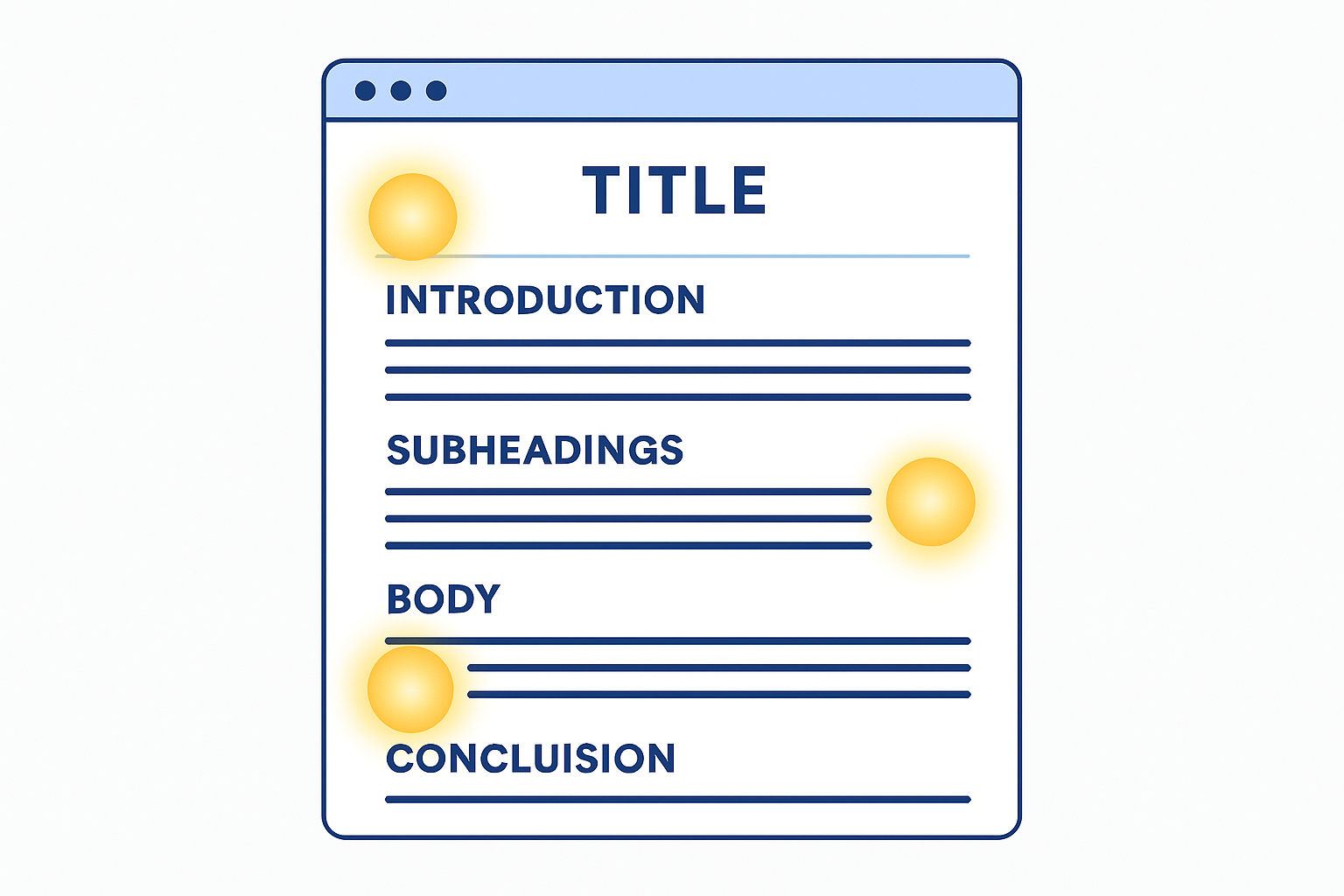
Strategic keyword placement across page sections is as important as finding keywords in text during your initial analysis.
Semantic Keywords and Topical Authority
No high-performing page ranks on a single keyword alone. Google’s Hummingbird and BERT updates fundamentally shifted ranking toward topical comprehensiveness. Therefore, when you find keywords in text, you should be building a semantic map — a web of related terms that collectively signal deep expertise on a subject.
Semantic keywords fall into three categories:
- Synonyms: “keyword identification,” “term extraction,” “keyword spotting,” “text keyword analysis.”
- Co-occurring terms: Words that frequently appear alongside your primary keyword in high-ranking content — for example, “search intent,” “content audit,” “on-page SEO,” “SERP features.”
- Entity mentions: Proper nouns and named concepts that establish your content’s topical neighborhood — tools like Ahrefs, Semrush, Google Search Console, and methodologies like NLP and TF-IDF.
TF-IDF: The Algorithm Behind Semantic Keyword Weight
TF-IDF stands for Term Frequency–Inverse Document Frequency. It is a statistical measure used in information retrieval to determine how important a word is to a specific document within a larger collection of documents. In simpler terms: it rewards words that appear frequently in your document but rarely across all documents — making those terms your most distinctive and topically significant keywords.
Several SEO tools — including Surfer SEO and Clearscope — use TF-IDF-based analysis to tell you which keywords your top-ranking competitors use and how prominently. Consequently, incorporating TF-IDF analysis into your keyword extraction workflow gives you a data-backed path to topical comprehensiveness that pure frequency counting cannot provide.
Building a Topical Authority Map from Extracted Keywords
Once you have extracted and clustered your keywords, use them to build a topical authority map — a structured plan that assigns keyword clusters to individual pages, blog posts, or content sections. This approach ensures your site covers a topic from multiple angles, which in turn signals domain expertise to Google’s quality raters and ranking algorithms.
Resources like Rank Authority provide in-depth guidance on building topical authority through structured keyword mapping and semantic content clusters — a strategy that compounds ranking power across entire topic silos rather than isolated pages.
Finding Keywords in Text for Competitive Research
One of the most powerful applications of keyword extraction is competitive content analysis. By systematically finding keywords in a competitor’s text, you can reverse-engineer their entire content strategy — identifying the terms they rank for, the topics they cover well, and crucially, the gaps they leave open for you to exploit.
How to Extract Keywords from a Competitor’s Page
- Copy the visible body text from the competitor’s page — headings, paragraphs, bullet points, and FAQ answers.
- Run it through a frequency analyzer to extract the top 30–50 terms and two-to-three-word phrases.
- Identify their primary keyword — the phrase that appears most prominently in their H1, title tag, and first paragraph.
- Map their semantic coverage — which subtopics and related terms do they address in depth, and which do they gloss over?
- Cross-reference with Ahrefs or Semrush to see which keywords actually drive traffic to that specific page.
- Build your content brief to cover all their topics more deeply while adding the subtopics and questions they missed entirely.
Using “People Also Ask” and Autocomplete for Additional Keyword Signals
Google’s People Also Ask (PAA) boxes and search autocomplete suggestions are underused sources for finding keywords in text. Each PAA question represents a real user query that Google has confirmed is closely related to your primary keyword. Similarly, autocomplete suggestions reveal the long-tail variations that actual searchers type most frequently.
Incorporate these questions and phrases directly into your content — as subheadings, FAQ answers, or dedicated paragraphs. This approach not only improves keyword coverage but also dramatically increases your chances of earning featured snippet placements and PAA box appearances.
Best Tools for Finding Keywords in Text
The right tool depends on your workflow, budget, and the type of text you are analyzing. Below is a comprehensive breakdown of the most effective options available in 2025.
Free Tools
- Google Search Console: The most accurate source of organic keyword data for your own live pages. It shows exactly which queries trigger impressions and clicks.
- WordCounter.net: A simple browser-based tool that produces instant word frequency reports from any pasted text — ideal for quick extractions.
- Google Docs “Find and Replace”: Useful for manually counting specific keyword instances across a long document.
- Keywords Everywhere (browser extension): Adds search volume and related keyword data directly to your Google search results page.
- AlsoAsked.com: Maps out the full tree of People Also Ask questions for any keyword — a goldmine for finding question-based keywords in text.
Paid and Professional Tools
- Ahrefs: Offers a Content Gap tool and keyword extraction from any URL — essential for competitive keyword research.
- Semrush: Its On-Page SEO Checker and Keyword Magic Tool surface keyword opportunities directly from text analysis.
- Surfer SEO: Uses TF-IDF analysis to compare your content’s keyword distribution against top-ranking competitors and generate specific optimization recommendations.
- Clearscope: An AI-powered content grading tool that scores your text for semantic keyword coverage relative to top-ranking pages.
- MarketMuse: Builds topic models from keyword extraction and tells you which concepts are missing from your content.
- MonkeyLearn: An NLP platform that extracts keywords, entities, and sentiment from large text datasets without coding knowledge.
Common Mistakes When Finding Keywords in Text
Even experienced SEOs make consistent errors during keyword extraction. Recognizing these pitfalls in advance saves significant time and prevents costly content rewrites later.
- Focusing only on single words: Single-word keywords are almost always too broad and too competitive. Instead, prioritize two-to-four-word phrases that reflect specific user intent.
- Ignoring search intent: A keyword found in text is only valuable if it aligns with what searchers actually want when they type that phrase. Always verify intent by reviewing the actual search results.
- Treating frequency as the only signal: High frequency does not automatically mean high importance. A word can appear many times because it is a stop word or a function word — not because it is topically significant.
- Skipping competitor analysis: Finding keywords only in your own text creates a closed loop. You need external benchmarks to know what your content is missing.
- Over-relying on a single tool: No single tool captures everything. Consequently, combining at least two methods — for instance, frequency analysis plus SEO platform validation — always produces better results.
- Neglecting long-tail keywords: Long-tail keywords (four or more words) typically have lower search volume but far higher conversion rates. They are also considerably easier to rank for, especially on newer or lower-authority sites.
Frequently Asked Questions About Finding Keywords in Text
Conclusion
Finding keywords in text is not a one-time task — it is a continuous analytical discipline that underpins every effective SEO and content strategy. By combining manual reading with frequency analysis, semantic clustering, TF-IDF scoring, and search data validation, you build a complete picture of what any document is truly about and how to optimize it for maximum visibility.
The six-step process outlined here applies equally to auditing your own content, reverse-engineering competitor pages, mining source material for new topic ideas, and optimizing existing articles for AI-powered search features. Furthermore, the tools and techniques in this guide scale from a single blog post all the way to an enterprise-level content library — making keyword extraction in text a skill that pays compounding dividends as your site grows.
In summary: master the process of finding keywords in text, and you gain a systematic edge that improves every piece of content you produce. For deeper strategies on keyword mapping, topical authority, content clustering, and semantic SEO, explore the resources available at Rank Authority — a comprehensive hub for data-driven SEO practitioners at every level.

