
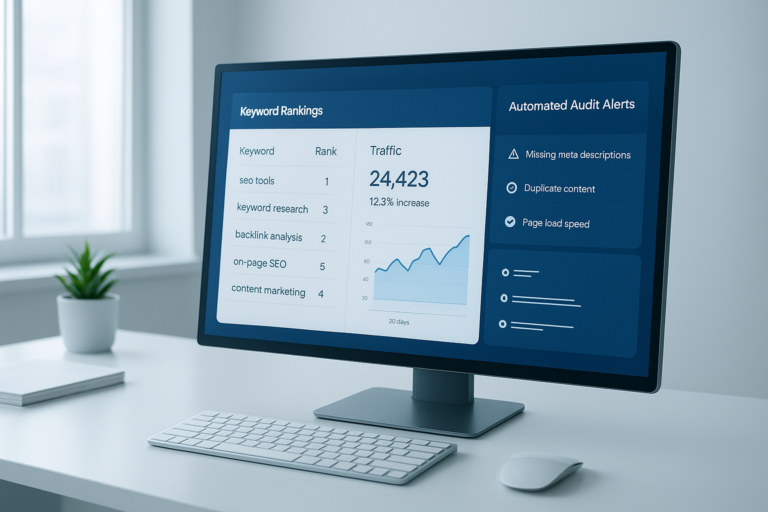
An SEO automation tool is an AI-powered system that autonomously researches, analyzes, and executes search engine optimization tasks on your behalf — reducing manual effort while accelerating ranking growth. Because search algorithms grow more complex every year, businesses that rely solely on manual SEO processes are increasingly falling behind. Therefore, understanding what an SEO agent does and how to deploy one effectively is now a competitive necessity.
Quick Answer: An SEO agent is an AI-driven tool that automates the full cycle of search optimization — from keyword discovery to technical audits to performance reporting. It acts on data continuously, so your site stays optimized even when your team is focused elsewhere.
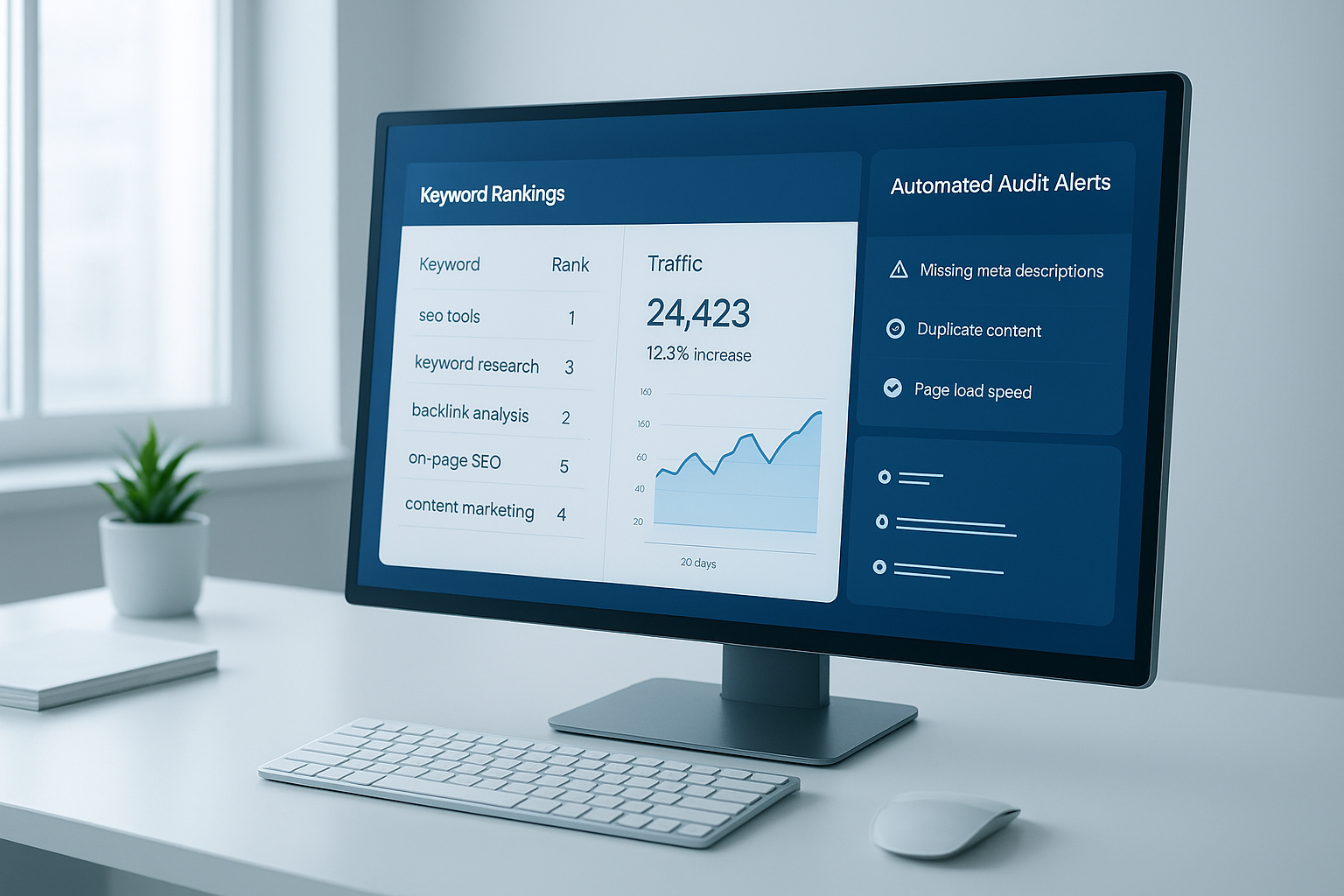
A modern SEO agent dashboard consolidates keyword data, audit alerts, and ranking trends into one actionable view.
What Does an SEO Agent Actually Do?
At its core, an SEO agent operates as a continuous optimization loop. First, it collects data from sources like Google Search Console, crawl reports, and competitor analysis tools. Next, it interprets that data using machine learning models trained on ranking signals. Finally, it surfaces prioritized recommendations — or in more advanced systems, implements changes directly.
In practice, this means an SEO agent can handle tasks that would otherwise require hours of manual work each week. For example, it can scan thousands of pages for thin content, flag missing meta descriptions, and suggest internal linking opportunities — learn the benefits of automated SEO — all overnight. As a result, your team wakes up to a prioritized action list rather than a pile of raw data.
Additionally, many modern agents monitor competitor pages in real time using AI-driven competitor tracking. When a rival publishes new content targeting your keywords, the agent alerts you and suggests a counter-strategy. This level of responsiveness is simply not achievable through weekly manual audits.
The Core Capabilities of an AI SEO Agent
Although every platform differs, most capable SEO agents share a common set of features. Understanding these capabilities helps you evaluate which tool best fits your workflow.
🔍 Keyword Intelligence
Discovers high-opportunity keywords, clusters them by intent, and maps them to existing or planned content automatically. See how on-page SEO tools perform these analyses.
⚙️ Technical Auditing
Crawls your site continuously to surface broken links, slow pages, duplicate content, and crawlability issues.
✍️ Content Optimization
Analyzes top-ranking pages and provides specific on-page recommendations for headings, word count, semantic terms, and structure. Learn when automated SEO services are worth the investment.
📊 Rank Monitoring
Tracks keyword positions daily across devices and locations, alerting you to drops before they become traffic losses.
How an SEO Agent Differs from Traditional SEO Software
Traditional SEO tools — such as rank trackers or crawlers — are passive instruments. They show you data, but the interpretation and action remain entirely your responsibility. In contrast, an SEO agent actively closes the gap between insight and execution.
Think of it this way: a standard analytics platform is like a weather report. An SEO agent, however, is like a navigator who reads that report and immediately adjusts your route. Because of this distinction, teams using agents consistently outpace those relying on static dashboards alone.
Furthermore, AI-driven SEO tools and agents learn over time. They observe which recommendations led to ranking improvements and weight similar suggestions more heavily in future audits. This feedback loop makes the system progressively smarter the longer it runs on your site.
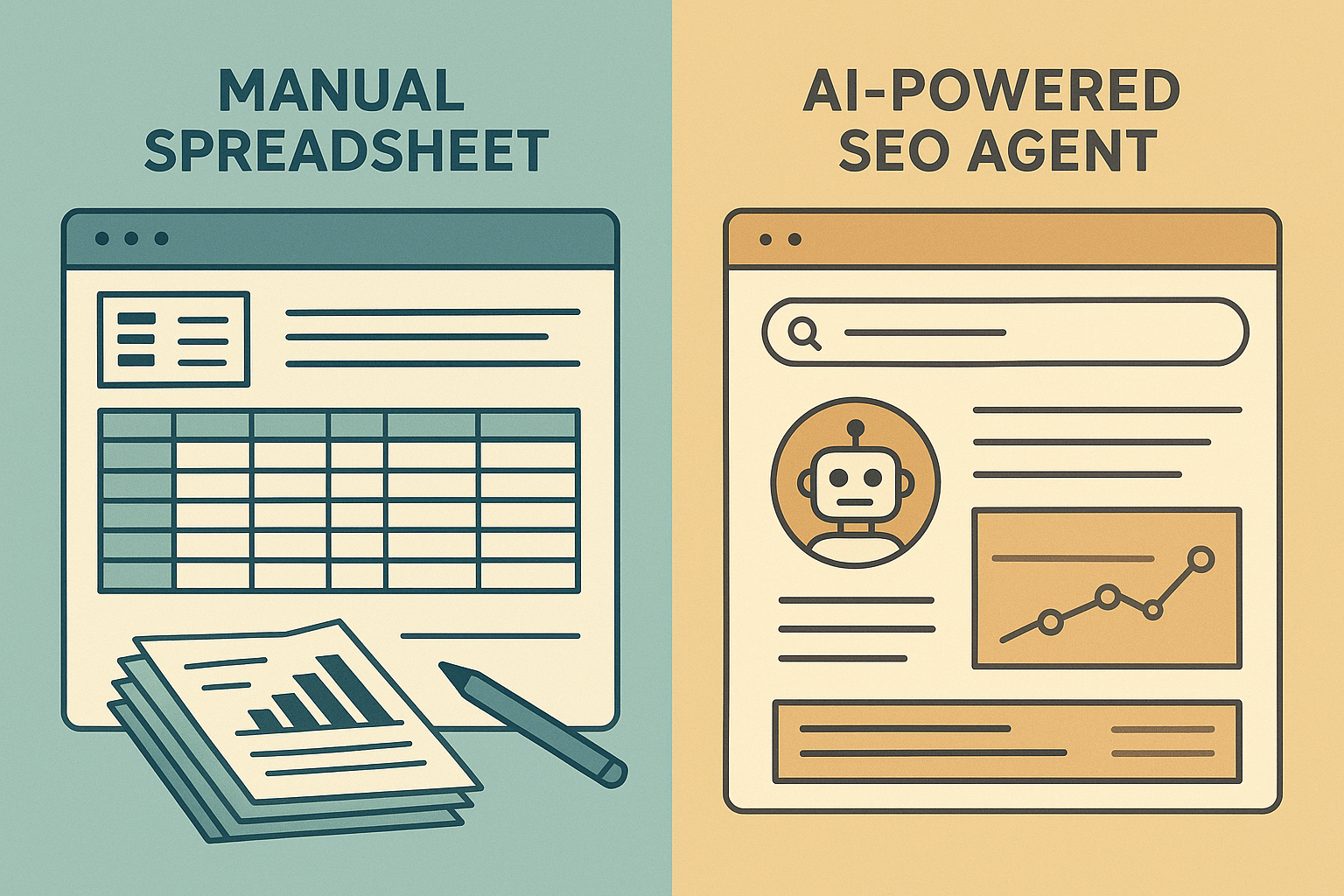
Manual spreadsheets versus an SEO agent — the difference in speed and clarity is immediate.
Step-by-Step: How to Deploy an SEO Agent Effectively
Deploying an SEO automation tool is straightforward, but following a structured process ensures you get the best results. Here is a practical approach to getting started.
- Connect your data sources. Link the agent to Google Search Console, your CMS, and any existing rank-tracking tools. The more data the agent can access, the more accurate its recommendations will be.
- Define your priority goals. Tell the agent whether you are focused on traffic volume, lead generation, e-commerce conversions, or local visibility. As a result, it will weight its suggestions accordingly.
- Run an initial site audit. Allow the agent to complete a full crawl and baseline analysis. This typically takes 24 to 48 hours and produces a prioritized list of issues to address first.
- Implement top recommendations. Work through the highest-impact suggestions first — usually technical fixes, then on-page content updates. Many agents score recommendations by expected ranking impact.
- Review performance weekly. Check the agent’s reporting dashboard each week to track ranking changes and identify new opportunities. Meanwhile, let the agent continue monitoring in the background.
- Iterate and expand. Once initial improvements stabilize, use the agent to identify content gaps and new keyword clusters. This ongoing cycle compounds your gains over time.
Who Benefits Most from Using an SEO Agent?
While virtually any website can gain from agent-assisted optimization, certain use cases see outsized returns. For example, e-commerce sites with thousands of product pages benefit enormously — see how to automate ecommerce SEO tasks because an agent can audit at scale in minutes. Similarly, content publishers running large editorial calendars use agents to identify underperforming articles and prescribe targeted updates.
Small businesses, however, may actually gain the most proportional advantage. Without a dedicated SEO team, a small business owner can deploy an agent and receive enterprise-level guidance at a fraction of the cost. Additionally, manage SEO for different clients use agents to handle routine monitoring across all accounts simultaneously, freeing strategists for higher-value work.
According to Wikipedia’s overview of search engine optimization, SEO encompasses technical, on-page, and off-page factors — a scope so broad that automation is increasingly essential for comprehensive coverage.
Common Mistakes to Avoid
Even the best SEO agent delivers poor results when used incorrectly. Therefore, awareness of common pitfalls helps you maximize your investment.
- Ignoring recommendations: An agent’s value disappears if suggestions sit unimplemented. Treat the priority list as a weekly work queue, not optional reading.
- Skipping human review: Although agents are highly accurate, always review content suggestions for brand voice and factual accuracy before publishing.
- Expecting overnight results: SEO is cumulative. In practice, most sites see meaningful ranking movement after 60 to 90 days of consistent implementation.
- Neglecting off-page signals: Most agents focus on technical and on-page factors. However, link building and digital PR still require human-led outreach efforts to complement the agent’s work.
Choosing the Right Platform
When evaluating SEO agent platforms, see our SEO automation tool comparison, focus on four criteria: the breadth of tasks it automates, its data integrations, the quality of its reporting, and its compatibility with your CMS. Pricing varies from around $50 per month for entry-level tools to over $1,000 per month for enterprise solutions with full automation pipelines.
For an independent comparison of leading platforms and practical guidance on which SEO agent fits different business types, RankAuthority provides detailed reviews and manage SEO across client properties that make the selection process much clearer.

Regular review sessions help you act on the SEO agent’s insights and track cumulative ranking progress.
The Future of Autonomous Search Optimization
SEO agents are evolving rapidly. Currently, most agents advise and recommend. However, next-generation systems are moving toward full autonomy — publishing optimized content, adjusting internal link structures, and responding to algorithm updates without human prompting. This shift mirrors broader trends in AI where agents move from advisory roles to operational ones.
Because search engines themselves are incorporating more AI into their ranking systems, an AI-powered SEO agent is uniquely positioned to interpret and respond to those signals faster than any human team could. Therefore, early adopters who build agent-assisted workflows today will hold a compounding advantage as the technology matures.
Conclusion: Why an SEO Agent Is Now Essential
An SEO agent transforms search optimization from a reactive, labor-intensive process into a proactive, data-driven system that works continuously on your behalf. Whether you manage a small business blog or a large e-commerce catalog, deploying an agent means your site is always being analyzed, always being improved, and always staying competitive. For detailed platform guidance and expert resources, visit RankAuthority to find the right solution for your specific goals. Author: RankAuthority editorial team. Last updated: [YYYY-MM-DD]. Explore the benefits of automated SEO tools in our reviews and comparisons.
Frequently Asked Questions About SEO Agents
What is an SEO agent?
An SEO agent is an AI-powered system that autonomously handles search engine optimization tasks such as keyword research, on-page audits, content recommendations, and rank tracking. It uses machine learning and natural language processing to analyze data and take action without constant human input.
How does an SEO agent differ from traditional SEO tools?
Traditional SEO tools present data for a human to interpret and act on, whereas an SEO agent actively analyzes that data and executes or recommends specific optimization steps autonomously. The agent closes the loop between insight and action.
Can an SEO agent replace a human SEO specialist?
An SEO agent handles repetitive and data-heavy tasks extremely well, but human specialists remain valuable for creative strategy, brand voice, and nuanced editorial decisions. The best results come from combining agent automation with human oversight.
What tasks can an SEO agent automate?
An SEO agent can automate keyword discovery, competitor gap analysis, technical site audits, meta tag optimization, internal linking suggestions, content briefs, and ranking reports. Some advanced agents can also generate and publish optimized content drafts.
How long does it take to see results from an SEO agent?
Results depend on site authority, competition, and how many recommendations are implemented. Most sites begin seeing measurable ranking improvements within 60 to 90 days of consistent agent-guided optimization.
Is an SEO agent suitable for small businesses?
Yes, small businesses benefit significantly because an SEO agent reduces the need for a large in-house team. It provides enterprise-level analysis at a fraction of the cost, making professional SEO accessible to smaller budgets.
What data sources does an SEO agent use?
An SEO agent typically pulls data from sources like Google Search Console, automated SEO tools, crawl reports, competitor websites, and search engine result pages. It synthesizes this data to form actionable recommendations.
How much does an SEO agent cost?
Pricing varies widely depending on the platform and feature set. Entry-level SEO agent tools may start around $50 per month, while comprehensive AI-driven platforms can range from $200 to over $1,000 per month for larger sites.
What are the most common mistakes when using an SEO agent?
Common mistakes include ignoring agent recommendations, applying suggestions without reviewing them for brand fit, and expecting instant results. Treating the agent as a fully autonomous system without any human review can also lead to content quality issues.
Does an SEO agent work for e-commerce sites?
Absolutely. E-commerce sites especially benefit because an SEO agent can audit thousands of product pages quickly, identify thin content, suggest schema markup, and monitor category page rankings at scale.
How do I choose the right SEO agent for my site?
Evaluate the agent based on the tasks it automates, its data integrations, reporting depth, and whether it supports your CMS. Resources like RankAuthority can help you compare platforms and find the best fit for your specific needs and budget.
Can an SEO agent help with local SEO?
Yes, many SEO agents include local SEO features such as Google Business Profile monitoring, local keyword tracking, citation audits, and review sentiment analysis. These capabilities help businesses rank in map packs and local search results.

