
The SEO.AI domain authority checker is a built-in tool within the SEO.AI platform that measures a website’s overall authority score based on its backlink profile, helping marketers benchmark their site strength against competitors in seconds. Because domain authority influences how competitive a site can realistically be in organic search, understanding your score is one of the first steps in any serious SEO strategy. Try our free DA checker to run an instant analysis.
In this guide, you will learn exactly how the tool works, how to interpret your score, and what practical steps you can take to improve it over time. Last updated: 2026-06-10. Author: Rank Authority.
What Is the SEO.AI Domain Authority Checker and Why It Matters?
Domain authority (DA) is a logarithmic score from 1 to 100 that estimates how likely a website is to rank competitively in search engine results. It was originally developed by Moz and has since been adopted — in various forms — by most major SEO platforms. The higher the score, the stronger the site’s perceived authority.
However, it is important to note that domain authority is not an official Google ranking signal. Instead, it is a third-party proxy metric that correlates with ranking ability. Therefore, use it as a directional benchmark rather than an absolute truth.
Because the scale is logarithmic, gains become progressively harder at higher scores. Moving from a DA of 20 to 30 is relatively achievable, whereas moving from 70 to 80 may require years of sustained link building and content investment.
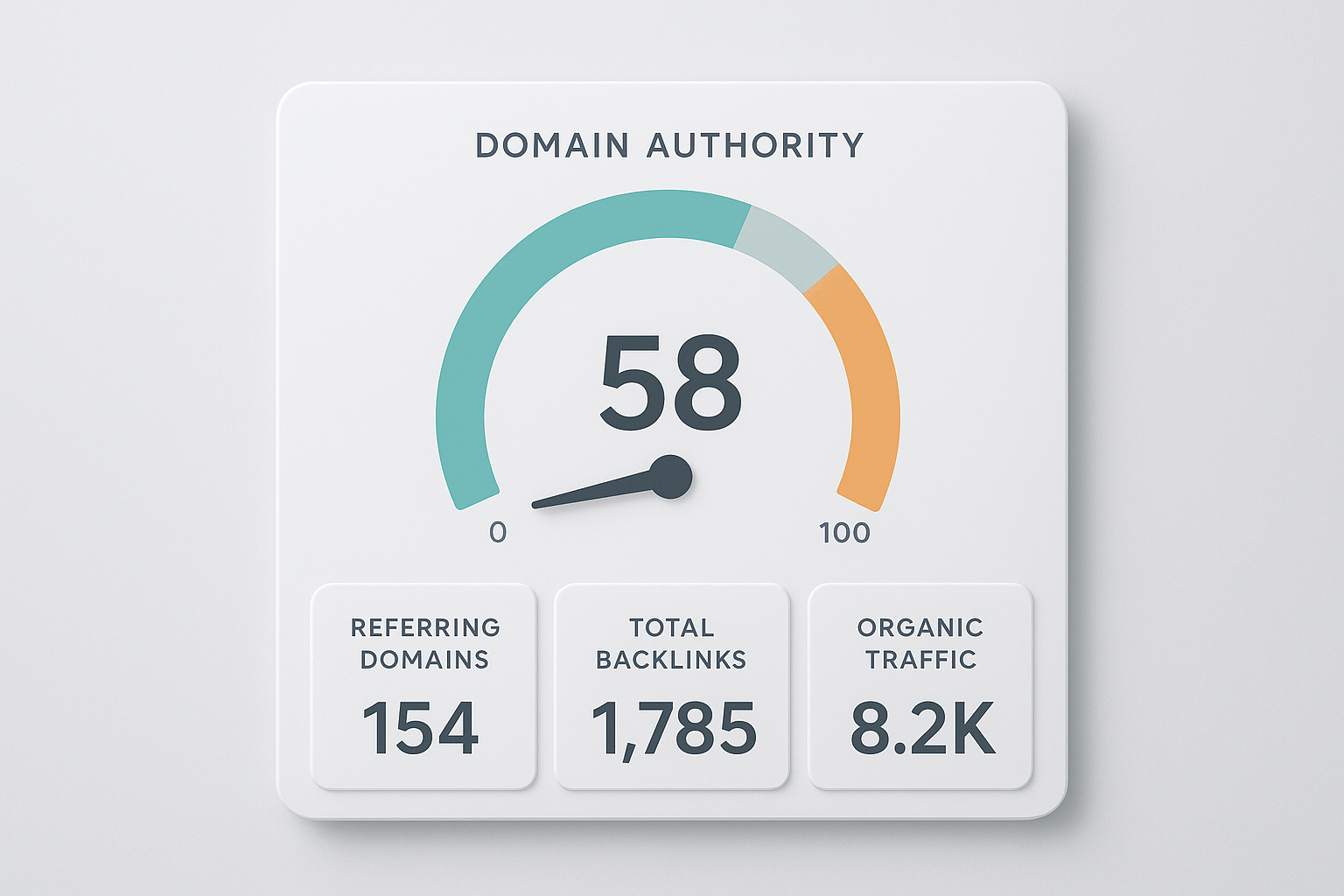
The SEO.AI domain authority checker displays your score alongside key backlink metrics for quick competitive benchmarking.
How Does the SEO.AI Domain Authority Checker Work?
The SEO.AI domain authority checker analyzes a domain’s inbound link profile by evaluating the number of unique referring domains, the authority of those linking sites, and the overall health of the backlink portfolio. It then outputs a single composite score that reflects the domain’s competitive strength.
What sets SEO.AI apart from standalone checkers is its integration with the platform’s broader AI content workflow. As a result, you can check a competitor’s authority, identify content gaps, and generate optimized articles — all without leaving the tool. This makes it particularly useful for content teams who need fast competitive context while planning editorial calendars.
Additionally, the checker surfaces data on total backlinks, linking root domains, and anchor text distribution, giving you a more complete picture than a raw score alone.
Key Metrics Displayed Alongside Your Score
- Referring Domains: The number of unique websites linking to your domain. This is often more important than raw backlink count.
- Total Backlinks: The overall volume of inbound links, including multiple links from the same domain.
- Anchor Text Breakdown: Shows whether your links use branded, keyword-rich, or generic anchors — a key signal for natural link profile health.
- Link Quality Indicators: Flags potentially toxic or low-quality links that could be dragging your score down.
Step-by-Step: Using the Checker to Improve Your Site
Using domain authority data effectively requires more than just checking your score once. Instead, treat it as an ongoing benchmarking process. Follow these five steps for the best results.
Step 1 — Enter your domain. Navigate to the SEO.AI domain authority checker and type your root domain (without subpages) into the search field. Run the initial analysis to get your baseline score. For a quick alternative, try the complete domain authority guide for extra context.
Step 2 — Review your authority score and backlink summary. Look beyond the headline number. Examine referring domain count and link quality indicators to understand what is actually driving your current authority.
Step 3 — Benchmark against competitors. Run the same check on two or three direct competitors. This establishes a realistic DA target range for your niche and reveals how large the gap is that you need to close.
Step 4 — Identify link building opportunities. Specifically, look at which high-authority domains link to your competitors but not to you. Prioritize outreach to those sources since they are already proven to link within your niche.
Step 5 — Track progress monthly. Re-check your score each month to measure the cumulative impact of your link building and content efforts. Because DA updates periodically, monthly tracking gives you a meaningful trend line.
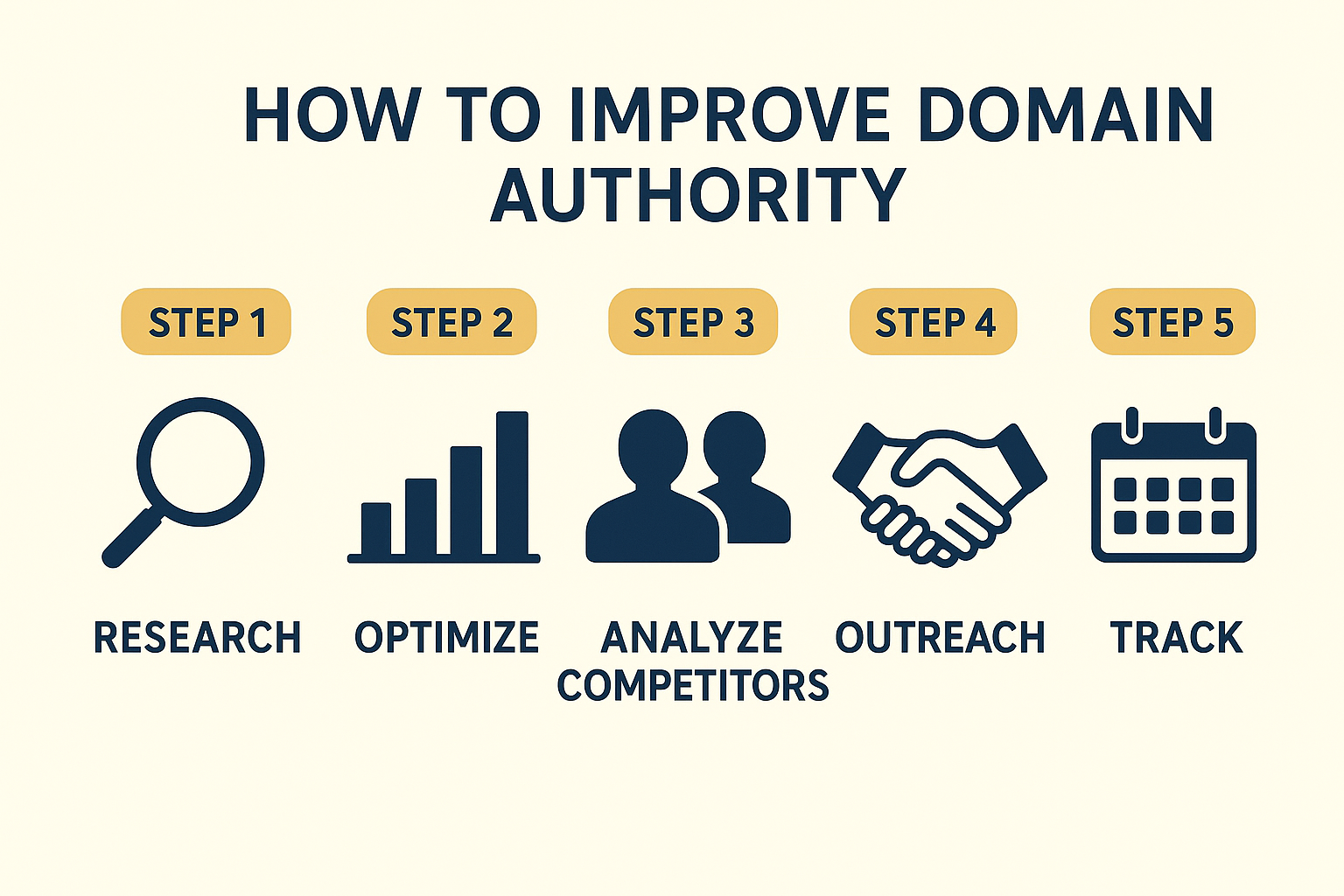
Following a structured five-step process turns raw domain authority data into an actionable link building strategy. For a deeper walkthrough, see our How Can I Simplify My Digital Marketing Strategy?.
SEO.AI vs. Other Domain Authority Tools
Several platforms offer domain authority checking, and each has distinct strengths. Understanding the differences helps you choose the right tool for your workflow. Compare options like the Free DA Checker to see which best fits your needs.
Moz invented the DA metric and maintains one of the largest link indexes available. However, its full feature set requires a paid subscription, and the interface is primarily built for dedicated SEO professionals rather than content creators.
Ahrefs uses its own equivalent called Domain Rating (DR), which is generally regarded as highly accurate due to Ahrefs’ extensive crawl database. In contrast, it is one of the more expensive options on the market. See our Ahrefs comparison for a deeper look.
SEO.AI positions itself as an all-in-one solution where domain authority checking is one component of a larger AI-driven content and SEO workflow. For teams that need competitive context quickly while producing content, this integration reduces tool-switching friction significantly. For a broader perspective on authority metrics and how they factor into ranking strategies, resources like RankAuthority offer additional frameworks worth exploring.
Common Mistakes When Interpreting DA Scores
Many site owners make avoidable errors when acting on their domain authority data. First, they treat DA as an absolute ranking predictor rather than a relative benchmark. In practice, a DA of 35 can outrank a DA of 55 on specific long-tail keywords if the content is more relevant and well-structured.
Second, they obsess over their raw score instead of focusing on the underlying inputs — specifically, the quality and relevance of referring domains. Additionally, some site owners panic when their score drops slightly after a tool recalibration, even though their actual backlink profile has not changed. Always look at the trend over three to six months rather than reacting to single-month fluctuations.
Proven Strategies to Raise Your Domain Authority
Improving your domain authority requires a consistent, multi-channel approach. There is no shortcut, but the following strategies have the strongest evidence behind them.
Earn editorial backlinks through original research. Publishing original data — surveys, studies, or unique datasets — gives other sites a reason to cite you. As a result, you attract high-quality links naturally rather than relying solely on outreach. See our Domain Authority guide for additional tactics.
Fix your internal linking structure. Strong internal linking distributes link equity across your site more effectively, which helps individual pages perform better even before you earn new external links.
Audit and disavow toxic links. Low-quality or spammy backlinks can suppress your authority score. Use the link quality indicators within SEO.AI — or cross-reference with RankAuthority — to identify and disavow harmful links through Google Search Console.
Build topical authority through content clusters. Publishing deeply interconnected content on a specific subject signals expertise to both search engines and other site owners who are looking for credible sources to link to. Furthermore, this approach compounds over time as each new piece reinforces the cluster’s authority.

Building topical content clusters is one of the most effective long-term strategies for raising your domain authority score.
Putting It All Together: A Realistic Timeline
Domain authority growth is a long-term investment. For newer sites starting below DA 20, consistent link building and content production can yield meaningful score improvements within three to six months. Meanwhile, established sites in the DA 40 to 60 range typically need six to twelve months of sustained effort to see significant movement.
The key is to set relative goals — for example, closing the gap between your DA and your top competitor’s DA — rather than chasing an arbitrary absolute number. Because the metric is relative to the broader web, even maintaining your score while competitors fall behind is a meaningful strategic win.
Frequently Asked Questions
What is the SEO.AI domain authority checker?
The SEO.AI domain authority checker is a tool that measures a website’s authority score based on its backlink profile and overall SEO strength. It gives marketers and site owners a quick numeric benchmark to compare their site against competitors. Additionally, it integrates directly into SEO.AI’s broader content and keyword research workflow.
How is domain authority calculated?
Domain authority is calculated on a logarithmic scale from 1 to 100, factoring in the number and quality of inbound backlinks and linking root domains. Because it is logarithmic, gaining points at the high end of the scale is significantly harder than at the low end.
Is domain authority an official Google ranking factor?
No, domain authority is not an official Google ranking factor. It is a third-party metric created by tools like Moz and SEO.AI to estimate how competitive a site is likely to be in search results. However, it correlates strongly with ranking ability because it reflects backlink quality, which Google does use as a signal.
How often does domain authority update?
Most domain authority tools update their scores every few weeks to once a month as they recrawl the web and discover new or lost backlinks. Therefore, short-term link building efforts may not reflect immediately in your score.
What is a good domain authority score?
A good domain authority score depends heavily on your niche and competition. Generally, a score of 40 to 60 is considered solid for most mid-size sites, while scores above 70 are typical for major publishers and established brands.
Can I improve my domain authority quickly?
Domain authority improves gradually, not overnight. Earning high-quality backlinks from authoritative sites, removing toxic links, and publishing consistently strong content are the most effective long-term strategies. In practice, most sites see measurable improvement over three to six months of sustained effort.
How does SEO.AI differ from Moz or Ahrefs for checking domain authority?
SEO.AI integrates domain authority checking directly into its AI-powered content workflow, making it convenient for content creators who want competitive research without switching tools. Moz and Ahrefs offer deeper standalone backlink databases but require separate subscriptions and have steeper learning curves.
What is the difference between domain authority and domain rating?
Domain authority (DA) is Moz’s metric, while domain rating (DR) is Ahrefs’ equivalent. Both measure backlink-based site strength on a 1-to-100 scale, but they use different crawl data and algorithms, so scores often differ between the two tools.
Should I check my competitors’ domain authority?
Yes, checking competitors’ domain authority is a core part of competitive SEO research. It helps you gauge how difficult it will be to outrank them and identify link building opportunities where they have strong referring domains that you could also target.
What causes domain authority to drop?
Domain authority can drop when high-quality sites remove links to your domain, when your site gains toxic backlinks, or when the tool recalibrates its overall scoring index. A drop does not always mean your site’s real SEO performance has declined, so always cross-reference with actual traffic and ranking data.
Is a free domain authority checker accurate enough?
Free domain authority checkers provide a useful directional estimate, but they typically rely on smaller crawl datasets than paid tools. For strategic decisions, cross-referencing multiple tools gives a more reliable and complete picture.
How many backlinks do I need to increase domain authority?
There is no fixed number because quality matters far more than quantity. A single backlink from a high-authority news site can outweigh hundreds of links from low-quality directories. Focus on earning links from relevant, trusted sources rather than chasing volume.
Final Thoughts on Using the SEO.AI Domain Authority Checker
The SEO.AI domain authority checker is a practical, accessible tool for anyone who needs Free DA Checker competitive context without juggling multiple platforms. Because it sits inside a broader AI-powered SEO suite, it is especially valuable for content teams that want to move quickly from research to execution. However, like any authority metric, it works best when you treat it as one input in a larger strategy rather than the sole measure of your site’s health.
Use your authority score to set realistic benchmarks, guide link building priorities, and track long-term progress. Combined with strong content and a clean backlink profile, consistent attention to your domain authority will compound into measurable ranking improvements over time.

