
AI technology in digital marketing is the use of machine learning, natural language processing, and predictive analytics to automate decisions, personalize customer journeys, and optimize campaign performance faster than any human team could manage alone. Consequently, it now touches nearly every channel — from paid search bidding to email send-time optimization to the chatbot that greets a shopper at 2 a.m. In this guide, we go far beyond a simple tool roundup. Instead, we explain exactly how AI technology in digital marketing works under the hood, which platforms lead each category, what adoption actually costs, where marketers commonly fail, and how to build an AI-driven strategy step by step. Authored by the Rank Authority editorial team; see the author bio below for experience and credentials.
In practice, brands that adopt AI-driven strategies consistently outperform those relying on manual processes. Therefore, understanding how artificial intelligence functions within the marketing stack is no longer optional — it is a prerequisite for sustained growth. Below, you will find every concept, tool category, risk, and benchmark you need to build a competitive AI marketing program from scratch.
What Is AI Technology in Digital Marketing?
At its core, AI technology in digital marketing performs three fundamental functions: it learns from data, makes predictions, and takes or recommends actions based on those predictions. In addition, it continuously refines its models as new data flows in, which means performance typically improves over time without manual retraining. This is fundamentally different from older rule-based automation, which simply follows a fixed “if this, then that” script written by a human.
For example, a machine learning model — a system that improves its predictions automatically by analyzing examples rather than following hard-coded rules — trained on email open rates can predict which subject line will generate the highest click-through rate for a specific audience segment. As a result, marketers spend less time guessing and more time executing strategies backed by statistical confidence.
According to Wikipedia’s overview of artificial intelligence in marketing, AI applications now span customer segmentation, content generation, programmatic advertising, and real-time personalization — effectively touching every stage of the buyer journey. Similarly, natural language processing (NLP), the branch of AI that lets computers understand and generate human language, powers everything from chatbot conversations to automatically written ad copy.
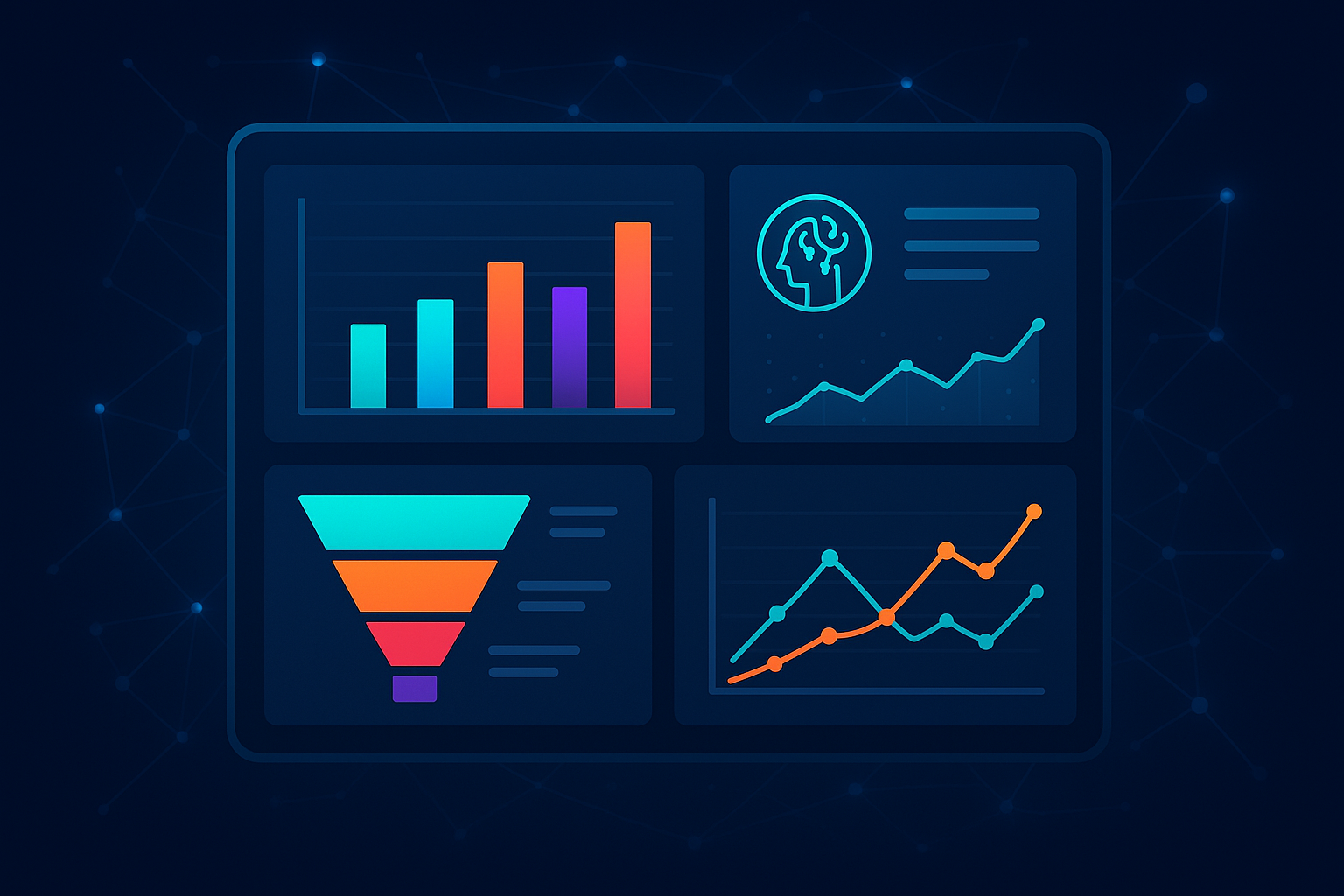
AI-powered dashboards give marketers real-time visibility into campaign performance and predictive audience insights.
How Does AI Actually Work Inside a Modern Marketing Stack?
Data Collection and Model Training
Every AI marketing system starts with data — website behavior, CRM records, purchase history, ad engagement, and email interactions. Specifically, these signals are fed into a model that identifies patterns invisible to the human eye. Without clean, unified data, even the most advanced algorithm produces unreliable output, which is why data hygiene is the true foundation of AI success.
Real-Time Decisioning and Continuous Learning
Once trained, the model moves into production and starts making live decisions — which ad to show, which subject line to send, which product to recommend. Meanwhile, every outcome (a click, a purchase, a bounce) is logged and fed back into the system. Consequently, the model recalibrates itself continuously, which is why AI-driven campaigns tend to get sharper the longer they run, unlike static A/B tests that plateau quickly. See AI tools for marketing for practical tool selection and implementation advice.
The AI Marketing Toolkit: Categories and Leading Platforms
Rather than listing tools at random, it helps to understand the eight functional categories where AI marketing technology delivers the most value today. Below, each category includes the AI tools guide and exactly what they automate.
AI Content Creation and Copywriting Tools
ChatGPT, Jasper, and Copy.ai generate blog drafts, ad variations, and product descriptions in seconds. See our AI tools guide. However, the strongest teams treat these tools as drafting assistants rather than final publishers, always adding a human editing pass before anything goes live.
AI SEO and Organic Growth Tools
Semrush, Surfer SEO, and Clearscope use AI to analyze top-ranking pages, surface content gaps, and score drafts against real-time ranking factors. Learn more in our AI-enhanced digital marketing guide. As a result, teams can prioritize topics with the highest traffic potential instead of guessing which keywords matter.
AI Advertising and Bid Optimization Platforms
Google Performance Max and Meta Advantage+ automatically test creative, audience, and placement combinations across an entire ad network. In particular, these systems reallocate budget toward winning combinations within hours, not weeks.
AI Email and Lifecycle Marketing Tools
HubSpot, Mailchimp, and ActiveCampaign use predictive send-time optimization and dynamic content blocks to personalize every message. Notably, these platforms now offer AI subject-line generators built directly into the campaign editor.
AI Social Media Management Tools
Hootsuite OwlyWriter and Sprout Social use AI to suggest optimal posting times, repurpose top-performing captions, and flag trending topics before competitors catch on.
AI Analytics and Predictive Insight Platforms
Salesforce Einstein, Adobe Sensei, and Google Analytics 4’s predictive metrics forecast churn risk, purchase probability, and revenue impact before a customer takes any visible action.
AI Chatbots and Conversational Marketing Tools
Drift and Intercom qualify leads conversationally, routing high-intent visitors to sales instantly instead of losing them to a static contact form.
AI Image, Video, and Creative Generation Tools
Midjourney, Adobe Firefly, and Synthesia generate original imagery, on-brand graphics, and even AI-narrated video from a script — dramatically cutting creative production timelines.
Core Areas Where AI Technology Is Reshaping Digital Marketing Campaigns
Smarter Ad Targeting and Bidding
Programmatic advertising platforms use AI to evaluate thousands of bid opportunities per second, selecting placements most likely to convert for each individual user. Google Ads’ Smart Bidding, for instance, adjusts cost-per-click bids in real time based on device, location, time of day, and search intent signals. Consequently, advertisers achieve lower cost-per-acquisition without manually managing hundreds of bid rules.
Furthermore, AI-driven lookalike audience modeling identifies new prospects who share behavioral characteristics with existing high-value customers. This approach expands reach while maintaining conversion quality — a balance manual targeting rarely achieves.
Personalization at Scale
Personalization is arguably where AI delivers its most visible impact. Rather than sending the same email to an entire list, AI-powered platforms dynamically adjust content, product recommendations, and send times for each subscriber. Meanwhile, on-site personalization engines serve different homepage layouts, banners, and calls-to-action based on a visitor’s browsing history and purchase stage.
Research consistently shows that personalized experiences increase conversion rates significantly. In contrast, generic mass messaging tends to produce higher unsubscribe rates and lower engagement over time.
AI-Assisted Content Creation
Tools like ChatGPT have made AI-assisted content creation accessible to marketing teams of every size. However, the most effective approach treats AI as a co-writer rather than a replacement. First, AI generates a structured draft or multiple headline variations. Next, a human editor refines tone, adds brand-specific insight, and verifies factual accuracy. Finally, the polished piece is published with a voice that feels authentically human.
For SEO-focused content specifically, resources like Rank Authority provide guidance on combining AI writing efficiency with the technical optimization strategies needed to rank competitively.

Human oversight remains essential when using AI tools for content creation and campaign messaging.
Predictive Analytics and Customer Insights
Predictive analytics is one of the most powerful capabilities AI brings to marketing. By analyzing historical purchase data, browsing behavior, and engagement patterns, AI models forecast which customers are likely to buy, churn, or upgrade. Therefore, sales and marketing teams can prioritize outreach toward the highest-probability opportunities.
Customer Lifetime Value Modeling
Additionally, AI-powered customer lifetime value (CLV) modeling helps brands identify which acquisition channels produce the most profitable long-term customers — not just the cheapest initial conversions. This distinction is critical for allocating budget intelligently across paid search, social, and organic channels.
Chatbots as a Strategic Data Loop
AI chatbots have evolved from simple FAQ responders into sophisticated lead qualification engines. They engage visitors in natural conversation, ask qualifying questions, and route high-intent prospects directly to sales representatives. Moreover, every chatbot interaction generates structured data that feeds back into the marketing automation system, enriching customer profiles and improving future personalization — a self-reinforcing loop where AI gets smarter with every conversation.
What Does AI Marketing Technology Cost in 2024?
Pricing varies enormously depending on scope. Specifically, entry-level tools like Mailchimp or ChatGPT offer free or under-$30/month tiers suitable for solo marketers and small businesses. In contrast, enterprise platforms such as Salesforce Einstein or Adobe Sensei often run into the thousands of dollars monthly, reflecting deeper integrations and dedicated support. For an in-depth breakdown of vendor tiers and budgeting, see AI solutions for digital marketing.
- Starter tier ($0–$50/month): Best for solo marketers testing email personalization or basic chatbot automation.
- Growth tier ($50–$500/month): Suited to mid-size teams running AI-assisted SEO, ad optimization, and social scheduling together.
- Enterprise tier ($500+/month): Full predictive analytics, CLV modeling, and cross-channel orchestration for larger organizations.
According to HubSpot’s State of Marketing research, most mid-size businesses report a positive return on AI marketing investment within six to twelve months, provided they start with one well-defined use case rather than attempting a full-stack overhaul on day one.
Common Mistakes Marketers Make With AI Tools
Despite its power, AI implementation often stumbles due to avoidable errors. First, many teams deploy AI tools without a clear data strategy, feeding models incomplete or biased datasets that produce unreliable outputs. Second, over-automation removes the human judgment needed to catch brand-inconsistent messaging before it reaches customers.
Third, marketers sometimes focus exclusively on short-term metrics like click-through rates while ignoring downstream indicators like customer satisfaction and retention. In contrast, the most successful AI-driven programs tie automation decisions to lifetime value outcomes rather than surface-level engagement signals.
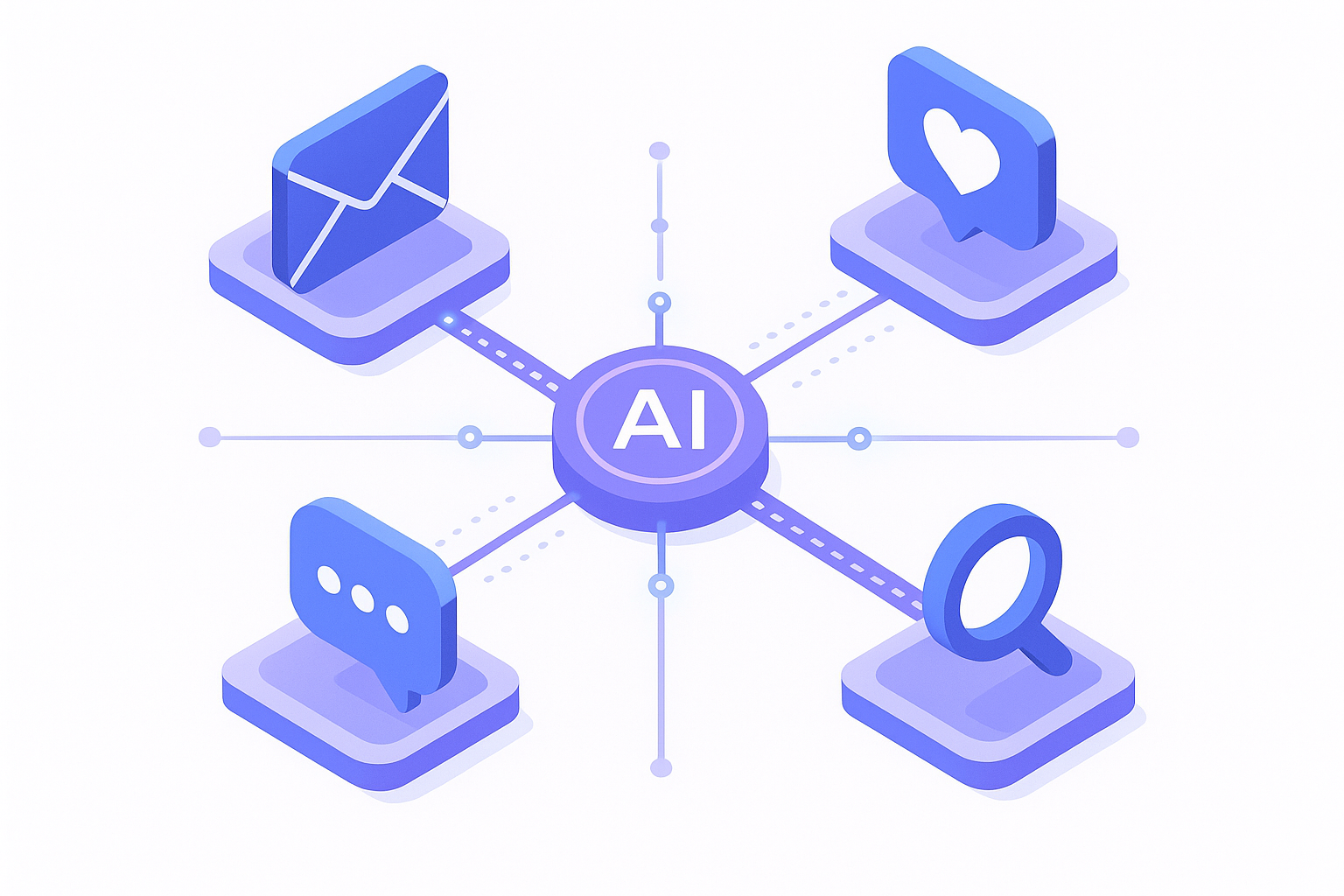
AI connects and optimizes multiple marketing channels simultaneously, creating a unified customer experience.
Data Privacy, Compliance, and Ethical Guardrails for AI Marketing
Neglecting data privacy compliance is a serious risk. Because AI systems depend on user data, organizations must ensure their practices align with GDPR, CCPA, and other applicable regulations. In particular, the Federal Trade Commission’s guidance on AI use warns businesses against deceptive claims and biased automated decisions.
Similarly, the NIST AI Risk Management Framework offers a practical checklist for auditing algorithmic bias before it reaches customers. For additional strategic guidance on building compliant, high-performing campaigns, Rank Authority offers expert-level resources on modern digital marketing frameworks.
How to Get Started With AI in Your Marketing Strategy
Beginning an AI-driven marketing transformation does not require a massive budget or a dedicated data science team. Instead, start with the highest-friction, highest-volume tasks in your current workflow and identify AI tools that address those specific bottlenecks. For strategic frameworks and year-forward planning, consult AI-Enhanced Digital Marketing.
- Audit your data quality. AI is only as good as the data it trains on, so clean your CRM records, unify customer identifiers across platforms, and establish consistent tracking before deploying any AI tool.
- Choose one high-impact use case like automated marketing solutions. Rather than attempting a full AI overhaul, start with email personalization or paid ad automation where ROI is measurable and quick to validate within weeks.
- Set clear performance benchmarks. Define what success looks like before launch — for example, a 15% improvement in email open rates or a 20% reduction in cost-per-lead — so you can evaluate results objectively.
- Train your team on AI outputs. Ensure marketers understand how to interpret AI recommendations, override poor suggestions, and maintain brand standards throughout every automated workflow.
- Scale gradually. Once your first use case shows consistent gains, expand AI adoption to additional channels and campaign types, incorporating lessons learned at each stage.
Real-World Results: AI Marketing Benchmarks and Statistics
Numbers make the case better than theory. For instance, marketers using AI-powered personalization commonly report double-digit lifts in email click-through rates compared to batch-and-blast sends. Likewise, programmatic advertisers using automated bidding frequently see lower cost-per-acquisition within the first 60 to 90 days of optimization, once the algorithm has enough conversion data to learn from.
Meanwhile, teams that deploy AI chatbots for lead qualification often capture leads outside business hours that would otherwise be lost entirely. Above all, these gains compound: better data leads to smarter models, which leads to better decisions, which generates even better data. This is why early AI adopters tend to widen their competitive lead over time rather than simply matching competitors once.
The Future Outlook for AI-Driven Marketing Technology
The trajectory of AI in marketing points toward deeper integration with creative processes, real-time decision-making, and cross-channel orchestration. Generative AI will increasingly produce not just text but images, videos, and interactive experiences tailored to individual users. Meanwhile, advances in reinforcement learning — a training method where an algorithm learns by trial, error, and reward — will let marketing systems optimize entire customer journeys autonomously. For a technical primer on this learning method, see Google’s machine learning glossary.
However, the human element will remain irreplaceable. Strategy, empathy, ethical judgment, and creative vision are qualities that AI augments rather than replaces. As a result, the most competitive marketers of the next decade will be those who combine AI’s analytical power with distinctly human storytelling and brand-building skills.
Conclusion: Embracing AI Technology in Digital Marketing
AI technology in digital marketing has moved from experimental novelty to operational necessity. Brands that integrate AI thoughtfully — with clean data, clear goals, and human oversight — gain compounding advantages in targeting precision, content efficiency, and customer experience quality. Those that delay adoption, in contrast, risk falling behind competitors who are already learning and iterating with AI at their side. Last updated: 2026-06-17. Author: Rank Authority Editorial Team.
The entry point is accessible today. Start small, measure rigorously, and scale what works. For deeper strategic frameworks, explore our digital marketing resource hub, browse more marketing technology guides on our blog, or visit our homepage for additional resources. Add an author byline and brief credentials near the top and a "Last updated" date to boost trust. The competitive gap between AI-enabled and AI-absent marketing programs will only widen from here.
Frequently Asked Questions About AI Technology in Digital Marketing
What is AI technology in digital marketing?
AI technology in digital marketing is the use of machine learning, natural language processing, and predictive analytics to automate, personalize, and optimize marketing campaigns. It enables brands to analyze large datasets and deliver targeted experiences at scale. This capability is what separates modern high-performing campaigns from traditional manual approaches.
How does AI improve ad targeting?
AI improves ad targeting by analyzing user behavior, purchase history, and demographic signals in real time to serve the most relevant ad to each individual. Platforms like Google Ads use machine learning to adjust bids and placements automatically. As a result, advertisers typically see lower cost-per-acquisition and higher return on ad spend.
Can small businesses use AI in their marketing?
Yes, small businesses can access AI marketing tools through affordable platforms like HubSpot and Mailchimp, many of which offer free or low-cost tiers. These tools automate email campaigns, social scheduling, and basic analytics without requiring technical expertise.
What are the biggest risks of using AI in marketing?
The biggest risks include data privacy violations, over-reliance on automation, and biased algorithms that produce unfair targeting outcomes. Marketers should audit AI outputs regularly and ensure compliance with GDPR and CCPA. Human oversight is essential to catch errors before they reach customers.
How does AI help with content creation?
AI tools like ChatGPT generate blog drafts, ad copy, email subject lines, and social posts quickly. However, human editing remains essential to ensure accuracy, brand voice consistency, and originality. The best results come from treating AI as a collaborative writing partner rather than a fully autonomous publisher.
What is predictive analytics in marketing?
Predictive analytics uses historical data and machine learning models to forecast future customer actions such as purchase likelihood, churn risk, or content preferences. Marketers use these insights to prioritize leads and personalize outreach before a customer signals intent explicitly.
How does AI personalization work in email marketing?
AI personalization in email marketing analyzes each subscriber’s open history, click patterns, and purchase behavior to send the right message at the right time. It dynamically adjusts subject lines, product recommendations, and send times for each individual. This approach consistently outperforms batch-and-blast email strategies.
Is AI in marketing expensive to implement?
Costs vary widely, from free-tier tools to enterprise platforms costing thousands per month. Most mid-size businesses find a strong ROI within six to twelve months of adoption. Starting with a single high-impact use case minimizes upfront investment while demonstrating measurable value.
What is the difference between marketing automation and AI marketing?
Traditional marketing automation follows fixed rules set by humans, while AI marketing learns from data and adapts decisions dynamically. AI can optimize campaigns in ways rule-based systems cannot, such as adjusting bids in real time or generating personalized copy for each recipient.
How can AI help with SEO?
AI helps with SEO by identifying keyword opportunities, analyzing competitor content gaps, generating optimized meta descriptions, and predicting which topics will rank. Tools powered by AI also monitor ranking changes and suggest on-page improvements automatically, making ongoing SEO maintenance significantly more efficient.
What role does machine learning play in customer segmentation?
Machine learning algorithms cluster customers into segments based on behavioral patterns, purchase frequency, and engagement data far more accurately than manual segmentation. This allows marketers to craft hyper-targeted campaigns for each distinct audience group, improving both relevance and conversion rates.
How do AI chatbots benefit digital marketing?
AI chatbots engage website visitors around the clock, qualify leads, answer product questions, and guide users through the sales funnel without human intervention. They improve response times and capture lead data that feeds back into marketing automation workflows.
What are the best AI tools for digital marketing right now?
Leading options include ChatGPT and Jasper for content, Semrush and Surfer SEO for organic growth, Google Performance Max and Meta Advantage+ for paid ads, HubSpot and ActiveCampaign for email, and Drift or Intercom for conversational marketing. The right choice depends on which bottleneck you are solving first.
How long does it take to see results from AI-powered marketing campaigns?
Email personalization and chatbot deployments often show measurable gains within a few weeks. In contrast, predictive analytics and bid optimization models typically need 60 to 90 days of live data before performance stabilizes and compounds.

