

An ai free search engine is a web-based search tool powered by artificial intelligence that delivers direct, conversational answers — and costs nothing to use. Unlike traditional search engines that return a list of blue links, these tools understand the intent behind your question and summarize relevant information instantly. In 2025, dozens of free options exist, and choosing the right one can meaningfully change how you find information online. Last updated: 2026-07-02.
What Is an AI Free Search Engine?
An AI free search engine is a platform that combines large language models (LLMs — sophisticated AI systems trained on vast text data) with live web indexing to answer queries in plain language. Rather than making you sift through ten web pages, the engine reads those pages for you and synthesizes a clear response.
Specifically, these tools use a technique called retrieval-augmented generation (RAG), which means the AI retrieves current web content and then generates an answer grounded in that content. As a result, answers are both conversational and anchored to real sources.
According to a 2024 report by industry analysts tracking search engine adoption, AI-enhanced search queries grew by over 200% in a single year — signaling a fundamental shift in how people seek information online.
Why People Are Switching to AI-Powered Search
Traditional keyword-based search was built for a web of documents. Today, however, users want answers — not documents. Furthermore, the rise of mobile browsing means people expect fast, direct responses without scrolling through ads and irrelevant results.
AI search engines solve this by understanding context. For example, if you ask “Which laptop is best for video editing under $1,000?”, a traditional engine returns product pages and reviews. An AI engine, in contrast, reads those pages and gives you a ranked recommendation with reasons — all in seconds.
Additionally, AI search tools support follow-up questions within the same session, maintaining conversational context. This makes research feel more like a dialogue and less like a scavenger hunt.
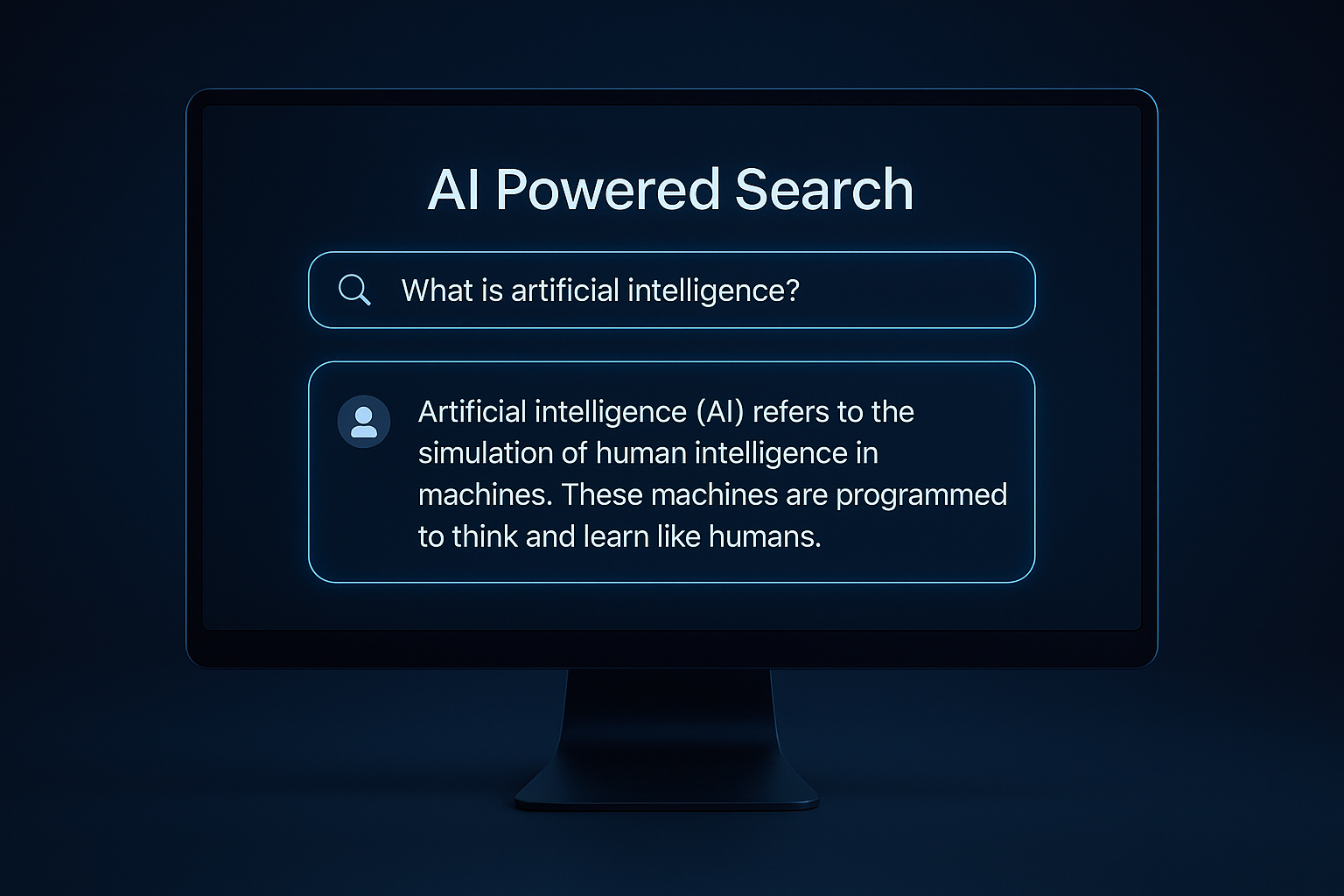
A modern AI free search engine delivers direct, conversational answers rather than a raw list of links.
Top Free AI Search Engines Available Right Now
Several strong platforms compete in this space. Below are the most notable free options, each with distinct strengths.
Perplexity AI
Perplexity AI is widely regarded as the leading free AI search engine. It provides real-time web access, cites every source it uses, and presents answers in a clean, readable format. The free tier supports unlimited basic searches, making it practical for daily use.
Furthermore, Perplexity allows follow-up questions within each thread, so complex research topics can be explored progressively. Its citation transparency is particularly valuable for students and professionals who need to verify information quickly.
You.com
You.com takes a modular approach. In addition to AI-generated answers, it offers specialized “apps” within the search interface — such as code generators, image creators, and writing assistants. Consequently, it appeals to users who want an all-in-one productivity hub rather than a pure search tool.
You.com also emphasizes privacy, offering a mode that limits data tracking. This makes it a strong choice for users who are cautious about how their search data is used.
Microsoft Bing AI (Copilot)
Microsoft integrated OpenAI’s technology directly into Bing, creating one of the most capable free AI search experiences available. Bing AI — now branded as Copilot — blends traditional search results with AI-generated summaries. Because it is built into the world’s second-largest search engine, it benefits from a massive, well-indexed web corpus.
Similarly, Bing AI supports image generation and document analysis on its free tier, making it one of the most feature-rich no-cost options.
Google AI Overviews
Google has rolled out AI Overviews — AI-generated summaries that appear at the top of many search results pages. While this is not a standalone AI search engine, it effectively brings AI-powered answers to the billions of people already using Google Search at no additional cost.
However, Google’s AI summaries have faced criticism for occasional inaccuracies, and the feature is still maturing. Nevertheless, for casual everyday queries, it provides a convenient first layer of AI assistance.
Comparing the top free AI search engine platforms helps you match the right tool to your specific workflow.
How to Get the Best Results from a Free AI Search Engine
Using these tools effectively requires a slightly different approach than traditional search. Follow these steps to maximize accuracy and usefulness by reading our AI search engine optimization guide.
- Choose the right AI search engine for your needs. Evaluate options like Perplexity AI, You.com, and Bing AI based on your priorities — citation quality, privacy, or interface style. Each platform has a distinct strength.
- Frame your query as a full question. Instead of entering keywords, type a complete, natural-language question. For example, ask “What are the best free AI search engines in 2025?” rather than just “AI search engines free.”
- Review the cited sources provided. Most AI search engines list the pages they used to generate the answer. Click through to verify key facts, especially for research, health, legal, or financial topics.
- Refine your query using follow-up questions. If the initial answer is too broad, ask a follow-up in the same session. AI engines retain context, so you can drill deeper without repeating background information.
- Cross-check critical information independently. For any decision-critical topic, verify the AI-generated answer against authoritative external sources such as government websites or peer-reviewed publications.
What AI Search Means for SEO and Content Strategy
The rise of the AI-powered search experience is reshaping how websites need to think about visibility. Because AI engines synthesize answers from multiple sources, traditional keyword-stuffing strategies are becoming less effective. Instead, content must be authoritative, clearly structured, and genuinely useful — learn how to improve online visibility.
In particular, structured data markup, FAQ sections, and clear headings help AI engines identify and cite your content accurately. Resources like RankAuthority provide in-depth guidance on AI Search Engine Optimization — covering everything from schema markup to answer engine optimization (AEO).
Furthermore, internal linking and topic clustering signal topical authority to both traditional and AI-driven search systems. If you want to understand how to optimize your content for AI answer engines, building comprehensive, well-organized authority ranking resource hubs is a strong starting point.
Key Differences Between AI and Traditional Search for Marketers
Traditional search rewards pages that rank well through backlinks and keyword density. AI search tools, however, reward pages that directly and accurately answer questions. Therefore, the shift favors content creators who prioritize depth and clarity over volume and manipulation.
As a result, businesses investing in high-quality, expert-authored content are better positioned to appear in AI-generated answers. This represents a meaningful opportunity for brands willing to adapt early.

Adapting your content strategy for AI-driven search is increasingly essential for digital visibility.
Limitations to Keep in Mind
No tool is perfect. Free AI search engines can occasionally produce confident-sounding but incorrect answers — a phenomenon researchers call “hallucination.” This happens when the model generates plausible-sounding text that is not grounded in real data.
Additionally, free tiers often come with usage limits or slower response speeds during peak hours. For heavy research workloads, a paid plan may eventually become worthwhile. However, for the vast majority of everyday queries, the free tier of tools like Perplexity AI or Bing AI is more than sufficient.
Similarly, real-time data access is not guaranteed on all free plans. Some engines may rely on training data with a knowledge cutoff date, which means very recent events might not be reflected accurately. Always check whether the engine specifies a knowledge cutoff or live web access.
Frequently Asked Questions About AI Free Search Engines
What is an AI free search engine?
An AI free search engine is a web search tool powered by artificial intelligence that is available at no cost. It uses natural language processing and machine learning to deliver direct, conversational answers instead of just a list of links. Learn more about practical workflows in AI keyword research guides.
How does an AI search engine differ from a traditional search engine?
Traditional search engines rank and list web pages based on keywords and backlinks. AI search engines, in contrast, understand the intent behind your query and generate a direct, summarized answer — often with cited sources.
Which AI free search engine is the best for everyday use?
Perplexity AI is widely considered the best free option for everyday use due to its accurate sourcing and real-time web access. You.com and Bing AI are also strong free alternatives worth exploring.
Is Perplexity AI really free to use?
Yes, Perplexity AI offers a free tier with unlimited basic searches. A paid Pro plan unlocks more advanced AI models and higher usage limits, but the free version is fully functional for most users.
Does Google have a free AI search engine?
Google has integrated AI Overviews into its standard search results, providing AI-generated summaries at the top of many queries. This feature is free and available to all Google Search users.
Are AI search engines accurate and reliable?
AI search engines are generally reliable for factual, well-documented topics. However, they can occasionally produce errors, so verifying important facts through the cited sources is always recommended.
Do AI search engines protect my privacy?
Privacy policies vary by platform. Some AI search engines, like You.com, offer privacy-focused modes. Always review a tool’s privacy policy before sharing sensitive queries.
Can I use an AI search engine for research and academic work?
Yes, these tools can accelerate research by summarizing complex topics quickly. However, always cross-reference the cited sources directly, as AI-generated summaries may occasionally misrepresent nuanced academic content.
What are the main limitations of a free AI search engine?
Free AI search engines may have usage caps, slower response times during peak hours, or limited access to the most advanced AI models. Some may also lack real-time data access on free tiers.
How do AI search engines make money if they are free?
Most free AI search engines monetize through premium subscription tiers, advertising, or enterprise licensing. Some are also backed by venture capital while building their user base.
What is the difference between You.com and Perplexity AI?
Both are free AI search engines, but You.com offers a modular interface with app-style integrations, while Perplexity AI focuses on clean, citation-backed conversational answers. Your best choice depends on your preferred workflow.
Can AI search engines replace traditional SEO strategies?
Not entirely. AI search engines still pull from indexed web content, so strong SEO remains important. However, strategies must evolve to optimize for AI answer engines and featured snippets. Platforms like RankAuthority offer practical guidance on this transition.
Conclusion
The emergence of the ai free search engine marks one of the most significant shifts in how people access information since the birth of the internet. Tools like Perplexity AI, You.com, and Bing AI have made conversational, intelligent search accessible to everyone — at no cost. Furthermore, as these platforms mature, their accuracy, speed, and feature sets continue to improve rapidly.
Whether you are a student, a researcher, a marketer, or simply someone who wants faster answers, there is a free AI search engine suited to your needs. The key takeaway is simple: start with a clear, full-sentence question, verify important information through the cited sources, and explore follow-up queries to go deeper. Consequently, you will get far more value from these tools than from traditional keyword search alone. Last updated: 2026-08-14.
Above all, stay curious and adaptable. The AI search landscape is evolving quickly, and the tools available today are only the beginning of what is coming next. Add an author byline and a brief credentials block (e.g., "By Jane Doe, SEO researcher — Last updated June 2026") to improve E-E-A-T and trust signals.

