

AEO vs SEO is one of the most important strategic questions in digital marketing today. As AI-powered platforms reshape how people find information, understanding the difference between these two approaches — and how to combine them — can determine whether your content gets found or gets ignored.
Search engine optimization (SEO) has been the cornerstone of online visibility for decades. However, a newer discipline called Answer Engine Optimization (AEO) is rapidly gaining ground. Together, they form the foundation of a modern content strategy built for both traditional search and AI-driven discovery.
What Is AEO vs SEO? A Clear Definition
SEO (Search Engine Optimization) is the practice of improving a web page’s visibility in traditional search engine results pages (SERPs), primarily on Google. It involves keyword research, link building, technical improvements, and content quality signals.
AEO (Answer Engine Optimization) is the practice of structuring content so that AI-powered platforms — such as Google’s AI Overviews, ChatGPT, Perplexity AI, and voice assistants — can extract and present it as a direct, spoken, or generated answer to a user’s question.
Direct Answer: AEO focuses on being chosen as the answer, while SEO focuses on being ranked in a list. Both are essential, but they require different content approaches.

AEO vs SEO visualized: traditional ranked results on one side, AI-powered direct answers on the other.
How Traditional Search Engine Optimization Works
SEO operates by signaling relevance and authority to search engine algorithms. Specifically, it relies on three core pillars: technical health, content quality, and backlink authority. According to Wikipedia’s overview of SEO, the discipline dates back to the mid-1990s and has evolved significantly with every major algorithm update.
Furthermore, SEO success is measured primarily through keyword rankings, organic traffic volume, and click-through rates (CTR). A well-executed SEO strategy can take three to six months to produce measurable results, but the long-term compounding effect is substantial.
In addition, technical SEO factors — such as page speed, mobile-friendliness, and Core Web Vitals — play a growing role. Google’s algorithm considers over 200 ranking factors, making SEO a multidisciplinary effort that spans development, content, and outreach.
Key SEO Ranking Signals
- Backlink quantity and quality from authoritative domains
- Keyword relevance and search intent alignment
- Page speed and Core Web Vitals scores
- Content depth, freshness, and E-E-A-T (Experience, Expertise, Authoritativeness, Trustworthiness)
- Internal linking structure and site architecture
How Answer Engine Optimization Works Differently
Answer engine optimization works by making your content easy for AI systems to read, understand, and cite. Therefore, the structure of your content matters as much as its depth. AI engines scan for content that directly answers a specific question, ideally within the first one to three sentences of a section.
Platforms like Perplexity AI, Google AI Overviews, and voice assistants such as Siri and Alexa pull from web content to generate responses. Consequently, if your content is not structured for extraction, it may be overlooked — even if it ranks highly in traditional search.
Notably, a 2023 study by BrightEdge found that AI-generated search features appeared in over 84% of queries across key industries. This shift underscores why AEO is no longer optional for brands that want to remain visible.
Core AEO Tactics
- Writing concise, direct answers in the opening sentences of each section
- Using question-based headings (who, what, where, when, why, how)
- Implementing FAQPage, HowTo, and Speakable schema markup
- Targeting conversational, long-tail, and voice-friendly queries
- Building topical authority through content clusters
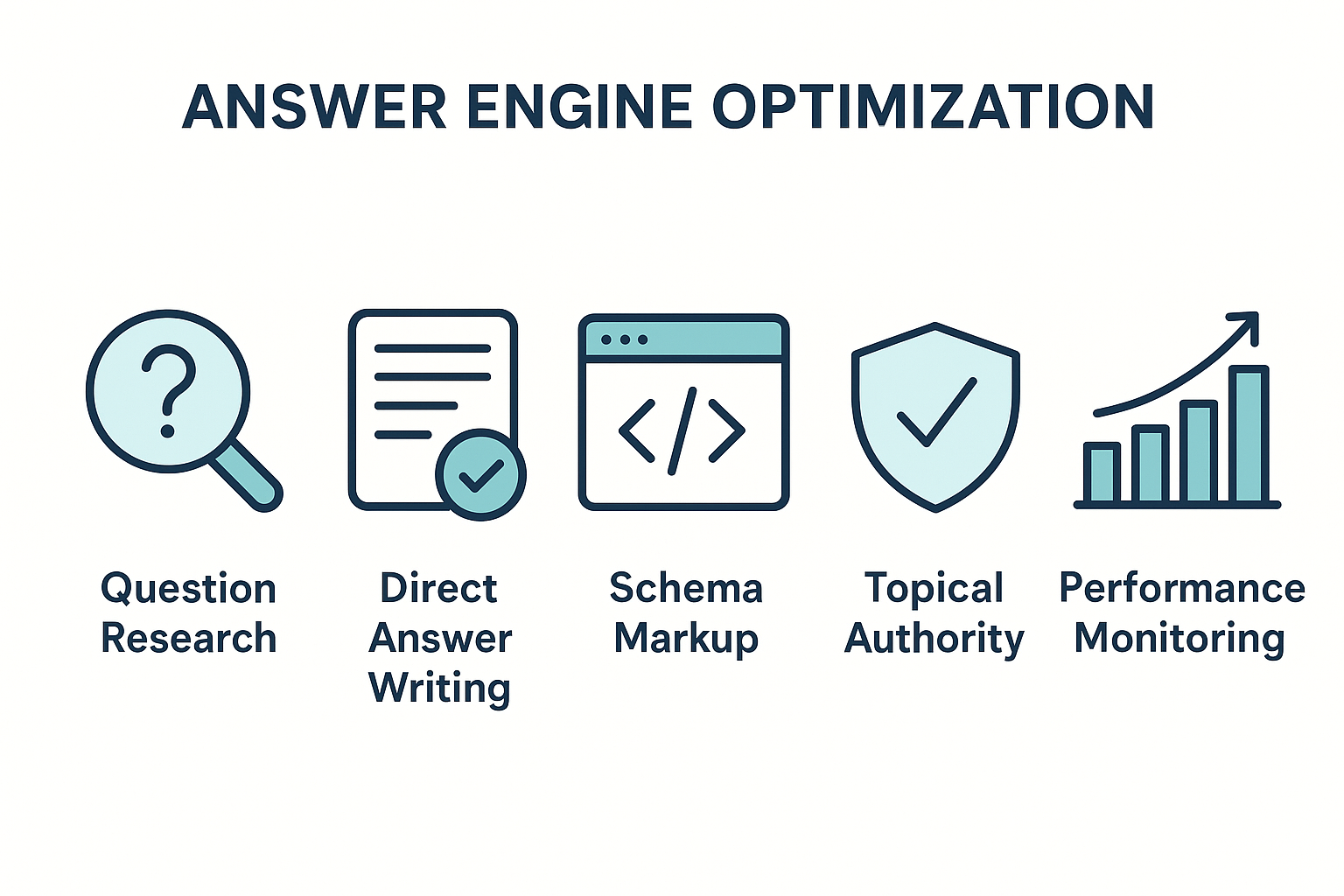
A step-by-step answer engine optimization strategy helps content appear in AI-generated responses.
AEO vs SEO: Side-by-Side Comparison
| Factor | SEO | AEO |
|---|---|---|
| Primary Goal | Rank in search results | Be selected as a direct answer |
| Target Platform | Google, Bing SERPs | AI Overviews, ChatGPT, voice assistants |
| Content Format | Long-form, keyword-rich pages | Concise Q&A, structured snippets |
| Key Technical Tool | Backlinks, Core Web Vitals | Schema markup, structured data |
| Success Metric | Rankings, traffic, CTR | Featured snippets, AI citations |
How to Optimize for Both: A Step-by-Step Process
Fortunately, AEO and SEO are not mutually exclusive. In fact, the best-performing content strategies combine both. Here is a practical process you can follow:
- Research conversational and question-based keywords. Use tools like Google’s People Also Ask section or AnswerThePublic to find queries phrased as questions. Focus on who, what, where, when, why, and how formats.
- Structure content with a direct answer first. Open each section with a one-to-three sentence direct response. Then follow with supporting detail, data, and examples so both users and AI engines receive immediate value.
- Add schema markup for FAQPage and HowTo. Implement structured data on relevant pages. This signals to Google and AI-powered engines exactly what questions your content addresses, increasing citation likelihood.
- Build topical authority with supporting content. Create a cluster of related articles that link to one another and to a central pillar page. Topical authority signals trustworthiness to both traditional and AI-driven search systems.
- Monitor and refine based on AI and search performance. Track featured snippet appearances, AI Overview citations, and keyword rankings regularly. Use this data to replicate successful patterns across your site.
For deeper guidance on implementing these strategies, RankAuthority.com offers comprehensive resources on modern search optimization for both traditional and AI-powered platforms.
What Is GEO and Where Does It Fit?
GEO — or Generative Engine Optimization — is a closely related term that specifically targets AI systems generating long-form responses, such as ChatGPT or Google Gemini. In practice, GEO, AEO, and SEO overlap significantly. However, GEO places extra emphasis on being cited within generated text rather than just appearing as a source link.
Similarly, voice search optimization shares tactics with AEO, since voice assistants return a single spoken answer. Therefore, content optimized for voice is typically also optimized for answer engines. You can explore more about voice search and GEO optimization strategies to round out your approach.
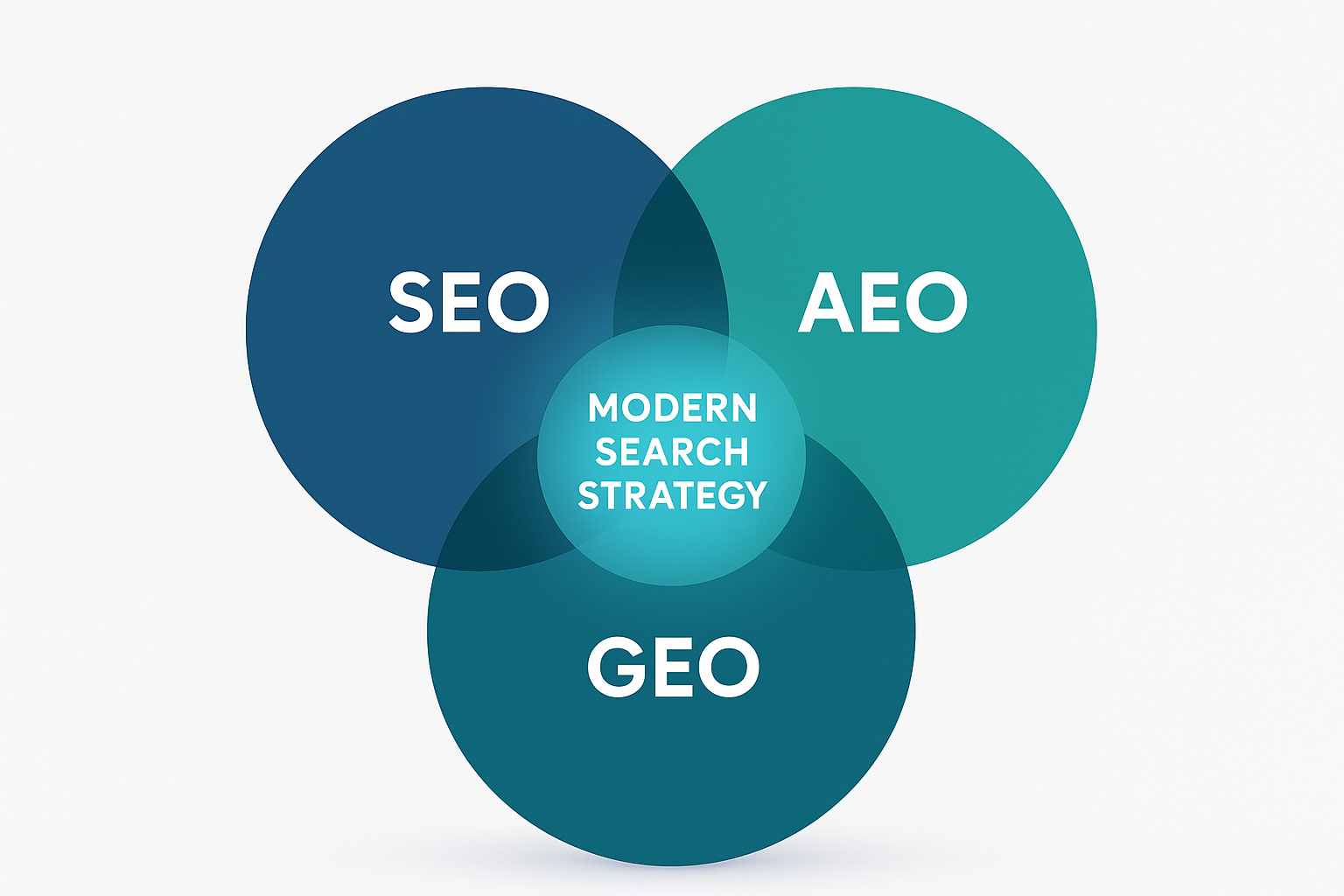
SEO, AEO, and GEO overlap significantly — a unified strategy addresses all three for maximum visibility.
Which Should You Prioritize Right Now?
The honest answer is: both, but with emphasis depending on your goals. If you are building a new site, SEO fundamentals — technical health, backlinks, and keyword-targeted content — must come first. Without baseline authority, AI engines are unlikely to cite you regardless of how well your content is structured.
On the other hand, if you already have established SEO authority, layering AEO tactics on top can unlock significant new visibility. Specifically, adding FAQ schema, restructuring introductions to lead with direct answers, and targeting question-based queries can produce results within weeks.
As a practical benchmark, aim to have at least 20 to 30 pieces of well-optimized content before investing heavily in AEO. At that point, your domain has enough authority for AI engines to consider it a credible source. Additionally, resources like RankAuthority.com can help you audit your current content and identify quick AEO wins.
Frequently Asked Questions About AEO vs SEO
What is the main difference between AEO vs SEO?
SEO focuses on ranking web pages in traditional search engine results, while AEO focuses on getting your content selected as a direct answer by AI-powered platforms. Both share some tactics, but AEO prioritizes concise, structured responses over broad keyword rankings.
What does AEO stand for?
AEO stands for Answer Engine Optimization. It is the practice of structuring content so that AI-powered answer engines and voice assistants can extract and present it as a direct response to a user’s question.
Is AEO replacing SEO?
AEO is not replacing SEO; instead, it is expanding it. Traditional SEO remains essential for driving organic traffic, while AEO ensures your brand appears in AI-generated answers. Most experts recommend a combined strategy.
How does answer engine optimization work?
Answer engine optimization works by structuring content with clear questions and concise answers, using schema markup, and targeting conversational queries. Engines like Google AI Overviews and Perplexity AI scan for well-structured, authoritative content to surface as direct answers.
Which is more important for voice search: AEO or SEO?
AEO is generally more important for voice search because voice assistants return a single spoken answer rather than a list of links. However, strong SEO authority still underpins which sources AI engines trust.
What types of content work best for AEO?
FAQ pages, how-to guides, definition articles, and structured Q&A content perform best for AEO. Content that directly and concisely answers a specific question is most likely to be selected by answer engines.
Does schema markup help with AEO?
Yes, schema markup significantly helps with AEO. Structured data types like FAQPage, HowTo, and Speakable signal to AI engines exactly what your content answers, making it easier to extract and present as a direct response.
Can small businesses benefit from AEO?
Absolutely. Small businesses can benefit greatly from AEO because it levels the playing field. A concise, well-structured answer can outperform a large competitor’s page if it more directly addresses the user’s question. For a deeper walkthrough, see our AEO Services for Local Businesses: The Complete Guide.
How do I measure success in AEO compared to SEO?
SEO success is measured through rankings, organic traffic, and click-through rates. AEO success is measured by featured snippet appearances, AI Overview citations, voice answer selections, and brand mention frequency in AI-generated responses.
What is GEO and how does it relate to AEO vs SEO?
GEO stands for Generative Engine Optimization. It is closely related to AEO and refers specifically to optimizing content for AI systems that generate responses, such as ChatGPT or Gemini. GEO, AEO, and SEO together form a complete modern search strategy.
How long does it take to see results from AEO?
AEO results can appear faster than traditional SEO in some cases, particularly for featured snippets, which can change within days of publishing optimized content. However, earning consistent AI engine citations typically takes weeks to months of authority building.
What is a common mistake when optimizing for answer engines?
A common mistake is writing vague, long-winded answers instead of concise, direct responses. Answer engines prefer content that answers the question in the first one to three sentences, followed by supporting detail.
Conclusion
Understanding AEO vs SEO is no longer a niche concern — it is a strategic necessity for any brand that wants to remain visible as search behavior evolves. SEO builds the authority and rankings that drive organic traffic, while AEO ensures your content is surfaced by the AI-powered platforms increasingly shaping how people find answers. Furthermore, combining both approaches with GEO principles creates a resilient, future-proof content strategy. Start with strong SEO fundamentals, then layer in AEO tactics like structured data, question-based headings, and direct-answer formatting. The result is content that performs across every channel — from traditional search to AI-generated responses.

