

Automated SEO monitoring is the practice of using dedicated software to continuously track keyword rankings, technical health, and content performance across your website so that nothing important slips through unnoticed. Instead of running audits by hand every few weeks, teams now rely on always-on systems that flag ranking drops, crawl errors, or content gaps the moment they happen. This shift matters more than ever now that AI Overviews, chatbot answers, and traditional blue-link results all compete for the same visibility. For business owners juggling dozens of pages, automated SEO monitoring turns a time-consuming chore into a quiet, background process that protects rankings around the clock — and, as you’ll see below, it does far more than most guides admit.
What Is Automated SEO Monitoring?
Automated SEO monitoring is software-driven tracking that checks your rankings, site health, and content metrics on a recurring schedule and alerts you the instant something changes. It removes the need for manual spreadsheet checks by running continuously in the background, 24 hours a day.
In practice, this means crawlers (bots that scan web pages automatically) and APIs (software connections that pull data between two systems) fetch fresh data from search engines and your website every day, comparing it against historical baselines. As a result, you learn about a ranking drop or a broken page within hours instead of weeks. According to Google’s own documentation, technical health and crawlability directly influence how content gets indexed and surfaced, which is exactly what these tools are built to protect (Google Search Central).
Search engine optimization itself, as defined by Wikipedia, is the practice of improving a site’s visibility in unpaid search results. Automated SEO monitoring simply applies continuous measurement to that ongoing effort, so nothing meaningful slips through the cracks between audits.
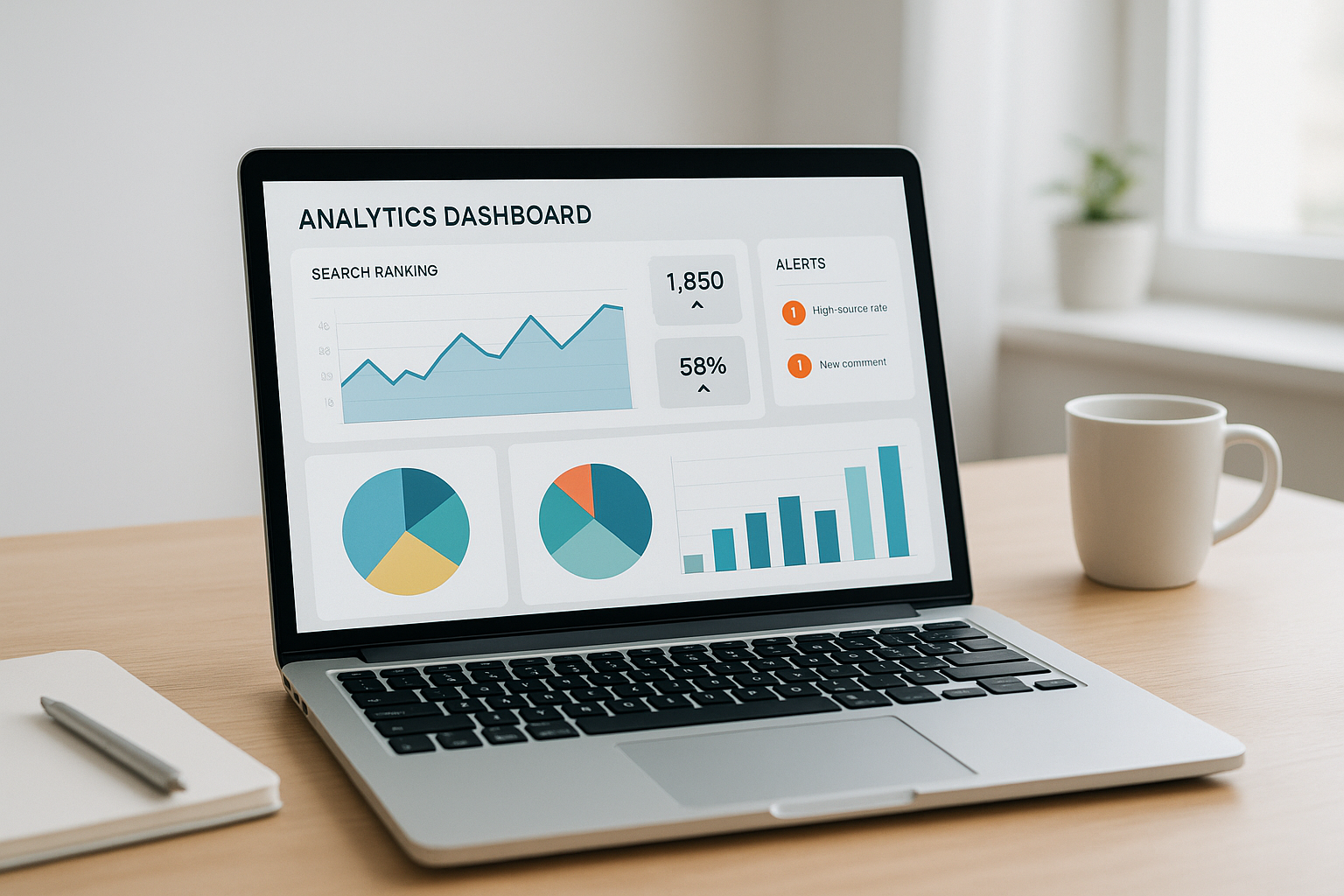
A real-time dashboard is the visible layer of automated SEO monitoring in action.
Automated SEO Monitoring vs. SEO Automation: Why the Distinction Matters
Many articles blur “SEO automation” and “automated SEO monitoring” together, but they solve different problems. SEO automation is the broad umbrella — it covers automating content briefs, internal linking, meta tag generation, and even backlink outreach. Automated SEO monitoring, on the other hand, is specifically the detection layer: it watches rankings, crawl health, and content decay so you know when to act.
In other words, monitoring is the smoke detector; broader automation is the sprinkler system that puts the fire out. Consequently, a site can automate content publishing all day long, but without monitoring, it has no reliable way to know when that content stops performing. If you want the fuller picture of how these two pieces fit together, this guide on how to streamline your SEO strategy using AI connects monitoring to the wider automation stack.
Why Continuous Search Performance Tracking Matters
Search results change constantly, and algorithm updates can move rankings overnight. Without continuous tracking, a business might not notice a traffic decline until monthly reports arrive — by which point the damage is already done. In contrast, real-time search performance tracking flags the drop within a day, giving teams time to diagnose and respond before revenue is lost.
Industry data consistently shows that organic search remains a dominant discovery channel, with studies from major analytics providers estimating that the majority of website traffic still originates from search engines. Therefore, even a small ranking slip on a competitive keyword can translate into meaningful revenue loss. Above all, speed of detection is what separates automated systems from manual review cycles. For a deeper look at measurement strategy, see this complete guide to automated performance analysis.
Key Features to Look for in SEO Monitoring Automation
Not all monitoring tools are built equally. Specifically, look for platforms that combine rank tracking, technical crawling, backlink alerts, and, increasingly, visibility tracking inside AI-generated answers. In addition, compare automated SEO tools that let you set custom alert thresholds so you’re not flooded with noise over minor fluctuations.
- Daily rank tracking across desktop and mobile results, including localized rankings
- Technical crawl alerts for broken links, redirects, and indexing errors
- Content performance metrics like engagement and organic traffic trends
- AI search visibility tracking for chatbot and AI Overview mentions
- Core Web Vitals monitoring (Google’s page-experience speed metrics, explained by web.dev), since slow pages quietly bleed rankings
- Competitor rank comparison so you see share-of-voice shifts, not just your own data in isolation
If you’re weighing whether these features justify the expense, this breakdown on whether automated SEO is worth the investment walks through the cost-benefit case in detail.
Top Tools and Platforms Used for Automated SEO Monitoring
Most monitoring stacks fall into three categories, and understanding which one covers which job prevents costly overlap.
Free and Foundational Tools
Google Search Console is the baseline every site should connect first — it reports indexing status, search queries, and manual actions directly from Google. However, it lacks daily historical rank charts and competitor comparisons, which is where dedicated monitoring platforms step in.
All-in-One Suites
Platforms like Semrush and Ahrefs combine rank tracking, backlink monitoring, and technical audits into a single dashboard. These suites work well for teams that want breadth, though they often require someone to manually interpret and act on the data. Learn how automated SEO tools can reduce manual effort.
Technical Crawlers
Screaming Frog and similar crawlers specialize in deep technical audits — broken links, redirect chains, and duplicate title tags. Consequently, larger sites often pair a crawler with a rank tracker for full coverage.
AI-Native Monitoring Platforms
This newest category, which includes RankAuthority’s automation engine, goes a step further by not just detecting problems but recommending — and in some cases executing — the fix. For teams that want fewer dashboards and more direct action, this guide to smart SEO solutions built for AI-powered search rankings is worth reading in full.
How Automated Rank Tracking Fits Into Your Strategy
Rank tracking is often the entry point into broader monitoring automation (Real-time SEO adjustments). Once you can see how positions shift daily, it becomes easier to connect ranking changes to specific content updates, backlink gains, or technical fixes. Consequently, teams stop guessing and start making evidence-based decisions.
For example, if a page drops five positions right after a competitor publishes updated content, that correlation is only visible with continuous tracking. Similarly, agencies managing multiple client sites rely on this data to prioritize which accounts need attention first. Learn more in this guide to rank tracking automation and how it saves time.
Automated SEO Monitoring vs Manual Audits: What’s the Difference?
Manual audits involve a person reviewing rankings, backlinks, and technical health at set intervals, often monthly or quarterly. In contrast, automated SEO monitoring runs continuously, checking data daily or even hourly depending on the platform. As a result, automation catches problems faster, though it still benefits from human judgment to interpret trends and prioritize fixes.
Neither approach fully replaces the other. However, most modern SEO strategies now use automation for detection and reserve manual review for strategic planning. This hybrid model is explored further in this resource on how to automate your website’s SEO efforts.

Manual audits and automated SEO monitoring serve different, complementary roles.
Building an Automated SEO Monitoring Workflow in 7 Steps
Setting up automated SEO monitoring doesn’t require deep technical expertise. Below is a practical, expanded sequence that works for small businesses, agencies, and in-house marketing teams alike.
- Audit your current SEO baseline: Record your current rankings, organic traffic, and technical health before automating anything, so you have a clear point of comparison later.
- Choose an automated SEO monitoring platform: Select a tool that matches your site size and goals, comparing crawl frequency, alerting, and AI search visibility features.
- Connect your website and set tracking parameters: Link your domain, target keywords, and competitor sites so the platform knows exactly what to track continuously.
- Configure alerts and reporting cadence: Set meaningful thresholds for ranking drops or traffic dips, then choose how often summary reports reach your team.
- Review insights and act on recommendations: Schedule regular time to review flagged issues and implement fixes quickly, since monitoring only creates value when it leads to action.
- Route alerts into your team’s daily tools: Connect monitoring notifications to email, Slack, or project boards so flagged issues reach the right person within minutes, not days.
- Benchmark quarterly and refine thresholds: Revisit your alert settings every quarter to account for seasonal traffic shifts and new competitor activity, keeping the system accurate over time.
Platforms such as RankAuthority streamline this entire sequence through 1-Click AI AutoPilot, which automates both the technical setup and the ongoing strategic adjustments that would otherwise require dedicated staff time. For more on implementation, see AI-enhanced SEO strategies. This is particularly useful for agencies overseeing several client properties at once, a scenario covered in more detail in this piece on scalable SEO solutions that grow rankings fast.
Automated SEO Monitoring and AI Search Visibility
Search no longer means ten blue links. Increasingly, answers appear inside AI Overviews, chatbot summaries, and voice assistants — none of which behave like a traditional ranking position. As a result, automated SEO monitoring now has to track a second dimension: whether your brand and content get cited inside these generative answers at all. Read about how AI enhances SEO to adapt monitoring.
In practice, this means monitoring tools query AI systems the same way a user would, then log whether your domain appears in the response. Similarly, some platforms now track “zero-click” impact — cases where users get their answer without visiting any site. For a practical breakdown of adapting to this shift, this resource on instant SEO solutions that rank faster with AI automation is a strong next read.
Common Mistakes to Avoid With Automated Search Tracking
One frequent mistake is setting up alerts and then ignoring them, which defeats the entire purpose of automation. Another is tracking too many vanity metrics instead of focusing on rankings, traffic, and conversions that actually move the business forward.
Furthermore, some teams set alert thresholds too tight, generating constant notifications for minor, meaningless fluctuations. Instead, it’s better to reserve alerts for changes that genuinely warrant attention, such as a five-position ranking drop or a double-digit traffic decline. A well-known reference on crawling and indexing behavior, Wikipedia’s overview of web crawlers, offers useful background on why technical monitoring catches issues human review often misses.
Finally, a subtler mistake is treating monitoring as a replacement for strategy rather than a support system for it. Automation tells you what changed; it still takes a plan to decide what to do next. If your team needs help building that plan, this guide on how to simplify your website’s SEO with automation connects the two.

AI-driven algorithms are what make automated SEO monitoring scalable across large sites.
Measuring ROI: Is Automated SEO Monitoring Worth It?
To measure return on investment, compare the cost of the monitoring platform against the traffic and revenue saved by catching problems early. For instance, if a tool costs $100 a month but catches a ranking drop that would have cost weeks of lost organic traffic, the math favors automation quickly.
In addition, factor in staff time saved. Manual audits can consume several hours per site each month; automation reclaims that time for higher-value work like content strategy or link building. According to the Wikipedia entry on search engine optimization, ranking visibility directly correlates with organic traffic share, which underscores why early detection has outsized financial impact.
Frequently Asked Questions About Automated SEO Monitoring
What is automated SEO monitoring?
Automated SEO monitoring is the use of software to continuously track rankings, technical health, and content performance without manual checks. It replaces periodic manual audits with always-on tracking that alerts you the moment something changes.
How does automated SEO monitoring work?
It works by crawling your site and search results on a set schedule, comparing new data against a baseline, and sending alerts when metrics shift. Most platforms use APIs and crawlers to pull this data automatically.
Is automated SEO monitoring the same as SEO automation?
No. SEO automation is the broader category covering tasks like content generation and link building, while automated SEO monitoring is the detection layer that tracks rankings and technical health specifically. Most modern strategies use both together.
Why is automated SEO monitoring important for small businesses?
Small businesses often lack dedicated SEO staff, so automated monitoring catches ranking drops or technical errors before they cause lasting traffic loss. It effectively acts as a 24/7 watchdog without adding to payroll.
What’s the difference between automated SEO monitoring and manual SEO audits?
Manual audits are point-in-time reviews done by a person, while automated monitoring runs continuously in the background. Automation catches issues faster, though manual review still adds strategic judgment automation can’t fully replicate.
How much does automated SEO monitoring typically cost?
Pricing varies widely, from free basic rank trackers to enterprise platforms costing several hundred dollars monthly. Many providers, including RankAuthority, offer a risk-free trial period so you can evaluate value before committing.
How often should automated SEO monitoring tools scan a website?
Daily scans are standard for rankings and uptime, while full technical crawls often run weekly. High-traffic or highly competitive sites may benefit from more frequent checks.
What metrics does automated SEO monitoring track?
Typical metrics include keyword rankings, organic traffic, crawl errors, page speed, backlinks, and indexation status. Some advanced tools also track visibility within AI-generated answers.
Can automated SEO monitoring detect technical SEO issues?
Yes, most platforms flag broken links, duplicate content, slow-loading pages, and crawl errors automatically. This is often the fastest way to catch problems that would otherwise go unnoticed for weeks.
What are common mistakes businesses make with SEO monitoring automation?
A common mistake is setting up alerts but never acting on them, which defeats the purpose. Another is tracking too many vanity metrics instead of focusing on rankings and conversions that matter to the business.
Is automated SEO monitoring suitable for agencies managing multiple clients?
Yes, agencies often benefit the most since automation scales monitoring across dozens of client sites without adding proportional staff hours. Centralized dashboards make it easier to report results across accounts.
How long does it take to see results from automated SEO monitoring?
You’ll typically see actionable alerts within the first week, though ranking improvements from acting on those alerts usually take four to twelve weeks. Results depend on competition and how quickly issues get fixed.
Does automated SEO monitoring help with AI search visibility?
Yes, modern monitoring tools increasingly track how content appears in AI Overviews and chatbot answers, not just traditional blue links. This is becoming essential as generative engines reshape how people search.
What happens if a business skips automated SEO monitoring entirely?
Without it, ranking drops and technical errors often go unnoticed until a monthly report arrives, by which point competitors may have already captured lost traffic. Early detection is the main advantage automation provides over waiting for scheduled reviews.
Final Thoughts on Automated SEO Monitoring
In summary, automated SEO monitoring gives businesses a continuous, reliable way to protect rankings, catch technical issues early, and adapt to the fast-changing world of AI-powered search. Rather than waiting for a monthly report, teams can respond to problems within hours instead of weeks. As search engines continue evolving toward AI Overviews and conversational answers, this kind of always-on visibility is no longer optional for anyone serious about growth.
Ultimately, whether you’re a solo site owner or an agency managing multiple properties, investing in automated SEO monitoring pays off through faster fixes, fewer missed opportunities, and steadier organic growth over time. Add an author byline and a clear "Last updated" date to increase E‑E‑A‑T and credibility.

