

SEO Strategy & Content Quality — Useful content fundamentals.
What Is Useful Content? The Definitive Guide to Creating, Measuring, and Scaling Content That Ranks — By Charles Cornish
Key Takeaway: Useful content is the foundational standard that determines whether your pages rank, convert, and compound in authority over time. This guide covers every dimension of content usefulness — from Google’s Helpful Content System to audience research, intent mapping, AI integration, content auditing, and a repeatable creation framework — so you can build content that decisively outperforms every competitor in your niche. By Rank Authority. Last updated: 2026-07-30.
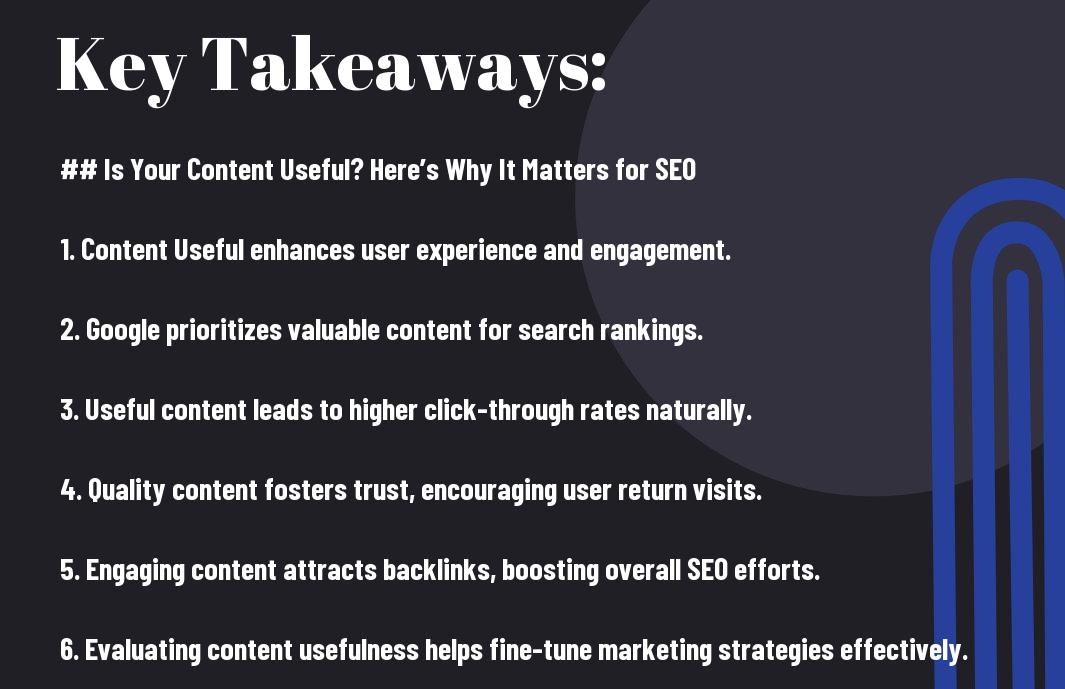
What Is Useful Content — and Why Does It Matter More Than Ever?
Useful content is content that genuinely serves the person reading it. It answers real questions, solves actual problems, and leaves readers better informed, better equipped, or more confident in a decision than they were before arriving. This is not a subjective ideal — it is the explicit standard Google’s Helpful Content System is designed to identify and reward at scale.
Content that exists primarily to capture a ranking — stuffed with keywords, thin on insight, and vague in its guidance — is precisely what modern search algorithms are built to filter out. Useful content attracts visitors, earns backlinks organically, reduces bounce rates, and builds the kind of compounding authority that sustains rankings long-term. Content that lacks genuine usefulness does the opposite: it inflates your bounce rate, signals poor quality to crawlers, and quietly erodes domain authority across your entire site.
Understanding what makes content truly useful — and building a repeatable system for creating it — is the highest-leverage SEO investment available to any brand or creator today. This guide covers every dimension of that understanding, from first principles through advanced execution.
Why “Useful” Is the Most Important Word in SEO Right Now
The SEO landscape has shifted decisively. For most of the 2010s, technical optimization — keyword density, backlink schemes, page speed — could carry mediocre content to strong rankings. That era is over. Google’s core algorithm updates from 2022 through 2024, culminating in the consolidation of the Helpful Content System into the core algorithm, have made one thing unmistakable: usefulness is the primary ranking variable for informational queries. Every other optimization layer — technical SEO, on-page signals, link building — amplifies useful content. It cannot rescue content that lacks it.
The Three Core Dimensions of Content Usefulness
Useful content operates across three measurable dimensions. Miss any one of them, and your content is incomplete regardless of how well it performs on the others:
- Relevance: The content directly addresses what the user was searching for — matching not just keywords, but the underlying intent driving the query. A piece about “useful content” that only defines the term without addressing how to create it fails the relevance test for most searchers.
- Accuracy: Every factual claim is correct, current, and verifiable. Inaccurate content destroys user trust instantly — and if users signal distrust through behavioral metrics, search engines take note.
- Actionability: The reader can do something concrete with the information. Useful content leads to decisions, actions, or deepened understanding — not passive consumption followed by a back-button click.
When all three dimensions align consistently across your content library, you build the kind of topical authority that search engines recognize and reward with durable rankings.
Understanding Your Audience: The Essential First Step
You cannot produce useful content for an audience you don’t understand. Before a single word is written, the most important investment you can make is in deep, systematic audience research. This step is where most content programs fail — not in the writing, but in the preparation that precedes it.
How to Identify What Your Audience Actually Wants
Genuine audience understanding comes from primary and secondary research sources. Use every available channel:
- Community listening: Read Reddit threads, Quora answers, LinkedIn discussions, Facebook groups, and niche forums where your audience asks unfiltered questions. These are the exact words and concerns your content must address.
- Internal data: Customer support tickets, sales call recordings, live chat transcripts, and survey responses reveal recurring pain points that no keyword tool will surface.
- Search feature mining: “People Also Ask” boxes, related searches, and autocomplete suggestions in Google reveal how your audience frames their questions — including angles you may not have considered.
- Competitor comment analysis: The comment sections of high-performing competitor content are a goldmine of unanswered questions and expressed frustrations — precisely the gaps your content can fill.
- Audience persona development: Synthesize your research into defined personas: not demographic caricatures, but documented maps of goals, knowledge levels, objections, and decision criteria.
Matching Content to Audience Knowledge Level
Useful content calibrates its language, depth, and assumed knowledge to the audience it serves. Jargon alienates beginners; over-simplification insults experts. A guide on “useful content” targeting marketing directors requires different framing than the same topic for small business owners publishing their first blog. Defining your audience before writing determines every downstream decision: vocabulary, depth, examples, tone, and format.
The “Jobs to Be Done” Framework for Content Planning
One of the most powerful lenses for audience-driven content is the Jobs to Be Done (JTBD) framework. Instead of asking “what does this person know?”, ask “what job is this person trying to complete?” A person searching “useful content” might be trying to: evaluate their existing content library, justify a content quality investment to leadership, understand Google’s quality standards, or build a new content strategy from scratch. Each “job” demands different content — and the most useful piece addresses all of them, clearly and in order of priority.
Google’s Helpful Content System — What It Actually Evaluates
Google’s Helpful Content System (HCS) began as a standalone signal in August 2022 and was folded into Google’s core ranking algorithm in the March 2024 Core Update. It is a machine-learning classifier that evaluates whether the majority of content on a website is created primarily for people — not for search engines. Understanding how this system works is essential context for every content decision you make.
Google’s Self-Assessment Questions — The Full List
Google has published a set of questions content creators should apply to their own work. These questions are direct signals of what Google’s classifier evaluates:
- Does the content provide original information, reporting, research, or analysis?
- Does it provide a comprehensive description of a topic — not an incomplete picture?
- Does it provide insightful analysis or interesting information beyond the obvious?
- If the content draws on other sources, does it add substantial value and originality rather than simply copying or rewriting?
- Does the headline or title provide a descriptive, accurate summary — without exaggeration or sensationalism?
- Is this the kind of page you would want to bookmark, share, or recommend to a trusted colleague?
- Would you expect to find this content referenced in a reputable publication, encyclopedia, or textbook?
- Does the content leave users feeling they learned enough to achieve their goal?
- Would someone reading this content walk away satisfied, or go back to search for a better answer?
If the honest answer to most of these questions is “no,” your content is not useful by Google’s standards — regardless of how well it is optimized at a surface level. No amount of keyword density, schema markup, or link building will sustainably compensate for a failure to pass this test.
The Sitewide Nature of the Helpful Content Classifier
One of the most consequential and widely misunderstood aspects of the HCS is its sitewide operation. Unlike a page-level penalty, the HCS evaluates the overall character of your entire domain. A large volume of thin, unhelpful, or AI-generated-without-review content can suppress rankings for every page on your site — including your best, most carefully produced content. This means content quality is not just a per-page concern; it is a portfolio-level strategy.
What Types of Content Google Explicitly Flags as Unhelpful
Google has specifically identified content patterns that trigger negative signals under the Helpful Content System. Avoid these at all costs:
- Content that summarizes what others have said without adding original insight, perspective, or analysis.
- Content targeting a keyword that doesn’t actually serve the user intent behind that query.
- Content that leaves users needing to search again to find a satisfying, complete answer.
- Content with misleading or sensationalized headlines that don’t match what the page delivers.
- Content created primarily to attract search engine visits rather than to genuinely help people.
- Content that presents a word-count facade of depth while providing only surface-level information.
- Content that answers a question with another question, or buries the answer in irrelevant padding.
The Six Key Elements of Genuinely Useful Content
Creating useful content consistently requires mastering the concrete, measurable properties that distinguish it from generic filler. Each element below is independently important — and together they define the standard that top-ranking content must meet.
1. Clarity — Can Your Reader Actually Understand You?
Clarity means your ideas are expressed in language your target audience uses and understands naturally. This requires knowing your audience’s knowledge baseline before writing. Avoid jargon that alienates beginners without explanation. Avoid over-simplification that condescends to experienced readers. The right clarity calibration is not a single universal setting — it shifts with every audience segment. The test: could your target reader act on this content without needing to look up additional context?
2. Relevance — Does It Match What They Actually Searched For?
Relevance is not keyword matching. It is intent matching — the alignment between what a user was truly seeking when they typed their query and what your content actually delivers. A user searching “useful content” may be seeking a definition, a framework for evaluation, a creation process, or a diagnostic for their existing site. Useful content addresses all plausible intents for a given query, structured so each type of user can navigate quickly to what they need.
3. Depth and Comprehensiveness
Useful content goes deep enough to fully answer the question at hand. Shallow, summary-level content that says nothing a user couldn’t find in a 30-second search is filler — not content. Depth does not mean length for its own sake; it means addressing every meaningful sub-question and nuance that a genuine expert would cover. The measure of sufficient depth is whether the user leaves with a complete answer, not a starting point for more searching.
4. Accuracy and Trustworthiness (E-E-A-T)
Google’s quality raters evaluate content through the framework of E-E-A-T: Experience, Expertise, Authoritativeness, and Trustworthiness. Useful content demonstrates all four. Include author credentials and first-hand experience where relevant. Cite reputable, specific sources. Use concrete data points rather than vague generalizations. Make sure every factual claim is current and verifiable. The “Experience” addition to the framework (formerly E-A-T) signals Google’s increasing weight on content that demonstrates genuine first-hand knowledge — not just research synthesis.
5. Originality — Going Beyond What Already Exists
Useful content does not merely aggregate or restate what other sources have said. It adds something that didn’t exist before: original analysis, proprietary data, a new framework, a contrarian perspective backed by evidence, or a synthesis that reveals insight hidden across disparate sources. Originality is increasingly the differentiating variable between content that earns citations, backlinks, and sustained rankings versus content that exists in the long tail and is never found again.
6. Actionability — What Should the Reader Do Next?
Every piece of useful content should leave the reader knowing exactly what to do next. This could be a specific recommendation, a step-by-step process, a decision framework, or a clear call to action aligned with where they are in their journey. Content that informs without empowering is only half-finished. The difference between a reader who bookmarks your page and one who bounces is usually whether you gave them something they could act on immediately.
Search Intent: The Architecture of Useful Content
Even genuinely useful content can fail to rank — or fail to satisfy visitors — if it is misaligned with the specific type of intent behind the target keyword. Search intent is not a single variable. It has type, format preference, and depth expectation. Understanding all three is the architecture work that precedes content writing.
The Four Types of Search Intent
- Informational intent: The user wants to learn something. (“What is useful content?”) — Best served with comprehensive guides, definitions, frameworks, and educational deep-dives. This is the dominant intent for “useful content” and demands comprehensive coverage.
- Navigational intent: The user wants to find a specific website or resource. (“Rank Authority useful content guide”) — Best served with branded, destination-specific pages. For a deeper walkthrough, see our How Can I Use AI to Improve SEO? The Complete 2025 Guide.
- Commercial investigation intent: The user is comparing options before deciding. (“best tools for creating useful content”) — Best served with comparison pieces, feature breakdowns, and tool reviews.
- Transactional intent: The user is ready to act. (“useful content SEO service”) — Best served with landing pages, service pages, and conversion-optimized CTAs.
Mismatching content format to intent is one of the most common and costly SEO mistakes. A transactional-format page targeting an informational query will almost always be outranked by a page that delivers what the user actually wants at that moment — even if the transactional page is technically well-optimized.
Content Format Preferences by Intent Type
Beyond intent type, users have format preferences — the way they expect information to be presented. These preferences are readable from what already ranks for a given query:
- Step-by-step guides dominate for “how to” queries where process clarity is the primary need.
- Comprehensive long-form articles dominate for definitional or framework queries like “what is useful content.”
- Listicles and comparison tables dominate for “best of” or “vs.” queries where users are evaluating options.
- Short, direct answers with supporting context dominate for factual, single-answer queries.
Aligning Content Structure to User Needs
Once you’ve identified the dominant intent and format preference for your target keyword, structure your content accordingly:
- Open with the clearest, most direct answer to the primary question — don’t bury the lead. Users who don’t get an immediate signal that they’re in the right place will leave.
- Use headings and subheadings that map directly to the sub-questions your audience is likely asking. Treat your heading structure as a navigational map for the reader.
- Support every claim with specific evidence, examples, case studies, or data. Vague claims signal low expertise; specific claims signal authority.
- Use visual hierarchy — bullet points, numbered lists, callout boxes, and short paragraphs — to make information scannable and accessible without sacrificing depth.
- Close with a clear, specific next step that matches where the user is in their decision journey. Don’t end with a generic summary — end with direction.
Semantic SEO and Topical Coverage
Search engines no longer match keywords in isolation — they understand topics, entities, and semantic relationships between concepts. Useful content naturally incorporates related terms and concepts that signal comprehensive topical coverage. For the keyword “useful content,” semantically related terms that should appear organically throughout your content include: helpful content, content quality, E-E-A-T, search intent, content relevance, informational content, user-first content, content depth, content freshness, topical authority, content comprehensiveness, and content originality. Incorporating these as a reflection of genuine topic coverage — not as a checklist — strengthens your content’s semantic authority and signals to Google that your page is a complete resource on the topic. See our SEO search keywords.
How to Audit Whether Your Current Content Is Useful
Before you can improve your content, you need an honest, systematic diagnosis. Many sites have content that appears useful on the surface but fails when measured against real user signals. Here is a complete content audit framework for evaluating your existing pages against the useful content standard.
Step 1 — Identify Your Content’s Primary Purpose
Ask honestly: Was this content written to help a specific reader solve a specific problem, or was it written to capture a keyword ranking? If the answer is primarily the latter, the content will feel hollow to users — and hollow content fails both readers and search algorithms. This is not a trick question; be honest, because the behavioral data will reflect the truth regardless.
Step 2 — Analyze Your Behavioral Metrics
Your analytics platform is one of the most honest auditors of content usefulness available. Review these key signals for every important page:
- Average engagement time (formerly “time on page”): Low engagement time on long-form content signals that users aren’t finding what they need and are leaving quickly.
- Bounce rate: High bounce rate on informational content typically indicates that users arrived, didn’t find the depth or answer they expected, and returned to search results.
- Scroll depth: If users consistently stop reading at the same point — say, 40% down the page — there is a structural or relevance failure at that point that needs diagnosing.
- Pages per session: Useful content naturally leads users to explore more of your site. Low pages-per-session on high-traffic entry pages indicates a failure to satisfy or engage.
- Return visitor rate: Users who come back to your site after an initial visit are one of the clearest signals that your content delivered genuine value they remember.
- Click-through rate from search (GSC): Low CTR despite decent rankings indicates your title and meta description aren’t matching the intent signal users are acting on.
Step 3 — Conduct a Search Intent Gap Analysis
Search the keyword you’re targeting. Read the top 5–10 results in full. Document every question those pages answer, every subtopic they cover, every angle they address, and every format choice they make. Compare that list systematically to your own content. Every gap represents an opportunity to make your content more useful — and more competitive. Pay particular attention to questions that appear across multiple competing pages but remain only partially or superficially answered.
Step 4 — Apply the “Knowledgeable Friend” Test
Google describes its quality standard as the experience of getting an answer from “a knowledgeable friend” — someone who gives you real, personalized information based on your specific situation rather than overly cautious, generic advice. Ask yourself: if a smart, experienced professional in your field read this article, would they find it genuinely insightful? Would they share it with someone who came to them with this question? If the answer is “probably not,” the content needs substantive work — not surface polishing.
Step 5 — Review Your E-E-A-T Signals
Audit your content for visible E-E-A-T signals. Check for:
- Author bylines with visible credentials, bios, or links to professional profiles.
- Citations to primary sources, original research, or authoritative publications — not just other blogs.
- Specific, dated data points rather than timeless-but-vague generalizations.
- Evidence of first-hand experience: personal testing, case studies, original experiments, or documented observations.
- Transparency about methodology, limitations, and the basis for any recommendations made.

How to Create Useful Content — A Complete 7-Phase Framework
Knowing what useful content looks like is only half the challenge. The other half is building a repeatable system for creating it consistently — one that scales without sacrificing the quality that earns and holds rankings. Here is a proven, end-to-end framework for content creation that puts usefulness at the center of every decision.
Phase 1 — Deep Audience Research
As covered above, you cannot write useful content for an audience you don’t understand. Invest substantively in forums, customer data, search feature mining, and competitor comment analysis before writing begins. The research phase is not optional — it is the foundation that determines whether everything downstream will be genuinely useful or merely technically correct. See our keyword research guide for practical research techniques and tools.
Phase 2 — Keyword and Intent Mapping
Map your primary keyword and its semantic variants to specific pieces of content. Each piece should have one clear primary intent it serves, supported by secondary and tertiary keywords that expand topical coverage naturally. Build a keyword cluster map — a visual or document representation of how each content piece relates to others in your topic area. This cluster approach enables internal linking that reinforces topical authority across your entire domain, not just for individual pages. For practical methods, see our Keyword research guide.
Phase 3 — Competitive SERP Analysis
Before building your outline, analyze the top-ranking pages for your target keyword in depth. Document: every heading and sub-heading used, every question answered, every angle taken, every format used, and every notable weakness or gap. Your goal is to build a complete picture of what the current best answer looks like — and then define specifically how your content will be more useful, more complete, and more original than any of it. For practical next steps see SEO benefits and apply them to your outline.
Phase 4 — Structured Outlining
Build a full, detailed outline that maps the user’s journey through the topic from first question to confident understanding. Your outline should answer three questions: (1) What does the user need to understand first to make the rest meaningful? (2) What are all the sub-questions that arise naturally from the primary question? (3) What should the user be able to do, decide, or understand by the end? A well-structured outline produces content where each section feels logically inevitable — a natural consequence of what came before.
Phase 5 — Writing with Specificity and Evidence
Every claim in your content should be supported with specific evidence. Replace vague generalizations with concrete examples, statistics, case studies, named tools, or step-by-step instructions. The difference is stark: “High-quality content improves rankings” is a vague, unverifiable claim that signals low expertise. “Pages appearing in Google’s featured snippets position are, on average, between 1,400 and 2,000 words and directly answer a specific question within the first 100 words of the article” is a specific, useful, verifiable claim that demonstrates genuine knowledge. For metrics and measurement advice, see SEO Scores Explained.
Phase 6 — Visual Aids and Content Formatting
Useful content is not just about what you say — it’s about how accessible and digestible you make it. Visual aids and formatting structure dramatically increase comprehension and engagement, particularly for complex topics. Use: learn more about content readability best practices to improve accessibility and engagement.
- Infographics and diagrams to visualize processes, frameworks, data relationships, and decision trees that are harder to absorb as text alone.
- Comparison tables to lay out options, features, tools, or criteria side by side — particularly valuable for commercial investigation intent.
- Screenshots and annotated images to illustrate step-by-step processes where visual confirmation aids understanding.
- Short paragraphs, bullet points, and numbered lists to prevent the dense text walls that cause readers to disengage — particularly on mobile devices.
- Callout boxes and highlighted key takeaways to give skimmers the most important information at a glance while encouraging them to read the full context.
- Video embeds where a visual demonstration or walkthrough would serve the user better than text description alone.
Phase 7 — Expert Review and Quality Validation
Before publishing any content intended to rank for competitive keywords, run it through a structured quality review process. At minimum: have a subject matter expert verify factual accuracy, check every statistic against its primary source, test every actionable recommendation for correctness, and read the full piece aloud to catch structural or clarity failures that are invisible to the writer’s eye. The content that reaches your audience must be the best version of itself — not the first draft.
Content Quality vs. Quantity — Why Useful Always Wins
The temptation to publish at high volume is understandable — more pages means more potential entry points from search. But publishing high quantities of low-usefulness content is not a neutral strategy; it actively damages your site’s performance. Google’s Helpful Content classifier is sitewide. A flood of thin, unhelpful pages can suppress the rankings of your best, most carefully produced content. The math is unambiguous: one exceptional piece of useful content outperforms a hundred mediocre pages — in traffic, in links earned, and in revenue generated. Learn how to prioritize outcomes in our SEO benefits overview.
The Compounding Cost of Thin Content
Thin content — pages that cover a topic at surface level without adding genuine insight, original data, or actionable guidance — creates several compounding problems that worsen over time:
- Crawl budget dilution: Search engine crawlers have finite time per site. Thin pages consume crawl budget without contributing to authority, slowing the indexation of your valuable content.
- Sitewide quality suppression: A high proportion of thin pages signals to Google’s classifier that your site is not a reliably useful source — suppressing rankings across all pages, including strong ones.
- Zero link equity: Nobody links to thin content. Without natural backlinks, pages cannot build authority, and without authority, rankings remain fragile and temporary.
- Brand trust erosion: Users who land on thin content and leave unsatisfied are less likely to trust your brand in any subsequent touchpoint — including your best pages.
- Content cannibalization: Multiple thin pages targeting related keywords compete with each other for the same rankings, splitting authority that could be concentrated in a single authoritative resource.
The Right Way to Scale Content Production
Scaling content production without sacrificing quality requires a system, not just more resources. The most effective approach: build fewer, better pieces on your primary topics; create pillar pages that comprehensively cover core subjects; and produce cluster content that addresses specific sub-questions and links back to the pillar. This topical authority model scales content production in a way that multiplies — rather than dilutes — your site’s usefulness signal to search engines. See our tips on supplementary content to support pillar pages effectively.
Balancing Comprehensiveness with Appropriate Scope
Truly useful content does not list everything that could possibly be said about a topic. It is comprehensive within the specific scope that the user’s intent requires. A post titled “What Is Useful Content?” should go deep on definition, framework, evaluation criteria, and creation methodology — but does not need to cover every SEO topic that tangentially touches content marketing. Scope appropriately to the intent, then go deep within that scope. That balance is what produces useful content at sustainable scale.
User Engagement: The Real-World Signal of Content Usefulness
Engagement is the market signal that tells you — and search engines — whether your content is actually useful in practice, not just in theory. Useful content generates observable, measurable behaviors: people stay longer, scroll further, share the page, return for more, and convert at higher rates. Understanding which engagement signals matter most helps you prioritize your improvement investments.
Primary Engagement Signals and What They Reveal
- Average engagement time: How long users actively interact with your content. Short engagement time on long-form content is a red flag. Useful content holds attention because it keeps delivering value.
- Social shares: Users share content they found genuinely valuable and want others to benefit from — not content that merely answered a surface-level question.
- Organic backlinks earned: Content creators and webmasters link to resources they consider authoritative and useful. Organic backlinks remain one of the strongest quality signals in SEO — and they only come naturally to content that genuinely deserves them.
- Comments and questions generated: An active comment section signals high engagement and reveals unanswered questions — giving you a direct roadmap for making the content even more useful.
- Conversion rate: For content with commercial intent, the ultimate usefulness measure is whether the reader takes the action you want. Content that speaks directly and honestly to user needs converts at substantially higher rates than generic content.
- Brand search increase: When users find your content genuinely useful, they remember your brand and search for it directly on their next visit — a compounding authority signal that lifts all of your pages over time.
The Virtuous Cycle of Useful Content and SEO
When you consistently produce useful content, a self-reinforcing flywheel develops: higher engagement signals quality to search engines → rankings improve → more users find and engage with the content → more backlinks and shares accumulate → domain authority grows → rankings improve further → the cycle accelerates. This is the sustainable SEO flywheel. Content that lacks genuine usefulness breaks the cycle at the first step and forces you to pay for traffic you could be earning organically — and keeps paying indefinitely.
Content Freshness — Keeping Your Useful Content Current
A page that was genuinely useful in 2022 may no longer be useful in 2025 if the topic has evolved, new data has emerged, or best practices have changed. Content freshness is not a vanity signal — it is a genuine usefulness signal. Outdated information misleads users, which is the direct opposite of helpful. Maintaining content currency is a continuous obligation, not a one-time publishing decision. See our updating content guide for audit cadence and update tactics.
How Google’s QDF Algorithm Rewards Fresh Content
Google’s Query Deserves Freshness (QDF) algorithm gives a ranking boost to recently updated or published content for queries where recency matters. QDF applies most strongly to breaking news, trending topics, event-driven queries, and any subject where industry standards are actively evolving — including digital marketing, AI, healthcare, finance, and technology. Regularly reviewing and meaningfully updating your content signals to Google that you actively maintain your site and that the information you publish remains current and trustworthy.
A Practical Content Update Schedule
Implement a structured review cycle for every important page on your site based on topic volatility:
- Evergreen content: Review and update every 12 months at minimum. Verify statistics against current sources, update examples, and check for changed best practices or newly emerged tools.
- Industry-specific content in fast-moving fields: Review every 6 months. Digital marketing, AI, fintech, and healthcare content can become materially outdated in less than a year.
- News or trend-based content: Update immediately when new developments change the accuracy, relevance, or completeness of the content.
- High-traffic underperformers: Pages receiving meaningful traffic but showing poor engagement metrics (low time-on-page, high bounce, low scroll depth) should be audited and improved as a priority — they represent traffic you’re already earning but failing to capitalize on.
Efficient Content Update Techniques
Keeping your useful content current doesn’t require rewriting from scratch every cycle. Focus your update effort on high-impact changes:
- Replacing outdated statistics with current data, clearly citing the source and publication date.
- Adding new sections addressing questions that have emerged or become more prominent since original publication.
- Incorporating user-generated feedback: common questions from comments, customer queries, or social media discussions that reveal gaps in coverage.
- Removing or revising sections that no longer reflect current best practices — leaving outdated guidance in place is worse than having no guidance at all.
- Updating internal links to point to new, relevant content published since the original article, reinforcing your topical cluster structure.
- Refreshing examples with more recent, more relevant, or more recognizable cases that resonate with the current audience.

Using AI to Create and Scale Useful Content Responsibly
AI SEO guide have dramatically expanded the capacity to produce content at scale. They have also created a massive wave of low-usefulness, undifferentiated content that actively dilutes search results and frustrates users who encounter it. Understanding how to use AI as a lever for useful content creation — rather than a substitute for it — is now a core competitive skill for every serious content program.
Where AI Adds Genuine Value in Content Creation
- Research acceleration: AI can rapidly surface relevant data, competing perspectives, semantic keyword clusters, and related entities that would take hours to compile manually — compressing the research phase dramatically.
- Structural drafting: AI is effective at generating first-draft outlines and section frameworks based on a given topic and intent, which a human expert can then enrich with original insight and accurate detail.
- Content gap identification: AI-powered SEO tools can systematically compare your content against competitors to identify topics you’re not covering — direct intelligence for improving usefulness.
- Optimization analysis: AI can evaluate readability scores, keyword density, semantic coverage, and structural quality against a target standard — providing objective feedback at scale.
- Repurposing and reformatting: AI excels at transforming existing expert content into different formats — summaries, FAQs, social snippets, video scripts — extending the reach of genuinely useful content already created.
Where Human Judgment Is Non-Negotiable
AI-generated content without expert human review fails the E-E-A-T test on the Experience and Expertise dimensions specifically. AI cannot provide genuine first-hand experience, original research-based insight, or the nuanced professional judgment that comes from real-world practice. AI also cannot verify its own factual accuracy reliably — a critical limitation for content on any topic where inaccuracy carries real-world consequences. The most effective approach combines AI efficiency with human expertise: use AI to accelerate mechanical and structural aspects of content creation, then add the original analysis, personal experience, and authoritative perspective that makes content genuinely, distinctively useful. Read our AI content writing for SEO guide for practical workflows.
Google’s Position on AI-Generated Content
Google has explicitly stated that it is not anti-AI — it is anti-content that lacks quality and helpfulness, regardless of how it was produced. AI-assisted content reviewed and enriched by subject matter experts, demonstrating real expertise, original insight, and verified accuracy, can absolutely qualify as useful content. AI-generated content published without expert review, original perspective, or quality validation generally cannot — and the Helpful Content System is specifically calibrated to identify the difference at scale. Learn more about why content quality is the central factor in modern SEO.
Measuring and Tracking Content Usefulness Over Time
Content usefulness is not a publish-and-forget metric. It requires ongoing measurement, interpretation, and adjustment. Building a systematic measurement framework ensures you can identify which content is performing, which needs improvement, and what patterns distinguish your best content from your weakest.
Building a Content Performance Dashboard
Track the following metrics for every piece of content on a regular review cycle:
- Organic sessions (Google Search Console + GA4): Absolute traffic from search, tracked week-over-week and month-over-month to identify trend direction.
- Average position and impression share (GSC): Ranking trend over time — learn how to measure and improve SEO. A declining position despite stable content is an early warning signal.
- Click-through rate (GSC): Your title and meta description’s effectiveness at converting impressions into visits.
- Engagement rate and average engagement time (GA4): Whether users who arrive are actively consuming the content.
- Backlinks earned (Ahrefs, Semrush, or Moz): The organic link growth of each page — one of the clearest long-term indicators of perceived usefulness.
- Conversion attribution: For content in your funnel, the downstream revenue or lead attribution tied to that content’s assisted conversions.
Interpreting Your Data to Prioritize Improvements
Data without interpretation is just noise. Develop clear decision rules for acting on what your metrics reveal. High traffic + low engagement time = content is attracting the right audience but failing to satisfy them — focus on depth, clarity, and structural improvements. Low traffic + high engagement time = content is genuinely useful but not reaching enough of its potential audience — focus on promotion, internal linking, and keyword expansion. High traffic + high bounce rate = likely a search intent mismatch between what the query signals and what the content delivers — revisit your intent analysis. Each pattern has a distinct diagnostic and a distinct remedy.

Frequently Asked Questions About Useful Content
What is the difference between useful content and SEO content?
Useful content is written primarily to serve the reader — answering their questions, solving their problems, and providing genuine value. Traditional SEO content was often written primarily to manipulate search rankings through keyword density and link schemes. Today, the distinction has collapsed: Google’s algorithms have evolved to the point where the most durable and effective way to rank is to be genuinely useful. The best SEO content and the most useful content are the same thing — content that would be worth reading and sharing even if it ranked nowhere at all.
How does Google identify and reward useful content?
Google uses multiple overlapping systems to evaluate and reward useful content. Its Helpful Content System — now integrated into the core algorithm — uses a machine-learning classifier to assess whether content across an entire site is primarily created for people or for search engines. It also applies E-E-A-T signals (Experience, Expertise, Authoritativeness, Trustworthiness), behavioral signals like engagement time and pogo-sticking (returning to search results after visiting a page), and link quality signals. No single signal determines ranking — Google uses all of these in combination to form a holistic quality assessment.
How long should useful content be?
There is no universally correct word count for useful content. Length should be determined by the complexity of the topic and the depth required to fully address user intent — not by a target number. A simple factual question may be best answered in 200 focused words. A comprehensive guide to a complex, multi-dimensional topic may require 3,000+ words to be genuinely complete. The only useful length question to ask is: “Have I fully answered the user’s question, with all necessary depth and context?” When the honest answer is yes, the content is the right length.
What makes content not useful to Google?
Google has specifically identified several patterns as signals of unhelpful content: summarizing what others say without adding original insight; targeting a keyword without actually serving the user behind the query; leaving users needing to search again for a satisfying answer; using misleading or sensationalized headlines; creating content primarily to attract search visits rather than to help people; and presenting a surface-level overview as if it were comprehensive coverage. Any of these patterns will trigger negative signals under the Helpful Content System — and because the classifier operates sitewide, enough of them can suppress your entire domain’s rankings.
Can AI-generated content qualify as useful content?
Yes — with critical caveats. Google is not anti-AI; it is anti-content that lacks quality and helpfulness, regardless of production method. AI-generated content that is reviewed, enriched, and validated by subject matter experts — and that demonstrates genuine expertise, original insight, and accurate, current information — can absolutely qualify as useful content. AI-generated content published without expert review, original perspective, factual verification, or quality curation generally cannot meet the standard. The discriminating variable is not the tool used to produce it, but the quality of the result it delivers to the reader.
How do I know if my current content is useful?
Evaluate using multiple lenses: behavioral analytics (engagement time, bounce rate, scroll depth, pages per session, return visitor rate), Google Search Console data (click-through rates, ranking position trends), qualitative self-assessment using Google’s Helpful Content questions, and gap analysis against top-ranking competitors. If your content ranks but users leave quickly, or if it fails to rank despite targeting the right keywords, low usefulness is the most likely root cause. Systematic auditing using the framework in this guide will surface exactly where and why your content is falling short.
What is the difference between useful content and engaging content?
Useful content and engaging content are related but not identical. Engaging content holds attention — it is well-written, visually appealing, and emotionally resonant. Useful content solves a problem or answers a question completely. The best content is both: it engages the reader’s attention long enough to deliver the full value of its useful information. Content that is engaging but not useful entertains without informing — it generates shares but not conversions. Content that is useful but not engaging may have the right information but fail to hold attention long enough to deliver it. Aim for both, with usefulness as the non-negotiable foundation.
How does useful content relate to topical authority?
Topical authority is the result of consistently producing useful content across every relevant sub-topic within your niche. When you build a library of deeply useful content that comprehensively covers a subject area — supported by strong internal linking that connects related pieces — search engines recognize your site as an authoritative source on that topic. This topical authority lifts the rankings of your entire content cluster, not just individual pages. Useful content at scale, organized in a deliberate topical structure, is the most reliable path to topical authority and the durable organic traffic growth it enables.
The Bottom Line — Useful Content Is the Foundation of Every Lasting SEO Win
Every durable SEO gain is built on a foundation of useful content. Rankings earned through genuine usefulness are stable, compounding, and defensible. Rankings earned through manipulation are temporary, increasingly hard to maintain, and increasingly expensive to rebuild after each algorithm update. The direction of Google’s algorithmic development over the past decade is unmistakable — and it is not reversing. Read our recommendations on how to improve search rankings to convert this foundation into measurable gains.
The practical path forward is clear: define your audience with precision, understand the intent behind every keyword you target, build content that fully satisfies that intent with depth, accuracy, and originality, measure engagement honestly against real user signals, keep your content current as topics evolve, and continuously improve based on what the data tells you. Applied consistently, that process is what separates brands that own their market segment in search from brands that perpetually chase rankings they can never sustain.
At Rank Authority, we use AI-powered tools to help you build and maintain the useful content that earns and holds top rankings. Whether you’re auditing your existing content library, developing a new content strategy, or scaling your production without sacrificing quality — the framework above is your starting point. Start building content that earns its rankings today. By Charles Cornish. Last updated April 29, 2026.

