

AI based seo content tools have fundamentally changed how smart teams earn and keep top search rankings — and this complete guide explains exactly how to use them to your advantage.
Direct answer: AI based seo content tools are software platforms that use artificial intelligence — specifically natural language processing and machine learning — to research, write, score, and continuously optimize web content for higher search engine rankings. They replace hours of manual SERP research with data-driven guidance delivered in real time.
AI based seo content tools are software applications powered by artificial intelligence and machine learning that help digital marketers, content creators, and SEO professionals produce, optimize, and maintain content that ranks higher on search engines like Google. In an era where algorithms process hundreds of ranking signals simultaneously, these platforms translate complex SERP data into clear, actionable writing guidance — leveling the playing field for businesses of every size. Furthermore, they do this continuously, so your content stays competitive long after its first publish date.
Quick Answer
AI based seo content tools use natural language processing (NLP) and machine learning to analyze top-ranking pages, identify keyword and topic gaps, generate optimized content briefs, and score drafts in real time. They help content teams produce search-ready articles faster and update existing pages before rankings slip — all without requiring deep technical SEO expertise.

AI based seo content tools centralize keyword research, content scoring, and competitive analysis into a single intuitive workflow.
What Are AI Based SEO Content Tools?
At their core, AI based seo content tools combine natural language processing (NLP) — a branch of AI that helps computers understand human language — with large-scale SERP data analysis. Together, these technologies give writers a real-time view of exactly what it takes to rank for any given search query. Specifically, the tool ingests the top 10 to 20 ranking pages for a keyword and extracts the patterns that correlate with high rankings: topics covered, semantic terms used, content length, heading structure, and readability level.
The result is a content brief or live editor that guides writers toward producing content that satisfies both search engine algorithms and human readers. This dual focus — machine signals and genuine reader value — is what separates modern AI SEO tools from older, keyword-stuffing-era approaches. In contrast to those outdated methods, today’s platforms reward depth, accuracy, and topical authority.
Why AI Matters More Than Ever for SEO Content
Google’s algorithms have grown dramatically more sophisticated. Consequently, simply including a keyword multiple times is no longer enough. Modern ranking systems evaluate topical completeness — whether your article covers the full range of subtopics a user might expect. AI based seo content tools close this gap by mapping what top-ranking competitors cover and showing you exactly where your content falls short. As a result, writers can focus their effort precisely where it produces ranking gains.
How Do AI Based SEO Content Tools Work?
The workflow typically unfolds in three core stages: research, creation, and optimization. Each stage builds on the last, so the entire process is faster and more consistent than a manual approach.
01
Research
Crawls live SERPs, extracts competitor topics, and maps semantic keyword clusters automatically — in seconds rather than hours.
02
Creation
Generates content briefs, structured outlines, and draft copy aligned with search intent and the topic depth Google rewards.
03
Optimization
Scores content in real time and flags missing terms, weak headings, thin sections, and readability issues before you publish.
Some platforms go further. Specifically, they offer one-click publishing pipelines that push optimized drafts directly to your CMS. For example, Rank Authority’s 1-click AI SEO feature is an excellent real-world illustration of how this end-to-end automation works in practice — from blank page to published, ranked content.
The Role of Search Intent in AI Content Optimization
Search intent — the underlying reason a user types a query — is one of the most critical ranking factors today. Therefore, the best AI based seo content tools classify intent automatically, distinguishing between informational queries (the user wants to learn), navigational queries (the user wants a specific site), and transactional queries (the user wants to buy or sign up). By aligning your content format and depth with the dominant intent, you satisfy both the user and the algorithm simultaneously.
Key Features to Look For in AI SEO Content Tools
Not all platforms are created equal. When evaluating AI based seo content tools, prioritize the following capabilities — each one addresses a specific failure mode in traditional content production.
-
✦
Real-Time Content Scoring
A live grade that updates as you write. It shows exactly how close your content is to outranking the current top results — so you know when to stop writing and when to keep going. -
✦
Semantic Keyword Suggestions
NLP-driven term recommendations that go beyond exact-match keywords. They cover the full topical landscape Google expects — related entities, co-occurring phrases, and question variants. -
✦
SERP Competitor Analysis
A side-by-side breakdown of what the top-ranking pages cover — their word counts, heading structures, questions answered, and the topics your content is currently missing. -
✦
Automated Content Briefs
Structured outlines with recommended headings, questions to address, word-count targets, and semantic terms to include — generated in seconds, not hours. -
✦
Content Decay Alerts
Automated monitoring that flags pages losing rankings or traffic. As a result, you can refresh them before competitors seize your position — rather than reacting after the damage is done. -
✦
Readability and Tone Analysis
Scores sentence complexity, passive voice usage, and reading level to ensure your content is accessible to a broad audience — a factor that directly affects dwell time and bounce rate. -
✦
CMS Integration and Publishing Automation
Direct connections to WordPress, HubSpot, and other platforms so optimized content moves from draft to live without manual copy-paste steps — saving significant time at scale.
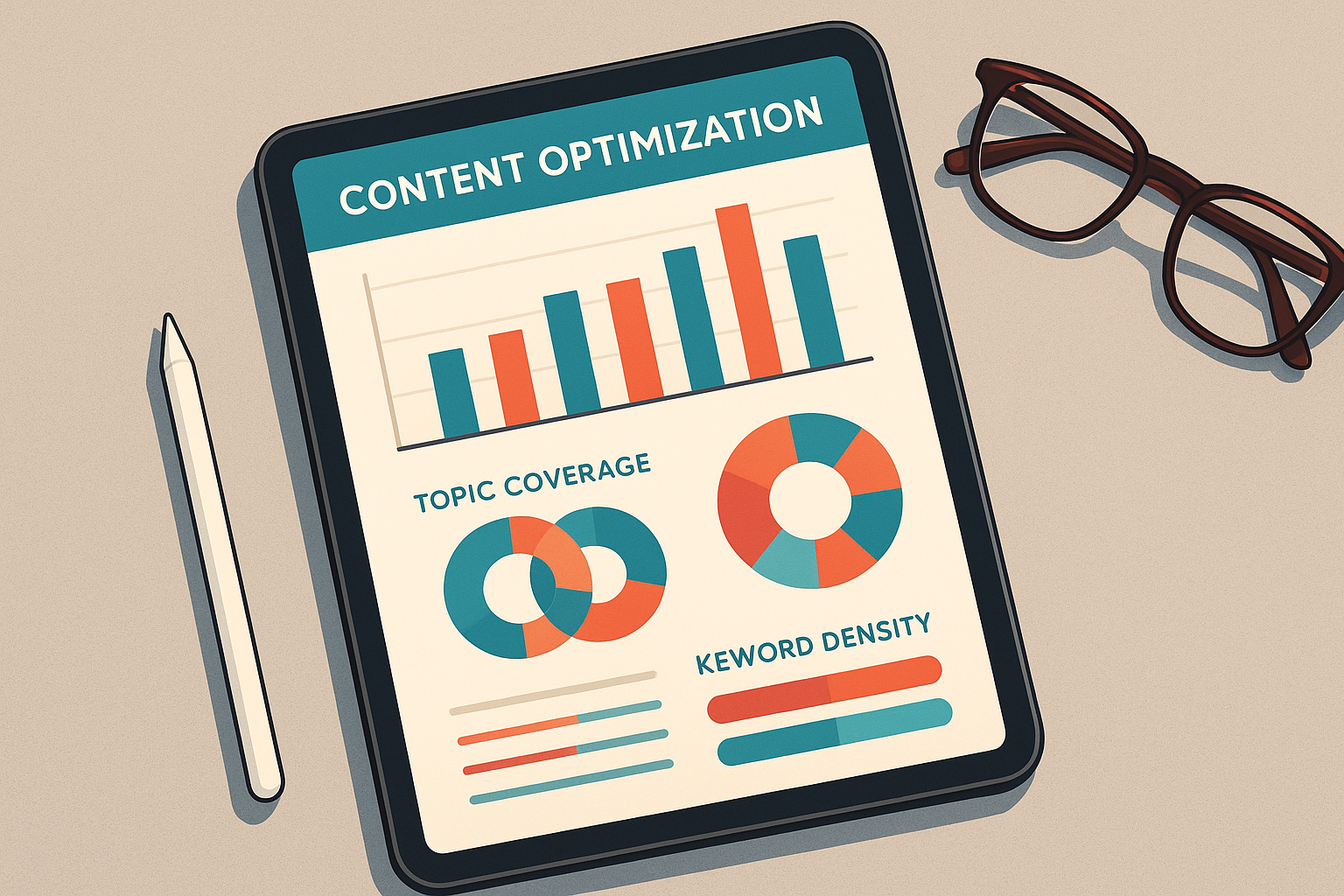
Modern AI content optimization interfaces make it easy to spot topic gaps and improve content quality before publishing.
Top AI Based SEO Content Tools Compared
The market has matured rapidly. However, a handful of platforms consistently stand out based on real-world performance, feature depth, and user experience. Below is a practical comparison of the leading options — organized by use case so you can identify the best fit for your situation.
Free vs. Paid AI SEO Content Tools
Several platforms offer limited free tiers — for example, Frase provides a free trial, and Google’s own tools (Search Console, Keyword Planner) are entirely free. However, free tools rarely offer real-time content scoring or deep NLP analysis. Therefore, teams serious about ranking competitively should treat a paid AI based seo content tool as a core investment rather than an optional add-on. The ROI typically materializes within one to three months as optimized content begins climbing the SERPs.
How to Use AI Based SEO Content Tools: A Step-by-Step Process
Understanding the features is important. However, knowing exactly how to apply them in a repeatable workflow is what produces consistent ranking gains. Specifically, follow this process to get the most out of any AI based seo content tool.
-
1
Enter your target keyword and run a SERP analysis
The tool fetches live ranking data and identifies the topics, terms, and questions that appear across the top results. This becomes the foundation for your content plan. -
2
Generate an AI-powered content brief
In most platforms, one click produces a structured outline with recommended H2s, H3s, semantic terms, word-count targets, and questions to answer. Use this as your writing blueprint. -
3
Write or paste your draft into the live editor
As you type, the tool scores your content in real time — flagging missing terms, sections that need expansion, and readability issues. You can see your score improve with each edit. -
4
Address semantic gaps and optimize for intent
Work through the tool’s keyword and topic recommendations systematically. Above all, prioritize the terms that appear most frequently across competing pages — these signal topical authority to Google. -
5
Publish and set up ongoing monitoring
After publishing, activate the tool’s content decay monitoring. Consequently, you will receive automatic alerts when rankings begin to slip — enabling proactive updates before traffic drops.
Content Updates: Why AI SEO Tools Are Essential for Long-Term Rankings
Publishing great content is only half the battle. Search rankings are not permanent — they shift as competitors publish new material, as Google updates its algorithms, and as user search behavior evolves. Therefore, content maintenance is just as important as content creation in any serious SEO strategy.
AI based seo content tools excel at this continuous improvement cycle. By connecting to your analytics and Search Console data, they can identify which pages are experiencing ranking drops and suggest targeted edits — new sections to add, outdated statistics to replace, or missing semantic terms to incorporate. For a deeper look at how to systematize this process, the guide on content updates for SEO at Rank Authority outlines a proven framework for keeping your content library competitive year-round.
Pro Insight
Pages that are regularly refreshed with AI-guided content updates tend to recover lost rankings 2 to 3 times faster than pages left untouched. This is because they signal freshness and continued relevance to search crawlers — a factor Google explicitly rewards.
How Often Should You Update Content With AI SEO Tools?
Most SEO professionals recommend a content audit cycle of every three to six months for high-priority pages. However, AI tools make this cadence manageable by automating the audit itself — surfacing the pages that need attention most urgently based on traffic trends, ranking position changes, and competitor activity. In contrast to manual reviews, this automated approach scales across hundreds of pages with no additional time investment.
What to Update: A Practical Refresh Checklist
When your AI tool flags a page for a content refresh, specifically focus on these high-impact update areas:
- → Replace outdated statistics with current data from authoritative sources
- → Add new sections covering topics that newly appeared in competitor content
- → Incorporate semantic terms your current content is missing
- → Expand thin sections that competitors now cover more thoroughly
- → Improve the introduction to more directly answer the primary search query
- → Update internal links to point to newer, relevant content on your site
AI SEO Tools for Different Team Types
The right tool depends heavily on your context. A solo blogger has very different needs from an enterprise content team. Similarly, a news publisher has different requirements from a B2B SaaS company. Here is how to match the tool category to your situation.
Solo Bloggers and Freelance Writers
For solo creators, the priority is speed and simplicity. Therefore, look for all-in-one platforms that handle research, brief generation, writing assistance, and optimization in a single interface — without requiring you to switch between multiple tools. Specifically, tools like Frase and Surfer SEO are popular choices at this level because they minimize setup and deliver immediate scoring feedback.
Content Agencies and SEO Teams
Agencies need platforms with robust workflow management, multi-user access, and the ability to produce briefs at scale. In addition, white-label reporting features are valuable for client-facing work. Tools like Surfer SEO and MarketMuse address these requirements well. Furthermore, API access allows agencies to build custom integrations with their existing project management systems.
Enterprise and In-House Content Teams
Enterprise teams typically manage large content inventories. Consequently, they need platforms with advanced content decay monitoring, inventory analysis, and the ability to prioritize hundreds of pages simultaneously. Clearscope and MarketMuse are particularly strong at the enterprise level. Above all, the scoring methodology must be transparent enough for non-SEO stakeholders — such as editors and executives — to understand and act on.

A well-structured AI content pipeline moves from data research through creation to measurable ranking growth.
Common Mistakes When Using AI Based SEO Content Tools
Even the best tool produces poor results when misused. Therefore, understanding the most common pitfalls will save you time and protect your rankings.
❌ Treating the AI score as the only goal
A perfect optimization score does not guarantee rankings. Search engines also evaluate brand authority, backlink profiles, and page experience. Consequently, use the score as a directional guide — not as a definition of success. For a deeper walkthrough, see our AI Visibility Audit: The Complete Guide to Rankings.
❌ Publishing AI-generated content without human editing
Raw AI drafts often lack the nuance, accuracy, and brand voice that readers expect. Furthermore, Google’s quality raters are trained to identify thin, generic content. Always apply human editorial review before publishing.
❌ Ignoring search intent in favor of keyword density
Including every suggested term without considering whether it serves the reader is a common mistake. Specifically, forcing keyword variants into irrelevant sentences creates awkward content that ranks briefly, then drops. Intent alignment always takes priority.
❌ Setting and forgetting after initial optimization
The SEO landscape changes continuously. Therefore, pages that ranked well in January may slip by July without any updates. Use your tool’s monitoring features to catch decay early and respond proactively.
Choosing the Right AI Based SEO Content Tool for Your Needs
The market for AI SEO tools has expanded rapidly. Consequently, choosing the right platform depends on your team size, publishing volume, and technical comfort level. Solo bloggers often benefit most from all-in-one tools that handle research, writing, and optimization in a single interface. Agencies and enterprise content teams, in contrast, typically need platforms with robust workflow management, team collaboration features, and API access for custom integrations.
Regardless of scale, the non-negotiables remain the same. Specifically, the tool must be grounded in real SERP data, it must update its models regularly to reflect algorithm changes, and it must make its recommendations transparent enough for writers to understand and act on — not just follow blindly.
Evaluation Checklist
- → Does it analyze live SERP data, not cached snapshots?
- → Does it support semantic NLP-based keyword suggestions?
- → Does it integrate with your existing CMS or publishing workflow?
- → Does it offer content decay monitoring and update alerts?
- → Is the scoring methodology transparent and explainable?
- → Does it classify and align content with search intent?
- → Does it support team collaboration and workflow management?
Frequently Asked Questions About AI Based SEO Content Tools
The Future of AI Based SEO Content Tools
AI based seo content tools are evolving rapidly. Several emerging trends will shape how these platforms work over the next few years. Understanding them now positions you to adopt new capabilities early — before your competitors do.
Generative AI and Content Production at Scale
Large language models — for example, GPT-4 and its successors — are increasingly integrated directly into SEO content platforms. Consequently, the line between “optimization tool” and “content creation tool” is blurring. Future platforms will likely handle the entire journey from keyword research to fully drafted, optimized, and published content in a single automated workflow.
AI Overviews and the Rise of Zero-Click Search
Google’s AI Overviews feature — which generates summaries directly in search results — is changing how users interact with organic listings. As a result, AI based seo content tools are beginning to optimize not just for blue-link rankings, but also for inclusion in AI-generated answer boxes. This requires even greater topical depth, clearer source attribution, and more structured content formats.
Personalized Content Optimization
Emerging tools are beginning to personalize optimization recommendations based on a specific site’s historical performance, audience profile, and competitive niche. In contrast to generic SERP-based suggestions, these personalized recommendations account for the unique authority signals and content patterns that make your site distinct — producing more accurate and actionable guidance.
Conclusion: Making AI Based SEO Content Tools Work for You
The adoption of AI based seo content tools is no longer a competitive advantage reserved for large enterprises — it is rapidly becoming the baseline expectation for any content team serious about organic growth. These tools compress weeks of manual research into minutes, surface optimization opportunities that human review would miss, and provide a continuous feedback loop that keeps your content performing long after its initial publication date.
The key is to treat AI as a collaborator, not a replacement for editorial judgment. Specifically, use it to handle the data-heavy lifting — SERP analysis, semantic gap identification, content scoring — while your human writers focus on voice, accuracy, and genuine expertise. That combination of machine precision and human creativity is what produces content that both ranks and resonates.
To explore a comprehensive suite of AI-powered SEO solutions built around this philosophy, visit Rank Authority — where cutting-edge AI based seo content tools meet practical, results-driven strategy.
For a deeper walkthrough, see our AI-Driven Content Marketing: The Complete Guide.
This article is produced by the editorial team at Rank Authority. All recommendations are based on independent research and practitioner experience.

