
Complete 2025 Guide
The landscape of digital marketing has fundamentally shifted. Understanding which platforms genuinely move the needle is now a competitive necessity — not a luxury. For essential statistics, explore the latest insights on AI Content Marketing Stats.
AI content strategy tools are software platforms that use artificial intelligence to help marketers, SEO professionals, and content teams plan, research, create, and optimize content at scale — faster and with greater precision than traditional manual methods. If you have been wondering how top-ranking websites consistently publish authoritative, well-structured content across dozens of topics, the answer almost always involves at least one of these platforms. This guide breaks down everything you need to know: what these tools actually do, which categories matter most, how to evaluate them, and how to build a workflow that compounds your results over time.
Quick Answer
AI content strategy tools automate the most time-intensive parts of content marketing — keyword clustering, gap analysis, brief generation, and optimization scoring. The best platforms combine data intelligence with AI writing assistance to help teams produce content that ranks and converts, without sacrificing quality or topical depth.
What Are AI Content Strategy Tools?
AI content strategy tools is a broad category covering any software that applies machine learning, natural language processing, or large language models to the strategic planning and execution of content marketing. Unlike basic AI writing tools that simply generate text on demand, true content strategy platforms operate at a higher level — they analyze search intent, map topical authority, identify competitive gaps, and guide the entire content lifecycle from ideation through publication and performance tracking. To understand image optimization better, learn if Can AI Generate Accurate Image Alt Text?.
According to Wikipedia’s overview of content strategy, the discipline involves the planning, development, and management of content — written or in other media. AI tools have dramatically expanded what’s possible within that framework by processing millions of data points in seconds, surfacing insights that would take human analysts weeks to compile manually.
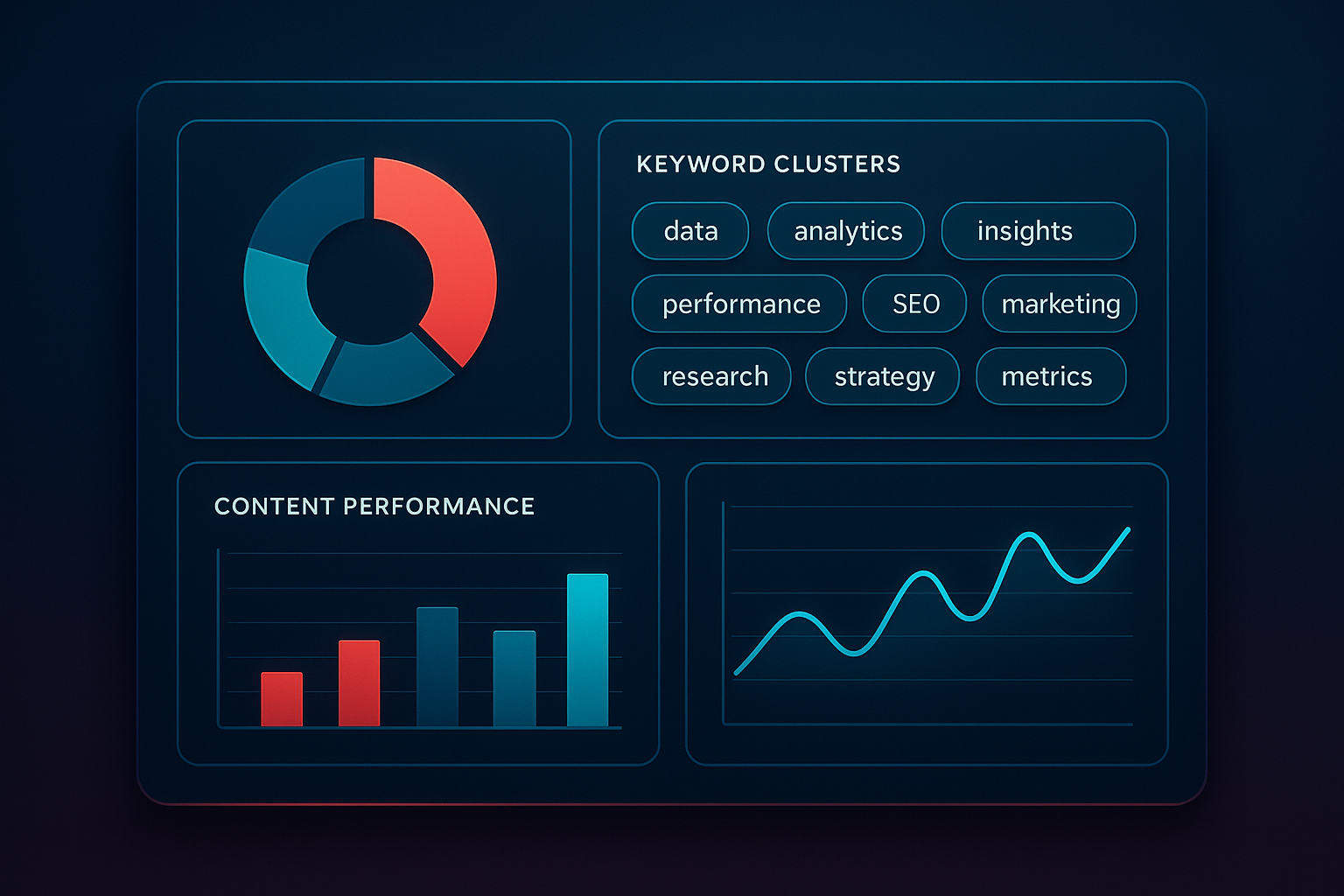
A modern AI content strategy tools dashboard — turning raw data into actionable content plans.
The 5 Core Categories You Need to Understand
Not all platforms do the same thing. Understanding the five functional categories helps you build a stack that covers every phase of your content operation without redundancy.
01 — Keyword Intelligence & Clustering
These tools go beyond basic keyword research to group semantically related terms into topic clusters, identify search intent patterns, and prioritize opportunities based on difficulty, volume, and business relevance. Examples include Semrush’s Keyword Magic Tool and Ahrefs’ keyword explorer with clustering capabilities.
02 — Topical Authority Mapping
Platforms in this category help you visualize and build topical authority by mapping pillar pages, supporting content, and internal link architecture. Tools like Clearscope and MarketMuse analyze how comprehensively your site covers a subject relative to top-ranking competitors.
03 — AI Content Brief Generation
These tools automatically produce structured content briefs — including recommended headings, semantic keywords, word count targets, and competitor references — so writers can produce optimized content without needing deep SEO expertise themselves. For insights on SEO strategies, see how How Can AI Change the Way I Do SEO?.
04 — On-Page Optimization & Scoring
Real-time content scoring tools analyze your draft against top-ranking pages and provide actionable recommendations for improving semantic relevance, readability, entity coverage, and structural clarity before you hit publish.
05 — Performance Analytics & Content Auditing
Post-publication tools track rankings, organic traffic, engagement metrics, and content decay over time — flagging underperforming pages for refresh, consolidation, or strategic removal. This closes the loop between strategy and measurable ROI.

Mapping a structured content workflow is the foundation of any effective AI-assisted strategy.
How to Evaluate and Choose the Right Tools
The market for AI content strategy tools is crowded, and vendor claims can be difficult to parse. Here is a practical evaluation framework that cuts through the noise: To explore image strategies, see if Can AI Generate Accurate Image Alt Text?.
Evaluation Checklist
- ✓ Does it integrate with Google Search Console and your CMS?
- ✓ Does it support your content volume and team size at a sustainable cost?
- ✓ Is its keyword and ranking data sourced from reliable, up-to-date indexes?
- ✓ Does it offer topical gap analysis, not just keyword volume metrics?
- ✓ Can it audit and score existing content, not just new content?
One factor that is consistently underweighted in tool evaluations is how well a platform handles supplementary content. Supporting pages — FAQs, glossaries, comparison pages, and related resource hubs — are critical for building topical authority. If you want to understand how supplementary content fits into a broader SEO strategy, the detailed breakdown at Rank Authority’s guide on supplementary content is an excellent starting point for structuring your supporting content architecture. For insights on content marketing, review how to leverage How to Leverage AI for Content Marketing.
Building a High-Performance AI Content Workflow
Having the right tools is only half the equation. The other half is workflow design. Here is how high-performing content teams structure their AI-assisted process:
Cluster First, Write Second
Use your AI tool to build keyword clusters and a topic map before assigning a single piece of content. This ensures every article supports a pillar and no effort is wasted on orphaned content.
Generate AI Briefs, Then Add Human Expertise
Let the tool produce the structural skeleton — headings, semantic terms, word count — then layer in original insights, data, and brand voice. This produces content that is both algorithmically strong and genuinely useful to readers.
Score Before You Publish
Run every piece through an on-page optimization tool before hitting publish. Aim for a consistent benchmark score across all content to ensure baseline quality is maintained at scale.
Audit Quarterly, Refresh Strategically
Schedule regular content audits using your analytics and auditing tools. Identify pages losing rankings, update them with fresh data and improved optimization, and consolidate thin content that is splitting topical authority. To enhance your understanding, check out the guide on AI Content Creation Platform: The Complete Guide 2025.
AI Content Strategy Tools and the ROI Question
Every investment in tooling eventually faces a return-on-investment question. The honest answer is that AI content strategy tools deliver measurable ROI primarily through three mechanisms: reduced time-to-publish, improved ranking rates on new content, and faster recovery of underperforming pages. Teams that implement a structured AI-assisted workflow typically report 30–50% reductions in the time required to take a content idea from research to publication, while simultaneously improving the percentage of new content that reaches page one within 90 days.
For a deeper look at how AI fits into a complete SEO investment strategy — including how to measure returns across content, technical, and authority-building activities — the Rank Authority 2026 AI SEO playbook provides a comprehensive framework built specifically for teams that need to justify and scale their AI-driven content investments. To explore AI-driven strategies, consider this resource on AI Content Writing for SEO: The Complete Guide.

Measuring ROI from AI content strategy tools requires tracking ranking rates, publish velocity, and content refresh outcomes. To find out about AI benefits, discover if small businesses can Can Small Businesses Benefit from AI in Search?.
Frequently Asked Questions
How do AI content strategy tools improve SEO performance?
AI content strategy tools improve SEO by identifying high-opportunity keywords, analyzing competitor content gaps, generating optimized content briefs, and providing real-time on-page recommendations — all of which help content rank higher and attract more organic traffic faster than manual methods alone.
What features should I look for in an AI content strategy tool?
Prioritize keyword clustering, topical authority mapping, AI-generated content briefs, competitor gap analysis, real-time content scoring, internal linking suggestions, and integration with Google Search Console. The best tools combine all of these into a single coherent workflow rather than forcing you to switch between disconnected platforms. For a deeper dive into image alt text, see if Can AI Generate Accurate Image Alt Text?.
Are AI content strategy tools suitable for small businesses?
Yes. Many platforms offer tiered pricing that makes them accessible to small businesses and solo marketers. Even entry-level plans provide significant advantages in content planning and SEO optimization compared to entirely manual methods, and the time savings alone typically justify the cost within the first month of use.
How does supplementary content affect an AI content strategy?
Supplementary content — FAQs, related tools pages, glossaries, and supporting blog posts — strengthens topical authority and improves internal link architecture, both of which are core components of a successful AI-driven content strategy. AI tools that map topical gaps will often surface supplementary content opportunities as high-priority items precisely because they carry disproportionate authority-building value.
Conclusion
AI content strategy tools are no longer optional for teams that want to compete in organic search. They compress the research-to-publish timeline, surface opportunities that manual analysis misses, and create a feedback loop that continuously improves content performance. The key is not to find the single perfect tool, but to assemble a complementary stack that covers keyword intelligence, topical authority, brief generation, on-page optimization, and performance auditing — then build a disciplined workflow around it. For a broader perspective, review the key findings on AI Key Findings Revealed: 200,000 Dataset.
Whether you are a solo marketer or managing a large content operation, the right combination of AI content strategy tools will be the single highest-leverage investment you make in your organic growth this year.

