
Search engines are smarter than ever — and your audit process needs to match. An AI-driven onpage SEO audit gives you the precision, speed, and depth that manual reviews simply cannot deliver.
An AI-driven onpage SEO audit is an automated, intelligence-powered analysis that examines every critical on-page element of your website — from title tags and heading structure to content relevance, internal linking, and Core Web Vitals — then delivers a ranked list of fixes that will move the needle on your search rankings. Unlike spreadsheet-based manual reviews, AI audits process hundreds of signals simultaneously, surfacing the issues that matter most with remarkable speed and accuracy.
An AI-driven onpage SEO audit uses machine learning and natural language processing to automatically evaluate your web pages against hundreds of ranking signals. It identifies critical issues, prioritizes them by impact, and provides specific, actionable recommendations — all within minutes.
What Is an AI-Driven Onpage SEO Audit?
An AI-driven onpage SEO audit is a systematic, technology-powered evaluation of every element on a webpage that influences its ability to rank in search engines. Traditional audits required an SEO specialist to manually check title tags, scan for duplicate content, assess keyword placement, and review internal link architecture — a process that could take days for a medium-sized site.
AI-powered auditing platforms change this equation entirely. They crawl your site at scale, apply natural language processing (NLP) to evaluate content quality and topical relevance, benchmark your pages against top-ranking competitors, and produce a prioritized action plan. According to Wikipedia’s overview of search engine optimization, onpage factors remain among the most controllable and impactful levers available to site owners — making systematic auditing essential.

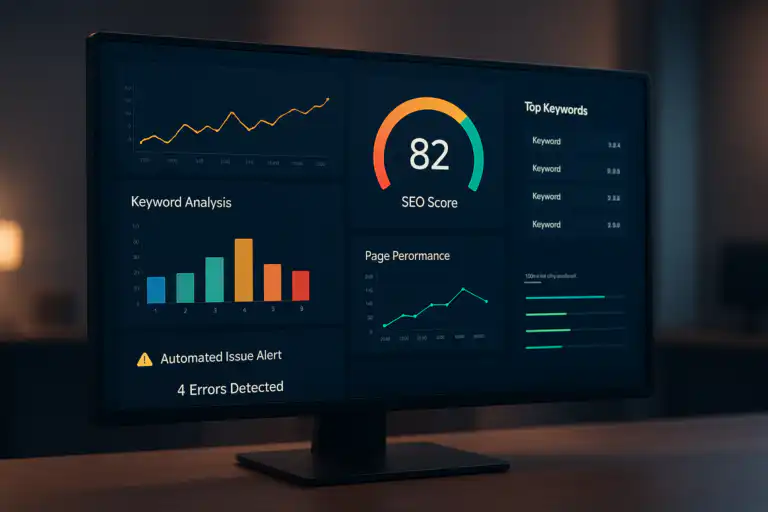
A modern AI-driven onpage SEO audit dashboard consolidates hundreds of signals into one actionable view.
Why Traditional Audits Fall Short
Manual onpage audits have three fundamental limitations: they are slow, they are inconsistent, and they cannot process competitive context at scale. A human reviewer checking 500 pages will inevitably miss patterns that only become visible when comparing thousands of data points simultaneously.
AI eliminates these gaps. Machine learning models trained on millions of ranking outcomes can detect subtle correlations — like the relationship between heading hierarchy depth and featured snippet eligibility — that no manual checklist would capture. The result is a more complete, more accurate, and ultimately more valuable audit.
- Days to complete
- Reviewer-dependent accuracy
- Limited competitive data
- Point-in-time snapshot only
- High labor cost
- Minutes to complete
- Consistent, objective scoring
- Competitor benchmarking built-in
- Continuous monitoring available
- Scalable at low cost
Core Elements Analyzed in an AI Onpage SEO Audit
A comprehensive AI audit evaluates the full spectrum of onpage factors. Here is what the best platforms examine:
1. Title Tags and Meta Descriptions
AI checks character length, keyword presence, click-through appeal, and uniqueness across all pages simultaneously. It flags duplicates and weak titles that fail to match search intent.
2. Content Quality and Topical Depth
Using NLP, the AI evaluates whether your content comprehensively covers a topic, identifies semantic gaps compared to top-ranking pages, and scores readability. Thin or shallow content is flagged immediately.
3. Heading Structure and Keyword Placement
The audit maps your H2–H6 hierarchy, checks for keyword cannibalization, and ensures your primary and secondary terms appear in contextually appropriate positions.
4. Internal Linking Architecture
AI maps your internal link graph, identifies orphan pages, detects over-linked anchor text, and recommends new internal links to distribute PageRank more effectively.
5. Image Optimization
Missing alt attributes, oversized images, and non-descriptive file names are all surfaced automatically — issues that are easy to overlook in manual reviews.
6. Page Speed and Core Web Vitals
The AI correlates your Largest Contentful Paint (LCP), Cumulative Layout Shift (CLS), and Interaction to Next Paint (INP) scores with ranking positions, helping you prioritize performance fixes with the highest ROI.

Color-coded severity levels help teams triage and fix the most impactful onpage issues first.
How to Run an AI-Driven Onpage SEO Audit: Step-by-Step
- Define your audit scope. Decide whether you are auditing the entire domain, a specific subdirectory, or a cluster of priority pages. Focused audits deliver faster, more actionable results.
- Choose the right AI platform. Look for tools that combine crawling, NLP content analysis, competitor benchmarking, and structured data validation in a single workflow.
- Set your target keywords. Feed your primary and secondary keywords into the platform so the AI can evaluate keyword intent alignment across every page.
- Run the crawl and analysis. Let the AI process your pages. Most platforms complete a full site audit in under 30 minutes for sites up to 10,000 pages.
- Review prioritized recommendations. Focus on high-impact, low-effort fixes first — typically title tag corrections, missing meta descriptions, and broken internal links.
- Implement and monitor. Apply the recommended changes and schedule recurring audits. Platforms like Rank Authority’s real-time SEO issue alerts notify you the moment new problems emerge, so you never fall behind.
The Role of AI in Content Gap Analysis
One of the most powerful — and often underutilized — features of modern AI audit platforms is content gap analysis. The AI compares your page’s topical coverage against the top 10 ranking pages for your target keyword and identifies the subtopics, entities, and questions your content is missing.
This goes far beyond keyword density checks. The system understands semantic relationships between concepts, meaning it can tell you not just that a keyword is missing, but that an entire subtopic your audience cares about is absent from your content. Filling these gaps consistently produces measurable ranking improvements within weeks.
For teams looking to streamline this process further, Rank Authority’s 1-click AI SEO feature automates the implementation of audit recommendations directly, collapsing the gap between insight and action.

AI maps your content’s topical coverage as a network, instantly revealing gaps your competitors are filling.
Frequently Asked Questions
Making AI Audits Part of Your Ongoing SEO Strategy
The most successful SEO teams do not treat audits as one-time events. They build AI-driven auditing into a continuous improvement loop: audit, fix, monitor, and re-audit. This cadence ensures that algorithm updates, content changes, and technical drift are caught and corrected before they cause ranking losses.
Integrating your audit workflow with your content calendar is equally important. Every new page published should be audited immediately post-launch, and every significant content update should trigger a re-evaluation of the page’s full onpage profile.
Key Takeaway
Treat your AI audit platform as a permanent member of your SEO team — one that works around the clock, never misses a detail, and scales effortlessly as your site grows.
Conclusion
An AI-driven onpage SEO audit is no longer a luxury reserved for enterprise SEO teams with large budgets. It is an accessible, essential practice for any website owner serious about organic growth. By automating the detection of onpage issues, benchmarking content against competitors, and delivering prioritized recommendations in real time, AI auditing compresses the path from problem to solution — and from problem to ranking improvement.
The competitive landscape rewards speed and precision. Organizations that adopt AI-driven auditing as a standard operating procedure will consistently outpace those still relying on periodic manual reviews. Start your first audit today, establish a recurring cadence, and let the data guide every optimization decision you make.

