

Complete 2026 Guide
AI Optimization Tools: The Complete Guide to Ranking Higher, Faster
Everything you need to choose, use, and maximize AI-powered tools that transform how websites rank — from keyword research and content scoring to technical audits and predictive modeling. For a deeper walkthrough, see our How Can I Leverage AI Insights for Content Creation?.
Quick Answer
AI optimization tools are software platforms powered by machine learning that automate SEO analysis, surface data-driven content recommendations, and continuously improve website rankings. They dramatically reduce manual effort, improve decision accuracy, and help websites adapt faster to algorithm changes than any manual process allows.
What Are AI Optimization Tools?
AI optimization tools are the direct answer to one of digital marketing’s biggest problems: too much data, too little time. These platforms use artificial intelligence and machine learning — a branch of AI where systems improve automatically through experience — to analyze search engine data, competitor content, and user behavior at a scale no human team could replicate manually.
In practical terms, where a traditional SEO audit might take a specialist several hours to complete, an AI-driven platform can crawl thousands of pages, cross-reference competitor data, and produce a prioritized action plan in minutes. Furthermore, unlike static legacy tools that simply report what happened, AI optimization tools recommend what to do next — and predict what will happen if you do it.
The term covers a broad spectrum of use cases. Some tools focus exclusively on keyword research and content scoring. Others specialize in technical SEO audits, backlink analysis, or conversion rate optimization. The most sophisticated platforms, however, integrate all of these capabilities into a unified intelligence layer that learns continuously from your site’s unique performance data.
According to Wikipedia’s overview of search engine optimization, the discipline has evolved significantly with machine learning — shifting from keyword stuffing and link schemes toward genuine relevance signals. AI tools are uniquely positioned to support and accelerate that evolution.
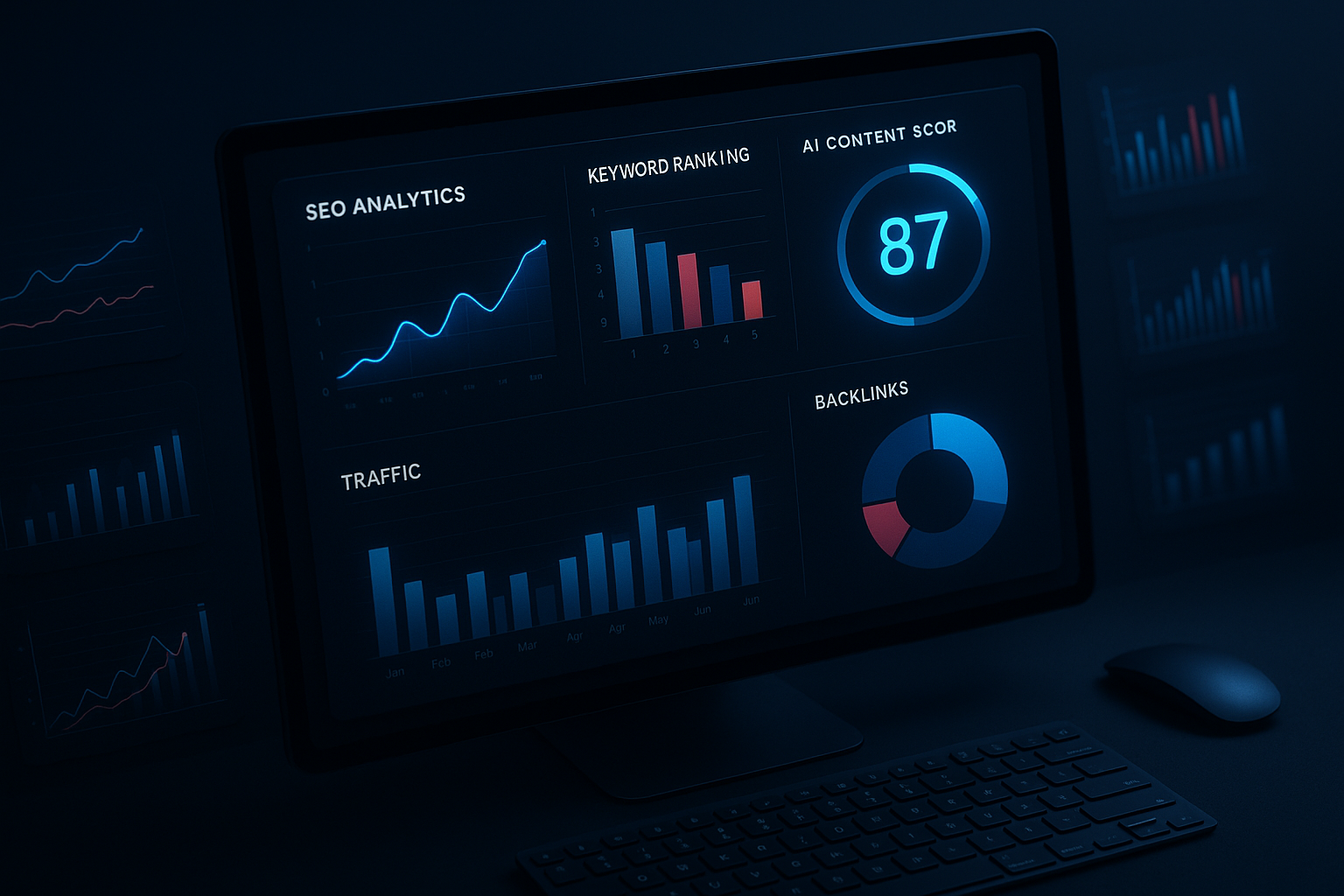
A modern AI optimization tools dashboard consolidates SEO data, content scores, and ranking insights into one actionable view.
How AI Optimization Tools Improve SEO Rankings
AI optimization tools improve SEO rankings by processing vast datasets — search queries, SERP patterns, competitor content structures, and user behavior signals — and translating that raw data into specific, prioritized recommendations that humans simply cannot derive manually at the same speed or scale.
Specifically, here is how that improvement plays out across the four key pillars of modern SEO: For a deeper walkthrough, see our AI Key Findings Revealed: 200,000 Dataset.
Keyword Intelligence
AI models analyze search intent patterns, semantic relationships between terms, and real-time volume shifts to recommend keywords with the highest probability of ranking success for your specific domain authority. As a result, you stop chasing high-volume terms you can’t realistically win and start targeting attainable, high-ROI opportunities.
Content Optimization
Natural language processing (NLP) engines — systems that interpret human language at scale — compare your content against top-ranking pages, identifying missing topics, suboptimal heading structures, and semantic gaps that suppress visibility. Consequently, every content revision is guided by data rather than guesswork.
Technical SEO Auditing
Automated crawlers detect crawlability issues, Core Web Vitals failures, duplicate content, broken links, and schema errors — then rank them by estimated ranking impact. Therefore, you always fix what matters most first, rather than working through a flat list of issues in arbitrary order.
Predictive Ranking Modeling
Advanced platforms use historical ranking data and regression models — statistical techniques that measure how one variable affects another — to forecast how a proposed change will affect rankings before you publish it. In addition, this predictive layer helps you prioritize high-impact changes over low-value busywork.
The Role of Machine Learning in Continuous Improvement
Unlike rule-based SEO software, AI optimization tools improve over time. Each search query processed, each content score calculated, and each ranking fluctuation tracked feeds back into the model. Therefore, a platform used for six months is meaningfully smarter than the same platform on day one.
This compounding learning effect is, above all, the central reason why organizations that adopt AI optimization tools early consistently outpace competitors who delay adoption. The earlier you start, the more personalized and precise the recommendations become for your specific domain and industry.
The 7 Categories of AI Optimization Tools You Need to Know
Not all AI optimization tools serve the same purpose. Understanding the distinct categories helps you build a stack that covers every optimization layer without unnecessary overlap or budget waste. Here is a complete breakdown of every major category available in 2026.
01 — AI Content Optimization Platforms
Tools like Surfer SEO, Clearscope, and MarketMuse score your content against top SERP results using NLP. They recommend specific word count targets, topic coverage requirements, and entity inclusion to match search intent precisely. Furthermore, they generate detailed content briefs that non-specialists can execute without deep SEO knowledge.
Best for: Content teams, bloggers, and content-heavy B2B sites.
02 — AI Keyword Research Tools
These platforms cluster keywords by intent, identify low-competition opportunities, and map search demand curves over time. In contrast to legacy tools that return flat volume lists, AI keyword tools surface topical authority gaps, suggest content hub structures, and highlight emerging queries before they become competitive.
Best for: SEO strategists building long-term topical authority.
03 — Technical SEO Automation Tools
AI-enhanced crawlers continuously monitor site health, auto-generate schema markup, flag Core Web Vitals regressions, and — in some cases — push fixes directly to your CMS without manual intervention. Similarly, they alert you the moment a crawl error or indexation problem emerges, rather than waiting for your next scheduled audit.
Best for: Large sites with complex technical architectures and frequent publishing.
04 — AI Link Building and Outreach Tools
Machine learning models identify high-authority link prospects, qualify them against relevance and spam signals, and personalize outreach emails at scale. As a result, acquisition rates improve dramatically compared to generic mass-outreach campaigns. These tools also monitor your backlink profile continuously, alerting you to toxic link acquisition or unexpected link losses.
Best for: Link building teams and agencies managing multiple client profiles.
05 — Conversion Rate Optimization (CRO) AI
CRO AI tools analyze user behavior heatmaps, session recordings, and A/B test results to recommend layout changes, CTA copy variations, and page flow improvements that increase conversions. Specifically, they correlate on-page behavior patterns with conversion outcomes — identifying friction points that traditional analytics dashboards often miss entirely.
Best for: E-commerce sites, SaaS landing pages, and lead generation funnels.
06 — All-in-One AI SEO Suites
Comprehensive platforms unify content optimization, technical auditing, keyword research, and competitive intelligence into a single interface. Consequently, teams spend less time switching between tools and more time acting on insights. Platforms like Semrush, Ahrefs, and Moz Pro have each integrated significant AI layers into their core functionality.
Best for: In-house SEO teams and agencies requiring a single source of truth.
07 — AI-Powered Rank Tracking and Reporting Tools
Beyond static rank trackers, AI-powered reporting tools identify ranking trend patterns, correlate traffic changes with algorithm updates, and auto-generate executive summaries. In addition, they segment ranking performance by device, location, and search feature type — giving you granular visibility that traditional rank trackers cannot match.
Best for: Reporting-heavy agencies and marketing directors accountable for organic traffic KPIs.

Professionals using AI optimization tools can process weeks of manual SEO analysis in a single session. For a deeper walkthrough, see our How Can AI Tools Enhance My Marketing Strategy?.
Top AI Optimization Tools Compared: Features, Pricing, and Best Use Cases
With hundreds of platforms competing for budget, understanding how the leading tools actually compare is essential before you invest. Below is a structured comparison of the most widely adopted AI optimization tools across key performance dimensions.
Free vs. Paid AI Optimization Tools: What You Actually Get
Several strong AI optimization tools offer meaningful free tiers. However, the gap between free and paid functionality is significant in most cases. Free plans typically limit the number of keyword queries, content analyses, or crawl pages per month. In contrast, paid plans unlock continuous monitoring, deeper competitor intelligence, and integrations with Google Search Console and Analytics.
For small businesses or solo operators just beginning their AI SEO journey, starting with a free-tier tool like MarketMuse or Frase is a sensible entry point. As your site grows and your content operation scales, the economics of paid plans become increasingly favorable compared to the cost of manual analyst hours.
Are AI Optimization Tools Right for Small Businesses?
Absolutely. The misconception that AI optimization tools are exclusively enterprise-grade software has been thoroughly dismantled by the current market. Most major platforms now offer tiered pricing, with entry-level plans accessible to solo operators and small teams who lack a dedicated SEO function.
For a small business owner without an internal SEO team, these tools essentially act as an on-demand analyst. They surface the highest-priority fixes, generate content briefs a non-specialist can execute, and monitor rankings automatically. Consequently, they compress what would otherwise require multiple hires into a single affordable monthly subscription.
Specifically, small businesses benefit most from AI optimization tools in three areas: For a deeper walkthrough, see our How Can Entrepreneurs Benefit from AI in SEO?.
- Content brief generation — AI tools produce detailed briefs so a generalist writer can create topically authoritative content without deep SEO knowledge.
- Automated rank monitoring — Instead of manually checking rankings, AI tools alert you the moment a keyword moves significantly, saving hours of routine tracking work.
- Competitive gap analysis — AI platforms identify exactly which keywords and topics your direct competitors rank for that you don’t — giving small businesses a clear, prioritized roadmap for growth. For a deeper walkthrough, see our Can Small Businesses Benefit from AI in Search?.
Resources like Rank Authority provide curated guidance on which AI optimization tools deliver the best ROI for different business sizes and industries — making the selection process significantly less overwhelming for owners who are new to the space. For a deeper walkthrough, see our AI Scorecard: The Complete Guide to Smarter SEO.
How to Choose the Right AI Optimization Tool Stack
With hundreds of platforms competing for your budget, a structured evaluation framework is essential before committing. Consider these five criteria — and apply each honestly to your actual situation rather than the site you plan to have:
How to Build a Minimal Viable AI SEO Stack
You don’t need every category of AI optimization tool to see results. In fact, overbuilding your stack too early creates decision paralysis and budget waste. Instead, consider this three-tier entry approach:
- Tier 1 — Foundation (Start Here): One all-in-one suite (Semrush or Ahrefs) covering keyword research, site auditing, and competitor analysis.
- Tier 2 — Content Layer: One AI content optimization platform (Surfer SEO or Frase) for content scoring and brief generation.
- Tier 3 — Conversion Layer: Add a CRO AI tool (Hotjar AI, Microsoft Clarity) only after your organic traffic justifies the conversion investment.
Step-by-Step: How to Implement AI Optimization Tools in Your SEO Workflow
Owning AI optimization tools is only the first step. The teams and individuals who see the greatest return are those who integrate these platforms into a repeatable, documented workflow — rather than using them reactively when rankings drop.
-
Step 1 — Run a Full Technical Audit
Use your AI technical SEO tool to crawl the entire site. Prioritize critical errors — broken links, crawl blocks, missing canonical tags, and Core Web Vitals failures — before any content work begins. Fixing the foundation first ensures your subsequent content investment isn’t undermined by indexation problems.
-
Step 2 — Map Keyword Opportunities
Pull a keyword gap report from your AI keyword tool. Specifically, identify terms your competitors rank for that you don’t — filtered by keyword difficulty relevant to your current domain authority. This produces a prioritized list of attainable targets rather than an aspirational wish list. For a deeper walkthrough, see our AI Insights for Marketers: Smarter Campaigns in 2025.
-
Step 3 — Generate Content Briefs
For each target keyword, use your AI content platform to generate a comprehensive brief: recommended word count, required topics, target entities, and competitor heading structures. Consequently, your writers receive clear, data-backed direction before they begin — rather than vague instructions to “write something about [topic].”
-
Step 4 — Create, Optimize, and Publish
Draft content against the AI brief, then run it through the content scoring tool before publishing. Target a content score in the top quartile of your niche — not a perfect 100. Over-optimization can signal keyword stuffing to modern search algorithms, so aim for thorough topic coverage rather than score chasing.
-
Step 5 — Monitor Rankings and Traffic
Set up automated rank tracking and traffic alerts in your AI suite. Monitor new page performance for the first 90 days post-publish. Additionally, track impressions in Google Search Console to identify early ranking signals before traffic materializes — a leading indicator that your content is entering consideration for relevant SERPs.
For a deeper walkthrough, see our AI Rank Checker: Track Your SEO Rankings Smarter.
-
Step 6 — Iterate Based on Performance Data
After 90 days, return to each published piece. Use your AI content tool to re-score against updated SERP data — top-ranking pages change, and your content’s competitive position shifts accordingly. Update content quarterly to maintain relevance, add new data points, and address emerging subtopics that search queries reveal.

The machine learning networks powering modern AI optimization tools process billions of data points to surface precise ranking recommendations.
Common Mistakes When Using AI Optimization Tools
Even powerful tools produce poor results when used incorrectly. Understanding these common failure patterns will save you both time and budget.
- Implementing AI recommendations blindly. AI tools generate data-driven suggestions, but they lack awareness of your brand voice, business model, and content strategy. Therefore, treat every recommendation as an input to a human decision — not an automatic output to execute without review.
- Optimizing for content scores instead of users. Content scoring tools measure NLP alignment with top-ranking pages. However, a high score on paper does not guarantee a good reading experience. Consequently, always review AI-optimized content for natural flow, clarity, and genuine usefulness before publishing.
- Neglecting technical SEO in favor of content. Many users focus almost exclusively on content optimization while ignoring crawl errors and Core Web Vitals issues that suppress rankings regardless of content quality. In particular, mobile page speed and Largest Contentful Paint (LCP) failures can cap rankings even on excellent content.
- Using too many overlapping tools. Stack bloat — maintaining multiple tools that serve identical functions — is a common waste pattern. Specifically, running three keyword tools simultaneously rarely produces three times the insight. Audit your stack every six months and eliminate redundancy.
- Treating AI SEO as a one-time project. Above all, the biggest mistake is deploying AI optimization tools for a single campaign and then going dormant. Sustained rankings require ongoing monitoring, quarterly content refreshes, and continuous adaptation to algorithm updates.
Frequently Asked Questions About AI Optimization Tools
What is the difference between traditional SEO tools and AI optimization tools?
Traditional SEO tools report data and surface insights that humans must interpret and act on. AI optimization tools go further — using machine learning to generate specific recommendations, predict ranking outcomes, automate routine tasks, and continuously improve their models as new data arrives. As a result, AI tools reduce manual effort by an order of magnitude while improving decision accuracy.
How often should I use AI optimization tools for my website?
For best results, AI optimization tools should operate on an ongoing basis rather than in periodic campaigns. Weekly content performance reviews, continuous rank monitoring, and quarterly content refreshes ensure your site adapts quickly to algorithm changes and competitive shifts. Furthermore, most platforms offer automated alerts so you can act on critical ranking changes in real time without manual monitoring.
Can AI optimization tools replace human SEO specialists?
Not entirely — and the distinction matters. AI optimization tools dramatically amplify what a specialist can accomplish by handling data processing, pattern recognition, and routine auditing automatically. However, strategic direction, brand voice, creative content decisions, and relationship-based link building still benefit meaningfully from human expertise. Consequently, the strongest results consistently come from combining both — AI handling scale and speed, humans providing judgment and strategy.
How long does it take to see results from AI optimization tools?
Results timelines vary by site authority, competition level, and the type of optimization applied. Technical fixes — resolving crawl errors, improving page speed — can produce ranking improvements within days or weeks. In contrast, content optimization and topical authority building typically show measurable ranking gains within 60 to 120 days. Therefore, set expectations accordingly and prioritize high-impact technical fixes before content investments.
Are AI optimization tools safe to use — will they trigger Google penalties?
Yes — when used as intended. Reputable AI optimization tools recommend improvements aligned with Google’s quality guidelines, not against them. The risk of penalties arises only when users abuse AI-generated content by publishing at scale without quality review, or when they mechanically over-optimize keyword density based on tool scores. Specifically, follow Google’s helpful content guidelines and treat AI recommendations as supporting your editorial process, not replacing it.
What is the best AI optimization tool for beginners?
For beginners, Frase and Surfer SEO offer the most accessible entry points due to their intuitive interfaces, clear actionable outputs, and relatively low starting prices. Similarly, Semrush‘s guided workflows make it manageable even for users without deep SEO backgrounds. Start with one tool, master its core features, and expand your stack only once you’re consistently acting on its recommendations.
Building a Sustainable AI-Powered SEO Workflow
The teams and individuals who see the greatest return from AI optimization tools are those who integrate them into a repeatable, documented workflow — not those who use them reactively when rankings drop. Structure is the difference between occasional wins and compounding organic growth.
A sustainable workflow follows this sequence: audit → prioritize → create → publish → monitor → iterate. AI tools support every stage — from the initial technical audit and content brief generation through to post-publish rank tracking and iterative optimization based on real performance data.
Above all, treat AI recommendations as inputs to a human decision-making process — not automatic outputs to implement blindly. Understanding why a tool recommends a specific change, and validating that recommendation against your broader content strategy, is what separates high-performing SEO teams from those who chase metrics without building lasting authority.
Conclusion
AI optimization tools represent the most significant shift in digital marketing efficiency since the introduction of analytics platforms. Whether you manage a single-page local business site or a multi-thousand-page content operation, the right combination of AI optimization tools removes the guesswork from SEO, accelerates content production, surfaces competitive gaps, and delivers ranking improvements that manual analysis alone cannot match.
For deeper guidance on selecting and implementing the right AI optimization tools for your specific goals, Rank Authority offers expert-curated reviews and strategy frameworks built for teams serious about sustainable, long-term search performance. For a deeper walkthrough, see our Can AI Help Improve My Website’s Search Rankings?.

