

Content Strategy · AI Tools · SEO for Creators
AI-Powered Keyword Research for Creators: The Complete 2025 Guide
“The creators who dominate search in 2025 are not working harder — they are letting AI find the doors that others walk right past.”
Direct Answer
AI-powered keyword research for creators is the use of artificial intelligence to automatically discover, analyze, and prioritize search terms matched to your niche, audience intent, and content goals. It replaces slow manual keyword hunting with intelligent, data-driven recommendations at scale — so whether you run a blog, YouTube channel, podcast, or newsletter, you consistently publish content that ranks. AI-powered keyword research for creators works by ingesting billions of search signals, applying natural language processing, and returning full topic clusters organized by intent — not just a flat list of keywords.
What Is AI-Powered Keyword Research for Creators?
AI-powered keyword research for creators is a fundamentally different approach to finding topics that rank. Specifically, it uses machine learning models — including natural language processing (NLP), the technology that helps computers understand human language — to analyze search behavior at a scale no human analyst could match. In short, it turns what used to be a days-long manual chore into a minutes-long, data-rich workflow.
Traditional keyword research meant opening a spreadsheet, pulling search volumes from a single tool, and manually judging whether a term was worth targeting. That process was slow, often inaccurate, and entirely dependent on the researcher’s intuition. AI changes every part of that workflow. Furthermore, it does something traditional tools simply cannot: it understands meaning behind search queries, not just the words themselves.
Modern AI keyword tools cross-reference billions of search signals against NLP models. As a result, they return entire topic clusters organized by intent. For example, they understand that someone searching “how to edit YouTube videos faster” and “best video editing shortcuts” is likely the same person at different stages of the same journey — and they surface both terms together so you can build content that captures the full funnel.
For creators specifically, this matters enormously. You are not an enterprise SEO team with ten analysts. Instead, you are one person — or a small team — trying to produce content that competes with publishers who have been online for decades. AI levels the playing field by giving you research capabilities that previously required an entire department.

AI-powered keyword research for creators surfaces entire topic clusters — giving solo creators the research power of a full SEO team.
Why Traditional Keyword Research Falls Short for Creators
The core problem with legacy keyword research is that it is reactive. You look at what already has search volume — which means you are always chasing topics that other creators have already staked out. By the time a keyword shows significant volume in a traditional tool, the competition has typically already moved in and published dozens of articles.
There is also a serious intent problem. A keyword with 10,000 monthly searches is worthless if the people searching it are not your audience. Traditional tools show you numbers. In contrast, AI tools show you meaning — they classify keywords by informational, navigational, transactional, and commercial intent so you know exactly what a searcher wants before you write a single word.
The Hidden Cost of Keyword Research Without AI
Without AI, creators typically spend four to eight hours per month on keyword research alone — and still miss dozens of high-value long-tail opportunities. Moreover, they frequently publish content targeting keywords that are misaligned with their actual audience’s needs. The result is wasted effort, low engagement, and rankings that plateau early.
There is also the problem of trend blindness. Traditional tools rely on historical data. Therefore, they are structurally unable to detect keywords that are beginning to rise before they appear in volume data. AI tools, however, can identify rising search trends weeks or months before they peak — giving you a critical first-mover advantage.
Key Research Finding
Research from Rank Authority’s analysis of 200,000 data points found that AI-driven content strategies consistently outperform manually researched approaches in organic click-through rates — particularly for long-tail and conversational queries that traditional tools tend to undervalue.
How AI Keyword Research Actually Works: A Step-by-Step Breakdown
Understanding the mechanics helps you use these tools more strategically. Consequently, you get better outputs and waste less time second-guessing the results. Here is exactly what happens under the hood when an AI keyword tool processes your niche:
-
STEP 1 — Seed Topic Ingestion
You enter a broad topic or URL. The AI crawls related SERPs, forums, Reddit threads, YouTube autocomplete, and Google Suggest data to build a comprehensive raw keyword universe around your niche — typically thousands of terms in seconds.
-
STEP 2 — Semantic Clustering
NLP models group related terms into topic clusters based on meaning, not just word overlap. This reveals how Google actually categorizes content in your space — and shows you which ideas belong together in a single piece versus which deserve their own dedicated article.
-
STEP 3 — Intent Classification
Each keyword is tagged with a search intent label — informational, commercial, transactional, or navigational. As a result, you know what format and content angle the piece needs before you write a word. A transactional keyword needs a landing page. An informational one needs a detailed guide.
-
STEP 4 — Opportunity Scoring
The AI weighs search volume, keyword difficulty, trend trajectory, SERP feature prevalence (featured snippets, People Also Ask boxes), and your domain’s current authority to score each keyword’s realistic ranking potential. Therefore, you prioritize effort where it will actually pay off.
-
STEP 5 — Content Gap Detection
The tool compares your published content against the full keyword universe to flag topics your competitors are ranking for that you have not yet covered. In other words, it hands you a prioritized list of untapped opportunities specific to your domain.
-
STEP 6 — Trend Forecasting
The most advanced AI keyword tools overlay real-time trend signals — from Google Trends, social listening, and news APIs — to flag keywords that are rising now. Consequently, you can publish content that captures traffic as a trend peaks, not after it has already faded.

Combining AI-generated insights with your editorial instincts produces a keyword strategy that is data-driven and deeply human.
The Best AI Keyword Research Tools for Creators in 2025
Choosing the right tool matters. Specifically, creators need tools that balance depth of data with speed of output — because time spent in research is time not spent creating. Below is an honest breakdown of the leading options and what each does best.
1. Ahrefs — Best for Comprehensive Competitor Gap Analysis
Ahrefs remains the gold standard for backlink data, but its AI-assisted keyword explorer is equally powerful. In particular, its Traffic Potential metric — which estimates how much organic traffic you can realistically win for a keyword cluster, not just a single term — is invaluable for creators planning pillar content strategies. Pricing starts at $129/month.
2. Semrush — Best for All-in-One Creator Workflow
Semrush’s Keyword Magic Tool generates keyword clusters instantly from a seed term. Furthermore, its Topic Research feature surfaces the exact questions and headlines your target audience is already engaging with — which is particularly useful for creators who need content angle ideas alongside raw keyword data. Pricing starts at $139.95/month.
3. Surfer SEO — Best for Real-Time Content Optimization
Surfer SEO bridges the gap between keyword research and content creation. Specifically, it analyzes the top-ranking pages for your target keyword and produces a Content Score that guides your writing in real time — telling you which semantically related terms to include, how long your article should be, and how to structure headings for maximum relevance. Pricing starts at $89/month.
4. LowFruits — Best for Long-Tail Opportunity Mining
LowFruits is purpose-built for creators and small sites. It identifies keywords where the current top-ranking pages are weak — forums, UGC pages, or thin content — signaling that a well-researched article from a creator could realistically displace them. In other words, it finds the easiest wins hidden inside large keyword sets.
5. Writesonic / Chatsonic — Best for AI-Native Ideation
AI writing platforms like Writesonic have expanded into keyword ideation, using large language models to generate content ideas and related keyword suggestions from conversational prompts. However, these tools work best as a supplement to data-driven tools rather than a replacement — because LLM-generated keyword ideas still need to be validated against real search volume data.
6. Google Search Console + AI Augmentation — Best Free Starting Point
For creators just starting out, Google Search Console is a free, first-party data source that shows exactly what queries are already driving impressions to your site. Consequently, pairing Search Console data with a free AI analysis layer — such as feeding your query exports into an AI assistant for clustering and intent analysis — gives you a powerful, near-zero-cost research foundation.
Pro Tip
Pair your AI keyword findings with real-time SEO monitoring. Rank Authority’s real-time SEO issue alerts notify you the moment a technical problem could be undermining your rankings — so your keyword research investment is never wasted by a crawl error or broken page you did not know about.
Can Small Creators Compete Using AI Keyword Research?
This is the question most independent creators ask first — and the answer is a clear yes. In fact, AI keyword research arguably benefits smaller creators more than large publishers, for one simple reason: long-tail specificity.
Large media sites target high-volume, broad keywords because they have the domain authority to rank for them. A creator with a newer site cannot win that fight directly. However, AI tools are exceptionally good at uncovering hyper-specific, conversational, long-tail queries that larger sites never bother to target — and these are often the keywords with the highest conversion intent and the most loyal audiences.
A Real-World Example of Long-Tail AI Research for Creators
A fitness creator, for example, might never rank for “workout routine.” But AI keyword research might surface “30-minute home workout for people with lower back pain and no equipment” — a query with modest volume but extraordinarily high intent, near-zero competition, and a reader who is exactly the person that creator serves.
Similarly, a personal finance creator who uses AI research might discover that “how to budget when you get paid weekly and not monthly” is being searched by thousands of people with no high-quality content currently ranking for it. That is a ranking opportunity a broad keyword tool would never show — because the search volume looks small on its own.
Furthermore, when you add up ten to twenty such specific long-tail articles, the cumulative traffic often exceeds what a single high-competition broad keyword would deliver — and it builds far more audience loyalty in the process.
YouTube and Podcast Creators: AI Keyword Research Beyond Blogging
AI-powered keyword research is not limited to written content. Video creators can apply the same principles to YouTube SEO — specifically targeting conversational, question-based queries in video titles, descriptions, and chapters. As a result, they surface content to viewers who are actively searching for answers rather than just browsing.
Podcast creators can similarly use AI keyword research to name episodes for discoverability and to create companion show notes that rank in Google search. Therefore, every format of content creation benefits from the same underlying AI research methodology.
How to Choose the Right AI Keyword Tool for Your Creator Type
Not every tool is the right fit for every creator. In particular, your budget, content format, publishing frequency, and technical comfort level all affect which tool will serve you best. Use this framework to guide your decision:
Practical Monthly Workflow: AI-Powered Keyword Research for Creators
Building a repeatable monthly workflow turns AI keyword research from a one-off experiment into a compounding content engine. Specifically, following a structured cadence ensures you never run out of high-quality content ideas and always publish with a ranking target in mind.
How to Evaluate Keyword Opportunities Before You Publish
Before committing to a keyword, run it through a quick five-point evaluation. First, check whether any of the top-ranking pages are genuinely authoritative or whether the results are full of thin, outdated content. Second, verify that the intent matches your content format. Third, confirm the keyword fits your audience’s actual problem, not just your topic area.
Fourth, consider the keyword’s trend trajectory — a keyword at 500 monthly searches but growing 40% month-over-month is more valuable than one at 2,000 searches and declining. Fifth and finally, estimate how long it will realistically take to rank given your domain authority. AI tools make all five of these assessments dramatically faster and more reliable than manual research.
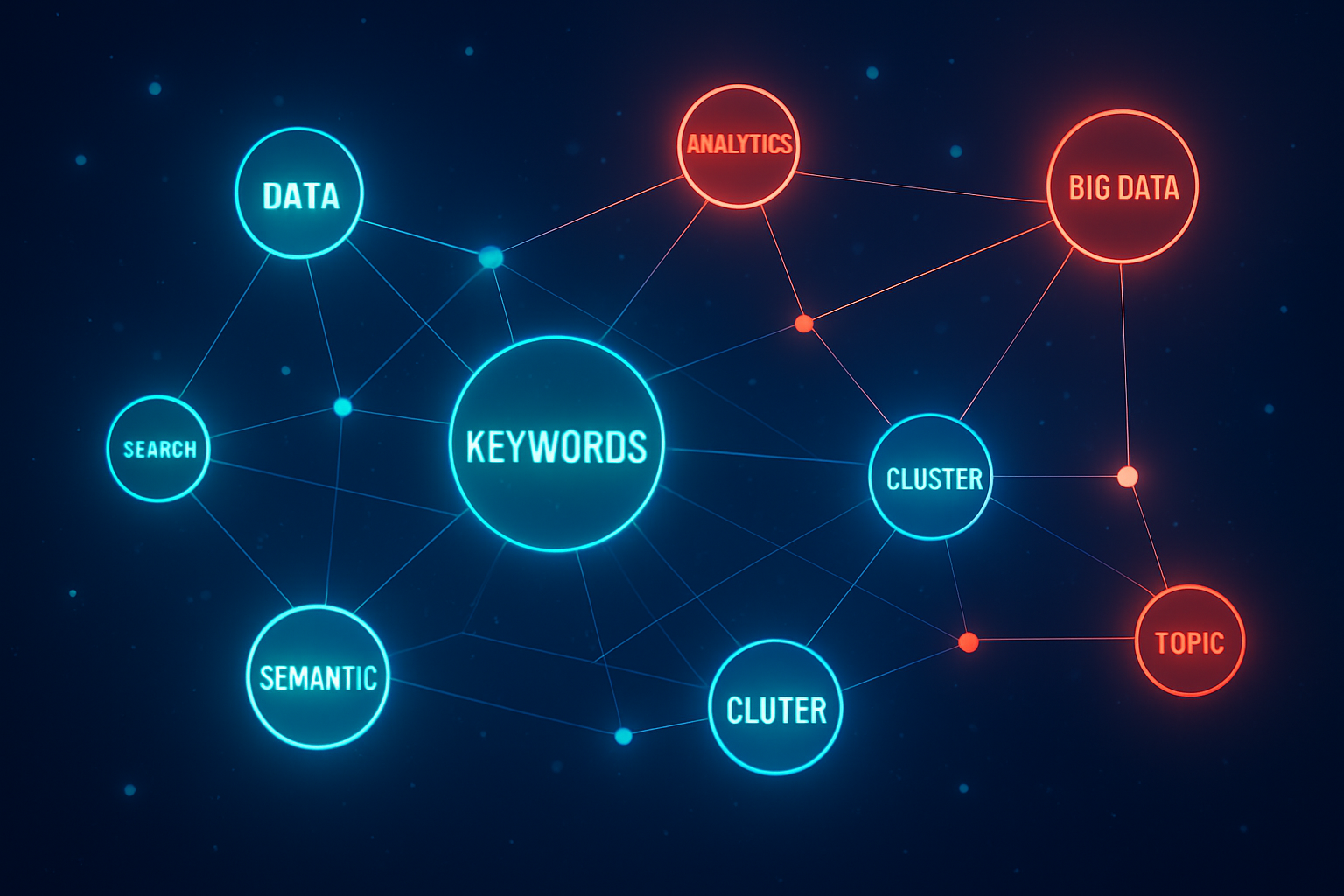
Semantic clustering maps the relationships between topics the way search engines actually understand them — and is central to AI-powered keyword research for creators.
Common Mistakes Creators Make with AI Keyword Research
Even with the best tools available, creators frequently undermine their results by making avoidable mistakes. Specifically, here are the five most common errors — and how to avoid each one.
Mistake 1: Chasing Volume Over Intent
High search volume is only valuable if the intent behind the query aligns with your content. Therefore, always verify intent before targeting a keyword — regardless of what the volume number says.
Mistake 2: Ignoring Semantic Variants
AI tools surface dozens of closely related variants for every target keyword. However, many creators target only the exact-match phrase and ignore the semantic cousins — consequently missing a significant share of total search traffic for that topic cluster.
Mistake 3: Treating AI Output as Final
AI keyword suggestions are a starting point, not a publishing checklist. In addition, you should always validate AI-suggested keywords against real SERP data before investing writing time. Some AI-generated keyword ideas have inflated difficulty estimates or misclassified intent.
Mistake 4: Skipping the Content Gap Analysis Step
Content gap analysis is one of the most powerful features AI tools offer. Nevertheless, many creators skip it because it requires comparing their own content against competitors — which can feel uncomfortable. In practice, however, it is where the most actionable quick-win opportunities are found.
Mistake 5: Running Research Once and Moving On
Search behavior changes constantly. Consequently, creators who run AI keyword research once and never revisit it are operating on stale data within weeks. A monthly cadence — as outlined in the workflow above — is the minimum necessary to stay current and competitive.
AI Keyword Research and Search Intent: A Deeper Look
Search intent — the underlying reason a person types a query into Google — is the single most important factor in keyword selection. Above all, matching your content format to the correct intent type is what separates articles that rank from articles that languish on page three.
AI tools classify intent into four categories. Informational queries are questions — the searcher wants to learn something. These map best to detailed guides, tutorials, and explainers. Commercial investigation queries indicate a searcher comparing options before a purchase — best matched to comparison posts and roundups. Transactional queries signal purchase readiness and map to product pages and landing pages. Navigational queries are searches for a specific brand or site.
For most content creators, informational and commercial investigation keywords represent the majority of opportunities. Moreover, AI tools help you identify which of these two categories a specific keyword falls into — something that is far from obvious when you are just looking at a keyword phrase without context.
Using People Also Ask Data in AI Keyword Research
Google’s People Also Ask (PAA) boxes are a goldmine for creators. Specifically, they reveal the follow-up questions real searchers have after their initial query — which means they show you exactly what subtopics to include in your content to satisfy the full scope of user intent. AI keyword tools that scrape and cluster PAA data give you a significant content depth advantage over creators who are writing without this information.
Featured Snippet Tip
AI keyword tools that flag featured snippet opportunities are particularly valuable. Specifically, if a keyword’s SERP shows a featured snippet held by a low-authority page, you have a clear signal that a more comprehensive, better-structured article can displace it — often in weeks rather than months.
Frequently Asked Questions About AI-Powered Keyword Research for Creators
How does AI keyword research differ from traditional keyword research?
Traditional keyword research relies on manual filtering of search volume and competition data. AI keyword research goes further by analyzing semantic relationships, user intent, content gaps, and trend momentum simultaneously — giving creators a much richer picture of which topics will drive real traffic and engagement. Furthermore, AI tools can process thousands of related terms at once, whereas manual research typically evaluates keywords one at a time.
Can AI-powered keyword research help small creators compete with larger sites?
Yes — and in fact, AI-powered keyword research for creators is especially powerful for small and independent publishers. It surfaces low-competition, high-intent long-tail keywords that larger sites overlook because the volume seems small in isolation. By systematically targeting these specific queries, smaller creators can rank faster and build a loyal audience without needing massive domain authority.
How often should creators run AI keyword research?
At a minimum, once per month. Search trends shift quickly — and AI tools can detect rising topics before they peak, giving creators a first-mover advantage. Additionally, monthly research keeps your content calendar aligned with what your audience is actively searching for right now, rather than six months ago.
What is the best free AI keyword research tool for creators?
Google Search Console is the best free starting point because it provides first-party data on exactly which queries are already driving impressions to your site. Pairing it with a free AI assistant for clustering and intent analysis gives you a near-zero-cost research foundation. For paid options, LowFruits and Surfer SEO offer strong value for creator budgets.
Does AI keyword research work for YouTube and podcasts — not just blogs?
Absolutely. YouTube is the world’s second-largest search engine, and the same principles of intent-based, long-tail keyword research apply directly to video titles, descriptions, and chapter headings. Podcast creators can use AI keyword research to name episodes and write SEO-optimized show notes that surface in Google search. Therefore, all creator formats benefit from AI-powered keyword research.
What are the best practices for AI keyword research tools?
Define your niche clearly before querying the AI. Review intent clusters rather than individual keywords. Combine AI suggestions with real-time SEO monitoring. Always validate AI recommendations against actual SERP data. Run a content gap analysis monthly. Finally, pair your research with technical SEO hygiene — tools like Rank Authority combine AI keyword insights with live SEO performance tracking to protect your rankings investment.
How is AI keyword research changing as search engines evolve with AI Overviews?
Google’s AI Overviews (formerly SGE) are changing which keywords drive click-through traffic. Specifically, simple informational queries are increasingly answered directly in the SERP without a click. Consequently, creators should prioritize deeper, more specific queries — where AI Overviews are less likely to fully satisfy intent — and focus on building topic authority through content clusters rather than targeting isolated keywords.
Conclusion: Make AI-Powered Keyword Research Your Competitive Edge
The gap between creators who use AI-powered keyword research and those still relying on manual methods is widening every month. AI does not just speed up the process — it fundamentally improves the quality of decisions you make about what to publish, when to publish it, and how to frame it for the people actively searching for exactly what you create.
Specifically, the path forward is clear: define your niche, feed it into an AI keyword tool, review your semantic clusters, and build a content calendar around the highest-opportunity targets. Combine that with consistent technical SEO hygiene — monitoring for crawl errors, broken links, and page speed issues — and you have a system that compounds over time.
Above all, remember that AI-powered keyword research for creators is not a tool to use once and forget. It is a practice to build into your monthly workflow. The creators who will dominate search in the next three years are building that system right now. There is no better moment to start than today.
Ready to Go Deeper?
Explore Rank Authority’s full suite of AI-driven SEO tools — from real-time issue alerts to large-scale keyword insights — and start turning research into rankings.

